Total Pageviews

Pages

23 February 2010

The Secret Diary of Adrian Mole Aged 13¾

"TV Times", 21-27 September 1985...

How did Sue Townsend become the best selling author of the 1980s? How did a spotty adolescent schoolboy from Leicester become a hero of page and screen?

Well, a character called Nigel Mole, a year older than Adrian, but also a teenage diary keeper and created by Ms Townsend, made his debut in July 1980 at a writers' group meeting at the Phoenix Arts Centre, Leicester.

The part of Nigel was played by actor Nigel Bennett, who had asked Sue Townsend if she had anything he could use for an audition for Huckleberry Finn.

Mr Bennett was impressed with the character of Nigel Mole, and and began work on adapting Ms Townsend's script for a one man show.

In October 1980, Nigel Mole made it into print for the very first time when a Leicester arts magazine, which was soon to fold, published extracts from Nigel's diary, freshly rewritten by Sue Townsend, using the title Excerpts from The Secret Diary of Nigel Mole Aged 14 ¾.


Janet Fillingham, Sue Townsend's theatrical agent, advised her to expand on the Mole theme, and sent a Nigel Mole monologue to BBC Birmingham. The BBC rejected the play but, unknown to Sue Townsend, Nigel Bennett had submitted his Mole audition piece to John Tydeman, Assistant Head of Radio Drama at Broadcasting House.

In March 1981, Mr Tydeman commissioned a thirty-minute radio script based on the diary of Nigel Mole. In September 1981, Janet Fillingham sent a copy of the completed radio script to Geoffrey Strachan, Managing Director of Methuen, suggesting that the script had the potential to be made into a book. Strachan agreed and during early 1982 Sue Townsend worked on the manuscript.

In November 1981, young actor Nicholas Barnes, exactly the same age as Nigel Mole (now a year younger at 13¾), recorded the Thirty Minute Theatre piece for BBC Radio 4.

Broadcast on 2 January 1982, The Diary of Nigel Mole Aged 13 ¾ proved to be a great success, prompting John Tydeman to commission a radio series adapted from the forthcoming book. However, Geoffrey Strachan was concerned that the name of Nigel Mole was too close to that of Geoffrey Willans' Down with Skool character, Nigel Molesworth. Nigel briefly became Malcolm Mole, but Sue Townsend, remembering the Vicks nasal spray TV ad, was not happy with the name. Darius and Marius were toyed with, then Adrian burst forth.

Sue Townsend found the adjustment difficult. She wrote to Geoffrey Strachan: “Are you absolutely dead set against 'Nigel Mole'? I am suffering severe withdrawal symptoms. I have lived closely with Nigel for a couple of years and Adrian can’t take his place. I've tried to accommodate him but failed.”

But the fates positively beamed upon Ms Townsend, despite her trauma over the name change. The book - The Secret Diary of Adrian Mole Aged 13 ¾ - was sent to Methuen in instalments in the April and May of 1982 and published in the October.

And it went straight into The Sunday Times best sellers list.

This book and its sequel, The Growing Pains of Adrian Mole, earned Sue Townsend the truly glittering prize of becoming best selling author of the 1980s.


Midway through the decade, the telly beckoned...

Mountains Out Of Mole Hills

TV Times, 31 Aug - 6 Sep 1985:

The laughter continues on ITV with the "The Secret Diary of Adrian Mole", Aged 13 ¾, which begins in two weeks. The series is based on the gloriously funny book by Sue Townsend, which has already been translated into 17 languages, including Japanese, Russian and Serbo-Croat, and is now selling by the million. So its popularity with viewers seems certain.

Adrian Mole is a worrier. He worries about his mother (is SHE worrying too much about Mr Lucas next door?). He worries about his diet (is he getting enough vitamin C?). He worries about his acne (or maybe it's lassa fever), about the girl he worships (Pandora), about how he's going to pay protection money, and about sex. It is his age, probably.

Thames Television auditioned over a hundred boys for the part of A Mole (13 3/4) before choosing 14-year-old Gian Sammarco, a Northampton schoolboy. In contrast, over 500 girls were tried out for Pandora. Young Lindsey Stagg, also from Northampton, won the role.

As for the adults, they are some of the finest names in British comedy acting, including Beryl Reid and Julie Walters.

A great feature of the series was Ian Dury singing the theme tune - Profoundly In Love With Pandora.

The "Sun", 1986 - Julie Walters has vacated the role of Pauline Mole, so Lulu steps in...
-
The '80s adolescent (and beyond) agonies of Adrian were greatly appreciated, both on page and screen. And several follow-ups since have ensured that we have been able to follow his progress from lad to man. I was slightly older than Adrian, but still very much of the same era and found a lot of Ms Townsend's insights into how some of us young lads were back then rather uncanny.
-

Here's a choice snippet from True Confessions of Adrian Albert Mole (1989), which could almost (but not quite, thank God) be an extract from one of my own early diaries - poetic, angst-ridden little... er... soul that I was:

In my desperation I went to the Lake District on the train. I was struck down by the beauty of the place, although saddened to find that there were no daffodils flashing in my outer eye as in William Wordsworth the old Lake poet. I asked an ancient country yokel why there were no daffodils about. He said, "It's July, lad". I repeated loudly and clearly, (because he was obviously a halfwit) "Yes I know that, but why are there no daffodils about?"

"It's July," he roared. At that point I left the poor deranged soul. It's sad that nothing can be done for such pathetic geriatric cases...

And to end on, this heart-rending poem for Pandora Braithwaite, the great love of Adrian's life:

Pandora,

I am but young

I am but small

(with cratered skin)

YET!

hear my call

x

If you haven't met Adrian yet, hurry along there...

And read about my horrific experiences as an unwitting Mole clone here...

20 February 2010

EastEnders 25th Anniversary - Post 4

The original Beale family in 1985 - Pete (Peter Dean), Kathy (Gillian Taylforth), Lou (Anna Wing) and Ian (Adam Woodyatt).

So, EastEnders 25th anniversary has come and gone.

I never usually watch modern soaps, but last night I tuned in, out of curiosity, to see how the occasion would be marked. This was a live episode, the action centred on the resolution of a murder mystery, and I was impressed. Featuring lots of heavy emotional scenes - and a live stunt where a character fell off the roof of The Queen Victoria pub - I thought that the cast and production team had no reason to reproach themselves by the episode's end.

Well done to all concerned!

I had read that the 25th anniversary episode was going to be firmly rooted in the present - it was pointed out that the show's characters had no idea that this was the 25th anniversary, so lots of references to the past would seem highly contrived.

But there was a small nod towards those of us who desired a link to the show's beginning: Ian Beale produced a "time capsule" that he and some of the other teenage characters had made back then. Amongst the contents were a Madonna vinyl single and a video tape - a home video Ian had made in 1985.

Dot Branning (June Brown) (always "Dot Cotton" to me!) insisted he played it, and there, between fuzz, crackles and picture break-ups, were glimpses of some of the Square folk of 1985 - Arthur and Pauline Fowler (Bill Treacher and Wendy Richard), Ethel Skinner (Gretchen Franklin), Den and Angie Watts (Leslie Grantham and Anita Dobson) and Michelle Fowler (Susan Tully), amongst others.

The footage was, of course, actually taken from early episodes, but I still enjoyed the gesture and empathised with Dot and Ian who were both moved by glimpses of old friends and family.

Then the tape broke. And the link to 1985 was also broken.

The Queen Vic in the mid-1980s.

Following-up the 25th anniversary live episode was a glimpse behind the scenes - The Aftermath - which featured Leslie Grantham, the original Albert Square bad boy, "Dirty" Den Watts.

Mr G was on fine form - asked what he thought made Den such an iconic character, he gave his considered opinion that it was his "charm and good looks"!

Screen capture from a trailer for EastEnders, aired before the show began in early 1985.

Leslie Grantham said of his time in the show:

"... to work with Anita Dobson, who played Angie, was just phenomenal. We just bounced off each other. So, it was great - I could abuse her one week, she could abuse me the next..."


I found Den and Angie's relationship completely electrifying!

Ali Osman (Nejdet Salih) has been in a scrap - the make-up lady paints in the damage.

Fierce old battle axe Lou Beale prepares a Christmas stocking in 1985. Anna Wing only appeared as Lou from 1985 to 1988, but the character really made her mark. Miss Wing was awarded the MBE in 2009, aged 94. She said: “As a child, I’d cling to the railings of Buckingham Palace, never thinking one day I’d be decorated by the Queen.”

This is the site of Albert Square in early 1984 - the "Lot" at the back of the Elstree Studios, then most recently used for Auf Wiedersehen, Pet. The layout of the Square was influenced by the presence of the tower block of flats. It was decided that if the flats could be clearly seen from the Albert Square exterior set, it would add to the show's inner city "feel". The flats' on-screen name was "Walford Towers" and Pete, Kathy and Ian Beale lived in one of them in the 1980s.

Later in 1984, and Albert Square is really taking shape.

Hugh Miller wrote a series of books based on EastEnders in the mid-1980s. Each one was set in the Square, pre-1985, so we could find out about some of the past goings-on - during the Second World War or in the "swinging '60s" for instance.

Or, in the case of the book pictured above, a far more recent time...


As she left Angie gazed at the empty doorway for a moment, then glanced at the brewery calendar on the wall. 10th October, 1981. Her mind shifted abruptly. 10th October. That made it a week now since she had found out. She had looked at the calender every morning since she discovered the little note on the floor beside Den's bed. She felt in the pocket of her robe and took it out again. The handwriting was firm, with bold forward-slanting strokes that denoted a lot of confidence.

Den -

I haven't run away. Make yourself a cup of coffee. I'll be back in about half an hour.

There was no signature, just one big cross. A kiss that wounded Angie's heart every time she looked at it...

Members of the Beale and Fowler clan in the mid-1980s. Michelle brought shame on the family when she became pregnant in 1985. She kept the name of the father - one Dennis Watts of The Queen Victoria public house - very quiet indeed. And she also kept the baby.

Paul McCartney And The Pipes Of Peace, The Smiths, Tears For Fears, Wham!, Boy George And Other Pop Gossip Of 1983...

From the Daily Mirror, Saturday, December 17, 1983:

Paul McCartney has gone to war - with a message of peace.

The rock star appears on both sides - as a British soldier and a German adversary in World War 1.

And, thanks to the magic of videotape, he ends up shaking hands with himself.

Paul acted the parts for a movie made to promote his record Pipes of Peace.

The song is based on a legendary Christmas incident in which the two sides downed arms and played football together.

Elsewhere in the Mirror, David Jenson brought us all the latest pop gossip...

HAPPY RETURNS FOR STEVIE...

Just in case you were wondering why Tamla Motown have re-released Stevie Wonder's "Happy Birthday", it is to celebrate Martin Luther King Day on January 15.

Stevie, who wrote the song about the assassinated civil rights leader, refused to allow its release in the States until King's birthday was declared a national holiday.

Included on the B side are four of Dr King's speeches, including the famous "I have a dream..."

The Cure are looking for two young musicians to join them for live work starting in January. The "live work", incidentally, includes a world tour!

WHAM! WATCH IT

Sell-out pair who are stage-struck

What do top stars Wham! worry about on a sell-out tour? "We're always bumping into each other on stage," says George Michael.

"One night we ran so hard into each other we both went flying. Another time I slipped on a bra that had been thrown on stage! We always have to look out of the corner of our eyes."

Now the tour is over, George and his buddy Andrew Ridgeley are looking forward to recording some new material - although a dispute with their record company which ended up in court recently may prevent its release for some time.

"We're a bit in limbo really. Because of our case we really can't afford to bring out a new album. But when we do get into the studio it will be good.

"We're writing in bits and pieces like we always do. For the next album we're going to try to diversify - combining all our influences."

TEARS BANISH TOUR FEARS

The boys in Tears For Fears have been having a tough time on their British tour, which winds up in Poole on Thursday.

Both have been struck down by flu, but being the troupers they are, they have soldiered on.

Curt Smith has been having vocal training lately and he's been able to cope with the strain much better.

Fellow singer Roland Orzabal has a trained voice. It is so powerful that he blew up a £400 microphone the other night.

What a funny bunny Boy...

Boy George tells me he plans to spend Christmas "Lying on my back, covered in tin foil and hibernating for a week."

Talking about the video for Culture Club's "Victims", George added: "I really think I look like a rabbit. I see it and expect a pair of big white ears to come out of my hat.

"My father said I look like an undertaker. I suppose it has got a certain Hammer horror element to it."

And the hottest new star in pop is still surprised at the huge success of "Karma Chameleon". He didn't want the biggest-selling single of the year released. He thought it would be a flop!

STICKING TOGETHER

Bananarama's Keren Woodward - she's the cutie with the dark hair - has been telling me how close the trio really are. For the past several months they've shared a flat together and now they've bought themselves houses next door to each other in North London.

1983 has been a tough year for the girls, with management hassles which led to them looking after themselves.

As a sign of their determination to stick together the girls, impressed by the film "The Day After", plan to build themselves an underground nuclear shelter.

THE SMITHS ARE A HIT WITH SANDIE

Chart newcomers The Smiths can now add the name of Sandie Shaw to their ever growing list of admirers. So struck by their music is the Sixties star that she has recorded a Smiths tune for her next single.

And I'm pleased to announce the Smiths follow up to "This Charming Man", "What Difference Does It Make", comes out in mid-January.

1980s Food - Posh Nosh For The Masses...


From an August 1986 ITV ad break - talk about conspicuous consumption! A witty salad cream ad (many of us were experiencing mayo for the very first time), posh potatoes (baked, of course!) and very posh biscuits with yogurt and muesli in them...


What was it with baked spuds? Perhaps the
F-Plan Diet had a lot to answer for, as spud fever gripped the nation in the mid-1980s. There was a very fancy potato cafe near me, decorated with old fashioned advertisements from the early 20th Century, where you could go and eat spuds filled with wonderful things. Now, who's for a nice jacket with prawn mayo, sliced hard boiled egg and grated cheese? Baked beans on top? Well, OK, if you insist...

In the early 1980s I was happy to simply give a baked spud a quick dollop of marge and a bit of grated cheese before wolfing it down. Not any more. In the mid-'80s I began scooping out the potato and mashing it up with butter and chopped chives, before replacing it in the jacket, placing grated cheese on top and then browning it under the grill. Or the potato might be mixed with tuna, chopped peppers and mayonnaise (I didn't meet peppers or mayo until the 1980s - before that I was only acquainted with salad cream and spring onions!).


Me, a humble working class lad, was suddenly scoffing posh nosh. I was eating food I'd never even laid eyes on back in 1982.


In the 1970s and early 1980s, supermarkets had reflected our thrifty (and ignorant of posh nosh) ways. Food ranges on offer increased - they always had - and there was a move in the early 1980s away from processed, tasteless products (more further on) - but there was still a rigid class thing when it came to food.

There was what "posh" people ate and what we ate.

And never the twain shall meet.

And there wasn't much point in supermarkets offering food that customers could not afford or were going to reject out of hand.

Remember the wide range of "Basics" and "Economy" products on sale at supermarkets in the early 1980s? These were dead cheap versions of everyday necessities to help us through the ravages of the recession. They started a trend, and you can still buy similar "cheap-as-can-be" supermarket items today.


Back then, Sainsbury's and Tesco's were different planets compared to the supermarkets of today. There simply wasn't the range of foods on sale we take for granted today.

My wife recalls a flatmate of hers making her own pasta from scratch in the '70s - the dried varieties were not available on supermarket shelves. The only dried pasta I saw back then in the supermarkets was of the long spaghetti or macaroni varieties.

The early '80s were hard times. There were, of course, the (then) super doopah out-of-town hypermarkets of the late '70s and early '80s, but you needed a car to get to them, and decent nosh didn't come cheap.
And even then, the food ranges couldn't hold a candle to the posh nosh explosion hitting even humble, everyday supermarkets in the mid-1980s.

But the 1981 newspaper article
below reveals some hopeful trends...

The '80s saw us cheap and common chaps and chapesses turning away from tasteless, processed foods and towards tasty, quality nosh. Even in the recession-ridden early 1980s, the move was back towards food that you could taste!

From the Daily Mirror, January 2, 1981:

Do yourself a flavour for 1981

Mmm! Delicious, that smell of fresh-baked bread!

And it's an aroma you're likely to savour more this year as shoppers elbow aside bland, over-processed foods in favour of good old-fashioned flavours.

Natural foods, till now a speciality of health food shops, will be popping up on supermarket shelves and - costing less.

We are already drinking more natural fruit juices - stand by for the "long life" type that don't need to be kept refrigerated.

We'll also be brewing more of our own money-saving beer and wine.

Tastier non-alcoholic drinks are on the way. And there will be more flavoured pintas to boost sales of ordinary milk.

Look out too, for new varieties of yogurts and cheese.

There will be no let-up in the High Street price war. Sales will run and run.

Retailers will be enticing customers with ever-more ingenious promotions. Tesco, for instance, are tying up with Heinz in a scheme based on prices 50 years ago when the supermarket group was founded.

Coupons will be a real snip - manufacturers make those offers on the basis that not everyone will take them up so there are some good bargains to be collected.

Watch out for new money-saving offers arranged between British Rail and the Post Office.

More stores will switch to electronic check-outs where prices are "read" by a laser beam and customers get itemised bills [Andy's note: Sainsbury's began the switch in 1982].

Food labels will be fuller. For instance, added water in products like tinned ham will have to be listed. You'll be told exactly what variety of potatoes and melons you are buying. And claims that products provide special benefits will have to be explained on the label.

Turkey will gobble up more of our money in unexpected ways - turkey bacon, burgers and bangers.

Fewer vegetables and more Continental made-up dishes and gooey gateaux will fill frozen food cabinets.


Personally I thought some of those new turkey products were "Bootiful!" - more here.

Supermarkets truly underwent a revolution during the mid '80s boom period, introducing many shocked shoppers to such oddities as avocados, peppers, olive oil and courgettes for the first time ever. The working classes would never be the same again.


These things were suddenly available in large numbers, were affordable, and there was a brash spirit of adventure in the air.

Yes, we were going to eat classy nosh!

There were even posh new potato crisps ranges - cheese and onion? No, ta, cream cheese and chive, please!

I giggled when I first heard of carrot cake. Carrot cake?!! Oh please - surely it was a joke? But it wasn't. And it was delicious.

As Andrew Marr, referring to the mid-1980s, said recently: "This is the moment when British shopping goes turbo charged."

And our supermarkets reflected that.
Sainsbury's started to seem quite classy back then - I'm sure I was rubbing shoulders with vicars and school teachers whenever I nipped in - and more than a few yuppie types. It all seemed very strange.

Cosmopolitan magazine, July 1983: "Good Food Costs Less At Sainsbury's" - and don't forget the fancy water to go with it! Sainsbury's had its own varieties in 1983 - from Shropshire and Perthshire.

As affordable posh nosh trickled down to the working classes, we also loved prawn cocktail - which was being slagged off by Fanny Cradock as long ago as 1967! But Nouvelle Cuisine was really "it". I could probably have eaten about nine Nouvelle sized portions in one sitting, and wouldn't give it house room.

My own personal favourite was all those fancy salad dressings suddenly so widely and cheaply available. When I was a kid, and indeed into the early '80s, salad to me meant cold meat or a wedge of pork pie, cheese, some limp lettuce, a few spuds, maybe a few spring onions, and a dollop of salad cream. Eating salad was a chore. Not any more!


The supermarket revolution wasn't just confined to expanding ranges of food. A female friend of mine was working at our local branch of Sainsbury's in the mid-'80s, and witnessed the arrival of bar code scanner tills there.

The beeping sound was dreadful, she told me.
Completely unused to it, the awful repetitive sound echoed in her head when she got home, and many of her colleagues experienced similar difficulties. On her honeymoon in 1986, my friend halted things at a very romantically-charged moment to ask: "Was that a beep?" Fortunately, her new husband also worked at Sainsbury's and was entirely sympathetic!


A Tesco magazine advertisement from December 1984. Pasta was just becoming exciting in the UK. Before the 1980s, my only experience of pasta was confined to tinned spaghetti - and the only dried ranges I ever saw in Sainsbury's and Tesco's were of the spaghetti and macaroni varieties. But in the 1980s, we truly woke up to culinary pasta possibilities as new dried pasta ranges burst onto UK supermarket shelves.

WHERE DO YOU GO FOR A GOOD ITALIAN?

While Italian restaurants have been popular for years, we're just beginning to recognise how versatile pasta can be in our home cooking.

It comes in so many different forms, it can be used for main meals, snacks, soups or salads.

In creating the Tesco pasta range we use Durum wheat, which is the finest quality you can buy.

Then in some cases we addd eggs to give a richer taste and spinach to make our distinctive pasta verde.

Our range includes spaghetti, tagliatelle, lasagna, macoroni, shells, vermicelli, quills, conches, wheels and bows.

Whichever you choose, you can be sure the Italians can't buy better...

To anybody who doesn't know/remember what it was like to be working class and the food we ate before the 1980s, I'm sure all this must seem bizarre.

Mind you, it wasn't all posh nosh once the mid-'80s had arrived - I also ate TONS of Batchelors Savoury Rice, and Bejam "bubble and squeak" portions and mini pizzas were a wow!


More about 1980s food soon...

Some jacket potato recipes from The F-Plan Diet. I can personally recommend the sausage and mustard pickle.


13 February 2010

Together (Southern Television, 1980 - 1981)

Karen has written: 

I notice you've mentioned the early '80s afternoon soap, Together. I remember it vaguely. Can you jog my memory? 

Not very much I'm afraid, Karen!

Together
was produced by Southern Television and first hit our screens in late January 1980.

It was set in a modern purpose built block of housing association flats called Rutherford Court, in reality a bunch of studio sets. I'm not sure if there was ever any location filming. I don't recall any.

Sarah Greene, later of
Blue Peter and Saturday Superstore, was Tricia Webber, one of the show's early characters. Sheila Fay (formerly Beryl's Mum in The Liver Birds) was the warden of a small housing association block of flats. Her husband was played by John Burgess, later "Bing" Crosby of Brookside fame. Annie Leake, formerly Wully Harris of Beryl's Lot, also had a role in the series.

I recall thinking that the show was originally slightly dowdy. The opening titles were later revamped and a theme tune with lyrics, sung I believe by Cleo Laine, was added.
 

Living side by side

Our lives are waves in a tide


And just as the tide flows


Our fortunes may come and then go


But with our friends we can survive


If we can keep alive


The art of living


Together...
 

Together was originally filmed three days before transmission, allowing for some topicality in characters' comments, but the second series went out live, and this allowed even more. Apparently, the studio canteen used to empty at 1.30 on transmission days as staff clustered around the Together studio sets, eager for cock-ups.

Together introduced a gay character called Peter Hunt in March 1981, who lived with a man called Trevor. Perhaps this sudden brave gay awareness theme from staid old Southern was inspired by the 1980
Waggoners' Walk Rob Pengelly story-line? Who knows? The writing was on the wall for Southern by March 1981 anyway, so perhaps it was just a case of "what the heck?!"

I thought Together was a good serial, but the only story-line I remember now was one involving the flats' communal TV aerial going wrong and Sheila Fay's character being concerned as the residents like
d Play Your Cards Right - which had begun in 1980 - and were in danger of missing an instalment!
 
Martha Finch (Kathleen Byron) endures a nasty moment on a disgusting green telephone in 1981.

Southern Television lost its franchise in late 1980, and its last day of broadcasting was 31 December 1981. Together had ended earlier that year.

I'm trying to get more Together info and will post it on '80s Actual if I'm successful.

Scottish Television soap Take The High Road's debut followed hard on the heels of Together, being broadcast from February 1980. That show was, of course, rather longer lasting!

Another afternoon soap of the 1980s was the English-speaking Welsh serial Taff Acre from HTV, which debuted in 1981. And quickly ended. Amongst its stars was Richard Davies, formerly of Please, Sir! Mr Davies had had previous soap experience as Idris Hopkins, corner shop keeper of Coronation Street.

And then there was Thames Television's Miracles Take Longer in 1984, set in an advice centre, and running to just one series. 

Gems (1985, Thames) had a rag trade setting and ran for three series.

There were only ever two series of "Together". The show made its debut in January 1980 and a year later the second series was on-air. But unfortunately Southern Television had lost its franchise in late 1980, so the writing was on the wall. On January 9, 1981, the "Daily Mirror" Viewing Guide synopsis for "Together" reveals that: 'Martha Finch hopes to get some decorating done'. 

Also on screen was Johnny Ball - launching a new show called "Think Again" - and those were the wondrous days of the first showings of "Monkey" on BBC 2 - 'Adventure with Tripitaka and his companions'. Sheer bliss!

I hope Martha (whoever she was) got her decorating done before the plug was pulled on "Together"!
-
According to legend, during the second series of "Together", which went out live, studio hands wallpapered a whole set during the commercial break. Perhaps it was Martha's?!

12 February 2010

1981: Margaret Thatcher Says "Yes" To "Yes Minister"...

The comedy series Yes, Minister began in 1980, and had soon attracted friends in high places...

From the Daily Mirror, 30/3/1981:

It's party time at the House of Commons tonight.

And it's not a political one, either.

The Speaker, the Rt. Hon. Mr George Thomas MP, is having a dinner and his guests of honour are the gang of three from "Yes, Minister" (BBC2, 9pm).

Jim Hacker MP (Paul Eddington), Sir Humphrey Appleby (Nigel Hawthorne) and Bernard Woolley (Derek Fowlds) will all be sipping cocktails in a state room directly below Big Ben.

The Speaker is a fan of the show and so, too, is Mrs Thatcher, who likes to record it on video to watch in the small hours of the morning.

In tonight's episode the Minister decides to curry favour with the electorate by going on a publicity tour of a farm run for children. Chaos results.

The dinner date was arranged when the three stars of the show went to watch a parliamentary session in the public gallery at the Commons recently.

Their appearance almost brought the business of the House to a halt, with MPs and actors gawping at each other.

Paul Eddington says: "We went to the Commons to get the flavour of the place, and I must say we had a very enjoyable time. There was a lot of sniggering and nudging when we were spotted."

Although "Yes, Minister" has received the best TV comedy award, there will not be a new series for some time.

The writers, Antony Jay and Jonathan Lynn, are too busy working on other projects to get together before the summer of 1982.

So it looks as if Mrs Thatcher will have to be satisfied with repeats.

08 February 2010

Readers' Enquiries... Albion Market On DVD? GSM Mobile Phone Technology, For Maddie With Love, And The Launch Of The Space Shuttle...

Cheers! Lisa O'Shea (Sally Baxter) and Lynne Harrison (Noreen Kershaw) enjoy a cuppa at Albion Market in 1985.

Kathy has written:

I love your features on Albion Market and thought the show was ace. Do you know if there is any chance of the 100 episodes being released on DVD?

Sorry, Kathy, I don't think it's very likely. I liked Albion Market too, but I know of no plans to bring the show to DVD. If I hear anything on the subject, I'll post it on this blog.

Still on the subject of '80s drama series, Jon asks:

Do you remember anything about an 80's telly show called For Maddie With Love? Are you planning an '80s Actual article about the show, and did it make it onto video?

Hi, Jon - yes, I do remember For Maddie With Love (1980-1981), an ATV series which starred Nyree Dawn Porter and Ian Hendry. It was the story of a woman who only had months left to live. Very few people had a VCR in 1980-1981, so there was no video release of the series, but there was a novelisation, by Sheila Yegar, published by New English Library in 1980. When I last checked on eBay, there were several copies on sale.

And finally Graham P says:

I love your blog, it's the absolute best when it comes to 80's facts. Could you please post more about technology - like the development of the GSM system for mobile phones, which is the system we use today, and the launch of the Space Shuttle Columbia in 1981? Also, please, PLEASE more 1980s computer pics!

Thanks for your compliments and enthusiasm, Graham. We do have a small post about the first Space Shuttle launch - it's here - and I'm hoping to revamp it soon as I now have more material. The GSM subject is fascinating and I have chalked it in as a future possible '80s Actual article - the beginning was in 1982 when Groupe Speciale Mobile (GSM) was formed to design a pan-European mobile technology.

And there will be more computer pics soon!

06 February 2010

EastEnders 25th Anniversary - Post 3

EastEnders 1980s gay couple, Colin and Barry. Colin was a middle class professional man, at home with his sexuality, Barry was a working class East-end lad, who felt pressure to conform to the "norm". The characters were criticised by some for being disgusting, and by others for not being allowed to show much warmth towards each other. But they were very much part of the brave beginnings of bringing gays out of the closet in UK TV soapland.

What made EastEnders different? Why did it originally outrage and delight to such a degree?

In my opinion, this was due to the show's uncompromising grimness - the setting of Albert Square, a few scandals involving early cast members, and the show's intense portrayal of social issues.

The show's left-wing sub text helped, too.


Soaps had "done" social issues before. Coronation Street had its moments right from the beginning, and Crossroads had bravely waded in in the mid-1960s. But it must be said that the issues were handled in a way that was thought to be suitable for the times. For instance, alcoholism could come about in the blink of an eye and could rapidly be overcome.

Were all viewers so much more "enlightened" in the 1980s that they could happily watch uncompromising portrayals of social issues in soaps? No, of course not, but what EastEnders seemed to be saying was: "Up yours, darlin', we're doin' it anyway!"

The thinking behind Producer Julia Smith's attitude to the social realism portrayed in the Albert Square saga can be found in our EastEnders 25th anniversary post 2.

Let's look at the portrayal of gay men in UK soaps from the 1960s to 1980...

The BBC radio soap, The Dales, apparently briefly featured a gay character in the late 1960s, and its successor, Waggoners' Walk (1969-1980), also approached the gay theme in the 1970s. But the character concerned "reformed" after he fathered a child with a local woman (who didn't know he was gay at the time) and got married. I've never known a gay man to "reform" - and why on earth should they?

Waggoners' Walk returned to the gay theme shortly before its axing was announced in 1980, with restaurant waiter Rob Pengelly announcing: "Girls don't turn me on at all!"

Little old working class me, brought up in a tightly bigoted atmosphere, thought: "There's going to be trouble now!" Nobody would have dared to make such an announcement where I lived!

But Waggoners' Walk was set in Hampstead, and the majority of the sophisticated, well-heeled characters took the news in their stride. Only brash, self-made businessman Matt Prior expressed any bigotry, and he soon got over it.

I seem to recall that Southern Television's early afternoon "drama series" (note: not soap!) Together (1980-1981) introduced a gay character - perhaps even a gay couple - circa 1981, not long before the series ended. Together had got off to a somewhat dowdy start in 1980, and it seemed to me at the time of the gay story-line that the writers were inspired more than somewhat by Rob Pengelly of Waggoners' Walk - and had decided to be more up-to-date.

But it's all very hazy, and the show, running only to two series and tucked away in the afternoon schedules, attracted little attention and soon disappeared - as did Southern TV.

And as for Rob of Waggoners' Walk, he got involved with Rocky Rowlands, an American who was internationally famous as a fashion designer.

Not something I could easily relate to.

EastEnders was different in that the characters were mainly working class and issues tended to explode, rather than be carefully discussed by people who would never have dreamt of dropping an aitch, as in Waggoners' Walk.

This was something that I, as a working class man from a thoroughly grotty back street, could identify with. There were sauce bottles and plates of mash on Albert Square tables, not Peter Tyson's latest experiment with herbs and spices. Lou Beale went to bingo - not to dinner with the editor of the Hampstead Herald.

EastEnders also went further than the Walk in the issues covered, shocking many in the process, and "infecting" other soaps.

And its gay men did not "reform", although poor Barry was under pressure to.

I do wonder if EastEnders would have come into existence without Brookside, another soap which sought '80s reality.

But whatever the truth of that, Albert Square's original groundbreaking impact, its thirst for social issues and "in your face" attitude, should not be ignored.

05 February 2010

EastEnders 25th Anniversary - Post 2

Julia Smith and Tony Holland - creators of EastEnders.

On 14 March 1983, Julia Smith and Tony Holland were summoned to the office of David Reid, then head of the BBC's Series/Serials Department. Mr Reid had a proposition for the pair: the BBC had decided to start a popular bi-weekly serial (note: not "soap opera" - the BBC - and other programme producers - then frowned upon the phrase). Julia and Tony, who had previously worked together on Z Cars, Angels and District Nurse, were offered the roles of Producer and Script Editor.

The planned bi-weekly was intended to run every week of the year.

Initially, the show was to be set in a mobile home park. Julia and Tony did not like the idea at all.

They favoured a serial set in modern day London, a view later echoed by the new head of Series/Serials, Jonathan Powell.

And that led Julia and Tony to the East-end.

Filming in the real East-end presented various problems, but finally the vacant "Lot" at the Elstree Studios, previously used for the hugely successful first series of Auf Wiedersehen, Pet, was decided upon as the setting for the new soap, er, sorry, bi-weekly, then provisionally titled E 8.

A purpose built East-end square would be erected on the Lot.

Julia and Tony flew off to Lanzarote in March 1984 to work on creating the characters.

There was to be a crusty old battle axe called Lou Beale; Lou's daughter, Pauline; Pauline's husband, Arthur Fowler; Pauline and Arthur's children, Michelle and Mark; Lou's son, Pete; his wife, Kathy, and son, Ian.

The show was to reflect the multi-ethnic East-end of the 1980s: Saeed and Naima Jeffery, he a quarter English, three-quarters Bengali, and she wholly Bengali, would run the local shop.

A character originally called Alan Carpenter (later changed to Tony) hailed from the Caribbean and would live with his son, Kevin (later changed to Kelvin) in the Square.

Then there was Chris (later changed to Ali) and Sue Osman. Ali was a Turkish Cypriot, Sue was English. They would run the cafe just off the Square.

Dr Harold Legg would be the area's wise, Jewish doctor. He'd lost his wife when a bomb was dropped on Albert Square during the Second World War.

And, as this was the 1980s, what about "upwardly mobile" types? Julia and Tony came up with Debbie Wilkins and Andy O'Brien. They weren't yuppies, Andy was a nurse, Debbie worked in a bank, but they weren't typical Albert Square types by any means.

Back down-to-earth again: Ethel May Skinner was an elderly local woman who doted on her dog, initially intended to be a Yorkie, but, as it turned out, a Pug. This was, of course, "Ethel's little Willy".

Mary Smith was to be a semi-literate young Punk, from the North of England. A single parent, she brought her baby daughter, Annie, to live in the Square.

"Lofty" George Holloway would be the area's misfit, a gawky young man who worked at the local pub, cash in hand.

And what about the family at the pub? Whilst in Lanzarote, Julia and Tony fleshed out the characters of Jack, Pearl and Tracey Watts - Den, Angie and Sharon to you and me. The family was originally intended to have an Alsatian dog called "Prince", but this later morphed into an apricot Standard Poodle called Roly.

A later dreamt-up addition to the original cast of EastEnders characters was Nick Cotton - a thoroughly nasty geezer!

The building of Phase One of the permanent Albert Square set at Elstree in the summer of 1984. It wasn't real. But it sure looked it. The Queen Vic and Lou Beale's house are well on the way, and the gardens in the centre of the Square are looking good.

The first episode of EastEnders was originally intended to be broadcast in January 1985, but this was postponed to February.

And what a shock the show was!

Old Reg Cox was found in his grubby bedsit - close to death, Nick Cotton stuck his fist through one of the Queen Vic's windows, Pauline Fowler was pregnant and her loving mother, Lou, told her to get rid of the kid...

And all in episode one!

Brookside, which began on Channel 4's opening night in November 1982, had already begun the process of de-cosying English soap opera, but EastEnders took things to the next level.

Like Brookside, the show had a left wing sub text ("Don't blame me - it's that cow in No 10!" said Lou Beale to son-in-law Arthur Fowler when he was feeling down because he was unemployed and "Community spirit went out when the Tories came in!" said Pete Beale) but Albert Square was also a place of pot boiling secrets...

Who was Dirty Den Watts' long-term mistress? Who was the father of teenager Michelle Fowler's baby? Who was the terrifying Walford Attacker - was it someone who lived in the Square? Was Pete Beale really Simon Wicks' father?

Often at the centre of the drama, were Den and Angie Watts at the Queen Vic - a married couple who had a spectacularly destructive relationship. and yet, bizarrely, seemed to need the other.

Compelling viewing.

Mrs Mary Whitehouse, clean up TV campaigner, didn't think so:

"It is at our peril that we allow this series. Its verbal aggression and its atmosphere of physical aggression, its homosexuality, its blackmailing pimp and its prostitute, its lies and deceit and its bad language, cannot go unchallenged."

And fancy showing the omnibus on a Sunday!

Julia Smith said:

"I think I'm just as moral as Mrs Whitehouse. And I care possibly more deeply. The difference is she believes in sweeping things under the carpet and pretending they don't exist. I believe in showing what does exist and preparing people for the world they live in. My prime aim is to entertain, my second is to inform. I do not preach. All I do is lead viewers to reach their own conclusions by having different characters representing different points of view. It would be nonsense to portray the East-end without any semblance of violence. It is a very violent place. The people there are not very literate. They express themselves in raucous laughter and hugs, not careful discussion, and it can all turn into anger very quickly. It's a much more physical way of life. I've never been frightened of handling controversial subjects. You can tackle anything, however early in the evening, providing you do it in the right spirit."

Some may criticise that EastEnders did not entirely reflect reality. The lens used was a very trendy left-wing lens indeed, and problems like misandry soon began to pervade on the back of that. I think those uttering such criticisms are right to some degree.

However, the shock waves sent out by Brookside and EastEnders ensured that the 1980s would change English soap opera. Forever.

Soaps today are far less political, far more sensationalised, but the grittiness and the lefty approach to social issues can all be traced back to the Close and the Square. TV soaps did issues before the '80s, but the approach was far less "in your face", far less relentless, and sometimes just plain daft.

Looking in on the action at the Rovers, or at Emmerdale Farm, or at the Crossroads Motel, you could spend lots of time feeling cosy.

But not in Brookside Close - and most certainly not in Albert Square!

Sandy Ratcliff was champion moaner Sue Osman in the early years of EastEnders. And yet somehow I liked the character. I sensed a vulnerability which made me feel for Sue, even before the cot death of her baby son, Hassan, in episode 36, broadcast in June 1985, which was a shattering piece of drama.

Click on the "EASTENDERS" label below for much more '80s Actual Albert Square info.

02 February 2010

1983: President Ronald Reagan Invites Us To Visit America...

Pages from a 1983 magazine advertising feature on America. The pictures on the right features the Twin Towers, the Statue of Liberty and a stretch of desert, whilst on the left, US President Ronald Reagan, elected in November 1980, issues an invitation:

THE WHITE HOUSE

WASHINGTON

On behalf of the American people, I am very proud to invite you to visit the United States.

Our nation's beauty, unique heritage, and hospitality are yours to see and enjoy. I hope you will take advantage of the opportunity to make new friends and participate in social and cultural exchanges with our people.

Remember that America's doors will be open to you during your travels. We will be delighted to provide you with an exciting and educational experience.

Ronald Reagan

Hertz car rental and the Amtrak U.S.A. Rail Pass offered opportunities to see America once you arrived there.

More on President Reagan here.

01 February 2010

Trivial Pursuit In The UK - How The Game Came About, And How We First Pursued It In 1984...

Did you pursue the trivial in 1984? Many people did as the UK edition of Trivial Pursuit made its debut in January.

Trivial Pursuit (originally to be called "Trivia Pursuit") was conceived by two Canadians, Chris Haney and Scott Abbot, on 15 December 1979. The general format was worked out very quickly, but devising the scoring system took three months! Chris and Scott spent the next couple of years setting up their own company and researching marketing techniques.

The famous Trivial Pursuit logo and board was designed in 1981 by artist Michael Wurstlin. A trial run of games was released in the Toronto and Vancouver areas in November 1981. All were sold.

Trivial Pursuit creators Chris Haney and Scott Abbott in the mid-1980s.

-
 In November 1982, Chris and Scott signed a contract with the manufacturers of Scrabble to distribute the game in the USA. Work began on the British edition in April 1983 and, at the start of '84, we discovered we could all pursue the trivial to our hearts content.

The game has cheese shaped wedges, general knowledge questions and a box design which looks good on any coffee table.

We fell in love with Trivial Pursuit here in England - and for the many versions released since, like the "Genius" edition pictured at the top of this post.


The original UK edition of Trivial Pursuit was our 1984 and 1985 Game of the Year.


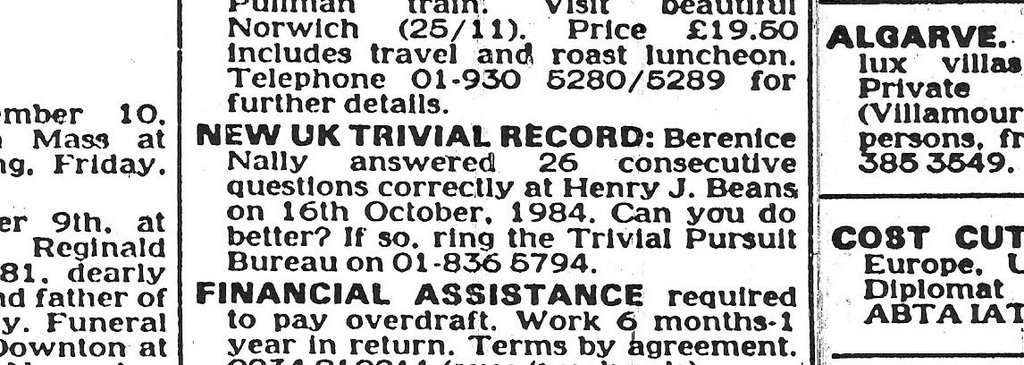
New UK Trivial Record - from the Times, November 1984.

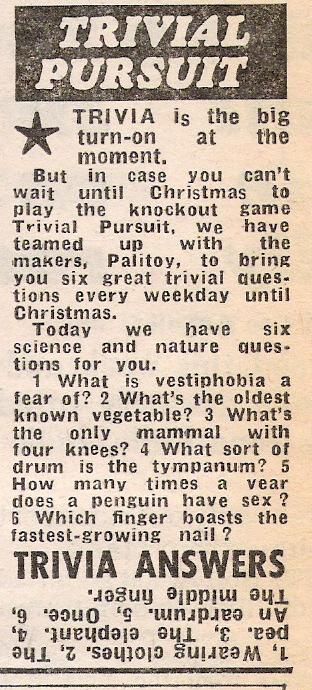
Trivial Pursuit questions (and answers) as featured in the Sun, December, 1984.
The '80s Actual Trivial Pursuit Timeline

(Details culled from a mid-1980s magazine interview with Chris Haney and Scott Abbott)

15 December 1979 - conception:

Chris Abbott and Scott Haney were having a friendly argument in the kitchen of Chris's Montreal home over who was the better Scrabble player. To resolve the dispute, Chris went to buy a Scrabble set, and realised that it was the sixth he'd bought in his life. The pair decided then and there to invent a new game. "It took us forty-five minutes to design the game," explained Scott in a 1985 interview, "and three months to figure out the scoring." Chris and Scott decide to call their new game "Trivia Pursuit" although this will later be altered.

January 1980:

Carrying an expired press pass and a camera without film, Chris and Scott visited a toy fair in Montreal. There, they pumped manufacturers about marketing strategies. According to Scott, the pair "collected about $10,000 dollars' worth of information in one afternoon."

Chris and Scott decided to set up their own company to produce the game, recruiting Chris's older brother John and a lawyer friend, Ed Werner. Chris left his job and began to contact companies who could manufacture the various game components.

October 1980:

Work began on preparing the all-important questions. Chris, his wife, Sarah, and two-year-old son went to Spain to begin the work. John later joined them there. The next five months were spent amassing mountains of trivia.

March - October 1981:

During the summer of 1981, Chris and Scott spent six weeks on the final editing of the Trivial Pursuit questions. Artist Michael Wurstin was hired to design the board and logo - he was paid with shares in the company. The game creators pored over colour combinations and package designs.


They decided to go for a chunky box, bearing the words "Trivial Pursuit" in elegant script, something that would look good on coffee tables, as well as in toy cupboards.

A test run of 1,200 copies was produced after thirty-two friends, relatives and former colleagues bought shares in the venture. In late October 1981, the game components arrived and work was carried out round the clock putting the boxes together.

November 1981 - September 1982:

The stage was set for the first test run of Trivial Pursuit games to make their debut in shops in the Toronto and Vancouver area in November 1981. All were sold.

Orders from retailers began to come in, but the supply of games had been exhausted and its creators had used up all their funds. Various banks were approached, but credit to produce further Trivial Pursuit games was refused. "We'd really hit rock bottom," recalled Chris a few years later.

In March 1982, they found a bank willing to lend them enough money to produce a further 20,000 games.

An old boat-yard on Lake Ontario became their assembly plant, and Scott left his job to become the company accountant. A computer was bought to store the questions in.

October 1982 - October 1983:

The four man team working at the Trivial Pursuit assembly plant were finding it difficult to cope with the flood of orders for the game. In October 1982 they handed over the distribution to a Canadian game manufacturer, which immediately ordered 80,000 games. In November 1982, Chris and Scott signed a contract with the distributors of Scrabble to manufacture and distribute the game in the USA.


In the spring of 1983, Chris phoned Steve Birch, a friend in England: "Can you come over? The game is going pretty well and we want you and Ray to do a British version."

Steve Birch and Ray Loud went to Canada and, with Chris and Scott, pored over the Trivial Pursuit questions, deciding which would need replacing for a British edition.

By the end of August 1983 the British game was ready to be manufactured.

January 1984:

Trivial Pursuit went on sale in Britain.