Total Pageviews

Pages

Showing posts with label comedy. Show all posts

20 April 2016

Victoria Wood


An Audience With Victoria Wood, 1988.

I actually cried today when I heard that Victoria Wood had died.

And it's rare that the death of a celebrity will do that to me.

Victoria scratched around for some years before finding fame, winning New Faces and singing her way through a brief stint on That's Life!

But then came the '80s... 

Back,  back, back in the early 1980s, Victoria starred in a Granada Television comedy sketch series with her friend Julie Walters called Wood and Walters.

Well, it didn't greatly impress me and I soon forgot it.

But, in 1985, with more creative control of her own over a new series, she returned to my telly screen - this time on the BBC.

And this time she was marvellous.

Victoria Wood - As Seen On TV.

Here was a show written by a woman which did not exclude men. Victoria had fun with human foibles of either gender, but there was no misandrist nonsense here.

This was a show for everybody.

And I loved it...

Bessie!... The Trivia Pursuit obsessed flatmates... Shopping... the guy with the telephone deodorising service... At The Chippie... Margery and Joan... Knock Knock On Your Knocker... Kitty... Let's Do It... Acorn Antiques... "It's Tofu" and so much more...

"Is it on the trolley?"

"They got on to politics, I ended up watching Take The High Road with the sound down."

"Never touch prawns, they hang around sewage outlet pipes, treading water, with their mouths open - they love it!"

"All the way to Nottingham, all the way back..."

 Victoria Wood - As Seen On TV brought Miss Wood stardom. And it was well deserved.

Victoria was a wit unequalled. And I always felt that if I'd ever met her I wouldn't be awe stricken (not like I was when I met Bill Waddington, Percy Sugden from Corrie!). No, Victoria seemed wise, witty, puzzled by life, funny, down to earth and a kind of absentee friend really.

I will miss her.

Our main blog post on Victoria Wood - As Seen On TV , from 2009, can be found here - http://80sactual.blogspot.co.uk/2009/02/victoria-wood-as-seen-on-tv.html  

And here we honour Victoria's fabulous comic creation Miss Babs of Acorn Antiques - http://80sactual.blogspot.co.uk/2014/07/soap-opera-heroines-of-1980s-no-1-miss.html

11 November 2015

Only Fools And Horses... ONLY Half-Brothers?


The Peckham Trotters in the 1980s. They bickered and fell out, they loved and supported each other - and Grandad watched two tellies at the same time. Just like any other family. Apart from that last bit.
 
I've had an interesting e-mail from Starvo. Here's an extract:

I know Only Fools... is one of the greatest sitcoms of all time, and that it began in the 1980's which you write about on here, but don't you think the revelation that Del and Rodney Trotter were only half-brothers spoiled it a bit? The writer had spent a lot of time building up a believable sibling relationship between the two lead characters, only to make a mockery of it with that. And it meant Rodney wasn't really related to Grandad at all. I felt let down.

Why did you, Starvo? I know a couple of "siblings" today who are "only" half-siblings, but they think the world of each other and have a better relationship than many full-siblings I know. Similarly, I know a "brother" and "sister" who are really only halves, but are unaware of the fact because according to their birth certificates they have the same father. And there are half-siblings in my family, too.

I think the "only" you use to describe the half-sibling bond between Del and Rodney is in a way quite sensible, after all they share half the same origins, not full, but in other ways it's quite odd because it implies that the relationship is less important than full-siblings. I don't believe that is often the case. When I wrote my Only Fools And Horses article on here, I didn't use "only" to describe the tie because Del and Rodney, I simply stated that they were actually half-brothers.

As for Grandad not being a blood relation of Rodney's, I suppose he wasn't. But he was still Rodney's grandad in every other way that mattered.

I think that was one of the greatest things about OFAH. The unity and love of the Trotter family, despite the fact that things were not quite as they might seem, and the situation not being as "respectable" as our squeaky clean 21st Century pundits might like it. Sometimes I think the attitudes of this century are far more old fashioned than the last.

Just a thought to leave you on: step-siblings and adopted siblings have no shared blood at all. Does that make the strong and very real sibling bonds that often exist between them any less real or important than blood-related full siblings? And if not, why did the revelation in OFAH that Del and Rodney were half-brothers make you think that it made a "mockery" of the close sibling relationship between the two?


08 March 2014

Great Feats Of The 1980s: Herring Juggling...

The 1980s were simply wondrous. I mean, the World Wide Web, Microsoft Windows, DNA fingerprinting, and other simply hornswoggling inventions were invented, the likes of Eddie The Eagle had us spellbound, and it was a time when our ethos was simply "GO FOR IT!" We will never see its like again. Something rarely mentioned is a fabulous feat from Minnesota, USA. 

Herring juggling.

"Herring juggling? Oh my gawd, who the hell juggles herrings?" you ask.

"No, no," I hasten to put you straight.

"It was the herring that did the juggling."

Let Mrs Rose Nylund of St Olaf fill you in - click on image to read...


28 July 2013

"Language, Timothy!" "Sorry, Father!" - The Adventures Of Timothy Lumsden


Sorry! - the novel. Ronnie Corbett as hapless librarian Timothy Lumsden is the cover star. Timothy desperately wanted to leave home, and sought "full board without scotch eggs".

Towards the end of 1980, Ronnie Corbett, the little one of Two Ronnies fame, was recording the pilot of what he later described as an "everyday sitcom" at the BBC. Although the Two Ronnies was still up and running, Ronnies Barker and Corbett had an agreement with the BBC that individual projects would be provided for them as comedic actors in their own right.

 The "everyday sitcom" pilot in production in late 1980 would never see the light of day. It wasn't deemed good enough.

It was whilst recording this destined-for-the-dumper pilot, that Ronnie Corbett was introduced to a brand new character, written especially for him, by writers Ian Davidson and Peter Vincent.

Enter, Timothy Lumsden! Timothy Christopher Robin Lumsden, to be precise.

Ronnie was happy. The BBC was happy. The pilot of the other show disappeared, never to be seen on-screen. And Sorry! went straight into production - for a full seven episode series, no pilot needed!

Interior scenes were filmed at the BBC in London, and the exterior for the small town setting for Timothy's exploits was provided by Wallingford in Oxfordshire.

In March 1981, the series went on-air. 

 Timothy Lumsden was a very English little man, who would instinctively apologise if somebody bumped into him, trod on his toe, etc. And Ronnie Corbett, himself born in Scotland, made this character live and breathe.

It was a brilliant performance.

Of course, Ronnie Corbett was already famous, but Timothy looked a bit different early on. Slightly more hair. Slightly curlier. Ronnie later commented: "I wore a false piece on top of my hair to make me look a bit curlier, but I don't know why I bothered with that." For me, it was useful because I was already a Ronnie Corbett fan, and loved watching him (particularly his "sit down" act on The Two Ronnies!), but the hair served to set Timothy Lumsden slightly apart, and I found it useful in establishing the character as a separate entity from the Two Ronnies performer.

 What initially warmed me to this series was its excellently drawn characters and the writers' obvious knowledge of what makes people tick - the relationships between the Lumsden family members were brilliantly observed. 

 Detail from the opening titles of Sorry!

Librarian Timothy was not always good with words - he got tongue tied, rambling and flustered at the drop of a hat when in the presence of any woman he liked (his mother had kept him off school the day his class did page 44 in biology), but he was a witty and kind man nonetheless. He was also an Ovalteeny and something of an unlikely hero - saving his godson from a bully, reuniting a runaway daughter with her father, saving a circus troupe from the bailiffs, putting aside the fact that he was going on a date with the woman of his dreams in order to save an elderly neighbour's house from being burgled...

Timothy's big problem was his mother - Mrs Phyllis Lumsden. At the start of the series he was forty-one. But Mummykins still treated him as though he was about five. She cooed at him. She lambasted him, she was always telling him to "stop showing off!", and wasn't averse to clouting him on occasion. She kept asking him if he was constipated. She wanted to make sure he had clean "handy-pandies" before he ate his dinner. She sent him to bed if he misbehaved. She cut his porridge into soldiers for him.

"WHAT?!" you explode. Or perhaps yawn. I dunno what kind of mood you're in today, so I really can't say.

Well, yes, I reply,  I know that cutting bread or toast into soldiers is far more common. But then Mrs Lumsden's porridge was decidedly uncommon. Thank goodness. Which leads us neatly onto the subject of her cooking skills. Or rather lack of them. Mrs L was still living in the war and post-war years of rationing - she still had two boxes of powdered egg in the larder. "Waste not, want not!" was her motto, and leftovers were a speciality. Left over Twiglets and scotch eggs for breakfast? Why not? And what about last Tuesday's spotted dick?

Timothy couldn't break the ties of his mother's apron strings. Even when he seemed close to it, he sometimes scuppered his own efforts because the suffocating bonds were just too tight.

Mrs Lumsden clung on to the past (note the ancient cut-price tin of Zam-Buk in the bathroom) and tried to make sure her son Timothy never grew up. She was so out-of-touch that, when Timothy presented her with an elaborate wrought iron shoe scraper as a present, she tentatively asked: "Is it a video game?"

It seemed appropriate that one of Mrs Lumsden's relatives had invented flypaper. 

 Actress Barbara Lott found fame as monstrous mummy Mrs Lumsden in Sorry!

Mrs Lumsden's daughter, Muriel (Marguerite Hardiman), had broken free and married and Mrs L had never really forgiven her. And Muriel's husband, Kevin (Derek Fuke), well... his eyes were far too close together...

And we all know what that means (incidentally, did you know that eyebrows which meet in the middle are a sign of a "gold digger", and that small ear lobes are a sign of "not a very nice person"? Timothy did).

Whilst we're off on a tangent, was Mrs Nugent Is Coming To Tea a record by Soft Cell?

Muriel committed terrible crimes in her mother's kitchen - like throwing away the J-cloth (Mrs Lumsden believed this should be a yearly event) and descaling the kettle (Mrs L was convinced the tea would taste dreadful because of that). Muriel even threw away the wall calendar in 1981 - "It's not November 1980 anymore!" The photograph of helpless little puppy dogs  had caused Mrs Lumsden not to move beyond that month and year.  She loved helpless little puppy dogs, did Mrs L.

Muriel fell out with her mother regularly, but knew her well, in fact, had similar steel in her own personality. But she was very much in opposition and determined to get her brother out into the world if she possibly could. Far easier said than done!

Timothy's father, Sidney (William Moore), had long retired from the Water Board and even longer accepted his wife's rule. At first glance, he simply seemed to echo her authoritarian stance on occasion - "Language, Timothy!" he'd say, usually when Timothy had said something completely innocent, or, "Bolshie, Timothy!" when the little one was trying to assert himself. 

Mrs Lumsden berated her husband and sent him out to his shed or the garden (smoking was only allowed beyond the compost heap) and generally ruled him with a rod of iron. But we quickly learned that there was a warmer, kinder side to Mr L, and he was often an ally and confidante for Timothy.

Tim frequented the local pub, and often met his old pal, Frank Baker (Roy Holder), there. Frank was another ally, urging Tim to break away from his mother. Unlike Tim, Frank was just your average guy, unhampered by a monstrous mater. He married, started a family, and generally lived life as millions upon millions of men live it. Sometimes he grew frustrated with Tim, but he showed such patience and restraint it was obvious that he really cared.

Apart from that dreadful time in 1982 when he hit Tim with a shepherd's pie.

Frank provided a useful bit of grounding to the show, along with the local pub scenario, including Jean (Jennifer Franks) the barmaid, as Sorry! sometimes leapt away into the surreal. Did Timothy have a guardian angel (see the episode It's A Wonderful Life, Basically), for instance? Or was he simply going a bit strange and imagining things after all those lonely years of oppression?

Timothy had a few more near misses when it came to matrimony, but the closer he got to finding true love, the more desperate his mother became to thwart him. She wasn't above enlisting the aid of her friend Dulcie Barrable (Mavis Pugh) in her attempts to spoil her son's escape plans, and once even faked her own death. Some of the later episodes had a faintly sinister tinge, and the surreal aspects of the plot increased. But would good win through in the end? 

In 1988, now aged forty-eight,Timothy bought his house and met the woman of his dreams. "Snow White's Cottage", that's what his friends dubbed his quaint new home.Of course, Timothy declared he was a yuppie - moving into the property owners' class. And also an Oink (remember all those acronyms so beloved of the 1980s? Dinky, of course, stood for "dual income, no kids yet", but "Oink" was definitely Timothy - "one income, no kids"!).

But then Mother called at Snow White's cottage with a basket of apples...

And the thudding noises coming from upstairs that Frank Baker heard when calling on Mrs Lumsden at her house later, in search of a suddenly missing Timothy, were not, as Mrs L said, Muriel doing her aerobics with Jane Fonda...

I won't spoil the ending, but Sorry! was a brilliant sitcom, and a few visits to the 1980s Lumsden family are a must if imaginative, high quality TV comedy is something you enjoy. 

But remember - no elbows on the table and make sure your handie-pandies are absolutely spotless before venturing in!

26 April 2013

ALF - Alien Life Form...

Dateline: Mid-1980s...  ALF was created by puppeteer Paul Fusco. In 1986, he crash landed his space craft into the garage of the Tanner family...

Like Knight Rider, the American TV comedy series ALF (1986-1990) slipped by me almost unnoticed on life's glittering 1980s high road. So, as with the '80s Actual feature on Michael and the very fabulous KITT, I turned to a good friend of mine for help, in this case Mandy, who loves the ALF series so much she is still brimming over with enthusiasm about it all these years on! The post below takes the form of questions from me and answers from Mandy...

Who was ALF? What did A-L-F stand for?

ALF (real name Gordon Shumway) was a furry alien from the planet Melmac. He crash landed into the garage of the Tanner family. When Brian (son) asked what 'it' was, Willie Tanner (father) replied, "It's an ALF," (an acronym for Alien Life Form). ALF was mischievous, cynical, and above all a prankster. He is best known for his sarcasm. He did care for the Tanners though and his heart was in the right place (in his ear to be precise).

Who were the Tanner family?

The Tanner family consisted of Willie (father), Kate (mother), Lynn (teenage daughter) and a young son called Brian. Oh, and not forgetting their cat, Lucky. Lucky lived a hazardous existence as cats were a delicacy on Melmac, but the Tanners' No. 1 rule was "we don't eat members of the family". This didn't deter ALF from trying his luck though!!

Where did they live? Were there any other main characters in the show apart from the Tanners and ALF?

The Tanners lived at 167 Hemdale in the San Fernando Valley of L.A. Other main characters in the show were the Ochmoneks, Raquel and Trevor (very nosey and annoying neighbours). ALF befriended a blind woman called Jody who never knew he was an alien - she just thought he was a bit weird. There was also Kate's mother, Dorothy, who would threaten to turn ALF over to the Alien Task Force.

What was the story-line?

ALF's planet, Melmac, has been destroyed in a nuclear war. He follows a signal to Earth and crash lands into the Tanners' garage. The Tanners are unable to bring themselves to turn ALF into the authorities (the Alien Task Force) with the fear of them experimenting on him, so they hide him in their home. They soon begin to develop affection for him, and he has a strong bond with the kids, although Kate takes more convincing. ALF has to adapt to life on Earth and the constant learning process frequently gets him in trouble. Despite all ALF's antics, there was a rather sad undertone to the show as ALF's planet had been destroyed and he missed his friends. He always dreamed of being reunited with them.

What did you think of the show? What did it mean to you at the time?

ALF was very funny, very funny indeed. This short little alien with burnt orange fur was so endearing. I was always amazed at the variety of his facial expressions, which for a puppet were truly remarkable. I eagerly awaited every new episode and was a real fan. Buying presents for me at that time was so easy, just get something with the old ALFer on it! I had posters, mugs, t-shirts, key rings, books and my favourite, a big talking ALF (which still has pride of place in my home). The odd ALF phrase still slips out in conversation to this day. The show was aimed at kids but some of the jokes had very adult tones. The show also courted a lot of controversy, with ALF seen drinking alcohol with Brian, and ALF's taste for cats. My favourite ALF clip is when he is singing along to Bob Segar's Old Time Rock and Roll; it's typical ALF!

 Did you ever watch  other 1980s American shows (Hill Street Blues, Cagney & Lacey, The Golden Girls, Roseanne, Kate and Allie, Married With Children, etc)? How did ALF rank against other '80s American TV shows in your opinion?

Other American '80s shows were good at the time, and I watched a few. I really don't get the same enjoyment when I watch them now, with the exception of Hill Street Blues, which was a brilliant programme. Hill Street Blues was an entirely different type of show, so trying to compare ALF with the likes of shows of that stature is very difficult. All I can say is I would not purchase other such shows on DVD, but would buy the entire four seasons of ALF in a heartbeat!

Thanks so much, Mandy. Now, Mr Shumway, let's take a look at you (Andrew blasts off to YouTube)....


16 April 2013

A Test For Andrew....

Catherine has written and hopes to stump me... 

On the subject of 1980s screen entertainments, if I was to name a few characters from a particular TV show, could you come up with the show's title without Googling or similar? Try these - they all appeared in a television show of the '80s: Timothy, Frank, Muriel, Kevin, Dulcie Barrable. Remember, no checking elsewhere. I'll have to trust you! 

You can, Catherine, you can! It's Sorry! the BBC sitcom that ran from 1981-1988 and starred the brilliant Ronnie Corbett as put-upon mother's boy Timothy Lumsden, Barbara Lott as the rather scary Mrs Lumsden, and William Moore as bumbling dad Mr Lumsden ("Language, Timothy!"). The Frank you mention was Frank Baker, Timothy's best friend, Muriel was Timothy's sister, Kevin his brother-in-law, and Dulcie Barrable was a friend of Mrs Lumsden. Mrs B had a cat called Floosie. 

I well remember Mrs Lumsden cutting Timothy's porridge into soldiers for him...

And that dreadful time Tim jumped in the river in the dead of night so that he could phone his mother!

Wonderful series. I must give it the '80s Actual treatment - been meaning to for ages! Thanks for writing.


15 March 2013

Red Nose Day - 25 Years - 1988-2013

 1988 - Griff Rhys Jones, Lenny Henry and Jonathan Ross take part in the very first Red Nose Day.

Did you wear your red nose today? '80s Actual Towers has been fair bristling with the things! Comic Relief was, of course, launched on Christmas Day 1985 with a live report from a refugee camp in Sudan, and the first Red Nose Day was held on 5 February 1988.

Recently, Lenny Henry wrote about the first Red Nose Day back in 1988, and how it has changed since then:

"Comic Relief these days is much more in line with shiny-floor shows like The X Factor – fast, zappy, presenter-led – but we were just asking everybody to be kind and help. We had live entertainment from comedians such as the Goodies and pre-recorded films from Africa, but lots of comedians discovered it was very difficult to do live comedy with an audience that has just watched somebody die. I went to Ethiopia for one section where we filmed a row of Ethiopian men in their tribal gowns. The camera panned along them and the voice-over said, 'Please give us some money; poverty can affect somebody you might know.’ The last person on the row was me, dressed in the same tribal gown. For the first time it wasn’t just an image of a starving child with a big belly and flies crawling all over their face – it was somebody that the audience knew. 

"There is a lot of fear bound up in comedy – 'How will I be funny? Am I going to be the funniest?’ – but since we were all aiming at the same target there was a bullish vibe. Everything went wrong, of course – the autocue stopped, someone tried to do some magic and it didn’t work, Frankie Howerd came on and wouldn’t stop talking – but people were really moved by the films. I thought that if I made people laugh, and donate, then maybe the kids I visited in the Kibera slum in Kenya wouldn’t have to live in a room with a sewer running down the middle of it. We raised £15 million that night, which was a big deal."

27 January 2013

Sorry, I'm A Stranger Here Myself

So excited to read that Sorry, I'm A Stranger Here Myself, the Thames TV comedy written by David Firth and Peter Tilbury (now mainly remembered for Shelley and It Takes A Worried Man), which ran for two series in 1981 and 1982, is coming to DVD in March this year. It's the tale of poor, henpecked Henry, who is left his uncle's house in the fictitious English Midland's town of Stackley, and escapes his ghastly wife to return to the scene of his formative years. Unfortunately, the Stackley of 1981/1982 is not the Stackley Henry so fondly recalls, hence the title - Sorry, I'm A Stranger Here Myself.

Punk rocker Alex is squatting in Henry's house, Asian Mumtaz is running the corner shop, and there is a militant union shop steward living next door!

This is a very witty portrayal of the 1980s as they were before the yuppies, before the brick-sized mobile phones, before the explosion of creative energy brought to television by Channel 4, before the credit boom, before the huge shoulder pads. A 1980s where the Rubik's Cube and CB radio are huge crazes, New Romantics are the current pop sensation, Charles is marrying Di, and inner city riots are erupting.

The stars were Robin Bailey, Christopher Fulford, David Hargreaves, Diana Rayworth and Nadim Sawalha.

I ate this series with a big spoon. Can't wait to see the DVD and write a full review!

24 April 2012

Howard, Hilda And Neddy...

 
 Howard and Hilda Hughes: "You can stay in the Polly Wolly Doodle room, Ann."

Mike has written to say:

I loved reading your blog post on Only Fools And Horses - lots of details, and very concise. Also enjoyed hearing about your step father's resemblance to Trigger! Is OFAH your favourite '80s sitcom?

Thanks, Mike, glad you enjoyed the post. If our research is superior to the BBC's we usually feel happy with an article, and in the case of OFAH, despite it being a BBC production, it is. In one of the BBC articles we recently read, the BBC states that the show's creator, John Sullivan, was a used car salesman at a time when he was actually working as a plumber and... wait for it... for the BBC! LOL!

We loved Only Fools... Grandad (Lennard Pearce) was our favourite character initially (we adored his two tellies and out of stepness) but Del, Rodney, Trigger and Uncle Albert soon took a grip on our affections.

But, much as we positively worshipped Only Fools... it is not our favourite 1980s sitcom.

That honour goes to the John Esmonde and Bob Larbey-penned Ever Decreasing Circles (1984-1989), a tale of an obsessive organiser and community-minded wally in a small suburban street (sorry, I mean close!) who finds all he holds dear threatened by a suave type for whom the sun always seems to shine.

It's a forgotten masterpiece.

Ever Decreasing... was great in so many ways - not least because it gave Richard Briers a chance to prove what a great actor he is. But the rest of the cast were wonderful too and the show is a very beautiful thing which we here at '80s Actual cherish and cherish again.

157 men went to mow, went to mow a meadow...

Read our review here.


16 April 2012

Only Fools And Horses

An historic TV listing page from the Sun, 8 September, 1981... The very first episode of Only Fools And Horses is about to be broadcast. Unfortunately, I was hooked on The Flame Trees of Thika, and missed it!

From the Sun:

David Jason blunders into a world of birds, bets and shady deals as the star of a new comedy series tonight.

The funny little man from A Sharp Intake Of Breath plays fast-talking fly-boy Del Boy Trotter in Only Fools And Horses (BBC1, 8.30)

But his deals never seem to come off.

The title of the seven-part comedy series sums up Trotter's philosophy - work is only for fools and horses.

Trotter, a South Londoner, has a younger brother and aged grandfather to support.

He holds a deeply felt conviction that someone somewhere is making an easy fortune and that sooner or later he will do the same.

Jason says: "Trotter feels that because he doesn't take anything out of the State he doesn't see why he should put anything back.

"He doesn't believe in paying any tax he can avoid."

Jason, a bachelor, has a country cottage in the Home Counties, where he writes radio shows.

In tonight's programme, Trotter buys a cargo of executive brief cases - only to find he cannot sell them because they are hot property.


 In 1980, BBC scriptwriter John Sullivan, having completed work on his previous TV series, Citizen Smith, was looking for a new project. Would a comedy set in the world of football set the 1980s alight? The BBC thought not, and they didn't like Sullivan's follow-up idea for a comedy centred on a street trader in London, either. But Sullivan persisted, and, with a little help from producer and director Ray Butt, won the day. The BBC commissioned a first series.

The working title for the new show was Readies, but the show's actual title turned out to be Only Fools And Horses. "Why do only fools and horses work?" was the question posed by the famous theme song (which took a little time to arrive), and Del Boy Trotter wanted to get rich quick. The title was highly appropriate.
 

John Sullivan was born in Balham, South London, in 1946, of Irish and English parentage. He grew up in a poor community, full of characters and comedy, as he later recounted. At school, he met the works of Charles Dickens and was never the same again.

As a young man in the early 1960s, John Sullivan had several jobs, including one in the used car trade. Interviewed years later, he said that during that time he met "a lot of villains, quite a rich seam to tap into later when I started writing. " In other interviews, he spoke of his need to break away from his poor background and make some money.

In 1962, Sullivan was hugely impressed by a BBC Comedy Playhouse production, featuring the characters of old man Steptoe and his frustrated son, Harold - desperate to break away from his grotty old dad and the scrapyard they ran. Sullivan was impressed by the drama and comedy in the show, and this would later influence his own work.

In the late 1960s, he started sending scripts to the BBC - but each one came back rejected. By the early 1970s, Sullivan was working as a plumber and still nursing ambitions to be a TV writer. He married Sharon Usher in 1974 and took an unusual route into the BBC for an aspiring scriptwriter - working in props, set dressing and scene shifting.  

At the Beeb, Sullivan met Ronnie Barker, who got him to write some sketches for the Two Ronnies, and the legendary comedy producer Dennis Main Wilson, who championed Sullivan's cause. The result was Citizen Smith making its TV debut as a series in November 1977. Wolfie Smith, lead character of the series and head of the Tooting Popular Front, was inspired by a man Sullivan had seen in a pub in 1968. Citizen Smith ran until December 1980. 

And so, we're back to the beginning of this article, with Sullivan finishing work on Citizen Smith in 1980 and looking for another series idea...

Sullivan drew extensively on his own background and life experiences for Only Fools... - Del's love of fancy foreign phrases, for instance, came from a man Sullivan had known when he was working in the used car trade when he was about seventeen years old, back in the early 1960s. Another inspiration for Del was the "fly pitchers" Sullivan had observed at various London street markets throughout his life.

Sullivan said that he wanted to reflect modern working class London - most series set in London seemed to take a rather nostalgic view of life in his opinion. The first series of ITV's Minder, which had a modern London setting, had not troubled the ratings but the 1980 series, tweaked and with more comedy added, saw Arthur and Terry beginning to take a grip on the viewing public's affections. Sullivan worried that his territory had now been covered, but later wondered if the success of the tweaked Minder may have influenced the BBC in saying yes to his idea for Only Fools And Horses.

How it all began... Del Boy ("Lovely jubbly!"), Rodney (bit of a plonker!) and Grandad of Trotters Independent Trading Co - New York - Paris - Peckham.

Filming of series one began in May 1981. The first episode was transmitted on BBC1 at 8.30 pm on 8 September that year.
It didn't do great trade with the viewers, but within three years Only Fools... was one of the most popular shows on the telly.

Del Boy Trotter (David Jason) and his younger brother, Rodney (Nicholas Lyndhurst), lived in a flat at Nelson Mandela House, Peckham, with their grandad (Lennard Pearce).

Del was a highly lovable character - his "get rich quick" schemes (he even flirted with a yuppie image having seen the film Wall Street in the late 1980s!) could not disguise the fact that he was really just a silly dreamer - and his love of his family was obvious. When Rodney left home after an argument in the very first episode, Del's facial expression on his return spoke volumes. No words were needed.

Grandad immediately leaving his armchair to prepare Rodney a meal (another plate of salmonella and chips?) also spoke volumes. Here were three characters who often grated on each other's nerves, but who loved each other dearly. Del had brought Rodney up from the age of six after their mother died. We later discovered that Del and Rodney were actually half-brothers, and that Rodney was not even a blood relative of Grandad, but nothing could dent the unity of the Trotter family. They were more of a family than many of the 2.4-children-with-same-parentage variety.

David Jason began his acting career in the 1960s. He partly based Del Boy's mannerisms and dress sense on Derek Hockley, a builder he had worked for as an electrician before becoming an actor.

When actor Lennard Pearce died in 1984, Grandad died too, and Only Fools... began to move away from the traditional sitcom mould by including genuinely sad scenes which moved many people to tears. A touch of pathos had been a sitcom ingredient for decades, Sullivan himself spoke of being influenced by the 1960s sitcom Steptoe and Son as we've already mentioned, but Only Fools... moved things on further, blurring sitcom with drama, serving to enrich and enhance the show and to move the show's characters beyond being mere comic devices.

To fill the gap left by Grandad, Buster Merryfield joined the show as the boys' Uncle Albert.


The Trotters and their friends at the Nag's Head became people we liked, in some cases perhaps even loved, and cared about.

My step-father was often mistaken for actor Roger Lloyd Pack, Trigger in the series. He was even interrupted whilst having a pub lunch by a couple wanting his autograph! Of course, in such high esteem did my step-father hold the brilliantly brainless character Trigger and indeed the entire series, he was chuffed to bits!

Only Fools... was sheer magic... favourite scenes? Too many to mention!

The show has won various awards and has been named the best UK sitcom ever in a viewers' poll.

I suspect it might be.

But it was so much more than a sitcom.

Cheers! Nag's Head regulars in the 1980s: Trigger (Roger Lloyd Pack), Rodney (or should that be "Dave"?) (Nicholas Lyndhurst), landlord Mike (Kenneth MacDonald), Del Boy (David Jason), Uncle Albert (Buster Merryfield), Boycie (John Challis) and Marlene (Sue Holderness)

14 April 2012

Alternative Comedy: The Young Ones

Tucked away in the TV pages of the Sun, 31/10/1981, was some interesting news about telly comedy. TV writer Charles Catchpole traced off-beat telly comedy back to Monty Python, which had begun in 1969. And of course that was inspired by The Goon Show, which had first aired in the 1950s. In the early 1980s "alternative comedy", anarchic, left-wing, proto-PC and generally a breath of fresh air, blasted onto our TV screens...

Jimmy Gilbert, head of light entertainment, has commissioned a try-out show for a possible series to be called "The Young Ones".

It promises to be one of the boldest ideas ever tried on telly. It will mix situation comedy, revue humour, fantasy and rock music.

The idea for "The Young Ones" was born out of the success of three off-beat shows - "Boom Boom Out Go The Lights", "Three Of A Kind", and "A Kick Up The Eighties".

It will star Rik Mayall, 23, alias Kevin Turvey of "A Kick Up The Eighties", as a down-at-heel student, sharing a flat with three friends.

Other parts will be played by three of the most promising of Britain's young comedians - Ade Edmundson, Nigel Planer and Alexei Sayle.

Edmundson is Rik Mayall's partner in an act called 20th Century Coyote. Planer is half of a double act known as The Outer Limits.

Rik Mayall, who is co-writing the show, says: "We will try to get permission to use Cliff Richard's song "The Young Ones" as the title music.

"But if we can't, we'll get a really dud group to record a crummy new version."

-
From the Daily Mirror, 9/11/1982:

A new comedy team hits the screen tonight. But be warned... this will be no innocent comedy romp.

It involves four outrageous characters living together as squatters in a derelict house.

They're a pretty shocking mob and their behaviour - and their language - is likely to upset older viewers.

But it's the younger TV audience they're aiming for with "The Young Ones" (BBC2, 9pm).

Rik Mayall, Ade Edmundson and Nigel Planer, who all worked at London's notorious Comic Strip club, team up with actor Chris Ryan to make the foursome.

Alexei Sayle, another of the Comic Strip's star comedians, plays their dodgy East European landlord.

Some BBC bosses were worried about the show at first, saying the comedy was crude and too near the knuckle.

Producer Paul Jackson says: "We were taking a big chance. When the first script was submitted, no one was quite sure if it would work."

But I think it's the most exciting new comedy we've done for years."

Rik Mayall, who devised and helped write the scripts, says:

"We had to cut certain words from sketches because they were considered too naughty by the BBC.

"We are not trying to push censorship back. But when you use swear words in normal life, and then you're not allowed to use them on TV, it's difficult to understand."

26 August 2010

Kate & Allie

American newspaper ad for a brand new comedy series - Kate & Allie, 1984.

Created by Sherry Coben, Kate & Allie was a groundbreaking and tremendously likeable American sitcom, which debuted in the States in 1984 and in England (on Channel 4) in 1986. The show told the story of two women who had first met as kids.

Baby boomers Kate McArdle (Susan Saint James) and Allie Lowell (Jane Curtin) were high school friends, but later drifted apart. Let loose upon the "Peace and Love" scene of the 1960s, Kate became a free wheeling, peace loving, protest marcher - and married an actor. Meanwhile, Allie became a neat suburban housewife - she married a doctor.

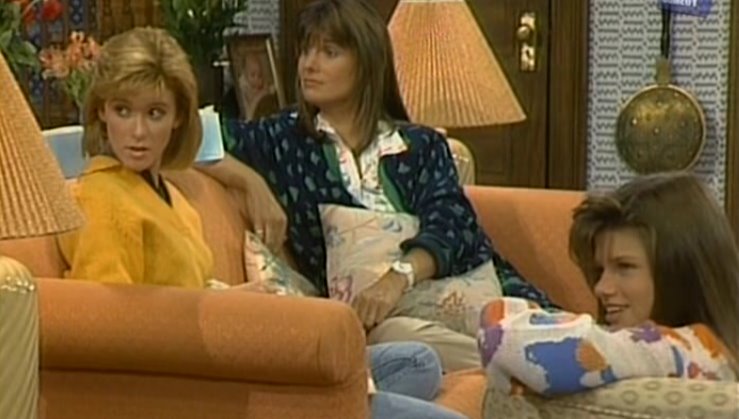
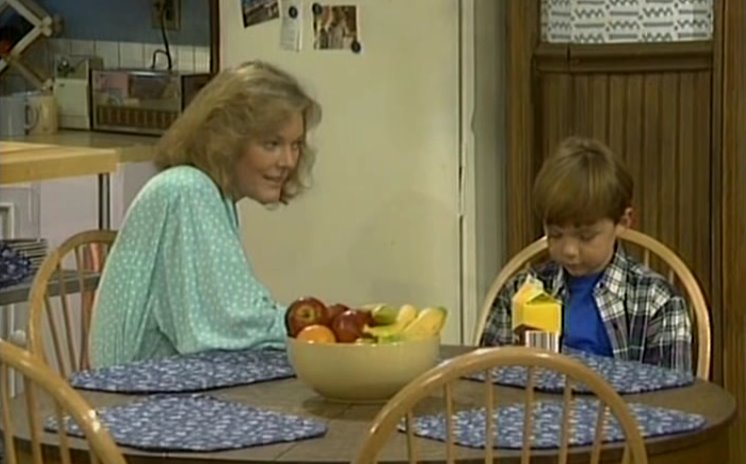
In 1984, now both divorced, Kate and Allie merged their two families - comprising Kate's teenage daughter, Emma (Ari Meyers), Allie's teenage daughter, Jennie (Allison Smith), and her younger son, Chip (Frederick Koehler).

Kate's apartment in Greenwich Village, New York, was now home to everybody, and we had an interesting alternative family set-up.

Creator Sherry Coben had been inspired by a high school reunion she had attended, where she observed a couple of unhappy divorcees who found comfort in sharing with each other. One of the most groundbreaking things about Kate & Allie was that the show never became some trendy, issue-led thing, Feminist ideology brainwashing or 'hey - this is hip and happening - let's do it!' garbage - as some previous shows had done. 

The show was character-led, it was based on changing social trends - the rising divorce rate in particular - but not chattering classes' nonsense. The characters were beautifully defined. Perhaps there was one episode towards the end of the run which didn't sit quite right, and an established character was briefly mutated into somebody quite different to suit Feminist ideology, but that's still excellent going for those times.

Allie was tightly buttoned and conservative, but underneath she was insecure and lacking in self respect. Her husband's affair and subsequent remarriage had severely shaken her.

Kate was laid back and happy-go-lucky, able to cope (well, usually!) with Allie's well-ordered suburban ways and occasional hysterical outbursts.

All was not portrayed as eternally peaceful in this alternative family, but Kate and Allie's friendship won through.


Could there be life after marriage for Allie, seen here with her ex-husband, Dr Charles Lowell (Paul Hecht)? She had still to meet Claire (Wendie Malick), the woman Charles had left her for, and when she finally did, the news that Charles and Claire had made love in Allie's marital bed, before the marriage had broken up, on Allie's designer sheets with the motif of little windmills, stunned her. Charles, meanwhile, was unhappy when Claire presented him with a new baby son, Stewart. Wasn't he too old for this? Didn't he deserve some peace and a nicely paced life which suited his age?

A landmark episode in this groundbreaking series, Kate and Allie face a huge rent increase when the landlady discovers that her one family apartment is now occupied by two families. Our heroines seek to wriggle off the hook by claiming to be a lesbian couple, winning the landlady's sympathy as she is herself gay. But the truth finally outs in a thought provoking scene which poses the question: just what constitutes a family? Is it only Mr and Mrs Average and 2.4 kids? The answer is - of course not!

Peace, love and protest were Kate's scene as a student in the 1960s. In the 1980s (just look at those shoulder pads!), she tried to rally her fellow customers at the local bank to protest at the establishment's attitude towards its customers, but was quickly removed by security guards!

Whilst Kate worked for a travel agent, Allie was at first housewife homebody, though later returned to college to get a degree. Kate commented that Allie had saved Emma (and herself!) from being latchkey kids. 

Later still, Allie and Kate pooled their resources to start a successful catering business.

Note the strange design of the matching wallpaper and curtains. Dot. line. Squiggle. Dot. Was it some kind of code, I used to wonder?

Also note that Allie has shoulder pads in her dressing gown!

Emma decides to make divorce the subject of her "Our Changing World" high school project, and finds the best subject material is to be found at home.

Kate found romance with Ted Bartelo (Gregory Salata), a plumber who was afraid of spiders. The two fell deeply in love, but split up repeatedly, realising that they both wanted different things out of life - Ted a family, Kate a continuation of her career. Finally, Ted found somebody who wanted the same things as him. Kate was devastated.

Kate and Allie was well written, and imaginative: one episode began as reality, before becoming Allie's imagination - something we only began to suspect as the plot became more and more bizarre; another saw Chip returning to the about-to-be-demolished apartment in the early 21st Century with his son and reminiscing about his childhood there in the 1980s; a further stand-out-in-my-mind episode centred on Chip - and soon his entire alternative family - befriending Louis, a young homeless man with learning difficulties.

Louis (Michael Countryman) found friendship and sewing lessons at Kate and Allie's apartment. The character was rehoused in supported living accommodation and developed romantic feelings towards Kate, before finding happiness elsewhere.

Something amiss... Jennie, Kate and Emma wonder what Chip has been up to...

So does Allie... surely he couldn't possibly have been using the oven door as a trampoline?! When the door comes off in her hand, Allie believes it...

Kate & Allie ran until 1989 - by which time Allie had remarried. Her new husband was a man called Bob Barsky (Sam Freed) who spent each week working away as a TV sportscaster, returning home only at weekends.

So, Kate moved into Allie's marital home to keep her company.

It wasn't the same. Perhaps it was the absence of the "Dot. Line. Squiggle" wallpaper at the new place, perhaps all the angles had been covered, but it soon became clear that Kate & Allie had run its course. The original premise of two divorced women merging their households had been groundbreaking; the set-up of the final series - divorced woman living with married friend and her often absent husband - was different, but not fascinating.

However, the show at its best was, in my very humble opinion, excellent and even towards the end, with the "Dot.Line.Squiggle" wallpaper sadly absent, there was some highly imaginative writing and the characters remained as likeable as ever.

Fondly remembered!

22 June 2010

Chris Sievey - Frank Sidebottom

Frank Sidebottom relaxes in 1985.

1985 again - Frank's Firm Favorites. - the EP!

Chris Sievey, the genius behind Frank Sidebottom, the man with the big papier-mâché head who first delighted us in the mid-1980s, has died.

A very sad piece of news.

I've found myself remembering how I first saw Frank...

My mate Pete and I were watching our favourite Saturday morning telly show Number 73.

We were not amongst the "target audience", both being over twenty at the time, but that didn't matter.

And suddenly, there amongst the regular cast, was Frank.

Pete and I looked at each other.

"Daft!" we said.

But within half-an-hour or so we were both laughing at Frank.

Pete turned to look at me: "What are you laughing at?!"

"I dunno!" I replied. "What are YOU laughing at?!"

Neither of us knew, but for some reason we WERE laughing at Frank's antics - and we continued to laugh in the years that followed.

Frank was, to use a very popular mildly derogatory word of the early 1980s, a wally. He was squeaky-voiced and child-like and his idea of entertainment was what most people considered naff.

But the naffness, given a Sievey-inspired tweak, was also highly amusing.


Remember "Little Frank", the ventriloquist's dummy Frank sometimes carried? Little Frank was, of course, a perfect, miniature replica of Frank.

A wally Frank may have been, but he was also an innocent. This upped his likeability rating no end.

He lived at home in Timperley with his mother, and related heart warming tales of his home life to his audiences - like the time he took the lawn mower apart, tried to reassemble it, but ended up with lots of left-over pieces of lawn mower workings. He attempted to flush them down the toilet to hide what he'd been up to from his mother.


Frank's quirky comedy is not considered to be alternative by most modern day people, but I think it kind of was. If you know what I mean.

Before finding fame as Frank, Chris Sievey had been a member of The Freshies pop group. They notably scored a hit (No 54 in February 1981!) with a ditty initially entitled I'm In Love With The Girl On The Manchester Virgin Megastore Checkout Desk.

Virgin Records requested that they should be left out of it, so the song was then retitled I'm In Love With The Girl On A Certain Manchester Megastore Checkout Desk.

The initial idea for the (then unnamed) man with the papier-mache head was that he would be a fan of The Freshies, and he made his debut in 1981 on a promotional video for the song Wrap Up The Rockets (AKA Rockets).

The Freshies were cultie, but not that well known, so most people didn't see the papier-mache head man in 1981. The band split up in 1982.

In 1984, the launch of a game called The Biz, designed for the ZX Spectrum by Chris Sievey, saw the fully-developed Frank Sidebottom feature on a 12-inch promotional record, which came free with the game. This was intended to be a one-off gimmick.

But Frank was soon a star of telly and radio - and the children's comic Oink!

Chris Sievey died on 21 June 2010.

He was 54.

12 February 2010

1981: Margaret Thatcher Says "Yes" To "Yes Minister"...

The comedy series Yes, Minister began in 1980, and had soon attracted friends in high places...

From the Daily Mirror, 30/3/1981:

It's party time at the House of Commons tonight.

And it's not a political one, either.

The Speaker, the Rt. Hon. Mr George Thomas MP, is having a dinner and his guests of honour are the gang of three from "Yes, Minister" (BBC2, 9pm).

Jim Hacker MP (Paul Eddington), Sir Humphrey Appleby (Nigel Hawthorne) and Bernard Woolley (Derek Fowlds) will all be sipping cocktails in a state room directly below Big Ben.

The Speaker is a fan of the show and so, too, is Mrs Thatcher, who likes to record it on video to watch in the small hours of the morning.

In tonight's episode the Minister decides to curry favour with the electorate by going on a publicity tour of a farm run for children. Chaos results.

The dinner date was arranged when the three stars of the show went to watch a parliamentary session in the public gallery at the Commons recently.

Their appearance almost brought the business of the House to a halt, with MPs and actors gawping at each other.

Paul Eddington says: "We went to the Commons to get the flavour of the place, and I must say we had a very enjoyable time. There was a lot of sniggering and nudging when we were spotted."

Although "Yes, Minister" has received the best TV comedy award, there will not be a new series for some time.

The writers, Antony Jay and Jonathan Lynn, are too busy working on other projects to get together before the summer of 1982.

So it looks as if Mrs Thatcher will have to be satisfied with repeats.