skip to main |
skip to sidebar
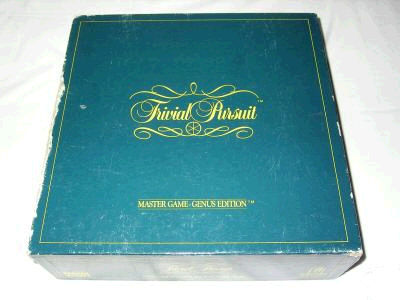 Did you pursue the trivial in 1984? Many people did as the UK edition of Trivial Pursuit made its debut in January.
Trivial Pursuit (originally to be called "Trivia Pursuit") was conceived by two Canadians, Chris Haney and Scott Abbot, on 15 December 1979. The general format was worked out very quickly, but devising the scoring system took three months! Chris and Scott spent the next couple of years setting up their own company and researching marketing techniques.
The famous Trivial Pursuit logo and board was designed in 1981 by artist Michael Wurstlin. A trial run of games was released in the Toronto and Vancouver areas in November 1981. All were sold.
 Trivial Pursuit creators Chris Haney and Scott Abbott in the mid-1980s.
-
In November 1982, Chris and Scott signed a contract with the manufacturers of Scrabble to distribute the game in the USA. Work began on the British edition in April 1983 and, at the start of '84, we discovered we could all pursue the trivial to our hearts content.
Trivial Pursuit creators Chris Haney and Scott Abbott in the mid-1980s.
-
In November 1982, Chris and Scott signed a contract with the manufacturers of Scrabble to distribute the game in the USA. Work began on the British edition in April 1983 and, at the start of '84, we discovered we could all pursue the trivial to our hearts content.
The game has cheese shaped wedges, general knowledge questions and a box design which looks good on any coffee table.
We fell in love with Trivial Pursuit here in England - and for the many versions released since, like the "Genius" edition pictured at the top of this post.
The original UK edition of Trivial Pursuit was our 1984 and 1985 Game of the Year.
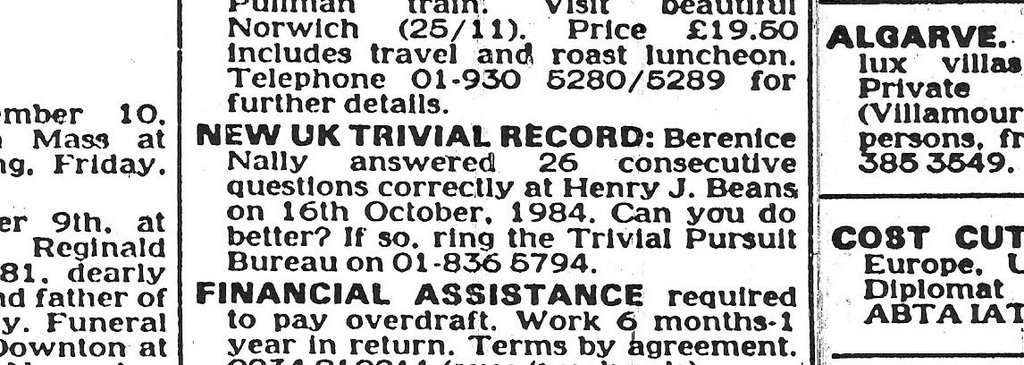
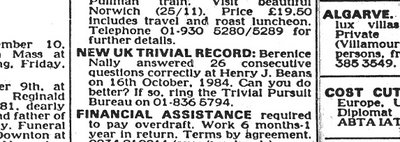 New UK Trivial Record - from the Times, November 1984.
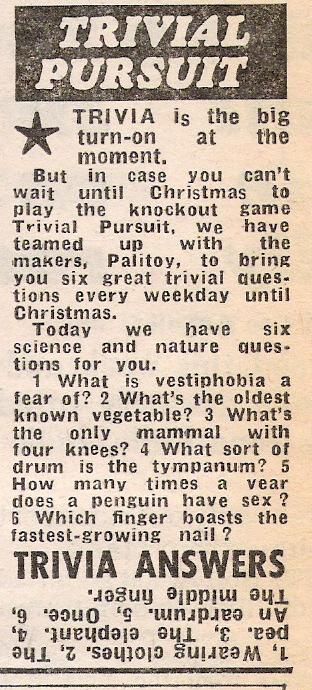
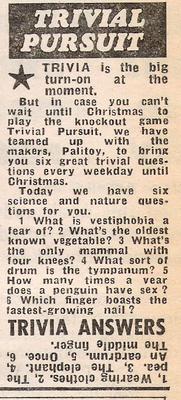 Trivial Pursuit questions (and answers) as featured in the Sun, December, 1984.
 The '80s Actual Trivial Pursuit Timeline
(Details culled from a mid-1980s magazine interview with Chris Haney and Scott Abbott)
15 December 1979 - conception:
Chris Abbott and Scott Haney were having a friendly argument in the kitchen of Chris's Montreal home over who was the better Scrabble player. To resolve the dispute, Chris went to buy a Scrabble set, and realised that it was the sixth he'd bought in his life. The pair decided then and there to invent a new game. "It took us forty-five minutes to design the game," explained Scott in a 1985 interview, "and three months to figure out the scoring." Chris and Scott decide to call their new game "Trivia Pursuit" although this will later be altered.
January 1980:
Carrying an expired press pass and a camera without film, Chris and Scott visited a toy fair in Montreal. There, they pumped manufacturers about marketing strategies. According to Scott, the pair "collected about $10,000 dollars' worth of information in one afternoon."
Chris and Scott decided to set up their own company to produce the game, recruiting Chris's older brother John and a lawyer friend, Ed Werner. Chris left his job and began to contact companies who could manufacture the various game components.
October 1980:
Work began on preparing the all-important questions. Chris, his wife, Sarah, and two-year-old son went to Spain to begin the work. John later joined them there. The next five months were spent amassing mountains of trivia.
March - October 1981:
During the summer of 1981, Chris and Scott spent six weeks on the final editing of the Trivial Pursuit questions. Artist Michael Wurstin was hired to design the board and logo - he was paid with shares in the company. The game creators pored over colour combinations and package designs.
They decided to go for a chunky box, bearing the words "Trivial Pursuit" in elegant script, something that would look good on coffee tables, as well as in toy cupboards.
A test run of 1,200 copies was produced after thirty-two friends, relatives and former colleagues bought shares in the venture. In late October 1981, the game components arrived and work was carried out round the clock putting the boxes together.
November 1981 - September 1982:
The stage was set for the first test run of Trivial Pursuit games to make their debut in shops in the Toronto and Vancouver area in November 1981. All were sold.
Orders from retailers began to come in, but the supply of games had been exhausted and its creators had used up all their funds. Various banks were approached, but credit to produce further Trivial Pursuit games was refused. "We'd really hit rock bottom," recalled Chris a few years later.
In March 1982, they found a bank willing to lend them enough money to produce a further 20,000 games.
An old boat-yard on Lake Ontario became their assembly plant, and Scott left his job to become the company accountant. A computer was bought to store the questions in.
October 1982 - October 1983:
The four man team working at the Trivial Pursuit assembly plant were finding it difficult to cope with the flood of orders for the game. In October 1982 they handed over the distribution to a Canadian game manufacturer, which immediately ordered 80,000 games. In November 1982, Chris and Scott signed a contract with the distributors of Scrabble to manufacture and distribute the game in the USA.
In the spring of 1983, Chris phoned Steve Birch, a friend in England: "Can you come over? The game is going pretty well and we want you and Ray to do a British version."
Steve Birch and Ray Loud went to Canada and, with Chris and Scott, pored over the Trivial Pursuit questions, deciding which would need replacing for a British edition.
By the end of August 1983 the British game was ready to be manufactured.
January 1984:
Trivial Pursuit went on sale in Britain.
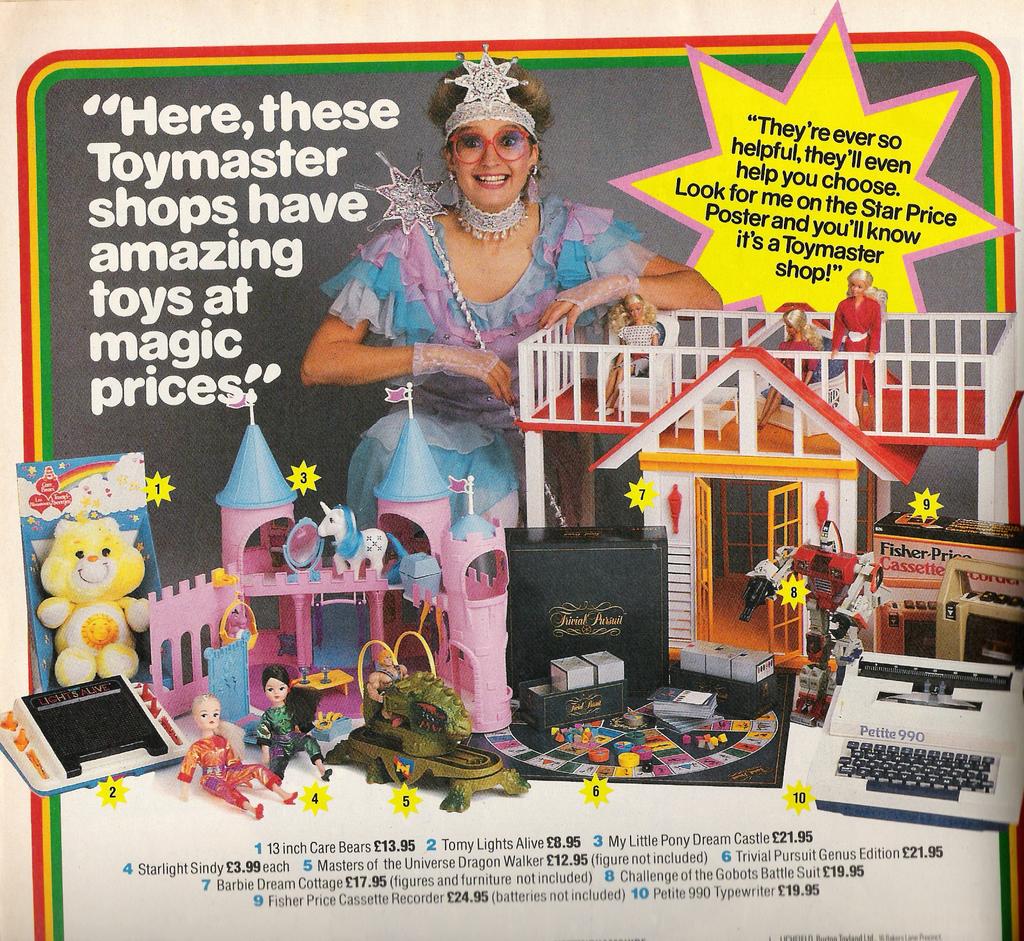
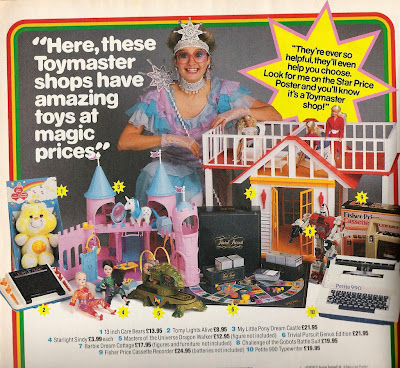 Merry Christmas and all the very best for 2009, folks! Here's a 1985 magazine ad featuring the lovely Su Pollard (Peggy from Hi-De-Hi!) and an assortment of toys and games which delighted youngsters at Christmas that year. A Tomy Lights Alive? Care Bears? Trivial Pursuit? My Little Pony? The choice was yours!Have fun, be good, and see you again in 2009...
1984 saw us moving into the Yuppie era. For many, the financial hard times were over. They had been grinding on since the early 1970s, and suddenly people seemed to be going a bit money mad.
But it wasn't all jam. The miners' strike began in protest at their latest pay offer and planned pit closures. A long and bitter time lay ahead for them and their families. Over the next few years, we also heard a lot about the "North/South Divide". Whilst the South of England boomed, things in the North of this country, and in Wales and Scotland were not nearly so good.
The North/South Divide was nothing new, but traditional industries in some parts of the UK had been declining for years, and the policies of the Thatcher government were doing nothing to alleviate the situation.
It wasn't all bad news, at least for those not living in England: public spending in Scotland, Wales and Northern Ireland was higher than in England, and had been for several years, via a system called the Barnett Formula.
Back in 1984 I was suffering from Thatcher phobia and couldn't even bear to hear her voice on the TV or radio. The merest sight or sound of her was enough to send me diving for the "off" button.
MAGGIE! MAGGIE! MAGGIE! OUT! OUT! OUT! GRRRR!!!!
1984 saw the blossoming of the openly gay pop star era in England. Paul Rutherford and Holly Johnson of Frankie Goes To Hollywood, the brilliant Bronski Beat and Boy George (who had declared himself "bisexual" and a "poof with muscles" in an interview with Titbits magazine in late 1983), all showed the way forward.
I remember back in the summer of 1980, reading in a Sunday tabloid that a well-known male pop star was bisexual. I recall my mother's shocked expression and my stepfather's angry growls at the news. A few years later, they bought my little sister a Boy George doll and were allowing her to display posters of openly gay pop stars on her bedroom wall.
And this during the era of "AIDS - the gay plague" in certain tacky newspapers. The 1980s really were a multi-faceted time. Looking back, the decade often seems chaotic and exhausting.
Frankie Goes To Hollywood stormed the charts with Relax. Banned by the BBC for its saucy gay references, the song went to No 1. But that wasn't the only reason - it's a brilliant piece of dance music. On the back of Frankie's success, "Frankie Say Relax" T-shirts flew into the shops.
"Sell him your soul, sell him your soul - never look back!" Propaganda, the totally brilliant German electro-pop group, gave us the absolutely awesome Dr Mabuse. Loved it. Still do.
Of course, this was 1984, and the Eurythmics' Sexcrime (Nineteen Eighty Four) drove me completely barmy on the dance floor. Music was getting faster. Harder. We were in the era of what I call "80s clatter pop", and I was head-over-heels for it.
But let's come back down to earth, shall we? All together now: "Aga doo doo doo..." This song, with its attendant silly dance, drove us all potty. However, I hold my hand up to dancing to it, doing all the movements, and enjoying it on more than one occasion after a few pints. Blush, blush.
Shoulder pads, 1984-style, were getting beyond a joke. Slowly growing since around 1982, they hadn't quite reached critical mass yet, but Chaka Khan, Alexis and Krystle were certainly looking a little burdened. Miami Vice began in America and the Don Johnson look became a trend - linen jackets with shoulder pads, the outline of the pads clearly defined through the thin material, so men were not left out. Shoulder pads were part of the "Power Dressing" image. The phrase was first recorded in 1980, according to the Twentieth Century Book of Words by John Ayto (Oxford, 1999). Back then, it meant a smart, efficient look for executive women. But as the 80s continued the shoulders grew and grew.
Colourful Moon Boots were another fashion sensation of 1984.
Mullets were starting to move into the Yuppie era by becoming big and bouffant, though it would be a few years before they reached maxi-size. The name "mullet" for this popular hairstyle would not come into use until the 1990s.
The aforementioned combinations of bright and drab colours - like yellow and grey - were becoming more and more popular in decor and clothing. Lycra was being worn more and more outside of gym, aerobics or Yoga sessions. The new lycra dresses showed off the "fit for business" figure of the mid-80s woman.
Computers took a great leap forward in 1984 - the Apple Macintosh came with its own "mouse".
In Russia, then still very much "behind the Iron Curtain", Tetris was invented.
Did you pursue the trivial in 1984? Many people did as the British edition of Trivial Pursuit made its debut in January.
We bid farewell to Sale of the Century this year. Never "hip", even at the start, it was, none the less, preferable to the American style gameshow The Price Is Right. Hosted by Leslie Crowther, the hysterical contestants and audience drove many to the "off" button.
And then there was 60s singer Cilla Black and Surprise, Surprise. Cilla had become a TV presenter when her singing career folded, and her TV career continued throughout the 70s and 80s (and 90s). On Surprise, Surprise, she sat on the "Cilla sofa" seeking to reunite long lost loved ones and bring the odd bit of light into people's lives by popping up in filmed sequences with a song. Lovely.
Spitting Image was brilliant, savage satire. If only there were programmes like it nowadays...
The skies over England are usually full of rain clouds, but was that an alien mother ship I saw in 1984? Diana and the V invasion on ITV made a pleasant alternative (for some) to the Olympics coverage on the Beeb.
In the BBC Radio 4 serial The Archers, Mrs Marjorie Antrobus (Margot Boyd) put in her first appearance, giving a talk on "The Colourful World Of The Afghan Hound" to the Ambridge Women's Institute.
The charity record Do They Know It's Christmas? was, of course, Christmas Number One. It was the brainchild of one Bob Geldof, formerly of the Boomtown Rats. Bob had been deeply moved by TV news footage of famine stricken people in the Third World, and enlisted the help of Midge Ure to put the song together. They then assembled the great and the good of the pop scene to sing it - "Band Aid", they called it. Boy George arrived late, but the record was on shop shelves in time for Christmas.
 Here's Su Pollard (aka Peggy from Hi-De-Hi) advertising Toymaster in a December 1985 TV Times. Amongst the goodies are Trivial Pursuit - Genius Edition, a Care Bear, a Masters Of The Universe Dragon Walker, a My Little Pony Dream Castle and a Tomy Lights Alive. Click on image for larger view.
 "You've got the brawn, I've got the brain, let's make lots of money..."Chernobyl blew and there was a sharp rise in radiation levels across Europe. I was caught out in a downpour just after it happened and, having heard that rain was a good carrier of radiation, I wondered if my snorkel parka would be glowing when I turned out the light and got into bed. Fortunately, it wasn't.
The Big Bang, computerised dealing on the London Stock Exchange, suffered teething problems. The new system was unable to cope, so traders were forced to trade in the traditional way until it was up-and-running again.
In March, Eddie Shah launched Today, the UK's very first colour daily national newspaper.
Another Royal Wedding - Andy and Fergie, this time. Not as big a deal as Charles & Di, but a good enough reason to hang the flags out and swig down a bottle of sherry for royalists.
"Hold a chicken in the air, stick a deckchair up your nose..."
Spitting Image took revenge on the merciless Black Lace for Aga Doo.
Oh dear... Ange from EastEnders made compulsive viewing as she struggled with the booze and Dirty Den, but, behind the mic, she simply proved that whilst Anyone Can Fall In Love, not everyone can sing.
Nick Kamen was charming eye candy for the girlies as he whipped off his jeans and put them through a power wash, but pure flim-flam as a singer - just like Ange.
But the ultimate stinker was designer-stubbled Nick Berry, Albert Square's Wicksy... Roll on Kylie and Jason!
Fortunately, the Pet Shop Boys saved the pop day with dance treat Opportunities - Let's Make Lots Of Money, and the Hip Hop/rock fusion of Run DMC and Aerosmith's Walk This Way was a pivotal moment in Hip Hop history. And that wasn't all! Love Can't Turn Around by Farley "Jackmaster" Funk was the very first House track to chart in England! And it made it all the way up to No 10!
I tried designer stubble, but it simply made me look seedy - the sort of character you definitely wouldn't buy a used car from.
Back to the music, and did you follow the Bangles and Walk Like An Egyptian?
It was a time when we talked Power, capital 'p' intended: of course there was power dressing, but there were also power walks/naps/breakfasts/showers/washes...
Black lycra continued to be a hit with women. With small, bolt-like metal studs dotted around the dresses and armour-like earrings, the message was "don't mess with me!" But for fun nights out figure-hugging lycra was also available in various putrid shades - you could even buy lycra micro minis. More like an elastic band than a skirt, these were essential for the girl who wanted to ensure that NOTHING was left to the imagination.
What was it with baked spuds? Perhaps the F-Plan Diet had a lot to answer for, as spud fever gripped the nation. There was a very fancy potato cafe near me, decorated with old fashioned advertisements from the early 20th Century, where you could go and eat spuds filled with wonderful things.
Now, who's for a nice jacket with prawn mayo, sliced hard boiled egg and grated cheese? Baked beans on top? OK...
In the 1970s and early 1980s I was happy to simply give a baked spud a quick dollop of marge and a bit of grated cheese before wolfing it down. Not anymore. Now I scooped out the potato and mashed it up with butter and chopped chives, before replacing it in the jacket, placing grated cheese on top and then browning it under the grill. Or the potato might be mixed with tuna, chopped peppers and mayonnaise (I didn't meet peppers or mayo until the 1980s - before that I was only acquainted with salad cream and spring onions!).
Me, a humble working class lad, was suddenly scoffing posh nosh. I was eating food I'd never laid eyes on back in 1982.
In the 1970s and early 1980s, supermarkets had reflected our thrifty (and ignorant of posh nosh) ways. Remember the wide range of "Basics" and "Economy" products on sale at supermarkets in the early 1980s? These were dead cheap versions of everyday neccessities to help us through the ravages of the recession. They started a trend, and you can still buy similar "cheap-as-can-be" supermarket items today.
Back then, Sainsbury's and Tesco's were different planets compared to the supermarkets of today. There simply wasn't the range of foods on sale. The '70s and early '80s were hard times.
But many humble, everyday supermarkets were undergoing a revolution during the mid-'80s boom period, introducing shocked shoppers to such oddities as avocados, peppers, olive oil and courgettes for the first time ever. The working classes would never be the same again.
Sainsbury's started to seem quite classy in the mid-'80s, and I'm sure I was rubbing shoulders with vicars and school teachers whenever I nipped in - and more than a few yuppie types. It all seemed very strange.
As posh nosh trickled down to the working classes, we also loved prawn cocktail - which was being slagged off by Fanny Cradock as long ago as 1967! But Nouvelle Cuisine was really "it". I could probably have eaten about nine Nouvelle sized portions in one sitting, and wouldn't give it house room.
My own favourite was all those fancy salad dressings suddenly so widely and cheaply available. When I was a kid, and indeed into the early '80s, salad to me meant cold meat or a wedge of pork pie, cheese, some limp lettuce, a few spuds and a dollop of salad cream. Not any more!
The supermarket revolution wasn't just confined to expanding ranges of food. A female friend of mine was working at Sainsbury's in the mid-'80s, and witnessed the arrival of bar code scanner tills. The beeping sound was dreadful, she told me.
Completely unused to it, the dreadful repetitive sound echoed in her head when she got home, and many of her colleagues experienced similar difficulties. On her honeymoon in 1986, my friend halted things at a very romantically charged moment to ask: "Was that a beep?" Fortunately, her new husband also worked at Sainsbury's and was entirely sympathetic!
Filofaxes and Garfield toys/posters/mugs were everywhere, Trivial Pursuit continued to be wildly popular. But what 'B' won 1986's Game of the Year title? Yes, a game based on Blockbusters. Bliss - now we could all enter into the spirit of the thing and have a 'P' at home.
An Aussie daytime soap with a stripper? Gosh! It seemed that Neighbours, which began here in October, was going to be a bit naughty - shades of a Bouquet of Barbed Wire, perhaps? But Daphne Lawrence, played by Elaine Smith, was the only stripper in the world who didn't take her clothes off, and we had to make do with commenting on her trendy hairdo and Helen Daniels' jumpers. They weren't quite in the Frank Bough league, but inspirational nevertheless.
Soon, we were also commenting on Mrs Mangel's simper and Madge Ramsay's enormous gob.
Early Neighbours was great. Read all about it here.

 Did you pursue the trivial in 1984? Many people did as the UK edition of Trivial Pursuit made its debut in January.
 Trivial Pursuit creators Chris Haney and Scott Abbott in the mid-1980s.
 New UK Trivial Record - from the Times, November 1984.
 Trivial Pursuit questions (and answers) as featured in the Sun, December, 1984.
 The '80s Actual Trivial Pursuit Timeline



 Posts
Posts