Total Pageviews

Pages

12 November 2015

Snoopy And Peanuts In The 1980s...


The release of the first personal stereo in America in 1980 sparked a huge craze, and coincided with - and contributed to - the peak of the roller disco craze. Here's Snoopy, wired for sound.

What a decade for Snoopy and the Peanuts gang the 1980s turned out to be! From Snoopy making his debut on home video and computer games (anyone for Snoopy Tennis?), and the opening of Camp Snoopy at Knott's Berry Farm, to Snoopy stepping out as Flash Beagle, Joe Vice and Boy George, and the continuing cycle of life amongst our favourite American comic strip characters as the strip roared towards its fortieth birthday in 1990, the 1980s were a glittering time for the world's best-loved beagle and his friends.

And they brought new challenges - mostly from new heroes and anti-heroes of the comic strip world, Calvin and Hobbes and Garfield. But Snoopy and co were well able to hold their own and, indeed, the authors of the newcomers acknowledged Charles Schulz's wondrous creations as an inspiration for their own works.

The Snoopy "1980 Collection" mugs. Just how different for America would the decade have been if Snoopy had been elected president in 1980, not Ronald Reagan?

1981 - and Hallmark released a charming series of Peanuts mini-photo frames. Snoopy - "A Real Inspiration", Snoopy love heart, and "Let The Good Times Roll" and Lucy - "Perfect Like Me" - were part of the series.

Camp Snoopy at Knott's Berry Farm opened in 1983. Snoopy looks great as a cowboy!


Continuing the cowboy theme, Snoopy says "Howdy!" This is very similar to a picture I had in my room in the 1980s, with the red and black background and orange frame, but the straw was absent from the mouth,  the phrase was "Howdy, Pardner!" and the smile was wider and cheesier - more like a film star stereotype.

I adore Snoopy. As I set out on my life's journey in the early 1980s, I was given a small framed picture of Snoopy, dressed as a cowboy, with his thought bubble proclaiming "Howdy, Pardner!" I put it up on my bedsit wall. It was a comforting and encouraging presence in the room, and I found it very cheering. Now, with my 50th birthday just past, I have the May 1982 strip below framed on my hall wall. Isn't it fabulous? Snoopy is truly for the whole of your life, from the juvenile jollity of the cowboy pic to the oh-so-true advice for the rather more mature below, Snoopy hands out comforting hugs and sometimes pithy but always excellent advice to everybody. Forget the expensive jollop. There's really only one way to look younger...

1982 - childlike simplicity and tough love truth from Snoopy's Beauty Tips.

Why is Peanuts such a worldwide hit? You don't have to speak English to enjoy it. It's been translated into many different languages, been a huge success in many different lands.

The reason doesn't take much pondering.

It's because Charles Schulz's work is so human. And if you're a human being it's for you.

Well, my favourite character, Snoopy, is, of course, a dog.

But such a human dog, with his fantasy life and zany personality.

I've always been a bit theatrical myself, singing, dancing and experimenting with various characterisations throughout my life.

Life's too short (and reality sometimes too grotty) to just be one person.

So I identify with Snoopy.

I'm also given to low periods in which my self esteem plummets and life becomes one long worry.

So I identify with Charlie Brown.

There are times when I ponder the mysteries of existence, search for the meaning of Life, the Universe and Everything and come up with some quite kooky ideas. So kooky, I could suck my thumb for comfort.

So, I identify with Linus. 

Many times I feel small and insignificant, totally swamped by the vastness of the world, the universe, and so on. And yet I have my life, my personality, my own pressing issues.

So I identify with Woodstock.

And sometimes, when I'm tired or unwell, I can rant and gob-off a lot.

So, I (occasionally) identify with Lucy.

1983 - and our very own Boy George's fashionable music loving friend, Boy Snoopy, appears as a cuddly toy.  Was there ever such a trendy beagle as Snoop?

Fads and new technology came thick and fast in the 1980s: in the wake of Flash Dance, Snoopy became Flashbeagle and got into aerobics; there was an outbreak of "temperament" on the tennis court in 1982, after John McEnroe had shaken up the staid atmosphere of Wimbledon in 1981; Lucy got some designer jeans; beanbags proliferated; Marcie attempted to give Peppermint Patty a very '80s hairdo - and Patty succumbed to some other weird do's during the decade (anyone for mousse?); Valley Speak invaded Peppermint Patty's schoolwork when her essay was graded "grody"; the aforementioned Peppermint P got a personal stereo; Trivia (as in Trivial Pursuit) briefly ruled; Woodstock got a beagle blaster - and was the only one in the neighbourhood to have a satellite dish; Charlie Brown discussed yuppies; Sally waited for Halley's Comet; computers began to accelerate into the everyday life of certain characters; and poor lonely Spike wrote to some of the female cast of Dallas to request signed photographs. 

One of my favourite pop culture inclusions from the decade came when Snoopy wondered if his old enemy, the Red Baron, might like a Garfield birthday card. Beautiful.

The Great Pumpkin was revisited on the animated screen in the 1980s Charlie Brown and Snoopy Show. Linus, Snoopy and Sally - she was there for her "sweet baboo", of course waited in the pumpkin patch. But wait! Sally's "sweet baboo" was not impressed by her presence. It seemed that it was going to be another long, cold and fruitless vigil..

 ... but then something came hurtling across the pumpkin patch... Had Linus's faith been rewarded at last?

Linus, my second favourite Peanuts character, continued to be a (I mean THE) dedicated disciple of The Great Pumpkin in the 1980s, and found that his evangelical fervour could be lucrative. In 1986, the Great Pumpkin actually appeared (for us, not for Linus) and gave us a quick burst of Sinatra, whilst Peppermint Patty introduced other concepts - such as The Great Secretary, and became an involuntary pumpkin wearer.

The 1980s posed big questions for Linus - like how would he fare with a "younger woman" and (GASP!) could he give up his beloved powder blue blanket? No spoilers here!

The 1984 Snoopy Flashbeagle radio.

The sometimes harsh realities of life from an average kid's point of view were often present in Peanuts, but there were many "ups" in the continuing saga, and when Peppermint Patty succumbed to terrorizing herself over thoughts of the End of the World in 1980, good friend Marcie was there to comfort her. And it was touching. It's that same Marcie who called Peppermint Patty "Sir", and let her down when the two became "Mallies" (trendy hangers-out at shopping malls) by actually doing some shopping and being pursued by a certain beagle "punker". But at the end of the day, Marcie was always there for Patty.

Yep, it was touching - but without being schmaltzy.

Friendship can flip into temporary bouts of hatred, particularly when you're a kid, and Marcie and Peppermint Patty's ongoing rivalry for Charlie Brown's attentions actually caused Marcie to resort to hair-yanking violence on one occasion in 1987. There had been minor spats between the two friends before, and there were after. But this particular incident revealed an angst-ridden, passionate soul lurking behind Marcie's somewhat geeky exterior, and it was sad to note that her relationship with Charlie Brown was largely all in her head (CB didn't really reciprocate), just as it was with Peppermint Patty's pash for CB. But, with rivalry reaching boiling point, it was almost like the kids were reaching early teenage-hood at times.

But, of course, they weren't.

This particular strip marked a turning point in my perceptions of the Marcie character, it made her more real, took her beyond being just a quirky and rather cute regular. I found myself promoting her to a favourite character. A couple of years later, parental expectations and the stress this induced in the girl rounded her out even more.

1984 - and Snoopy - a legend in his own mind, is off to the Olympics with a terrific range of PVC figures. A little word about dating Peanuts merchandise here. Some will be dated to the year of manufacture, like the mugs and photo frames at the top of this post, but both dated products and others will probably also feature old copyright dates - 1958, 1965, etc. Bear this in mind as it can be puzzling to find merchandise copyright dated before the character depicted (Peppermint Patty, etc,) even existed, or with characters indulging in popular trends which  postdate the copyright date(s) stamped on the item. 

Some people think that Snoopy, whose character evolved more than somewhat in the 1960s, he of the Walter Mitty style fantasies, rather spoiled the reality of the strip. There's no doubt that the early years of the strip were grittier and somewhat darker at times. But latter-day Snoopy was wonderful. I wouldn't change a thing about him. I loved his caring relationship with Woodstock and his fantasies. But it always came back to reality - with Snoopy on his doghouse, often waiting for his supper. He always seemed a very heartening character to me, making the best of a rather boring existence. And overcoming the handicap of not being human and being able to fulfill his dreams with his fantasies.

At one point in the 1980s, Charlie Brown decided to devote his life to making Snoopy happy. He couldn't keep it up, and he couldn't, of course, read Snoopy's mind as Snoopy replied to Charlie's outpouring of regret at not being able to live up to his aim. Snoopy was already happy. Naturally. His fantasies transported him far away from the mundane realities of his suburban canine existence.

1984 - and with VCRs beginning to appear in more and more homes (in England still only around a quarter of the population had them in 1985), Snoopy's Home Video Library appeared in the States. Viewers could enjoy the exploits of the gang - including the awesome Lucy snatching the ball away from Charlie Brown - whenever they pleased.

What made America great? In the 1980s, we discovered that Peppermint Patty believed it was peanut butter sandwiches. I find it interesting that most of the classroom comic strips from that decade feature Peppermint Patty and Marcie, rather than the older established characters. Of course, Peppermint P was SO interested in her education, she couldn't help nodding off!

In the hi-tec '80s, Snoopy made his debut in computer games - like this Game And Watch Panorama Screen...

... and this Nintendo Table Top Snoopy game..


Here's the game in action - with Snoopy, Schroeder (at his piano, of course!), Lucy and lots of little Woodstocks.

Of the characters who fell by the wayside as the strip evolved, early years nasty girl Violet Gray made a few appearances in the 1980s - including an un-indexed one which appears on page 126 of the 1981-1982 Complete Peanuts volume, in which she is, predictably but enjoyably, snooty to Pigpen - another former regular from the early years.

Violet's role as nasty girl was taken over by Lucy Van Pelt, who was rather more likable (well, it wasn't her fault she had crabby genes!). I thought Violet's loss was a shame in some ways - Lucy couldn't "do" snooty at all! But, taken all in, I wouldn't have been without Lucy, she was a far more rounded character, and I suppose her presence meant there was little space in the stories for Violet.

A brief blow-in in the mid-1980s was a character called Tapioca Pudding, whose father was "in licensing" and, it seemed, wanted to use his daughter's image on various products. As well as  that popular cutesy dolly Strawberry Shortcake, this reminded me of a 1960s Bewitched story, in which Samantha created a doll based on her own daughter - "The Tabitha Stephens Doll" - to get her husband out of trouble with the advertising company he worked for. 

There's now't as queer as folk, as we say here in England.

Probably the ultimate piece of 1980s Snoopy imagery - Charles Schulz gave us Joe Vice in 1986. Forget the Miami version, Crockett and Tubbs? Pah! Snoops and Woodstock were the real deal!


This poster is from a 1986 Peanuts strip - featuring the ever-trendy Snoopy getting down to some serious aerobics, courtesy of a video. Jane Fonda eat your heart out! We love ya, Snoops!

Wow - how's this for a 1980s Peanuts cardigan?! Woodstock, Snoopy and Marcie are indulging in a little chatline chat. Chatlines were a great innovation - hugely enjoyable - until your parents got the phone bill. Peanuts was marketed to the max for decades. But that was OK, because the strip had soul.

So, which era is my favourite for Peanuts? Is it the 1980s? Well, funnily enough, although the 1980s are when I first came to really appreciate the strip, I would have to say no. Much as I love the 1980s Snoopy gang's exploits, having read the Complete Peanuts books, which feature every strip from its beginning in 1950, I would have to say that the 1950s and 1960s take the prize. Reading the debut and evolution of Peanuts has been a tremendous pleasure for me. In the 1970s and 1980s the strip was fully formed and up-and-running. And whilst the 1980s contain probably my favourite Peanuts strip ever ("Don't be born so soon"), and I certainly don't think the strip ever "flagged", I find the first fifteen to twenty years tremendously exciting to read. And re-read. What I missed! Still, I'm glad I wasn't born any sooner (!), and thank heavens for the Complete Peanuts series!

Here's more pearls of wisdom from the 1980s Peanuts strip - this time from Marcie. Charles Schulz was a wise man!

Sadly, Charles Schulz died in the year 2000 and Peanuts came to an end just before his death. But the characters have lived on through republished strips and merchandising and we're shortly to see the new Peanuts Movie.

Snoopy's a cowboy again in this 1987 collection of Peanuts comic strips, complete with neon cacti.

Here in England, Peanuts inspired The Perishers comic strip, which appeared in The Daily Mirror for many years. But while I adored Maisie, Marlon, Wellington and Boot, I loved (and still love) Snoopy far more. National boundaries or oceans were no challenge for Snoopy. He simply ignored them, flew over them (probably in his Sopwith Camel), and stole my heart away. I'll always love Snoopy.

Legal beagle Snoopy in England - depicted in this wonderful 1986 lamp, with one of our iconic old-style telephone boxes. If I'd known he was coming, I'd've baked a cake - or some of his beloved chocolate chip cookies!

11 November 2015

Only Fools And Horses... ONLY Half-Brothers?


The Peckham Trotters in the 1980s. They bickered and fell out, they loved and supported each other - and Grandad watched two tellies at the same time. Just like any other family. Apart from that last bit.
 
I've had an interesting e-mail from Starvo. Here's an extract:

I know Only Fools... is one of the greatest sitcoms of all time, and that it began in the 1980's which you write about on here, but don't you think the revelation that Del and Rodney Trotter were only half-brothers spoiled it a bit? The writer had spent a lot of time building up a believable sibling relationship between the two lead characters, only to make a mockery of it with that. And it meant Rodney wasn't really related to Grandad at all. I felt let down.

Why did you, Starvo? I know a couple of "siblings" today who are "only" half-siblings, but they think the world of each other and have a better relationship than many full-siblings I know. Similarly, I know a "brother" and "sister" who are really only halves, but are unaware of the fact because according to their birth certificates they have the same father. And there are half-siblings in my family, too.

I think the "only" you use to describe the half-sibling bond between Del and Rodney is in a way quite sensible, after all they share half the same origins, not full, but in other ways it's quite odd because it implies that the relationship is less important than full-siblings. I don't believe that is often the case. When I wrote my Only Fools And Horses article on here, I didn't use "only" to describe the tie because Del and Rodney, I simply stated that they were actually half-brothers.

As for Grandad not being a blood relation of Rodney's, I suppose he wasn't. But he was still Rodney's grandad in every other way that mattered.

I think that was one of the greatest things about OFAH. The unity and love of the Trotter family, despite the fact that things were not quite as they might seem, and the situation not being as "respectable" as our squeaky clean 21st Century pundits might like it. Sometimes I think the attitudes of this century are far more old fashioned than the last.

Just a thought to leave you on: step-siblings and adopted siblings have no shared blood at all. Does that make the strong and very real sibling bonds that often exist between them any less real or important than blood-related full siblings? And if not, why did the revelation in OFAH that Del and Rodney were half-brothers make you think that it made a "mockery" of the close sibling relationship between the two?


27 October 2015

Fashions Of The 1980s - Jelly Shoes...


Sue writes:

I recall having a pair of jelly shoes when they were a brand new trend and I was about 7 years old in the late 1980s. I loved them. They were a lovely pink colour, and they came from a range called 'Jelly Brights'. Do you recall them? And do you have any good pics or articles about the '80s jelly shoes fashion? It's so funny to see them back in fashion over the last few years. I was there first time around in the '80s.

I do recall them, Sue, and I have a pic from the 1989 Look Again catalogue showing the very range, "Jellybrights", that you remember! I hope you like it.

26 October 2015

The History Of The Yuppie Word


A couple of English mid-1980s yuppies in London. They had the big hair. They had the brains. They had the looks. They made lots of money.

Jeanne has written to ask me about how the yuppie word - an acronym pasted onto a model suggested by "hippie" came about.

Well, Jeanne, the term first arrived in print in a May 1980 Chicago Magazine article by Dan Rottenberg, and at that point simply referred to young urban professionals who were buying up houses and apartments in former working class areas and rather destroying the feel of these places in Chicago - with trendy shops and theatres opening to service their needs where once had been old family concerns, etc. Poorer folk who had traditionally lived in those areas were being priced out.

At that point, President Carter was still in charge at the White House, and the booming busting part of the 1980s was not in sight. So, we seem to have quite an innocent local word, not an approval word by any means, but lacking the vehement condemnation and international infamy which would later follow.

After the inauguration of President Ronald Reagan in 1981 (he was elected in November 1980) this began to change. The term "yuppie" caught fire and was applied to the type of person who flocked to the stock exchange and lived a highly excessive lifestyle, taking full advantage of the new political regime.

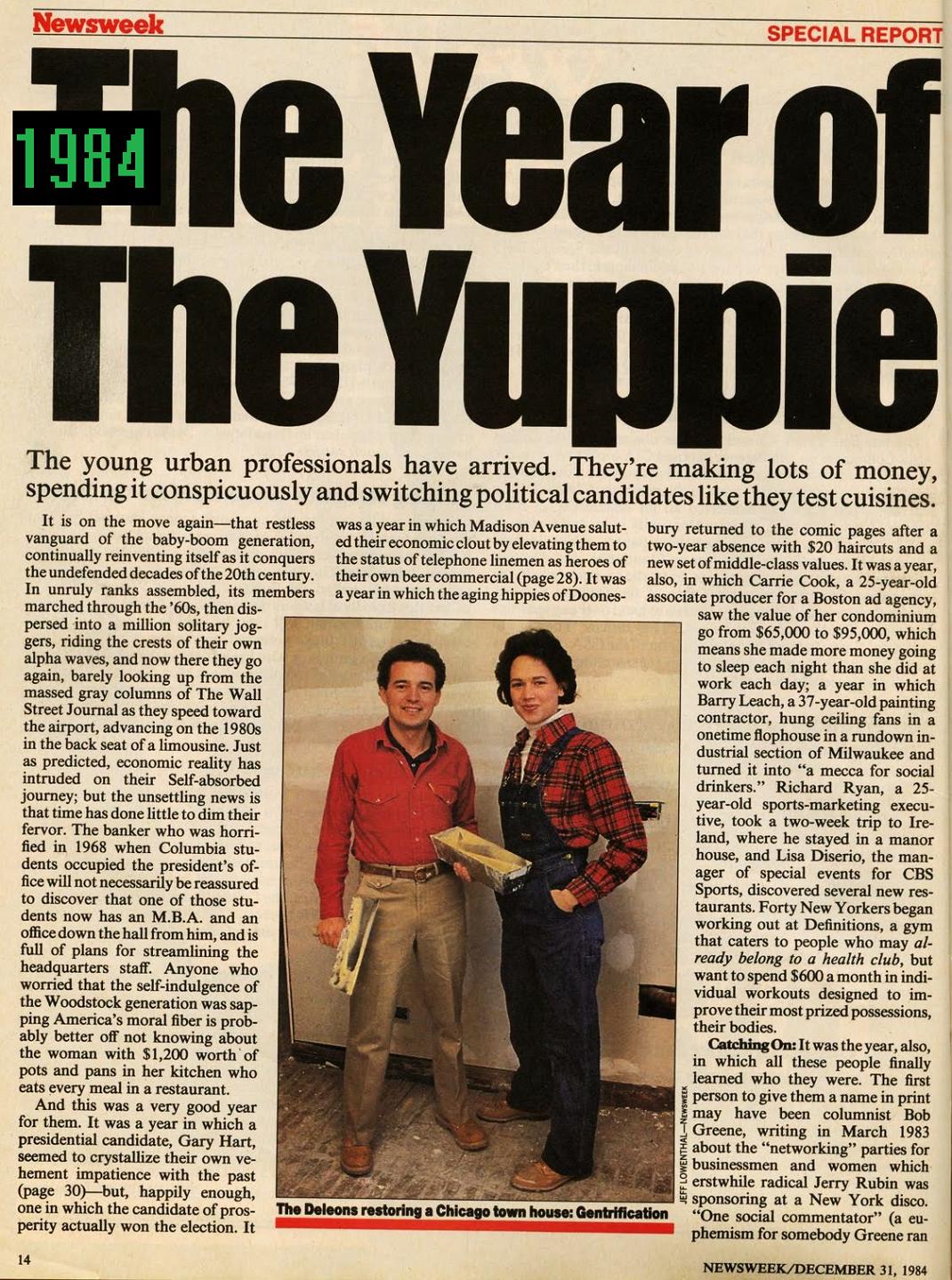
The American 'Newsweek' magazine , in its December 31st issue, declared 1984 "The Year Of The Yuppie".  With $600  a month workouts available at the new Definitions Gym in New York (most of us lesser mortals never worked out in those days), continuing "gentrification" of quaint neighbourhoods, property values soaring, Presidential candidate Gary Hart, and the ex-flophouse in Milwaukee which became a "mecca for social drinkers" (complete with ceiling fans) what wasn't there to love?

The yuppie was still pretty dowdy in 1983, if the humorous American Yuppie Handbook and an American mug I have from the same time are anything to go by (they wanted pasta machines, Rolex watches, Sony Walkmans and a VCR), but within a few years the image had altered to that of Wall Street - "Greed Is Good".

The infamous yuppies of the mid-to-late 1980s were apparently ruthless individuals, their lives dominated by the love of money and THINGS. They quaffed champagne. They snorted cocaine. They wanted it all. And they wanted it now.

The word spread to England in the mid-1980s, and was applied to similar types, waving their wads about, who took advantage of the financial knock-on effects of the American Reaganite ethos and the prevailing, highly similar attitudes of the Thatcher governments. They bulled. They beared. They sported the new revamped and highly trendy Filofaxes and the brand new miracle, the handheld brick cell phone ("Yuppie toys!" we called 'em). They drank bottled water. They worked out. They were fit for business. Fit for life.

Of course, not all yuppies were champagne swilling, cocaine snorting, horribly greedy gits with absolutely no redeeming qualities whatsoever, but "yuppie" became a buzz word for those who were all or some of these things. The yuppies of the mid-to-late 1980s were horribly grandiose, high tec, greedy, without care. That was the popular view.

And that, as far as I'm aware, is a history of the yuppie word, how it was originally applied and how its usage altered with the changing political regimes and attitudes in America and England as the 1980s progressed.

There was a point, circa 1985, 1986 and 1987 in my home city where I could almost smell the money around about me. The night clubs went neon. The pubs went posh or themed. Glittering new office blocks rose left, right and centre. The supermarkets were full of "posh" (and strange) foods that we'd think nothing of eating now. The smell of wonga hung heavy. But, unfortunately, I never had much. Ah, well, as a care worker at least I could take the moral high ground.

But I couldn't help finding yuppies fascinating.

Read more of our material on them by clicking the "yuppies" label below.

26 September 2015

1987: Then Jericho - The Motive... The Business Will Just Steal Your Soul...


"The business will just steal your soul, and that's what I believe.

But where's there truth there's poetry

It happens naturally..."

There's no getting over the riches that the 1980s gave... I'm still blown away by this song. And transported back to that youthful summer of 1987 - with its hair gel and slick dressing...

Well, the 1980s idea of slick dressing.

And the following year would be so different...

Acciiieed! Accciiieed!

There'll never be another 1980s.

17 August 2015

This Is England - Shane Meadows - Darling Of The Guardian Reading Lefties...

Karen writes:

What do you think of the This Is England series by Shane Meadows, depicting life in the Thatcher '80s?

Um, poop would probably be a good word, Karen. To be fair, I only watched the first This Is England, supposedly set in 1983, but the atmosphere was far more 1978/1979/1980. It was all more hip hop by 1983. And having read Shane Meadows's bleatings about how he remembers Thatcher coming to power when he was a little tot because his school dinners turned nasty - well, that seemed like poop too.

I was brought up on a sink estate in the 1970s and early 1980s, and it was nothing like This Is England. Shane was too young to really know the early 1980s.

Sorry, I couldn't bear Thatcher - but I can't bear trendy Lefties like Shane Meadows either.

But the Guardian LOVES him.

Enough said.

29 June 2015

Greetings Cards of the 1980s... Hanson White's "Giggles" series...


In those far-off '80s days, particularly mid-to-late decade, it seemed that so many new ventures were beginning that it was flipping hard to keep up. If not impossible. Boy, were we booming! Last year, I received a humorous birthday card from a friend - it was part of the Hanson White company's "Giggles" line, and the brand name for some reason stirred memories. Going through a box of my old birthday cards this year, I found an original "Giggles" card from the brand's launch year of 1987.

Great fun - as was the "Giggles" card I received last year, which concerned Sherlock Holmes and Dr Watson going on a camping trip and having their tent stolen!

So, "Giggles" have now been around for twenty-eight years!

Time flies when you're having fun...

But whatever happened to Katie, the lady who sent me the 1987 card? 

I'll have to check out Facebook...

Couldn't have done that in the '80s...

07 April 2015

Binatone Modern day '80s Style Brick Phone... WOW!

The 1980s of course saw the introduction of the first hand-held cell phone ever, the Motorola DynATAC 8000x, unveiled In America in 1983, on sale in England in 1985. The '80s also saw the beginning and development of the GSM system we use today. What a time it was! 

And now Binatone have designed a wondrous tribute to the original analog '80s bad boy - a modern mobie with a look fresh from the yuppie decade. Here's the blurb: 

Introducing The Brick: the biggest mobile phone you ever had, or the biggest bluetooth handset you will ever have. Retro 1980s cool doesn't come any more iconic than The Brick, a phone as big as the attitude that used to come with it.Phones are getting smarter, thinner, smaller. They all look the same. Battery performance gets worse every year. Is talking on the phone still fun?

 The Brick is simple, bulky, comfy. It will turn heads at every party, and its juice will last for months. Taking inspiration from the early days of mobile phones, The Brick from Binatone was created as the first retro mobile ever. Made famous by Gordon Gekko in 1987's Wall Street and once only affordable to flash city boys, now anyone can afford this fabulous slice of fun nostalgia! The Brick may be amusing but Binatone have still taken it seriously when it comes to getting all the little details right. From the sturdy keys with sound effects to the bling logo on the back, it certainly looks the part.  

The style may look back years but the technology is bang up to date, including the option of either putting your SIM card directly into The Brick or using it to make and take calls from your regular smartphone via Bluetooth. The battery gives you an impressive 14 hours of talk time (and nearly a whole month on standby), while you can use the 1.8 inch colour screen with 128 x 160 resolution to scroll through your contacts or enjoy a nostalgic game of Snake. 

There's even an SD card slot on The Brick, so you can store up to 32 GB (approximately 6,500 songs) of your favourite music on your phone -just be sure to fill it with plenty of Duran Duran, Michael Jackson, Prince, a-ha, and Flock of Seagulls for the full 80s effect! Combined with a striking costume or outfit, The Brick is the perfect accessory for any 80s fancy dress party, or if the 80s was your favorite decade then use it every day!  

I don't usually advertise on this blog, but this I couldn't resist! Think I'll be getting me one of these... 

Summertime Andy in Miami Vice gear complete with a brick... mmmmm... 

Click on the 'mobile phones' label below for more info on the brick/GSM revolution in the 1980s...

08 March 2015

The 1980s Mobile Phone As A Defensive Weapon!

The Sun, November 18, 1988.

Yuppie Richard De Vahl didn't hesitate when a mugger attacked him... he clocked him with his mobile phone. The thief collapsed stunned, then fled empty-handed.

Richard, 26, a property consultant, carries his £2,000 phone with him everywhere.

He said yesterday that the black mugger threatened to stab him if he didn't hand over his cash.

Richard, of Fulham, London, added: "I wasn't over-pleased at this, so I smashed my phone over his head.

He reported the incident to local police.

A spokesman said: "We are looking for a man complaining of bells ringing in his head..."

The arrival of the mobile phone in the 1980s was a boon to yuppies.

07 March 2015

New Romantics


 August 1980 - the release of Ashes To Ashes, with its groundbreaking video, was a great moment for David Bowie - and propelled the Blitz Kids and others towards the pop scene to form the New Romantics, the first big 1980s music and fashion scene.

20th Century Words by John Ayto traces the term "New Romantic" to 1980. So, what was a New Romantic? Late 1980 saw the emergence of two acts - Adam And The Ants and Spandau Ballet - into the upper echelons of the pop charts. They gave us Ant Music and To Cut A Long Story Short, respectively, and although both songs were very different, the Ants and the Ballet blokes were both heavy on the face make-up and the dashing outfits of years long, long past.

And, suddenly, we were all talking of New Romantics.

1981 brought a flurry of them into our lives - including, of course, Duran Duran and Ultravox. Planet Earth, complete with video, was very typical of the scene - synths, futuristic setting, OTT dandy flounces, lashings of lippy, and bizarre hairdos. The movement crossed over to America and Kim Carnes sent us the divine Bette Davis Eyes. 

TV Times, June 1981. How would you feel if your son looked like Adam Ant? If he'd lived where I lived, he'd probably have got seriously punched. But although nobody I knew was brave enough to adopt the image, Adam And The Ants were immensely popular with us lads.

So, the first big new pop sensation of the fledgling 1980s. How did it all begin?

Well, that's not quite what it seems! Read up on it elsewhere and you'll find that it all seems to have originated from a club called The Blitz Club in London, whose patrons paid homage to David Bowie - apparently dubbing themselves "Blitz Kids". Or was it somewhere called Billy's? Or both? Or...

Anyway, it was a dressy night club scene - or a couple of dressy night club scenes - where men wore make up and/or flamboyant outfits

The UK press created the "New Romantics" tag when Adam and the Ants and Spandau Ballet first hit the pop charts in late 1980.

David Bowie, of course, had been exciting the pop scene since 1969, and was very heavy on image. Was he Ziggy Stardust? A Thin White Duke (goodness, I thought that particular image was bloody boring and so retro!), but whatever he was he attracted dedicated followers in droves and his music brought flashes of sheer brilliance. 

In 1980, David had another one of those flashes - with his Scary Monsters (and Super Creeps) album, and a single which would be included on this album, released in August 1980, although not officially classed as a New Romantic song, was what kick-started the scene. That song was, of course, Ashes To Ashes.

The video (or "promo" as we referred to them back then) was striking and hugely expensive, and featured Steve Strange, who wowed the pop charts in 1981 and 1982 with Visage hits like Fade To Grey and Mind Of A Toy.

But not all of those considered New Romantics in the early 1980s were part of The Blitz Club scene - Adam And The Ants for instance. 

And I can certainly state that I'd never heard of the Blitz and what attracted me to the New Romantic style was that I had simply had enough of the gobbiness and run-down seediness that had dominated the previous decade.

Several years before the New Romantics, as I lurched into my teens, I was yearning for something a bit more flash, a bit more stylish. I was depressed with the thick layer of mould up my bedroom wall, my threadbare "make do and mend", often hand-me-down clothes. 

I craved for glamour and excitement. I'm sure I was not alone! There was simply something in the air - many of us wanted a change. 

After the likes of Slade shouting their mouths off - as tacky as you please, the sleaziness of the Disco scene and the hopelessness (and, of course big gobbedness) of Punk, plus the oh-so-unoriginal 1970s revivals of 1950s style, 1960s mods and rockers (no thank you, Paul Weller!), plus the '60s ska scene and rockabilly, I was hungry to dress up, desperately hoping that the 1980s would be different.

And they were.

And probably the first manifestation of that was the emergence of the New Romantics in late 1980.

The wonderful Roxy Music, still going strong in the early 1980s, are considered to be an influence on the New Romantics, and I'm sure the group was, but the New Romantics, despite their precursors, were still startling and fresh at the time.

Boy George, of course, was part of the Blitz Club scene, he worked as a cloakroom attendant there, and he was an early New Romantic for sure -  but by the time he made his chart debut in 1982, the New Romantic thing, which had burned fiercely from late 1980 and throughout 1981, had fizzled as far as we the public were concerned. So, The Boy was, at the time, greeted as a stand alone newcomer, a unique individual, loved or loathed. Similarly, A Flock Of Seagulls, who had chart success in late 1982 with Wishing, whilst looking very New Romantic indeed, were not, at the time (as far as I remember!) labelled as such.

Let's hear it for the boy - Boy George, of course - before fame, pictured in the Daily Mirror in April 1981. Although an original New Romantic mover, shaker and trendsetter, by the time he arrived in the pop charts in 1982, the New Romantic scene was just about dead and buried. So, he was regarded simply as Boy George. And his own very personal sense of style inspired admiration, clones, and some homophobia. Soon-to-find-fame George (as seen in the newspaper picture), then simply referred to as George O'Dowd, 19, was wearing Chinese slippers (£3.99), old school trousers he'd tapered himself, and leg warmers. A 1920s dress (20p, Oxfam) was draped around his waist. The tassle belts, the long scarf, and Oxfam beads around his neck, cost him a few pence, the crimplene blouse came from his mum and the wooden cross from a friend. A black felt hat and assorted earrings completed his outfit.

Adam and the Ants.. well, Adam - AKA Stuart Goddard - has stated that his early '80s pop venture was not part of the New Romantic movement. I never knew at the time. Loved the band and saw it as very much part of the New Romantic thing way back then. Sorry, Adam! I still love you and the Ants - whatever you were!

Two groups which I was labelling "New Romantic" long after 1981 were Duran Duran and Spandau Ballet. They were always and forever "New Romantics" to me. I loved the way the Duranies dropped the frillies for those gorgeous brightly-coloured suits - and the 1982 Rio video marked a turning point in my own personal fashion statements. 

 A change of image for Duran Duran, seen here in 1981 and 1982. Loved the colourful suits with pushed up sleeves and large shoulders!

Even now, knocking on towards fifty, I still feel a stirring of youthful (if that's possible at my age!) excitement at the thought of the New Romantics and the blossoming synth pop scene of the early 1980s in general. Combined, these two factors were the first indication that 1980s music and fashion were going to be OK for me. And, as it turned out, brilliant!

06 March 2015

Computer Technology 1988 - IT For The Terrified...


TV Times, 10/11/1988: IT for the Terrified -

1: STORMY FRIDAY

Our world is increasingly dominated by new technology. So how can ordinary people be expected to understand what is happening?


Those were strange days indeed! I never thought I'd get to grips with computer technology back then - ever! I simply couldn't imagine it - the whole thing was far too complicated and what would be the point? I was far from being alone...

But the invention of the World Wide Web by Tim Berners-Lee in 1989 would end up bringing computers into just about ALL our lives.

Good programme, IT For The Terrified - I'd love to see it again. It would be quite nostalgic and fascinatingly dated!

05 March 2015

1989: The Fall Of The Berlin Wall

Thinking about 1989 the other night, two events sprang into my mind, followed by a whole battalion of others. I haven't much time, so I'll just toddle through the first two here...

The first of the 1989 events that came to mind when I focused the little grey cells on that memorable twelve months, was the invention of the World Wide Web by English software engineer Tim Berners-Lee at CERN in Switzerland.

This event passed unnoticed by the vast majority of us at the time - we would not discover its wonderful, world-altering significance until the 1990s. Read all about it here.


The second event to trot into my noddle was the Fall of the Berlin Wall...


An absolutely stunning historical moment...


Here's how the
Daily Mirror reported events on Saturday, November 11, 1989:


TOGETHER AT LAST

on the day the world became a better, braver place...

Holes were bulldozed in the Berlin Wall and East Germany promised free elections yesterday as thousands of her citizens continued to pour out to the West.

Minutes after the election announcement, East German bulldozers began smashing two more holes as exit points in the wall. And eight more border crossings will be made next week.


For the Communists it is a calculated gamble in an attempt to stem an exodus. For the East German people, already almost delirious with the pace of change, it is another giant step to freedom.


The East German Communist Party unveiled an amazing package of reforms, including free elections, changes in the economy and parliamentary control over the army.


This revolutionary programme means party bosses have now given thousands of demonstrators everything they demanded during peaceful candlelit protests.


They knew that East Germany's 16 million people would never have halted the protests unless free elections were granted.

Yesterday the East Germans were walking and driving through the Wall at the rate of 800 an hour, sounding their car horns and weeping with emotion.


For some, however, the dizzying pace was almost too much. The East German guards did not know quite how to react to the West German who stretched out the hand of friendship near the Checkpoint Charlie crossing.


But for the families who were crossing into West Berlin all day there were no doubts. They came, they saw... and they fell in love with the capitalist world they had for so long been taught to distrust.


With the toys in the shops - the Batman cars, the walking, talking, living dolls, the video games, the mountain bikes.


With the clothes. The baby wear. The range of cars.


But, most of all, with the overflowing shelves in the supermarkets.
For many who are younger than the 28-year-old wall, it was their first day of freedom. Their lives have been dominated by secrecy and shortages.

Their first taste of Western plenty was a free handout.


Police and savings banks told excited East Germans who wanted to go shopping the way to social security offices.


There they were given 100 West German marks - worth about £35 - in "welcome money."


Gunter Martin, a factory worker from Halle, waved a wad of East German marks and said: "This is completely useless to me here.


"It's the most unbelievable day of my life. I just shut up my car repair shop and jumped in my car as fast as I could."


Reinhold Haupt, a 41-year-old electrician who drove from Ashersleben to spend the weekend in West, was showered with hospitality by a crowd of West Germans giving the new arrivals a heroes' welcome.

 
Within minutes someone offered him a bed, another said he would take him on a tour, a third handed him a cup of coffee and a woman pressed a 10-mark note into his hand.

He spent his "welcome money" on bananas, oranges, coffee and chocolate, all in short supply in East Germany.


Civil servant Thomas Kolbar said: "I turned up at my aunt's house last night and she nearly died of shock."


The Communists' gamble may pay off. Most East Germans are only visiting the West, happily returning home after partying or sight-seeing in the West.


No one could count the numbers going to the West in Berlin. But elsewhere, 45,000 East Germans swarmed to the West yesterday and only 2,500 stayed.


More from 1989 soon.

03 March 2015

More 1980s Sports Wear For Men - The Way Things Changed - 1981 And 1989....

UGH! 1981! Oh dear, oh dear, oh dear... "Sporty mix 'n' match separates in a comfortable jersey-knit with 'tennis' motif". Never fear. As the 1980s continued, sportswear would never look the same again. Thank heavens.

Some of these aren't too bad... but hardly exciting.

In fact, 1981 was simply not very exciting in the world of sportswear. And just look at that dreadful bubble perm (far right)! Still (smiles fondly), good old Fred Perry!

1989 - the ultimate year of the 1980s - "The Style Decade" - and sportswear was certainly stylish by then. So much had changed since 1981. All the designs featured are SO much of the era. And that lad in the second pic looks like he's finding the fact a painful experience. Makes me eyes water.

Tragically, by 1989, many of us were on pose overdrive. But never mind. Those tracksuit designs are now called "classic" and highly sought after. Classic? They're pure 1980s, darlings! But fashion snobs HATE acknowledging the fact! Nevertheless, these designs are very influential and popular today. And I LOVE them!

Le coq sportif. By 1989, some even quite working class men were going to the gym! Sports clothes for men had become colourful, modern, designer. So handy for getting down to a serious workout. Or nipping out to the corner shop for a packet of fags.

02 March 2015

Introducing the first mobile phone - the DynaTAC 8000x

The first commercially available handheld cellular phone ever was unveiled in 1983 (although, according to Motorola, they weren't available to consumers until 1984). Motorola had invested fifteen years of research and $100 million in the advancement of cellular technology, and the story stretched back much further than that. The first handheld mobile was called the DynaTAC 8000X and was unveiled on March 6th. It was, of course, a brick. At a price of $3,995 it wasn't for everybody.

If the first commercially available mobile was a brick, boggle at the thought of the first working Motorola prototype ten years earlier which has been described as a boot! Motorola built several prototype models between 1973 and 1983.

And we ended up with a brick.

Rudy Krollop, one of the original Motorola designers, said recently: "In 1983, the notion of simply making wireless phone calls was revolutionary and it was an exciting time to be developing the technology at Motorola."


England's first mobile phone call was in 1985.

01 March 2015

1982: Postman Pat Joins The Postcode Campaign


 "Postman Pat, Postman Pat, Postman Pat and his black and white... er... postcode..."

"Always use your postcode - you're not properly addressed without it," said the Post Office ads - endlessly in the early 1980s. Most of us wouldn't have known our postcodes if somebody had stuffed them up our noses back then. In 1982, Postman Pat, the BBC children's TV character, who made his debut in 1981 and was created by John Cunliffe, joined the chorus in this rather natty little badge. By the late 1980s, I knew my postcode. Just about.