He joined Radio 1 in January 1980 to do a Saturday night show. After a spot of hopping around the schedules, in 1981 he got the weekday afternoon slot and so Steve Wright In The Afternoon was born. By 1989, he was flying high - having introduced us to the likes of Sid the Manager, Damien the social worker and, of course, Mr Angry of Purley.
Yep, it's another true story on '80s Actual - we take a look back at Mr Wright's arrival and early years on the BBC here soon.
Alternative comedian Alexei Sayle gave us novelty chart hit 'Ullo John! Gotta A New Motor? in 1984. Apparently originally released in 1982, the song bombed - Mr S. was simply not famous enough, it seemed. But, re-released a year or so later, it was a different story.
It sounded bloomin' awful and I loved it to bits.
Mr Sayle also had an album released in 1984 - The Fish People Tapes, based on a series called Alexei Sayle And The Fish People, broadcast on London-based Capital Radio in 1981. Both the radio series and record apparently featured a few digs at the Government.
Good job, eh?
One of the tracks included - That's Milton Springsteen - was a parody of the Jam's early 1980s song That's Entertainment.
'Ullo John was included on the album and was soon tweaked for a fondly remembered 1985 TV ad - "Hello Tosh Gotta Toshiba?"... or should that be "'Ullo Tosh..."?
Ian Dury provided the main voice over for the ad...
"'Ullo - ullo - ullo Tosh gotta Toshiba?
'Ullo Tosh gotta Toshiba?"
"That's an FST."
"RIGHT!!" "That's an FST."
"RIGHT!!" "It's the flattest squarest tube. It's the flattest squarest tube."
And what did the flattest squarest tube give you? A flatter screen and sharper picture. It was a good development.
Return to the mid-1980s with the 'Ullo John! video and the Toshiba ad below...
Let's take a look at some 1980s televisions. Forget those silly programmes you've watched which infer that we were all watching funky, late '60s designed space-age tellies in the '70s and early '80s. I've never clapped eyes on one and I was born in 1965. For yonks, most people watched bog-standard tellies with plastic wood effect surrounds or, when it came to portables, white plastic surrounds were popular. The tellies above were featured in the Brian Mills spring and summer 1983 catalogue. It was during the 1980s that remote control tellies became prevalent, but the prices listed above were certainly not cheap in those days.
And what's all that What Is Teletext? stuff at the top of the catalogue page? Surely Teletext had been around for years? Well, yes, it had, but it had never really caught on. Cost again, I suppose. According to 40 Years of British Television, by Jane Harbord and Jeff Wright (Boxtree, 1995), only six per cent of UK homes were receiving Teletext in 1984. Hence all the exciting catalogue hype.
I was less of a technophobe than I am now (well, there wasn't half as much technology about back then!), but decided there was nothing on Teletext I couldn't get from the daily paper, ordinary TV broadcasts, or the radio. However, taking a close look at the catalogue page above, I see that Teletext listed materials needed for each day's activities in Play School - which, on the two days featured, included "materials for doctors and nurses game" and pipe cleaners. Fascinating. I don't think you could get that information elsewhere.
So, obviously Teletext did have its uses. I stand corrected. Youthful arrogance, that's all it was.
From the Brian Mills Spring & Summer 1983 mail order catalogue.
The Pye Tube Cube radio/black and white TV/cassette/digital clock combination - an exciting new piece of technology, launched circa 1982. These were great - CONSUME, CONSUME! Nah, t'weren't like that in early 1983 when I bought mine. The big booming bit of the '80s was yet to arrive. The simple fact was that my seriously old telly (I was still a black and white guy in the early 1980s) had a horizontal hold so "gone" people on screen looked like eggs on legs, and the wood effect plastic surround was peeling off.
So, I put it out of its misery and bought a Tube Cube (again black and white) from my aunt's mail order catalogue, paying for it in minute weekly amounts.
Captures from an advertisement for the Tube Cube featured on TV-am's first broadcast in 1983.
"Wake up to what Pye is doing. The Tube Cube - your next clock radio, cassette recorder and breakfast TV all in one."
I got on very well with mine and had it until the early '90s - when I sold it.
The 1983 Tube Cube ad.
A Teeny TV That Suits Your Pocket Britain launches an £80 mini-marvel Daily Mirror, September 17 1983.
A tiny TV with a big future went on show for the first time yesterday. It's the size of a paperback book - and at £79.95 its price will also fit most people's pockets. What's more the TV is British - the invention of electronics wizard, Sir Clive Sinclair. It has a revolutionary flat screen and measures only 5 1/2 in long, 3 1/2 in high and 1 1/4 in deep. It will run for 15 hours on a special £3 battery. The set, which is black-and-white, has only two controls and will automatically adjust to any TV system in the world except the French. Multi-millionaire Sir Clive told a London news conference: "This represents a number of firsts. It is a major breakthrough." He said the launch was partly held up by a strike at the Dundee factory where the TV tubes are made. This allowed Japanese rivals to win the race to the shops with their own mini-sets - but at far higher prices. Sir Clive said that his set would be the best, the brightest, the easiest to use and the cheapest. "We had the flat tube long before anyone else in the world and the only way the Japanese can match our price is by selling at a loss," he said. Sir Clive, who is already working on a colour version, hopes to sell up to a million of the new sets each year.
1984: here's that "Wake Up To What Pye Is Doing" slogan again - this time being used to plug a 22" Teletext TV which apparently put manual tuning "firmly in the past":
Teletext information is received as clearly as it can be. You see your favourite programmes spot on the signal every time... - André Previn plugging the Ferguson TX "Best picture of all time" in the Janet Frazer mail order catalogue, autumn and winter 1984/5.
Nice Pye Red Box portable - went very well with black ash furniture! It was first on sale c. 1984.
A mid-1980s black ash telly cabinet. Ooh, lovely! Note the snazzy colourful 1980s specs, too!
The Tatung Designer series, 1986. In the mid-1980s, we began to move away from wood surround effect TVs or the white plastic surround portables. These portables are colour sets, some with that marvel of 1980s TV technology, the FST (flattest squarest tube). Remotecontrol 21 inch models would set you back £379.90 and the 20 inch standard TT £279.90.
There was a choice of five designer colours - electric blue, jade green, laser red, artic white and ebony black. Black became a highly popular colour for TV surrounds in the late 1980s, a trend which lasted throughout the 1990s.
The 22 inch Teletext TV costs £429.90, the 26 inch Teletext £549.90 and the 20 inch Teletext £389.90.
A range of tellies featured in the Argos spring and summer 1985 catalogue.
Great ad from the mid-1980s featuring the voice of Ian Dury...
'Ullo, Tosh, Gotta Toshiba? They ain't 'arf built well! It was the FST - flattest, squarest tube - sharper picture, know wot I mean, it was the dog's... er, pyjamas! See the ad below.
From the spring/summer 1986 Argos catalogue.
1987 - the Sony Watchman - two or four inch pocket TVs.
Argos, autumn and winter 1987. TVs with black plastic casings - like the Pye and Phillips models featured, were becoming popular. Black was the colour most associated with sets in the late '80s and throughout the '90s.
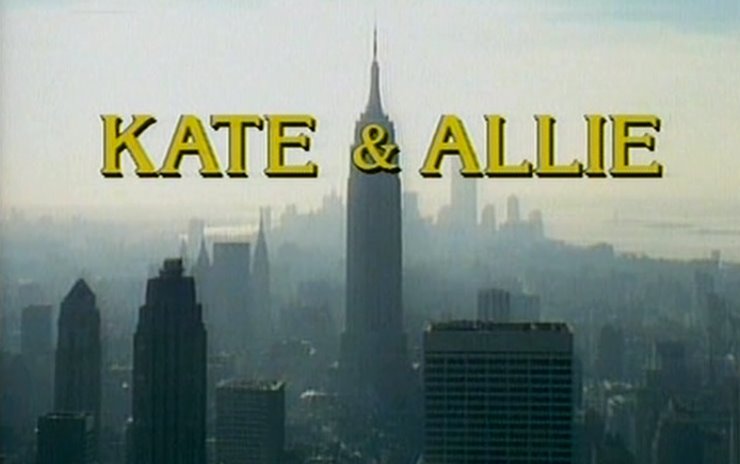
American newspaper ad for a brand new comedy series - Kate & Allie, 1984.
Created by Sherry Coben, Kate & Allie was a groundbreaking and tremendously likeable American sitcom, which debuted in the States in 1984 and in England (on Channel 4) in 1986. The show told the story of two women who had first met as kids.
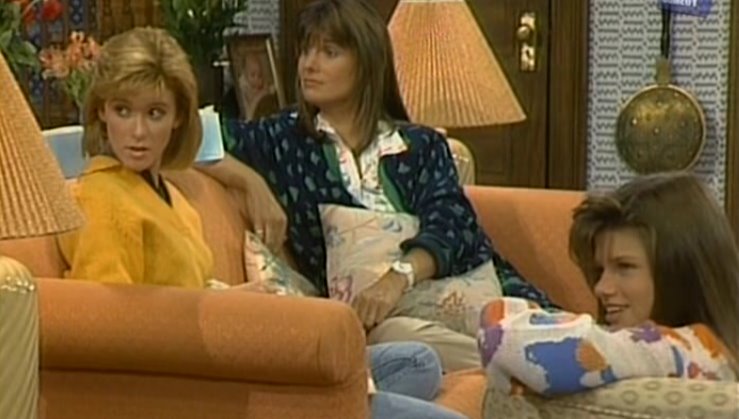
Baby boomers Kate McArdle (Susan Saint James) and Allie Lowell (Jane Curtin) were high school friends, but later drifted apart. Let loose upon the "Peace and Love" scene of the 1960s, Kate became a free wheeling, peace loving, protest marcher - and married an actor. Meanwhile, Allie became a neat suburban housewife - she married a doctor.
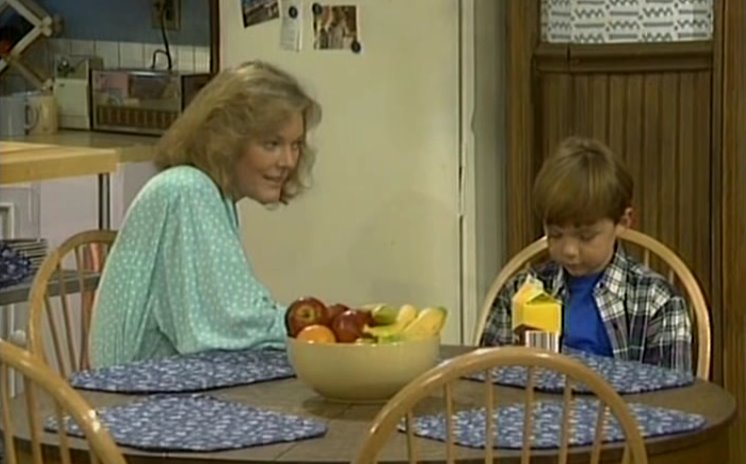
In 1984, now both divorced, Kate and Allie merged their two families - comprising Kate's teenage daughter, Emma (Ari Meyers), Allie's teenage daughter, Jennie (Allison Smith), and her younger son, Chip (Frederick Koehler).
Kate's apartment in Greenwich Village, New York, was now home to everybody, and we had an interesting alternative family set-up.
Creator Sherry Coben had been inspired by a high school reunion she had attended, where she observed a couple of unhappy divorcees who found comfort in sharing with each other. One of the most groundbreaking things about Kate & Allie was that the show never became some trendy, issue-led thing, Feminist ideology brainwashing or 'hey - this is hip and happening - let's do it!' garbage - as some previous shows had done.
The show was character-led, it was based on changing social trends - the rising divorce rate in particular - but not chattering classes' nonsense. The characters were beautifully defined. Perhaps there was one episode towards the end of the run which didn't sit quite right, and an established character was briefly mutated into somebody quite different to suit Feminist ideology, but that's still excellent going for those times.
Allie was tightly buttoned and conservative, but underneath she was insecure and lacking in self respect. Her husband's affair and subsequent remarriage had severely shaken her.
Kate was laid back and happy-go-lucky, able to cope (well, usually!) with Allie's well-ordered suburban ways and occasional hysterical outbursts.
All was not portrayed as eternally peaceful in this alternative family, but Kate and Allie's friendship won through.
Could there be life after marriage for Allie, seen here with her ex-husband, Dr Charles Lowell (Paul Hecht)? She had still to meet Claire (Wendie Malick), the woman Charles had left her for, and when she finally did, the news that Charles and Claire had made love in Allie's marital bed, before the marriage had broken up, on Allie's designer sheets with the motif of little windmills, stunned her.Charles, meanwhile, was unhappy when Claire presented him with a new baby son, Stewart. Wasn't he too old for this? Didn't he deserve some peace and a nicely paced life which suited his age? A landmark episode in this groundbreaking series, Kate and Allie face a huge rent increase when the landlady discovers that her one family apartment is now occupied by two families. Our heroines seek to wriggle off the hook by claiming to be a lesbian couple, winning the landlady's sympathy as she is herself gay. But the truth finally outs in a thought provoking scene which poses the question: just what constitutes a family? Is it only Mr and Mrs Average and 2.4 kids? The answer is - of course not!
Peace, love and protest were Kate's scene as a student in the 1960s. In the 1980s (just look at those shoulder pads!), she tried to rally her fellow customers at the local bank to protest at the establishment's attitude towards its customers, but was quickly removed by security guards!
Whilst Kate worked for a travel agent, Allie was at first housewife homebody, though later returned to college to get a degree. Kate commented that Allie had saved Emma (and herself!) from being latchkey kids.
Later still, Allie and Kate pooled their resources to start a successful catering business.
Note the strange design of the matching wallpaper and curtains. Dot. line. Squiggle. Dot. Was it some kind of code, I used to wonder?
Also note that Allie has shoulder pads in her dressing gown!
Emma decides to make divorce the subject of her "Our Changing World" high school project, and finds the best subject material is to be found at home.
Kate found romance with Ted Bartelo (Gregory Salata), a plumber who was afraid of spiders. The two fell deeply in love, but split up repeatedly, realising that they both wanted different things out of life - Ted a family, Kate a continuation of her career. Finally, Ted found somebody who wanted the same things as him. Kate was devastated.
Kate and Allie was well written, and imaginative: one episode began as reality, before becoming Allie's imagination - something we only began to suspect as the plot became more and more bizarre; another saw Chip returning to the about-to-be-demolished apartment in the early 21st Century with his son and reminiscing about his childhood there in the 1980s; a further stand-out-in-my-mind episode centred on Chip - and soon his entire alternative family - befriending Louis, a young homeless man with learning difficulties.
Louis (Michael Countryman) found friendship and sewing lessons at Kate and Allie's apartment. The character was rehoused in supported living accommodation and developed romantic feelings towards Kate, before finding happiness elsewhere.
Something amiss... Jennie, Kate and Emma wonder what Chip has been up to...
So does Allie... surely he couldn't possibly have been using the oven door as a trampoline?! When the door comes off in her hand, Allie believes it...
Kate & Allie ran until 1989 - by which time Allie had remarried. Her new husband was a man called Bob Barsky (Sam Freed) who spent each week working away as a TV sportscaster, returning home only at weekends.
So, Kate moved into Allie's marital home to keep her company.
It wasn't the same. Perhaps it was the absence of the "Dot. Line. Squiggle" wallpaper at the new place, perhaps all the angles had been covered, but it soon became clear that Kate & Allie had run its course. The original premise of two divorced women merging their households had been groundbreaking; the set-up of the final series - divorced woman living with married friend and her often absent husband - was different, but not fascinating.
However, the show at its best was, in my very humble opinion, excellent and even towards the end, with the "Dot.Line.Squiggle" wallpaper sadly absent, there was some highly imaginative writing and the characters remained as likeable as ever.
Norfolk turkey farmer Bernard Matthews came up with the advertising phrase "bootiful" in 1980.
The story goes that when the first of the ads was filmed in 1980, the Director asked Mr Matthews, who was standing on the lawn outside Great Witchingham Hall, all ready to become an ad star, how he personally would describe his turkey, and Mr Matthews replied
"Bootiful, of course."
Newspaper ads of the time ("Matthews Golden Norfolk Turkeys - as seen on T.V.") indicate that the telly ads were first screened in early 1981.
And "Bootiful" soon swept the country.
The first "bootiful" TV ad, filmed in 1980.
What about the workers?" - another "bootiful" ad, this time from 1982.
"Do yourself a flavour for 1981" - Daily Mirror, January 2, 1981:
"Turkey will gobble up more of our money in unexpected ways - turkey bacon, burgers and bangers."
An early piece of newspaper advertising linked to the TV advertising campaign, "Daily Mirror", April 1981: "Matthews Golden Norfolk Turkeys (as seen on T.V.)"
A break from talking turkey - Bernard on screen in 1988 advertising his lamb roasts. Thinking back, my own personal Bernard Matthews favourites were the turkey roasts - creating a Sunday dinner effect without the hassle of cooking a joint -and the turkey sausages - great with savoury rice - a meal I ate about three times a week in my carefree, flat-sharing days of the mid-to-late 1980s!
For many years, little girls across the land had sought to ape their elders' fashions.
My late grandmother, born in 1910, often told me of the uproar which ensued when she sneaked off and got her hair cut in a then-fashionable "bob" when she was seven years old. The bob went on to become one of the defining hair styles of the 1920s. But little girls circa 1918 were definitely not supposed to have this "grown-up" style.
"I just wanted to be in the fashion," Gran told me. "But my parents were outraged!"
To be in fashion was a much more accepted business for little girls in the 1980s.
Raiding Mum's dressing table for make-up had long been a favourite pursuit of little Karen or little Sharon, and in 1982/1983 a lot of girls were also taking their fashion cues from the TV series Fame, with leg warmers and Fame sweat shirts.
Other fashion "musts" for the teenies back then included pixie boots, donkey jackets, hair gel, ra ra skirts, and deely boppers. Both of my little sisters (one born in 1971, the other in 1974) were heavily into these things in 1982 and 1983.
The Mini-Pops, which debuted on Channel 4 on 8 February 1983, sought to bring to the small screen the little'uns' passion for fashion and for aping their elders. The idea was that kids, boys as well as girls, should dress up as pop stars and give their own renditions of pop hits.
What lots of little kids did at home, singing along to Toyah or Bucks Fizz or dad's old Rolling Stones LP, they could now do in a studio - and share their fun via the telly screen with the whole country.
And for the Mini-Pops kids there wereclothes which echoed those of their pop heroes and heroines.
And there was make up, too, lashings of it, without having to make a raid on Mum's and risk a clip round the ear hole.
What's more, the parents who took their pride and joys along to the Mini-Pops auditions in the summer of 1982 seemed more than happy at the prospect of them becoming miniature Bananaramas or whoever.
Bliss!
Or was it?
Middle Britain threw up its hands in horror at the little girl who sang Sheena Easton's 1980 hit 9 to 5 in night attire (Sheena had at least worn a boiler suit) - "Night time is the right time, we make love..."
Disgusting! The girl in question later said that she had no idea what it meant (as an aside, I think "making love" once had a much more innocent meaning: one made love with words and poetry, but long before the 1980s it had been designated as "nookie" only).
In fact, middle Britain threw up its hands in horror at the whole spectacle of these little kids wearing glitzy and sometimes skimpy mini-versions of their pop idols' garb.
And as for the lip gloss and the eyeliner and some of the dance moves...
Disgusting to the absolute max.
And surely the show would attract every Tom, Dick and Pervy in the country? It would kill of the children's childhoods prematurely. They'd all need psychiatric help by the time they were teens...
It's wrong to generalise, and perhaps it wasn't only middle Britain that was outraged by the show, but the attitude of the working class tabloid the Daily Mirror to the first Mini-Pops show on 8 February 1983 was rather different...
There is a chance tonight to spot the stars of tomorrow. Twenty youngsters were chosen from 800 hopefuls for a place on the new series MINI POPS (Channel 4, 6pm).
Over the next six weeks they get the chance to dress up as their pop idols and sing their hit songs.
Mike Mansfield, who produced the show, says he was "amazed" at their talent."A few of them could become very big names," he predicts.
Some of the youngsters have already hit the charts with a Mini-Pops album.
The series was filmed at record speed. Mansfield explained: "The children are available only during school holidays. We ended up making the entire series in one week."
He believes the show will appeal to all ages.
Mansfield says: "Adults will watch because they love kids. And the kids will watch because lots of them rehearse in their bedrooms with a hairbrush for a mike while singing along to a hit record."
From the Daily Mirror TV listings, February 8, 1983:
Mini-Pops: New light entertainment series in which the entertainers are all kids aged between seven and ten. They're our future stars.
All good, innocent fun, you see?
But elsewhere, well...
From the Observer, 27 February, 1983:
Is it merely priggish to feel queasy at the sight of primary school minxes with rouged cheeks, eye make-up and full-gloss lipstick belting out songs like torch singers and waggling those places where they will eventually have places? The final act of last week's show featured a chubby blonde totlette, thigh-high to a paedophile, in a ra-ra skirt and high heels; her black knickers were extensively flashed as she bounced around singing the words "See that guy all dressed in green/He's not a man, he's a loving machine." Kiddiporn, a shop-window full of junior jailbait? And does the show thrust premature sexual awareness onto its wide-eyed performers?
One phone caller to Channel 4's Right To Reply show raged:
"Mini Pops should be called Mini Whores. Are you people out of your mind?"
A bit strong, wasn't it? After all many female (and, indeed, some male) pop stars of the 1980s put their make up on with a trowel and wore tarty garb, it was the norm, and surely these were just little children pretending to be them?
What does come across, from looking into the subject, is the innocent intentions of the show'sproducers and the enthusiasm of the kids involved.
But worthy folk worried about the "sexualisation" of children performing on the show.
And perverts tuning in.
And so, the show ended.
What did I think?
Did I believe that the show was going to attract evil perverts?
Did I believe that it was robbing the kiddies of their childhoods?
Did I believe that it was simply fun?
Did I think that it was.... um... well... just a teensy bit common?
Well, this is where this blog post gets really embarrassing.
Get down to 73! Neil Buchanan, Dawn Lodge (Andrea Arnold), Ethel Davis (Sandi Toksvig) and Harry Stern (Nick Staverson) provided Saturday morning TV fun in the 1980s.The series ran from 1982 to 1988.
I've had an interesting e-mail from Ian, regarding my favourite Saturday morning kids' show ever - No 73.
Ian was a No 73 viewer in 1986, and watched an episode in which a guest demonstrated how coins were made and pressed.
Ian recalls that around one hundred special No 73 coins were made, and offered to the first one hundred viewers to write in.
Ian tells me:
I was lucky enough to get one and it originally came in a small red gift box with a letter signed by the crew, unfortunately the box and letter have long gone but I have held onto the coin for all these years.
The coin was inscribed with the initials of the No 73 occupants of the time - N for Neil, K for Kim, D for Dawn and H for Harry, and the year it was produced - 1986.
Ian writes:
I have looked a number of times on the internet for anything to do with the coin but have never found anything, if anyone else out there still has one it would be great to know
So, if anybody has a No 73 coin like Ian's, please drop me a line.
I have been in touch with a very kind and helpful contact of mine who has access to the No 73archive to ask if the coin episode still exists, and he informs me that all the seasons from 1982-1985 are intact, but after that it becomes very patchy, with many gaps. The episode won't exist on any professional format.
If anybody videod the coin episode, or any other No 73 episodes from 1986-1988, we'd love to hear from you!
Both sides of the No 73 coin- images provided by Ian.
The Secret Diary Of Adrian Mole Aged 13 ¾by Sue Townsend was published in October 1982, and the paperback edition in October 1983. The sequel, The Growing Pains Of Adrian Mole, followed in 1984.
Back in the early 1980s, I determinedly donned a donkey jacket. The height of fashion. "It was like it was nailed to your back, even at the height of summer!" said a nasty old relative of mine recently.
This was "dressing down" to the max.
But, slowly but surely, the influence of the New Romantics and posey TV shows of the decade began to impinge upon my dullard brain, and so I got dressy.
And I loved it.
I was the original 1980s fashion victim - and a cerise mesh vest, neon blue jacket with colossalshoulders, and skin tight banana yellow trousers were amongst my very favourite things to combat nakedness.
In the mid-1980s, I became a care worker and there was a chic which went with that - a nice lumberjack shirt, or what I called a "wholemeal" jumper (boring brown, un-startling pattern) and maroon trousers were so suitable for this role.
I looked comforting. Dependable. The right look was so important for everything I did.
And when the optician said I needed glasses, I chose a nice, stylish pair and gloated over how they added to my safe, dependable look for work - and how they also gave me an academic air.
I didn't wear for them nights out, they didn't go with myMiami Vice chic, but for my work/daytime chic they were so fabulous.
In the mid-1980s, there were all kinds of chics.
A slight unease began when I visited my GP to have my ears syringed in late 1985, about three weeks after getting my glasses.
There were two nice old ladies in the waiting room - the sort of old ladies you don't see nowadays - both wearing hats - both reminiscing about the Second World War.
The receptionist indicated that doc was ready to see me, and as I made my way to his consulting room door, one of the old ladies twittered:
"Doesn't he look almost exactly like Adrian Mole?!"
I turned, incredulously, to see both old ladies were looking at me.
"Oh, did you hear me?" asked the one that had spoken.
"Yes!" I was furious, and glowered at her.
Without a word of apology, the old dear turned to her pal, and both tittered.
Reflecting that the elderly were not what they were, I went into the doctor.
A few days later, I emerged from my flat, on the way to the Co-op for Weetabix and spuds. A bloke fixing the exterior light of the flat next door turned to me, grinned broadly, gave me a huge thumbs up, and said:
"Hi, Adrian!"
I gave him an icy glare and swept past him.
I was getting worried. I knew who Adrian Mole was, had seen the books by Sue Townsend, and some of the TV series episodes starring Gian Sammarco, and I knew there was a resemblance between me and this character when I wore my goggles.
But surely not that much?!
Christmas arrived - and a family Christmas party. I went straight from work, knowing that I was safe in my glasses as none of my loving kinfolk would ever take the P.
Two of my cousins stepped forward, with gaily wrapped pressies.
These two cousins had never given me presents before ever - and I'd known them all my life.
I was touched.
I opened the first. It was a book.
It was The Secret Diary Of Adrian Mole Aged 13 ¾.
I opened the second.
It was another book - The Growing Pains Of Adrian Mole.
"Thought you might like them, seeing as you wrote them," said one of my dear cousins.
I was startled.
I was stung.
"You bloody little gits!" I spat, and stalked off.
I was growing very unhappy indeed.
In Miami Vice chic night-time mode, without my glasses, I looked nothing like Adrian Mole, but by day...
Things came to a head a few days later, when, strolling down the main street after work, I was suddenly mobbed by a group of about nine lads, who came galloping across the road, looking thrilled to bits, and squawking: "ADRIAN MOLER! ADRIAN MOLER!"
They were big and beefy lads, and I was terrified.
One clapped me ferociously on the back, the others stood around bellowing: "WOTCHA, ADRIAN!" "HI, AIDY!!" "WOT YOU UP TO, ADRIAN?" and other things like that.
Trembling with fear, I moved off, with "der lads" shouting after me: "BYE, AIDY!!" "SEE YA, ADRIAN!!" and "HEY - ADRIAN - GIVE MY LOVE TO PANDORA!"
Back in the safety of my flat, I gathered my wits.
Adrian Moler? Sounded like "Greaser".
Did these lads actually think that I'd set out to look like Adrian Mole? That I was effecting a kind of Adrian Mole chic?
Off came the glasses.
And I never wore them again.
And, not being confident with the contact lens concept, I simply let my eyes go hang.
Something I regret because I now have to wear glasses - it's an absolute necessity.
Anything beyond arm's length is a complete blur.
Of course, these days I'm fond of Adrian. The daft lad with the literary pretensions who started his first diary in January 1981 has grown up and I'm very worried about him - having just read The Prostrate Years.
But there was a time, in the mid-1980s, during my unwitting Adrian Moler period, that I couldn't stick the little prat.
In recent years, I thought that Harry Potter, as portrayed in the films, looked like Adrian Mole as portrayed in the '80s TV series.
But nobody gave him any stick about it.
Life is so unfair.
Read our main Adrian Mole '80s Actual article here.
Of course, Japan was introduced to Pac-Man (or Puck-Man as he was then called) way back in May 1980, and the little fella then came bursting out to dominate the rest of the world in the years that followed.
I liked him a great deal - "WACCA WACCA WACCA, old friend" - but was hopeless on the machine at the local boozer and proved myself even more hopeless when my cousin Brenda and her husband Paul bought a TV games system at Christmas 1984. This was very new territory for them (and me), but whilst Brenda failed miserably at mastering this exciting technology, Paul took to it like a duck to water and was very full of himself by the time that I arrived for a visit on Boxing Day.
Pac-Man was Paul's favourite, and I was persuaded to have a go. I was actually quite gung ho at the prospect after a couple of glasses of wine, but soon conceded defeat.
"Andy, you're not supposed to just stand there and let the ghosts catch you!" said Paul at last, thoroughly exasperated.
"Why not? They're going to catch me anyway!" I replied.
Paul took the game back, and was soon happily WACC-ering away, whilst me and cousin Brenda swigged some more wine, and found amusement with a small, clockwork version of Pac-Man which had been sitting innocently on the coffee table.
Wound up, he waddled along, opening and shutting his mouth and, thoroughly sozzled as we now were, Brenda and I decided that he looked rather like an auntie of ours who liked a drink or two at the local Labour Club on Saturday nights.
As Pac-Man waddled along the arm of the sofa, we intoned robotically: "LAGER-LAGER-LAGER..." - and shrieked with laughter when he reached the edge and tumbled onto the carpet, where he lay on his back, jerking about, opening and closing his mouth, and attempting to waddle.
We kept popping him back on the sofa arm, and doing our "LAGER-LAGER-LAGER" thing for what seemed like about ten minutes. This was, in reality, sober Paul told us the next day, well over an hour, during which time we became increasingly hysterical with laughter.
"Ruined my concentration!" sulked Paul - the Pac-Man TV game king.
"You stick to your Pac-Man, we'll stick to ours!" said heavily hung-over Brenda.
I found a very similar clockwork Pac-Man to the one which had so delighted us in 1984 in a charity shop the other day, and immediately began intoning robotically: "LAGER-LAGER-LAGER!"
"Lager? Wot you on about?" asked my mate Pete, who was with my at the time.
"Read '80s Actual on Monday and all will be revealed!" I replied.
The Grand Hotel, Brighton, after the IRA bomb explosion on October 12, 1984.
Margaret Thatcher...
Does the name make you smile? Or does it make you boo and hiss? This UK Prime Minister enjoyed three successive general election victories, in 1979, 1983 and 1987... and has become one of the ultimate 1980s icons.
It pleases modern day journalists to speak of the "Thatcher revolution", but without the election of Ronald Reagan as American President in 1980, the decade may have turned out very differently indeed. After all, America's influence on the world economy cannot be doubted, and it was in America, after Reagan's first term began, that the acronym "yuppie" was coined.
But, with the stage set just right for her, Margaret Thatcher, like the mid-to-late decade, boomed.
The '80s boom had not really got into its stride in 1984. OK, there was no mistaking it for 1980, 1981, 1982 or even 1983, but we still had a little way to go.
Despite the external factors influencing the 1980s, there is no doubt that here in the UK Margaret Thatcher wrought absolutely huge changes.
And, standing alongside Ronald Reagan, was a powerful presence on the world stage.
But everything may have ended very differently in the early hours of 12 October 1984.
The Grand Hotel had been booked for the annual Conservative Party conference. When the bomb detonated at 2.54 am, Margaret Thatcher was still up, working on her speech.
She escaped unscathed. Five people died, and thirty-four others, including Norman Tebbit, then President of the Board of Trade, and his wife, Margaret, were injured.
Whatever one thinks of Margaret Thatcher's politics, it's hard to deny her courage. She insisted that the conference began as planned at 9.30am, and declared: "This attack has failed. All attempts to destroy democracy by terrorism will fail."
In August 1986, Margaret Thatcher and Norman Tebbit returned to The Grand Hotel...
From the Sun, August 29, 1986:
Brave Maggie Thatcher returned in triumph yesterday to the hotel where she cheated an assassination squad of IRA bombers.
The Premier spent an hour at the refurbished Grand Hotel in Brighton where, two years ago, she missed death by inches as a massive blast brought down the ceiling in her bathroom.
As she inspected the plush new frontage of the building where five people died and thirty were injured, Mrs Thatcher said: "It's almost as though it had not happened."
She handed back the union jack which was flying over the Grand on the night the bombers tried to wipe out the British Cabinet, gathered for the Tory Party conference.
The flag had been given to Mrs Thatcher by tearful hotel staff as they picked their way through the rubble.
She returned it to general manager Richard Baker and told him: "We've taken very good of the flag. I hope it's been ironed."
Iron man Norman Tebbit, whose wife Margaret was crippled for life in the blast, joined Mrs Thatcher for the emotional return to Brighton.
Mr Tebbit, who was trapped in agony for hours in the debris, bravely joked: "I remember my last night here, room service was a bit slow. I had to wait for three and a half hours before anyone came for me."
Then he added sombrely: "Of course there are sad memories, but I like to look ahead and not backwards. I am sure even those who lost their lives would not have wanted a wake."
Massive security was mounted for the visit, with 1,000 police on duty and armed detectives in hotel uniforms.
All these years on, Margaret Thatcher remains a controversial figure in the UK.
There are those out there who believe she was our saviour, others who swear blind that she is responsible for most things wrong in the UK today.
The political scene of the 1980s seems to arouse much more interest and passion than the political scene of today.
The '80s Actual blog is designed to be an antidote to all those television shows and on-line articles of recent years which examine pop culture - and frequently get it hopelessly wrong!
If you sat watching the BBC's "I Love The 1970s" and exclaimed over items being shown "I could swear that was 1968!" or "Wasn't that 1981?" chances are you were right.
If you look at certain '70s fan sites and think a lot of the material written about is actually from the '80s, you are almost certainly correct.
If on-line encyclopedia articles which state that pop culture of 1983 is really 1977, or similar, have you wishing for reality, then '80s Actual is for you.
There is a huge drive in the media and on-line to negate the 1980s, to attribute that decade's innovations and fond memories to other decades, and basically to present it as a completely vapid ten years, not worthy of examination.
I'm not sure why. Perhaps it's just comforting to have a decade people can scapegoat and declare "HORRIBLE"?
This blog is based on actual memories, media footage (thank you, YouTube!) and snippets of newspaper and magazine articles from the 1980s. If you read it here, I think you can rest assured it's accurate, though I can take no responsibility for the newspaper reports from the decade!
The '80s Actual blog examines the decade's news stories - from the emergence of Lady Diana Spencer into the public eye in 1980, to the fall of the Berlin Wall in 1989.
Was it simply "The Greed Decade" as many like to claim? I think not - the '80s saw the emergence of yuppies, but also Red Wedge, the Greenham Common Peace Women, and increasing concern for the environment. It may be convenient to scapegoat the '80s as the cause of all known ills, but the reality of the decade was far different - absolute bedlam, as Right fought Left, idealism fought corporate ambition. The election ofRonald Reagan as American President in 1980, and his second victory in 1984, had a far more decisive effect on the international political landscape than the three successive general election victories of UK Prime MinisterMargaretThatcher in 1979, 1983 and 1987.
Musically, the 1980s saw the beginnings of House Music, the exciting and still evolving world of synths taking centre stage, the evolvement of Rap music into the fully-fledged Hip Hop scene, Band Aid and Live Aid, great Indie, startling Acid House, and Raves...
And there was so much more! The decade truly had something for everyone - and provided a welcome escape for a while from the long-running and boring saga of flared trousers as fashion, begun back in the 1960s!
It was a brilliant decade for telly - bringing us such wonders as A Very Peculiar Practice, Inspector Morse, Spitting Image, Hot Metal, The BeiderbeckeTrilogy and Edge of Darkness.
The 1980s also saw the creation ofThe Simpsons, Twin Peaks, and other wonderful (often groundbreaking) American TV showslike Kate & Allie, Cheers, The Golden Girls, Married... With Children, The Cosby Show, Roseanne, and Hill Street Blues.
The '80s gave us some wonderful UK TV ads. Remember Ted Moult advertising double glazing at the Tan Hall Inn with "Fit The Best - Everest"? Remember the Weetabix gang? Remember theScotch video tape skeleton ("Re-record, not fade away"?). Remember the romantic yuppie couple in the coffee ads? And what about "Lotta Bottle"?
In fact, the '80s totally transformed our telly viewing, bringing us Channel 4 and Sky TV.
There are also also '80s Actual sister blogs taking us back to the '70s and '60s - The Real 1970s and Spacehopper.
The view of the 1980s presented here is from an English perspective - much of the original '80s material used is from England, but I hope this blog will prove useful and enjoyable to people in the other nations of the UK and much further afield.

 He joined Radio 1 in January 1980 to do a Saturday night show. After a spot of hopping around the schedules, in 1981 he got the weekday afternoon slot and so Steve Wright In The Afternoon was born. By 1989, he was flying high - having introduced us to the likes of Sid the Manager, Damien the social worker and, of course, Mr Angry of Purley.






 Posts
Posts