Total Pageviews

Pages

22 January 2009

Barbara Woodhouse

The inimitable Mrs Woodhouse with a canine pal in the early 1980s.

Barbara Woodhouse was born in 1910 and always loved animals. She was known for her way with horses and cows as well as for being a dog trainer.

Having trained dogs to appear in films, Barbara became a celebrity herself in 1980 with her BBC series Training Dogs The Woodhouse Way.

Her commands to the dogs in her charge quickly became catchphrases, parroted across the land. "Walkies!" we shrilled and "Sit!" Do you remember the strange arm movement which went with the latter command?
-
The first page of my copy of Barbara's autobiography is signed by the great lady herself. My wife found the book in a second hand bookshop when I was in bed with flu, c. 1996.

I remembered Barbara as a somewhat starchy English "school marm" type character, standing around trilling orders in her sensible tweed skirts, and didn't expect to enjoy the book. But I was pleasantly surprised. Barbara's insights into training animals were fascinating, and she had a great sense of adventure, having travelled to South America to live as a young woman in the 1930s.

Some of Barbara's dog training methods aroused controversy - I remember much animated chatter about the use of choke chains, but nobody could doubt her genuine love for her canine students. And she was a great character. It came as no great surprise when she was voted TV Personality of the Year 1980.

The Daily Mirror reported on 2/1/1981:

The lady who orders dogs about, Barbara Woodhouse, spent Christmas in Switzerland and was in bed by 11pm on New Year’s Eve.

Switzerland was a real thrill for this lady who became a TV star in 1980: “Even there people were coming up to me and shouting ‘Walkies!’ "

From the Sunday People, November 1981:

TV’s doggie queen Barbara Woodhouse has been calling some of Hollywood’s superstars to heel. She’s been in California to train the canine delinquents of Beverly Hills and to teach their famous owners to “walk the Woodhouse way”.

Barbara’s TV series has made her an instant celebrity in America and she has had the top dog treatment from the start.

“I was treated like royalty, it was amazing,” said Barbara.

“Everywhere I went people greeted me with the word ‘walkies’.”

The results of Barbara’s American teach-in are to be shown in a Yorkshire TV special over Christmas.

Among the problem pooches she helped were those belonging to Zsa Zsa Gabor, David Soul, Dorothy Lamour, Wilfred Hyde-White, Britt Ekland and Bill Shatner.

Problem number one was Zsa Zsa’s nervous Alsatian.

“I trained it to sit and walk to heel,” said Barbara. “It only took me about five minutes.

-
“Zsa Zsa was delighted.”


Next stop was David Soul and some advanced training for his Labrador.

“The trouble was that the dog kept jumping into the swimming pool after rubber balls,” she said.

David Soul said he thought Barbara was terrific. “But my dog hasn’t changed much,” he said.

Then it was on to the home of William Shatner, Captain Kirk in the TV serial “Star Trek”.

“He had two Dobermans and seemed a little ill at ease at first,” said Barbara.

Another of Barbara’s calls was to Britt Ekland’s home where she trained two Elk hounds and a cat.

Barbara with Stefanie Powers and pooch.

Barbara wrote:

If any fortune teller five years ago had told me I should travel the world, with my husband, demonstrating my method of training dogs, to people whose welcome is “walkies” and “sit” when I arrive in their countries, I’d never have believed it. Yet it has happened.

I’ve trained dogs for the Singapore enthusiasts, and celebrated our meeting wading through a wonderful dinner of ten courses of rice, fish, chicken or other ingredients, and was assured that if it spilt on the tablecloth, due to my lack of experience with chop sticks, it was a compliment to the chef to have a dirty tablecloth.

I’ve seen a police dog crossing a wire tight rope in Pretoria wearing leather booties to save its paws.

I’ve not seen a flag raised on a flag pole, but a banner which read: “Welcome Barbara Woodhouse”. A Doberman Pinscher pulled the rope that raised the banner onto the flag pole.
-
I’ve trained the stars and their dogs in Hollywood including David Soul, Stefanie Powers, Zsa Zsa Gabor, Wilfred Hyde White, William Shatner etc; I found them quick and easy to train.

I’ve met Ray Berwick and his Cockatoo, Fred. I’ve met Ron Randall and his lovely horse, star of the film “Black Stallion”.

I’ve met Tippi Hendren and her husband Noel Marshall who made that fantastic film with the lions, “ROAR”. The lions roam uncaged around her estate and home. There, also, I got acquainted with a leopard who wandered up to me, lay on my chest and licked my hand before resuming his morning stroll.

I took a baby Cougar back to its mother without her attacking me. It is said that female Cougars are fierce and will attack anyone going near their babies.

I found all the dogs I met easy to train, or rather re-train if they had faults. The people I met in Australia, Canada, South Africa and the USA are full of love for their animals. The welcome for my husband and I was unbelievable.

Unless you’d known you’d flown thousands of miles, as we had flown, you could almost imagine you’d never left England.

Dog Training and the love of horses and ponies, I’ve found, will take me around the world to get to know the animal lovers who share my interest, knowledge and affection for their pets.
-
Barbara cautiously befriends a cheetah.

In 1983, Barbara appeared in a couple of amusing advertisements on the opening morning of TV-am, ITV's breakfast television service. The product? Eggs!

"Tell an eggshell who is boss. Let it know that you are...

CROSS!"


Barbara died in 1988. Her fame had been brief, but her impact great. Even today, the doggy commands "Walkies!" and "Sit!" are still widely associated with her.

Two of the 1983 egg ads featured in commercial breaks on the first day of TV-am.

This Andrex Appeal advertisement dates from September, 1981.

1989: The Twin Peaks Pilot

24 February, 1989: the body of local Home Coming Queen Laura Palmer (Sheryl Lee), wrapped in plastic, is found by Pete Martell (Jack Nance) washed up on the shore of the lake outside his home in the idyllic Pacific North West town of Twin Peaks...

Twin Peaks, of course, took the world briefly by storm in 1990 and 1991.

One of the most original and multi-faceted TV shows ever, Twin Peaks got no further than series two and ended amidst accusations from some that it had "out-weirded itself".

So, what was it all about and where does 1989 come into the picture?

I will tell all...

In 1989, David Lynch (Blue Velvet) and Mark Frost (a writer of that wonderful 1980s police drama series Hill Street Blues) produced the pilot episode of Twin Peaks - and production was well advanced on the first seven episodes before the year ended - in fact episode five was being produced in November!

Everything was in place - right from the start. The music, the atmosphere, the characterisations - the show was spot on.

An historic video cassette - the Warner Home Video European release of the 1989 "Twin Peaks" feature, running time approximately 113 minutes, copyright MCMLXXXIX [1989], Lynch/Frost Productions Inc. The material contained on the video was used as the Twin Peaks pilot episode, but contained an alternative ending. This video is sometimes referred to as "Twin Peaks - The Movie".

David Lynch looked back to the late 1980s origins of Twin Peaks in an interview in the early 1990s:

"We were at Du Par's, the coffee shop at the corner of Laurel Canyon and Ventura and all of a sudden, Mark Frost and I had this image of a body wrapped in plastic washing up on the shore of a lake."

A map of the fictional town was soon drawn up…

"We knew where everything was, and it helped us decide what mood each place had, and what could happen there. Then the characters just introduced themselves to us and walked into the story.

“The pilot was written in only nine days and shot in 23.

"I didn't feel we compromised, and I felt good.

"These shows should cast a spell. It's sort of a nutty thing, but I feel a lot of enjoyment watching the show. It pulls me into this other world that I don't know about."

As well as 1989 being the year of the Twin Peaks pilot, it is also the year that most fans agree all the plot action was set in. Amazingly, it seems that all the bizarre and tangled events of the series occurred in just a few weeks of 1989! Although continuity faltered once or twice and Jennifer Lynch's 1990 novel, The Secret Diary of Laura Palmer, pointed towards 1990 as the year of Laura's murder, apparently if you study days and dates in the series and film "prequel" Fire Walk With Me, 1989 emerges as the one and only.

Not that Twin Peaks seemed to have caught up to 1989. The town seemed, in many ways, still stuck in the 1950s - which gave the series a real "back woods" feel. Good old cherry pie, and home comin' queen values jostled with modern day evils.

FBI Special Agent Dale Cooper (Kyle MacLachlan) meets the Little Man from Another Place (Michael J Anderson) and Laura Palmer in the Red Room. But just remember: "When you see me again, it won't be me!"

Life wasn't always so heavy and downright weird in the "Twin Peaks" universe - and at the Sheriff's Station, receptionist Lucy Moran (Kimmy Robertson) was one of several characters that added a comedy thread to the show's rich brew.

In 1993, Pat Cokewell, owner of the Mar-T Cafe, the RR Diner in Twin Peaks, told about her establishment’s first transition from reality to Peaks legend. This is an extract from the 1990s Twin Peaks magazine Wrapped In Plastic:

“One of the first questions people ask is, how did they find you? How did they find the Mar-T? Well, with all movies they send out a location scout. So that was my first contact in February of 1989. I said, 'Oh yeah.' (We weren’t very busy.) ‘You can use it, but we’re fixing to do some remodelling.’ But they said, ‘Oh, no, no, no, don’t do anything like that. We want it just as it is.’

“About two weeks later, they said that David Lynch will be up on the weekend and he’ll decide. (They’d looked at another cafe, too.) So they came up, and they told us they wanted to use it."

Pat Cokewell recalled the arrival of the film crew and cast around the end of February 1989: "I’d never seen so much equipment. There were about seventy-five people that were working and another hundred that were watching from the outside. So when they said, “Rolling,’ you better keep quiet.

“For those of us that met David Lynch, he’s a wonderful director. You hear stories about directors yelling and screaming on the set, and that did not happen for the four days that we had the privilege of having him around the Mar-T. When he was not working, he was talking to you.”
-
Sheriff Harry S Truman (Michael Ontkean) shakes hands with FBI Special Agent Dale Cooper (Kyle MacLachlan) whilst a parade of doughnuts awaited their fate. With some "damn fine coffee" nearby, all seemed well. But not for long.

The Log Lady (Catherine Coulson). Did the log have information about Laura's murder?

Josie Packard (Joan Chen), the beautiful young widow of local mill owner Andrew Packard, held many secrets - not least her love affair with Sheriff Truman.

Andrew Packard's sister, Catherine Martell (Piper Laurie), held some devastating secrets herself and plotted to ruin Josie. She and her lover, local hotel owner Benjamin Horne (Richard Beymour), added a strand of 1980s era power soap to the "Twin Peaks" brew, as they plotted together - but could they trust each other?

Sarah Palmer (Grace Zabriskie) has a mystical vision, and screams in terror. But who's that in the mirror?!

A supernatural horror strand was ably provided by Bob. Was he a demon? Or simply the show's representation of the evil that men do?

Bob, the terrifying being that appeared to certain people and possessed Leland Palmer (Ray Wise), was not part of the original plan for Twin Peaks.

I’m indebted again to my Wrapped In Plastic collection which contains this insight from Frank Silva, the man behind Bob:

“First thing I have to say is that Bob was an accident. He was never, ever there from day one. It was a whole, unbelievable accident. It basically happened during the original pilot. I was a crew member, the on-set dresser in the art department. We were doing the shot in Laura Palmer’s bedroom. I was tweaking the bedroom, and the camera was in the doorway. David was out in the hall and he jokingly said, ‘Frank, you’d better get out of there. You’re going to get caught in the camera..’ And I looked at David and went, ‘Okay.’ And then a blood vessel kind of like burst in his head, and he said, ‘Frank! Get down at the end of the bed, just crouch down there, and act scared!’ And I went, ‘What?!?’ ‘Just act scared!’ And that was how Bob began.

“At the end of the day, in order to make sense of me being shot at the end of the bed, he added the scene at the end of the pilot - this was never scripted - where Grace Zabriskie, Laura’s mom, is lying on the sofa, and she’s chain smoking, and she suddenly jets up and says, ‘Leland, I saw him.’ There are three mirrors on the back wall where the sofa is. I’m clear across the room, being a crew member, holding cigarettes in my hand for her to do each take. So I’m standing there, she jets up, and she says, ‘Leland, I saw him.’ David goes, ‘Great! How was that for the camera?’ So the camera guy says, ‘Well, it was really great, but Frank was in one of the mirrors.’ And David went ‘WOW!!’ We couldn’t have planned it better! This is where it all started with the Bob character.”

Twin Peaks blasted on to our screens in 1990 and we were asked “Who killed Laura Palmer?”

“Not another soap!” I moaned. “It sounds just like ‘Who Shot JR’!”

But of course it wasn’t.

It was like nothing else ever seen on TV.
-
I was initially curious, and soon enthralled. Then baffled. Disturbed. Disorientated. Obsessed. Chilled. Amused. Terrified.
-
This show played games with my mind like no other - before or since.
-
And I loved it.


21 January 2009

LOADSAMONEY!

Here's rising young alternative comedian Harry Enfield in 1988. In the picture above he's in character live on stage as one of his most popular creations - Loadsamoney!

Loadsa, waving his wonga: "What's that?"

Audience: "Loadsamoney!"

Loadsa: "What?"

Audience: "Loadsamoney!"

Loadsa: "No, it's loadsa FU**ING money - I ain't on telly now! Loadsa fu**ing money! Loadsa fu**ing money!

"Shut your mouths and look at my wad and worship it up! This is the wickedest wad in the world, it is the wad of wads and it is all fresh MONEY, 'cos one thing I cannot bear is a stale wad. My money's gotta be brand new or it can FU**K off !

"How come I've got so much money again? 'Cos I'm a plasterer, 'en I? And plasterers are great. Roofers? Scum! Scaffolders? Coarse and ignorant peasants..."
Etc, etc, etc.


The Sun, 16 September, 1988. Cor! Harry lands a sponsorship deal with Holstein Pils for his stage show, worth £50,000. DOSH! DOSH! DOSH!

What was it with socially aware lefty comedians? We saw 'em all in the 1980s, these startling new alternative comedians, slagging off the Thatcher creature, railing against capitalism, and stuffing the wads of cash they earned from it in their high interest accounts quicker than you could blink. Here, Sun columnist Fiona Macdonald Hull sticks the boot into Harry Enfield: "How I loathe Yuppies!" But don't be too harsh. It was the same with the Peace and Love hippie trippie crowd on the pop scene in the 1960s. Do as we say - not as we do! And it's the same with the ultra priggish celebs of today. Shame! Whatever happened to the days of true idealism? Of people backing their words with their actions? And when exactly WERE those days?!

The Sun, October 21, 1988: £500,000 on the way!

Another of Enfield's popular creations:

Note: very broken English - no typing errors here - written as spoken:

"Hallo everybody peeps! Good evening and welc! My name is Stavros in case you don't know all red 'cos you blinkin' thick, and I'm got a little kebab house in Greece. Bethnal Greece, East Londos..."

25 December 2008

Merry Christmas, 2008!

Merry Christmas and all the very best for 2009, folks! Here's a 1985 magazine ad featuring the lovely Su Pollard (Peggy from Hi-De-Hi!) and an assortment of toys and games which delighted youngsters at Christmas that year. A Tomy Lights Alive? Care Bears? Trivial Pursuit? My Little Pony? The choice was yours!

Have fun, be good, and see you again in 2009...

1983: Tony Blair - The Shape Of Things To Come...

Daily Mirror, May, 1983...

Pat Phoenix, Elsie Tanner of Coronation Street, was a staunch supporter of Old Labour and here she is with two young election hopefuls, Cherie and Tony Blair and her partner, Tony Booth - father of the aforementioned Cherie and one time "Scouse git" to Warren Mitchell's Alf Garnett.

09 October 2008

"Naff Orf!" Says Anne - The People's Princess...

Princess Anne - "Naff off!" (well, she actually said, "Naff ORF!"), The Sun, April 1982.

The early-to mid 1980s were an eventful time for the Royals, with the Queen Mother reaching 80, that frightening incident at the Trooping of the Colour, Charles and Di mania and marriage (more here), the arrival of Wills and Harry, the man in the Queen's bedroom (more here) and Anne, the "People's Princess", shouting abuse at journalists...

"Naff ORF"?! Somehow, despite their education and status, members of the Royal family seem to have something of a problem with English pronunciation. And was it really "on" for Anne to get so frightfully cross?

Still, despite the odd off moment, it seemed that Princess Anne was actually very good value for money back in the 1980s...

All that smiling. Absolutely exhausting.

28 September 2008

Speak And Spell

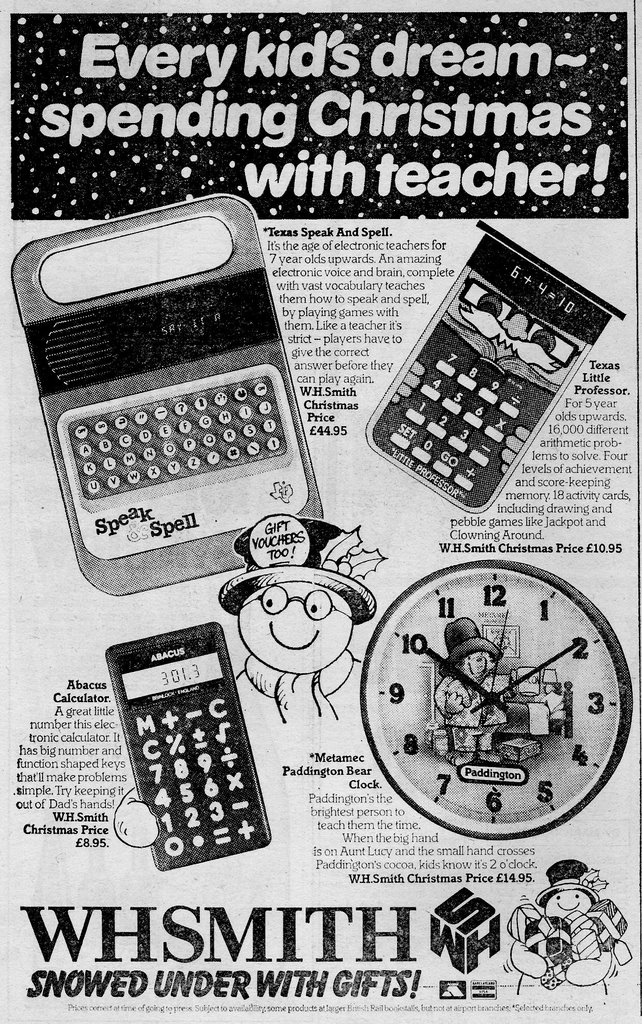
A newspaper advertisement from December 1980, featuring a "Speak & Spell". This clever push-button operated gadget was originally released in America in July 1978. In 1980, a new membrane keyboard model (pictured below) debuted - although the version featured in the ad above is of the push button variety.

Do not run away with the idea that all kids were playing with Speak & Spells at Christmas 1980. For many families £44.95 was an absurd amount for an individual present - remember there was a recession on.

Purse-string holders in my family did not even consider objects like the Speak & Spell for purchase until somewhat later in the decade.

We had our own English-speaking version here as there are many differences between American English and English as it is spoken in England and the other nations of the UK.

Speak & Spell later went on to great fame - appearing in a certain film about a stranded alien. Click here for details!

"That is correct!"

A Speak & Spell with membrane keyboard, released in 1980.

25 September 2008

1982: Erika Roe - The Twickenham Streaker

Twickers Winning Streak

Sunday Mirror, 3/1/1982

This daring girl was the tops for 60,000 rugby fans at Twickenham - and millions of TV viewers yesterday. She did her strip during the England v. Australia international. Oh, and by the way, England won.

End of newspaper blurb.

“Streaking” - throwing off all your clothes and cutting a dash in public - was (apparently) a craze in America in the early 1970s.

It probably came about because of all that 1960s “Be free, Man!” stuff - although people had run amok in public naked for kicks before that. 20th Century Words by John Ayto (Oxford, 1999) records this quote from a 1974 American Runner’s World magazine: “During the winter of 1958-9 a group of us ‘streaked’ all over Berkeley.”

So perhaps it was the rockin’ rollin’ 50s that set the trend in motion?

Who knows?

Over here in England, we’d sniggered over a song called The Streak in 1974 (“Here he comes! There he goes! And he ain’t wearin’ no clothes!”), and one or two hardy souls had flashed their bits, but the craze never really got going (not surprising when you consider our climate).

And then, in January 1982, a young woman called Erika Roe braved the English elements, together with a pal, and invaded the rugby pitch at Twickenham - bravely carrying all before her.

 
She is our best remembered and most celebrated streaker…
 Titters At Twickers

I say chaps! It’s shirts off at the big, big match

A buxom brunette had a nice try yesterday - at converting millions of TV viewers to the jolly old sport of rugger.

She ran on to the pitch at half-time during the England v Australia match at Twickenham - and promptly began to peel off her blouse.

There were hearty roars of approval from the 60,000 chaps in the crowd as the stripper - with the chest measurements of a full-back - and a girl-friend, built more like a fly-half, tried to do a lap of honour.

Even the England team, who were getting a pep-talk on the field, couldn’t keep their eyes off the topless antics.

Skipper Billy Beaumont said: “I was trying to get through to the boys - but most of them seemed to be gazing over my shoulder.”

Finally the topless pair were tackled and put into touch by smiling policemen. A 24-year-old girl from Hampshire was later questioned and warned she may be summoned for insulting behaviour.

The display, shown live on BBC’s “Grandstand”, didn’t distract the England team - they went on to win 15 - 11, Beaumont’s 11th win in 20 matches as skipper.

 
He’s clearly on a winning streak.

Daily Mirror, 7/1/1982

Public opinion on Erika's ... er... revelations differed, as seen above. Some blokes (probably an awful lot!) liked them:

Thanks Erika Roe for doing a streak at the televised Twickenham rugby international. I've seldom seen so many smiling faces at work as the lads discussed it all on Monday morning.

Good luck to Erika. She has given the men of Britain a wonderful tonic.

Of course, women seeking "equality" were not so keen:

God help our chances of being treated as equals when someone like Erika Roe thoroughly enjoys streaking in front of thousands of rugby fans. What a silly woman she is.

And what did I think? Well, I could see both sides.

23 September 2008

Michael Fagan: The "Prowler" At Buckingham Palace...

On the 9th of July 1982 an intruder entered the Queen's bedroom at Buckingham Palace.

From the Daily Mirror, 12/7/1982:

An intruder at Buckingham Palace got into the Queen's bedroom, it was revealed last night.The man sat on the Queen's bed for ten minutes and she engaged him in conversation. Eventually she found an excuse to fetch a footman, on duty in the corridor outside, and the prowler was detained.

Early this morning Buckingham Palace would only say: "It is entirely a police matter."

But the apparent ease with which a stranger managed to reach the Queen's side - she unprotected and he undetected - casts grave doubts about the efficiency of security at the Palace.


The drama happened early in the morning and the Queen remained calm.

She was eventually able to get help when the man asked for a cigarette.

The Queen said there were none in the bedroom and offered to have some brought.

Once the intruder's confidence had been gained, the Queen opened her bedroom door and beckoned a footman outside in the corridor.

The footman pretended to bring the cigarettes, opened the bedroom door and detained the intruder.

Prince Phillip, it is reported, was in a separate bedroom at the time of the incident.

Lapses in security at Buckingham Palace during the past year have caused grave concern for the Queen's safety.

Action to improve security is already under way.

On Saturday a barbed-wire barricade was put up as part of the new safety measures. The wire tops iron spikes already protecting the palace walls.

The palace has been invaded by strangers several times in the last year.

Three West German tourists camped in the grounds for twelve hours, thinking they were in a public park.

A man claiming he was hopelessly in love with Princess Anne was found wandering in the grounds.

Last month a member of the Royal Household reported seeing an intruder at the palace shortly after American President Ronald Reagan arrived.

A top-level police enquiry into security has been ordered by Metropolitan Police Commissioner Sir David NcNee...

24/9/1982:

Yesterday, in just about the craziest case since the trial of the Knave of Hearts in Alice in Wonderland, a court of law solemnly declared open house at the Queen’s residence.

The Sun declared that the decision to clear Michael Fagan of the charge of burgling Buckingham Palace was “BONKERS!”


… Michael Fagan, the prowler who had a bedside chat with the Queen, was sensationally cleared yesterday of burgling Buckingham Palace.

An Old Bailey jury took just 22 minutes to acquit 32-year-old Fagan.

He had told them that “a little voice in my head” had ordered him to break into the Palace twice this year.

Fagan added that he did it to prove that the Queen’s security was lax.

He said: “I wanted to show that the Queen was not too safe… I could have been a rapist or something.”

The jury of seven men and five women cleared him of trespassing at the Palace, and stealing half a bottle of Californian wine belonging to Prince Charles.

Fagan - whose break-ins earned him the nickname “Spiderman” among Palace staff - beamed with delight at the verdict.

But last night he was still behind bars at London’s Brixton Prison facing two other charges - of taking a car and of assault.

Fagan’s wife Christine and mother Ivy were in the public gallery to hear of Fagan’s two break-ins - on July 7 and July 9 this year.

He appeared in the dock in the crowded Number One Court wearing a red pullover, navy slacks and white open-necked shirt.

Fagan, of Copenhagen Street, Islington, North London, was flanked by three prison officers and replied “Not Guilty” when the charges were read out.

Fagan told how he first got into the Palace on June 7 - after disturbing housemaid Sarah Carter. He said: “I went round there with the children and heard security was a bit lax. So I decided to show that someone could get in.

“I disturbed a young lady and then walked around the place…”

At this point Recorder James Miskin, QC, urged him not to talk so quickly as he had to write the evidence down. Said Fagan: “OK - did you get it?”

Fagan, who started most of his sentences with “yeah”, said he was surprised he was not captured right away after disturbing the housemaid.

He added: “I could have been a rapist or something.

“I stayed there about half-an-hour without being captured. I even had time to have a drink because I was thirsty.”

Fagan said during his roaming he noticed names on various doors.

“Princess Anne was on one room and Captain Mark Phillips on another. I decided not to disturb them,” he said with a laugh.

He said he opened another door with “Prince Phillip” on it, adding: “But they were out seeing President Reagan.”

Fagan described how he went into a post room and drank from a bottle of Californian wine he found there.

The court heard the wine - and a pair of baby bootees - had been sent to Prince Charles and Princess Diana before the birth of their son.

Fagan slumped forward and rested his arms on the edge of the witness box as his counsel, Mr Richard Slowe, quizzed him about his activities.

He said: “I was in the room for half-an-hour waiting to get pinched.

“In my opinion I have done the Queen a favour. I proved her security was not one up.”

Mrs Barbara Mills, prosecuting, suggested to Fagan that the wine had not been his to drink. He replied: “It was not my palace to get in, was it?”

He went on: “There was no tap… I was thirsty. I had done a good day’s work for the Queen showing the security was bad.”

Earlier Miss Carter told how she came face-to-face with Fagan.

She told the jury she was sitting on her bed after 11.00pm when she heard a noise.

“Turning towards the window I saw some fingers on the outside of the frame. They were a few inches up from the sill itself.

“I saw a fleeting glimpse of a man’s face. Then I ran out of the room into the corridor shutting the door behind me.”

She told two other housemaids in nearby rooms about what she had seen and added:

“As I talked to them I heard a small noise in my room. But I decided against opening the door.”

The three girls then alerted a duty police officer.


Det Sgt Geoffrey Braithwaite admitted that at first he did not believe the girl’s story because of the climb involved.

Mrs Mills told the court it was 55ft from the Palace courtyard to Miss Carter’s window.

But later pigeon repellent - from window ledges - was found on a carpet and a full scale alarm raised.

But, despite a big search with the help of police dogs, no trace of the intruder was found.

Then, on July 9, Fagan made his second visit to the Palace and was finally arrested.

Fagan was cornered in a pantry near the Queen’s bedroom by footman Paul Whybrew.

Mr Whybrew, who has been at the Palace for six years, said in a statement that Fagan kept insisting that he wanted to talk to the Queen… “My queen.”

He added: “I tried to keep him calm and he said he was all right.

“He said it was urgent and tried to pass me but I got in his way. I also noticed his breath smelled of alcohol.

“I laughed and tried to be casual and friendly and said: ‘How did you get here?’ He replied: ‘I just want to talk to her.’

To stall for time, Mr Whybrew told him: “All right but let her get dressed first.”

Mr Whybrew said Fagan appeared to be “not coherent or rational. He seemed very tense.”

The footman asked him if he would like a drink and Fagan replied: “Yes please, I would like a scotch.”

Fagan was given a glass of Scotch - and then PC Cedric Robert arrived in the pantry.

PC Robert said Fagan “appeared scruffy and was wearing a grubby grey sweatshirt and jeans. He was barefoot.”

As they grabbed his arms to lead him away, Fagan said: “I want to see the Queen - let me go back to talk to her.”

On his way through the Palace, Fagan became very abusive and said his name was Rudolph Hess, the Nazi war leader…

Of the charges laid against Mr Fagan, the Sun informed us:

Fagan was accused of “burglary contrary to Section 9 (1)B of the Theft Act 1968, the particulars being that between the sixth day of June and the ninth day of June, 1982, he entered Buckingham Palace and stole therein a quantity of wine.”

He was NOT charged with entering the Queen’s bedroom - which happened during his second Palace escapade - because, says the Director of Public Prosecutions, no criminal offence was committed.

Remembering '80s Technology...

I wasn't a great technology fan in the 1980s. In fact, the sort of things that were zooming into our homes and work places as the decade progressed seemed highly weird and a little bit suspect to me. I spent my leisure time down the local pub or Nite Spot, "done up like a dog's dinner", quaffing back the "Reassuringly Expensive", pushing up my linen jacket sleeves (they would keep sliding down!) and caressing my designer stubble. Sadly, the stubble made me look like a "well dodgy geezer" and had to go, but my blonde highlights, cerise vest and obvious shoulder pads ensured that I was still at the height of fashion. Lucky old me!

I was slightly the wrong age for the '80s technological revolution - when I left school in the early '80s, computer studies were just coming in, and the only time I'd glimpsed a home computer game was when Tristram got the "Pong" TV game as a present in an episode of George and Mildred shown at Christmas 1979.

The office I worked in in the early-to-mid '80s was absolutely computerless.

Some pals of mine were interested in what was happening and kept up with the incoming technology (or at least as much as they could afford to). But not me.

So this blog is something of a voyage of discovery for me. And like my other blogs is based on hard facts, recollections and material from the decade concerned.

By the late '80s, the new technology popping up everywhere was impossible to ignore. But I still wasn't keen.

Sky Clearbrook, a fellow blogster - the man behind the excellent "Avenues And Alleyways" blog, was much more "of the times" when it came to technology, and shares some memories and suggestions for this blog below...

Sinclair ZX81 - My mate had one of these.

* The keys were similar to that of a Speak 'n' Spell.

* It had 1K of memory which could be upgraded by purchasing the 16K RAM Pak.


* The 16K RAM Pak sat upright at the rear of the computer often caused what became known as the RAM Pak wobble.

* Completely monochrome display.

* The graphics for any game you bought for it would have usually consisted of Xs firing off Is to shoot the invading Os.

Sinclair ZX Spectrum

* Almost proper keys this time. Rubberised - became notorious for collecting dust.


* Came in 16K and 48K varieties. A 128K version in differently-styled casing came along a couple of years later.

* Featured colour graphics. It was only possible to have two colours per character (8 pixels by 8 pixels), so games very often suffered from what became known as "colour clash" when a number of characters moved in front of each other.

* Manic Miner and Jet Set Willy became huge hits. There were two versions of Manic Miner. It was originally released on the Bug Byte label, and then later with some changes on Software Projects. The two games made Matthew Smith very rich indeed. There were always stories about hidden levels and rooms, but I think these were mainly urban myths.

* Worth doing a few features on some of the software houses....

* Ultimate - Play The Game were based in the exotically-named Ashby De La Zouch (just like KP crisps!). They were very secretive, releasing very high quality games only periodically. "Sabre Wulf", "Atic Atac", "Lunar Jetman" and "Knight Lore" were probably their biggest hits for the Speccy.

* Ocean Software fairly churned them out. Saturated the market with their US Gold range (licensed from the likes of Midway et al) and film/tv show tie-ins which were a bit hit-and-miss.

* Imagine - The Name Of The Game were the subject of a BBC documentary. They released quite a few good games, but famously went bust - well worth digging into that.

Magazines

* Sinclair User. Often published page after page of BASIC programs for the reader to type in. You could literally spend hours typing something in, only to run it and find that there were bugs somewhere in it. Cue loads of laborious rechecking. More often than not, the next month's issue would feature loads of corrections for previously published programs!


* Crash. The absolute dog's b******s. Written by real gaming enthusiasts, they would have loads of exclusive features, cheats and walkthroughs, etc. They subsquently launched versions of their mag for the Commodore 64 (Zapp 64) and the Amstrad (can't remember the title). There was one famous issue of Crash (summer 1985?) where they did a really good piss take of Sinclair User called... Unclear User. It was absolutely hilarious - right down to the logo, fonts and formatting, but it got them into quite a bit of hot water. The issue was pulled and then re-issued minus the offending pages. Anyone with a copy of the pulped version probably has a bit of a collector's item on their hands.

Phew. There's a fair bit there. I'm sorry these are really only suggestions for research rather than hard facts, but I hope the steer proves useful. If I think of anything else, I'll send you another mail.


Thanks, Sky - keep in touch!
-

"The Kit"

From the Cambridge Evening News, August 1982:

A Willingham businessman has hit the jackpot with his new concept in drumming.

Mr Mike Coxhead set up a company, MPC Electronics, based at his home in Willingham four months ago specifically to launch his idea, which is called "The Kit".

It is a small machine which electronically produces drum sounds to match those of a full-size drum kit. The drummer taps out the sound with his fingers on touch-sensitive pads giving a limitless range of rhythms.

Now Mr Coxhead and a partner, Mr Clive Button of Norwich, have captured orders worth £250,000 world-wide.

"The Kit" and its sister machines, "The Tymp", "The Clap" and "The Synkit" have gone into production at the Medco electronics plant in Ainsworth Street, Cambridge.

Mr Coxhead said the firm had had to take on ten more workers to cope with the orders and another twenty were expected to be employed by Christmas.

When he unveiled the prototype in April he told the "News" he was quietly confident it would sell abroad.

He is delighted with the response gained through the New York distributors. "I could end up a very wealthy man," he said.

The production model has been redesigned into a smoother looking unit. Mr Coxhead said it "went down big" in the USA where 2,000 were ordered before the product was in the shops.

"They have got the money over there and they are into synthesised music and the electronic idiom," he said...

Japan has also proved to be a viable market. "It's good to beat the Japanese at their own game. They are in the shops over there and selling well."

1981: The Space Shuttle's Maiden Flight...


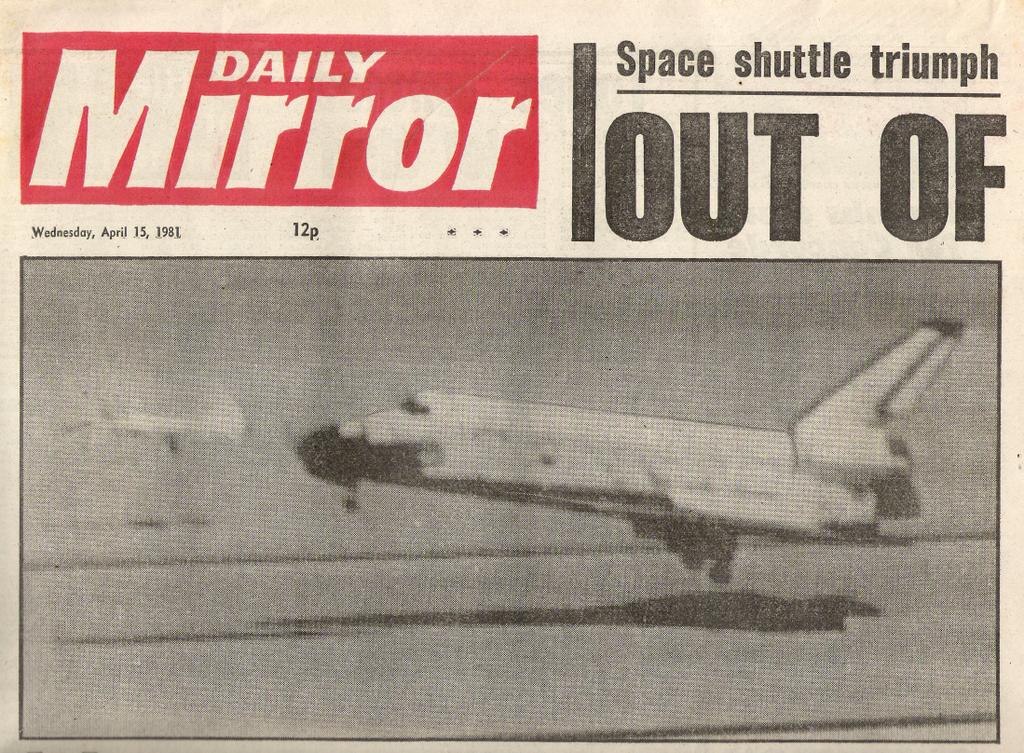
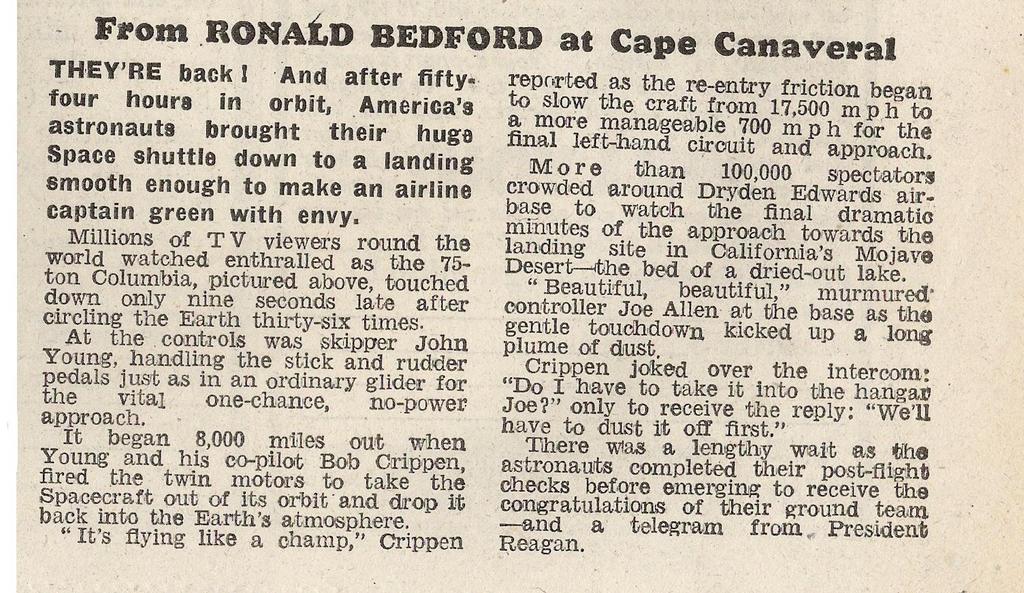
Snippets from The Daily Mirror, 15/4/1981. The space shuttle Columbia has returned from its maiden flight, nine seconds late!

13 April 2008

Rubik's Cube History

Bűvös Kocka - Magic Cube.

Erno Rubik, a lecturer in the Department of Interior Design at the Academy of Applied Arts and Crafts in Budapest, Hungary, was passionately interested in geometry - the study of 3D forms - in construction and in exploring the hidden possibilities of combinations of forms and material in theory and in practice.

Rubik’s favourite teaching method was to communicate his ideas using models, made from paper, cardboard, wood or plastic, challenging his students to experiment by manipulating clearly constructed and easily interpreted forms. It was the realisation that even the simplest elements, cleverly duplicated and manipulated, yielded an abundance of multiple forms that would eventually lead to the Rubik's Cube.

Rubik set out to create a three dimensional object, of high aesthetic value, which was not only richer in configuration variations and more of a mental challenge than any puzzle in existence, but would also continue to be one, self-contained whole, throughout its manifold transformations.


This objective at first seemed absolutely impossible. After conceiving the idea of the 3x3x3 Cube, Rubik first tried to hold together the elements of a simpler, 2x2x2 cube, by means of an elastic rubber construction that threaded its way through all 8 elements. But he simply could not get the device to work.

Inspiration struck on a sunny summer day in 1974 as Rubik was watching the River Danube flow by. His eyes were attracted by some pebbles, whose sharp edges have been rubbed and smoothed away in the course of time, producing rounded shapes of great but simple beauty. He decided that the interior of the Cube elements had to have the same rounded form.

The interior mechanism, which is basically cylindrical, took some time to construct. For ease of manipulation, the balance between tightness and looseness had to be just right, tolerances had to be exact. Finally, the fifty-four outer surfaces of the individual elements were given their colours.

Lots of different decorative patterns, with numbers and symbols as well as diverse colour combinations were tried, but none of them worked as well as six simple but distinct colours, one for each face of the Cube.

Erno Rubik demonstrated the Cube to his students. He allowed some of his friends and students to play with it and the effect was startling: once somebody had handled the Cube it was difficult to get them to give it back! People found the Cube absolutely compelling right from the very beginning.

The compulsive interest of friends and students in the Cube surprised Erno Rubik a great deal, and it was months before any thought was given to the possibility of having it manufactured for sale.

Rubik took out a Hungarian patent for the Cube in 1975 - he named it "Bűvös Kocka" - "Magic Cube". Eventually, toy production firm Politechnika took on the job of equipping itself for mass production and making the puzzle available to the Hungarian public.

Given the complex interior structure of the Cube, and the economic conditions in Communist Hungary, this was no easy undertaking. Fortunately, Politechnika, President Lehel Takacz and Chief Engineer Ferencz Manczur, saw tremendous potential in the Cube and were happy to accept the challenge.


The process of turning Rubik’s hand-made Cube into thousands of low cost, mass manufactured units was, however, despite the best efforts of all concerned, painfully slow.

It took almost three years, but at last, towards the end of 1977, the first test batches of Magic Cubes appeared on the shelves of Budapest toyshops.

During 1978, without any promotion or publicity, the Magic Cube began very slowly to gain in popularity. By the beginning of 1979, there was growing interest in the Magic Cube throughout Hungary.

Hungary was firmly “behind the Iron Curtain” at the time and the growing popularity of the Cube did not permeate the Western World for quite some time.

Two men of Hungarian origin living in the West were absolutely integral in initiating events which eventually enabled the Cube to make the journey from behind the Curtain.

Dr Tibor Laczi, born in Budapest, was employed by a major German computer manufacturer and discovered the Magic Cube on a business trip to Hungary. He was absolutely fascinated by it, and sensing its potential consumer appeal, brought it to the Nuremberg Toy Fair in February 1979 in the hope of finding an interested German toy distributor. He was unsuccessful, but met up with an individual at the fair who was also destined to make a crucial impact on the Cube’s history.

Tom Kremer was a successful and respected toy and game inventor himself and ran his own marketing and licensing company, Seven Towns Ltd, in London, England.

The two men made a decision, there and then, to join forces and try to reproduce the Hungarian success of the Cube internationally.

Dr Laczi went back to Hungary to set to work on the prevailing Hungarian bureaucracy whilst Tom Kremer set off on a world tour of toy manufacturers.

He was convinced that to realise the Magic Cube's full commercial potential it had to have the marketing muscle, the promotional power and distribution network of a major international company. Unfortunately he found none of the movers and shakers in the field shared his enthusiasm. Although impressed by the Cube, the general view within the industry was that its prospects were poor. It was too difficult to manufacture, too “quiet” and “cerebral”.

After many rejections, Tom Kremer succeeded in persuading Stewart Sims, Vice President of marketing at the Ideal Toy Corporation, to come to Hungary to see the Magic Cube in its homeland. It was September 1979, by which time the Cube had gained a sufficient degree of popularity to be seen out and about on the streets of Hungary occasionally - and it was immediately plain that the puzzle was a source of absolute fascination.

After five days of negotiations between Mr Sims and the Communist organisation, which was largely ignorant of the operation of a free market, with Tibor Laczi and Tom Kremer working flat out to keep the negotiations afloat, an order for one million cubes was signed.

As the New Year of 1980 loomed, the Magic Cube was at last heading for wide-spread distribution in the West.

In the meantime, word about the Magic Cube had been spreading to academic circles in the Western World. David Singmaster, a mathematician based at the South Bank University in London, England, first encountered the puzzle at the International Congress of Mathematicians in Helsinki in August 1978, and brought some to England for distribution amongst interested friends and colleagues, mainly in academic circles.

He wrote a newspaper article about the Magic Cube in June 1979, the first to appear outside Hungary, which helped bring the puzzle to the attention of academic circles world wide.

A small number of Magic Cubes had found their way beyond Hungarian borders, but the vast majority of people in the West remained ignorant of the puzzle’s existence.


Bridget Last wrote "A Simple Approach To The Magic Cube" in 1980 - and it was published by small company, Tarquin Publications of Diss, Norfolk in a limited print run. Small numbers of Magic Cubes had seeped beyond Hungarian borders, via academics and puzzle fans. But numbers were terribly small and the vast majority of people were ignorant of its existence. Still, was this the first Cube book published in England? Meanwhile, Pentangle, a small niche puzzle company of Over Wallop, Hants, imported small numbers of Magic Cubes, but nowhere near enough for it to enter mainstream pop culture. However, nobody could guess what would happen next!

The Magic Cube made its international debut at the toy fairs of London, Paris, Nuremberg and New York in January and February 1980. Erno Rubik was on hand to demonstrate his creation, and the Cube made an immediate impression on trade buyers.

Orders came in thick and fast, but there was one major problem - the Hungarian Cubes did not conform to Western quality standards and packaging norms. Drastic changes were needed in the manufacturing process. The implementation of these changes was slow.

Finally a new, lighter Cube, easier to manipulate than before, emerged. There are significant differences in the look, weight, and ease of manipulation of the Magic Cube and the Rubik's Cube. Magic Cubes are rare, but if you have managed to find one, compare.

Ideal Toys decided to rename the Magic Cube. "The Gordian Knot" and “Inca Gold" were considered, but the company finally decided on “Rubik’s Cube” - simple, distinctive and giving credit where it was due. The first Rubik's Cubes were exported from Hungary in May 1980.


One of the first Rubik's Cubes - Toy of The Year 1980 and 1981 in the UK. The first consignment arrived here just before Christmas 1980 and the British association Of Toy Retailers, noting the intense interest in the product, voted it top toy. A shortage in supplies resulted in many cheap imitations appearing. The country was finally fully stocked with Rubik's Cubes in the spring of 1981.

The Rubik's Cube swept the world in 1981 - and even made it onto the cover of the "Sunday Times" review of the year!

For more '80s Actual Cube stuff, please click on the "Rubik's Cube" label below.