Total Pageviews

Pages

22 March 2012

The Simpsons

Look kind of familiar? The Simpsons as they appeared in 1987. The characters soon morphed into the more familiar images we still see today.

Over in America in early 1987, Matt Groening created The Simpsons.

The USA's favourite dysfunctional family first appeared in Mr Groening's mind whilst he was sitting in the lobby of James L. Brooks's office, producer of The Tracey Ullman Show for the Fox Network.

Tracey was already a celebrity here in England. Think of Three Of A Kind. Think of those wacky pop hits.

I can't break away, though you make me cry...

But they don't know about us - and they've never heard of love...

And so on.

Back to the USA and 1987.

Mr Groening had originally intended to pitch for a series of cartoon shorts for Tracey's series based on his Life in Hell series. However, he quickly realised that animating Life in Hell for television would require the rescinding of publication rights for his life's work. And so his fertile mind, working on absolute overdrive in Mr Brooks' lobby, came up with Bart, Homer, Marge, Lisa and Maggie.

The Simpsons debuted as a series of cartoon shorts on The Tracey Ullman Show on April 19, 1987.


According to legend, the show's producer was concerned about the ugly appearance of these new creations, and our very own Tracey reportedly reassured him: "Relax! It's an '80s show!"

And so popular were The Simpsons cartoon shorts that, in 1989, work began on a half hour series of Simpsons shows, with the first, a "holiday special", being broadcast on December 17, 1989.

And the rest is history!

An American TV guide from December 1989...

To some viewers one of the best parts of Fox's "The Tracey Ullman Show" was the commercial breaks.

That's no knock on the talented Ullman. It's just that each set of commercials was preceeded by the antics of the Simpsons, the animated family created by cartoonist Matt Groening whose playlets were hilarious dispatches from the front lines of the ongoing war between parents and their children.

We haven't seen much of the Simpsons lately. The quiet is due not to a truce, but to the preparation of a new offensive. The Simpsons will soon debut in their own Fox series, probably next month. And on Sunday, December 17, Fox will air "Simpsons Roasting On An Open Fire", a holiday special starring dad Homer, mom Marge, brother Bart, sister Lisa and baby Maggie...

The Simpsons are a family as families really are. Homer is in a continual state of low level exasperation, with the threat of an eruption always lurking. Marge is the jumpy peacemaker, bearing a quivering white flag back and forth between the battle lines of Homer and the children. And the kids are like the first mammals in the age of the dinosaurs, peeping from the underbrush at a world of behemoths, pausing in their torture of each other only to unite against the threat of its interruption by lumbering adults whose seeming soul purpose in life is to ruin any hope of having fun.

"The most common thing people tell me," says Simpsons creator Matt Groening in a soft, friendly voice, "is that I've been spying on them."

17/12/1989 - an historic telly event for America. The first full-length episode of The Simpsons, a seasonal tale entitled Simpsons Roasting On An Open Fire, was broadcast.

19 March 2012

The New Man

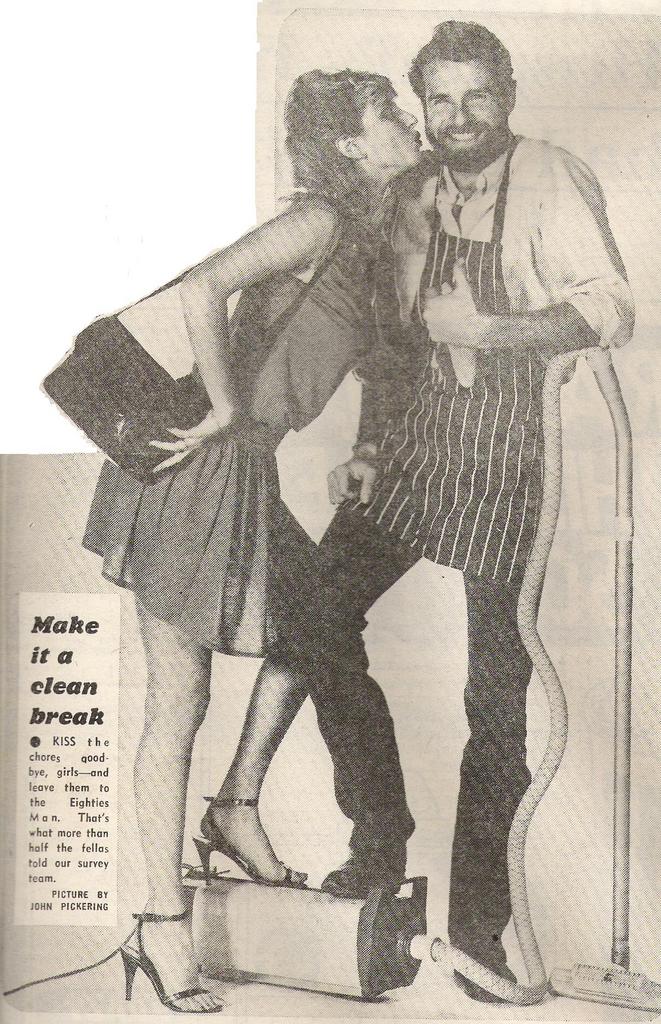
The Eighties Man: Day Two of a fascinating Sun series.

FELLAS DON'T FEEL A NINNY IN A PINNY!


They'll chip in on the chores.

The Sun, January, 1983.

Today's man does not mind a bit if he is left holding the baby - in fact he quite enjoys it.

He sees nothing odd in pushing a trolley around the supermarket, running around with the vacuum cleaner, or cooking the supper.

He believes - and his wife agrees - that looking after the children and doing the household chores should be shared equally between men and women.

When it comes to getting up to feed the baby 65 per cent of men and 71 per cent of women think that, where possible, they should take turns.

Almost as many men - 62 per cent - think shopping for groceries is a task that should be shared. And more than half - 58 per cent - say that the burden of housework should be split.

Yet a decade ago a real man would not have been caught dead with a dirty nappy and would never be seen with his hands in the sink, let alone flitting around with a duster.

What has caused this major shift of attitudes?

Partly the fact that more and more women have jobs outside the home.

In our survey almost half the women - 43 per cent - worked and four per cent were the main wage earners.

Housework HAS to be shared if it is to get done at all.

But Women's Lib was, in some ways, People's Lib. Men who felt they were missing something by leaving child-care to their wives were encouraged to lend a hand.

Yet there is still some way to go before everyone rejects the old idea that a man's place is at work and a woman's place is in the home.

And the men and women who do not believe that housework and childcare should be shared equally stick to the old patterns.

Of these, 46 per cent believe that cooking the meals is woman's work.

Forty-one per cent think the same about housework and one in three say women should do the food shopping.

But 48 per cent of all men say that painting and decorating are their work and 40 per cent feel the same about gardening.

The American "Eighties Man"/"New Man" - was a similar concept, which rose into the public consciousness c. 1982, although with more emphasis on men being allowed to develop and display emotional sensitivity then is illustrated in the article above. The fact that men do display emotion in their own way, and women are not unique paragons of all the virtues, was unacceptable. We still tap into ancient notions of chivalry and deference to women, and women's in-group bias is a studied fact, so equality (anybody for a glass cellar job outside of the male ranks?) is not actually equality, just as the past was not really a case of 'oppressing' women.

20th Century Words by John Ayto (Oxford, 1999), traces the "New Man" to 1982 -

"a man who aims to be sensitive, caring, and non-aggressive and to take a substantial role in his household's domestic routine..."

Apparently, as the decade went on, the New Man began to be regarded as a bit of a wimp in some quarters:

1985, Chicago Tribune:

Does the New Woman really want the New Man?... The answer, as you might guess, is a frustrated no.

Sadly, the 1990s regressed, giving us the "New Lad".

I thought the 1980s were great from a male viewpoint. In my neighbourhood, back in the 70s/early 80s, boys who liked soap operas were considered... well... strange. But in the 80s, with the arrival of trendy soaps like Brookside and teenage soaps like Home and Away, it was OK for us to join in.

And to get emotional.

As a kid in the '70s, I always felt as though I was in an emotional straitjacket.

Also, grooming. No man in my family ever owned a hairdryer before the 1980s. It would have been unthinkable. In 1984, I became the first!

The "old Man" was often not very keen on the "New Man", as this comic strip from the Sun newspaper's women's section, September 15 1988, shows!

Toys: Back To 1984 - Transformers, The A Team, My Little Pony, Postman Pat, Roland Rat and Knight Rider...

A skim through the toy selection in the Janet Frazer autumn and winter 1984/5 mail order catalogue - starting with some robots! Remember those "Transformers - Robots In Disguise" on telly - robots that turned into boats and things? Weird, eh? And what about the toys? Genius, or TV merchandising overkill? In my day, we were lucky if Mum had a spare spud for a Mr Potato Head...

Mind you, that's not to say there wasn't loads of TV-related merchandising in the 1960s and 1970s. I loved the Magic Roundabout, and you could buy Dougal house slippers, Magic Roundabout lampshades, Magic Roundabout biscuits, Magic Roundabout wallpaper, Magic Roundabout figurines, Magic Roundabout clocks, Magic Roundabout tea towels, Magic Roundabout curtains, Magic Roundabout mattresses, Magic Roundabout cuddly toys, Magic Roundabout annuals, Magic Roundabout storybooks, Magic Roundabout colouring books, Magic Roundabout dot-to-dots, a grand Corgi miniature Magic Garden, Magic Roundabout crockery, Magic Roundabout tablecloths, Magic Roundabout soap, Magic Roundabout bubble bath, Magic Roundabout umbrellas...

Most of these things I desired but couldn't have because my parents couldn't afford them. But certainly the concept of children as consumers was not invented in the 1980s.

A whole range of A-Team merchandise, including a toy "Mr T" - "HE'S BIG AND BOLD! HE'S THE BOSS!"

A My Little Pony baby walker - the little girl in the illustration looks thrilled with it, doesn't she?

He-Man and the Masters of the Universe - an animated TV series featuring the likes of the goodly Prince Adam and the evil Skeletor. Lots of viewers. Lots of associated merchandise - including here your very own Castle Grayskull - "fortress of mystery and power".

Snake Mountain - "ELECTRONIC MICROPHONE CHANGES YOUR VOICE INTO A SCARY 'VOICE OF EVIL'!" Ain't technology wonderful?

The battle between good and evil rages fiercely.

First appearing in 1981, Postman Pat was a tremendous success, earning many fans beyond the target audience of tiny tots. All together now: "Postman Pat, Postman Pat, Postman Pat and his black and white cat"!

Roland Rat - the ultimate '80s superstar. Look at all this - Roland Rat and Kevin the gerbil jigsaws, a stencilling kit, Roland, Errol the hamster and Kevin the gerbil toys and your very own RATMOBILE!

Knight Rider - a highly popular American children's series starring David Hasselhoff as Michael Knight and a very sophisticated car called KITT - had some very snazzy associated merchandise. Also in the picture is a battery operated Knight Rider push button intercom set that: "really works from room to room. Includes 30ft cable, buzzer sound and working light."

1987: The Great Gale And The Stock Market Crash...

Much is made of Michael Fish's reassurances that all was well on the night of the gale, but apparently he simply reassured viewers, after a telephoned query to the BBC, that there wasn't going to be a hurricane that night. The wind never reached hurricane force, so perhaps we should let him off? Mind you, I can't help thinking that Auntie Beeb and co should have been aware that something was brewing!

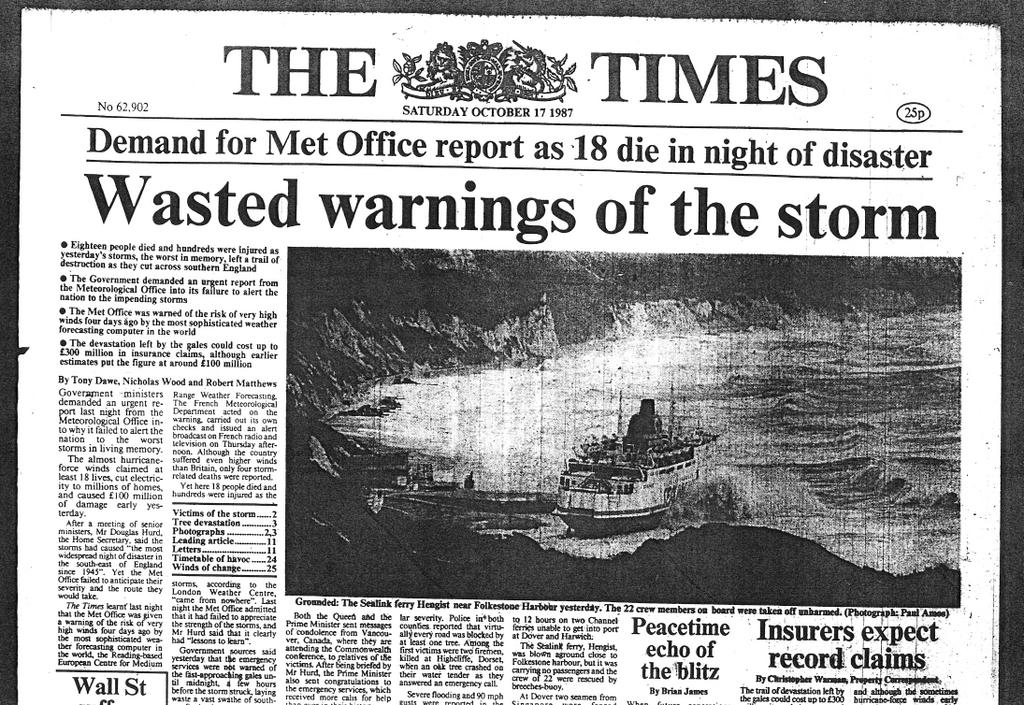
From The Times, 17/10/1987...

Eighteen people died and hundreds were injured as yesterday's storms, the worst in memory, left a trail of destruction as they cut across southern England.

The Government demanded an urgent report from the Meteorological Office into its failure to alert the nation to the impending storms.

The Met Office was warned of the risk of very high winds four days ago by the most sophisticated weather forecasting computer in the world.

The devastation left by the gales could cost up to £300 million in insurance claims, although earlier estimates put the figure at around £100 million.

Government ministers demanded an urgent report last night from the Meteorological Office in to why it failed to alert the nation to the worst storms in living memory.

The almost hurricane-force winds claimed at least 18 lives, cut electricity to millions of homes, and caused £100 million of damage early yesterday.

After a meeting of senior ministers, Mr Douglas Hurd, the Home Secretary, said the storms had caused "the most widespread night of disaster in the south-east of England since 1945"...

Extract from Peacetime Echo of the Blitz, The Times, 17/10/1987:

When future generations crowd at the knee to ask: "What did you do in the Great Wind, Daddy?" the boldest will answer for sure: "I walked." As London awoke yesterday from a night when even its bravest buildings seemed to be howling, it was to darkness and to stillness.

Then the first humans came into view. They looked footsore but triumphant, coming together in twos and threes to walk together in streets without traffic to destinations in office blocks without lights. "How's your house?" was an invariable greeting, uttered with an almost superstitious awe.

As they walked, they talked with stoic modesty: "Well, I was lucky. Got a lift in a bread van to Kingston. Then the bus came. Never been to the Elephant before, but I thought it would save me a mile or so, I thought 'here goes'. Only took me an hour after that."

They walked looking about them at the bizarre. The pot plants standing on a traffic island. The traffic cone in the window of a sandwich bar. The deckchair atop a bush in St James's Park; the racing skiff from the Serpentine, now embedded in the branches of a tree. A man in the electricity showroom pumping at a gas burner to brew tea...

Whatever next? We didn't have long to wait to find out...

The Yuppie Millionaire's Guide To The Good Life, an article published in The Times on 19th October 1987, featured news of the arrival of a new American magazine simply called Millionaire, which bore the subtitle "Lifestyles of the working rich".

To quote the article:

Even the advertisements appeal to raw indulgence. "Absolute power corrupts absolutely" goes the pitch in the full page [advertisement] for Maserati.

The publisher of "Millionaire" is Mr Douglas Lambert, the Florida millionaire who started "Playgirl". He says he is not aiming at the older, idle variety of rich, but at the younger battalions who have emerged from the business boom of the Reagan years, "the person who is out there earning money and wants to spend it on nice things".

He says: "I have no problem with that. I think the attitudes of the 1960s are gone." A brief excursion in Manhattan is enough to convince anyone that Mr Lambert is understating it. Eavesdrop on any gathering of under-35-year-olds and the topic is almost always related to money.

But the article also recorded the fact that more and more Americans felt the boom era was drawing to a close as the stock market suffered "daily jitters".

Ironically, the 19th October 1987, the very day that the yuppie millionaire's guide to the good life article appeared in The Times, will forever be remembered as "Black Monday"...

1987, which had started out as such a sleek, shoulder-padded, money-worshipping beast, had suddenly gone completely off its rocker...

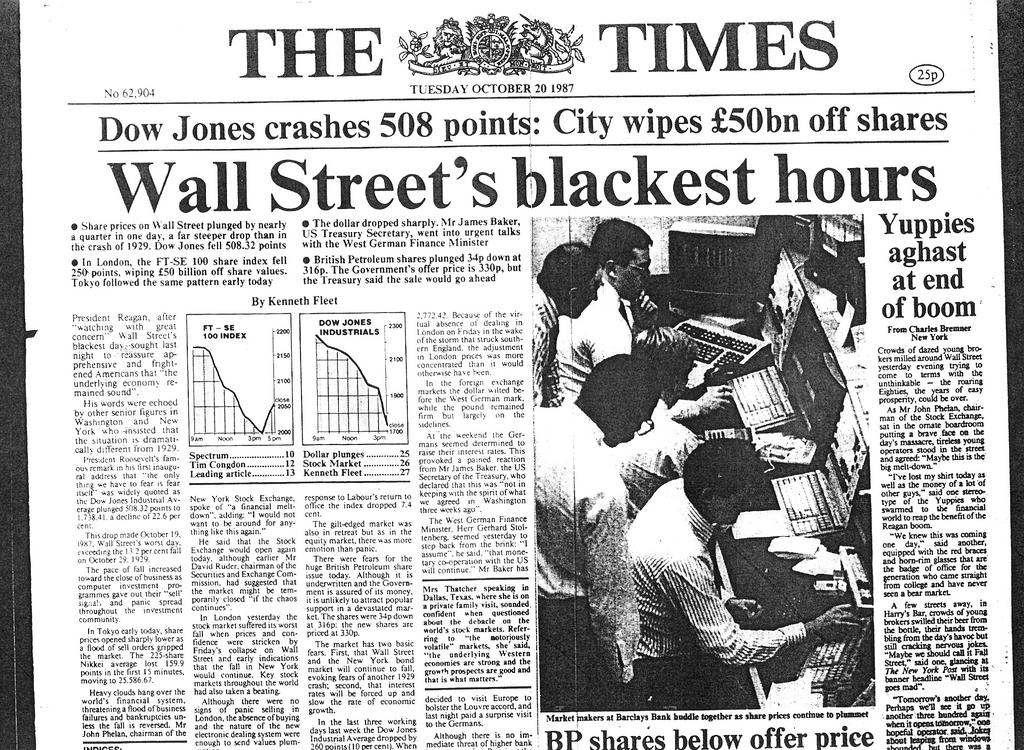
From The Times, October 20th 1987.

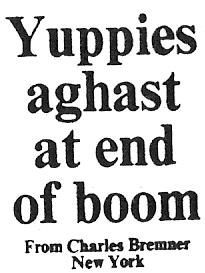
Crowds of dazed young brokers milled around Wall Street yesterday evening trying to come to terms with the unthinkable - the roaring Eighties, the years of easy prosperity, could be over.

As Mr John Phelan, chairman of the Stock Exchange, sat in the ornate boardroom putting a brave face on the day's massacre, tireless young operators stood in the street and agreed: "Maybe this is the big melt-down."

"I've lost my shirt today as well as the money of a lot of other guys," said one stereotype of the Yuppies who swarmed to the financial world to reap the benefits of the Reagan boom.

"We knew this was coming one day," said another, equipped with the red braces and horn-rim glasses that are the badge of office for the generation who came straight from college and have never seen a bear market.

A few streets away, in Harry's Bar, crowds of young brokers swilled their beer from the bottle, their hands trembling from the day's havoc but still cracking nervous jokes. "Maybe we should call it Fall Street," said one, glancing at The New York Post with its banner headline "Wall Street Goes Mad".

"Tomorrow's another day. Perhaps we'll see it go up another three hundred again when it opens tomorrow," one hopeful operator said. Jokes about leaping from windows abounded, but there was a feeling that the country was not in such bad shape as it was in 1929.

Older hands said they saw an end to the collapse provided the market came to its senses within the next few days. They pointed to the continuing strength of the economy, still growing after the longest post-war expansion.

But it was obvious nothing would be the same again after Black Monday. A black man on a bicycle seized the mood when he shouted at the brokers: "Freedom! The Reagan revolution is over. Death to Yuppies."

A tubby broker bellowed back at him: "Whoever dies with the most toys wins. We start over again tomorrow."

1985: Live Aid

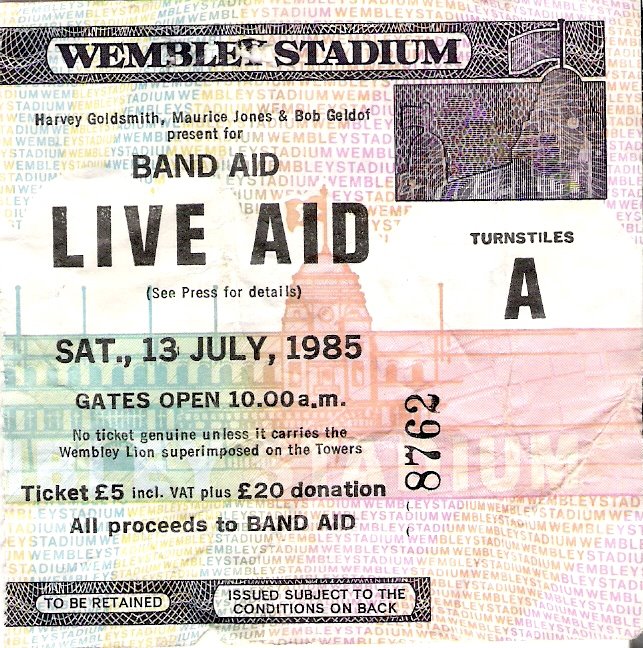
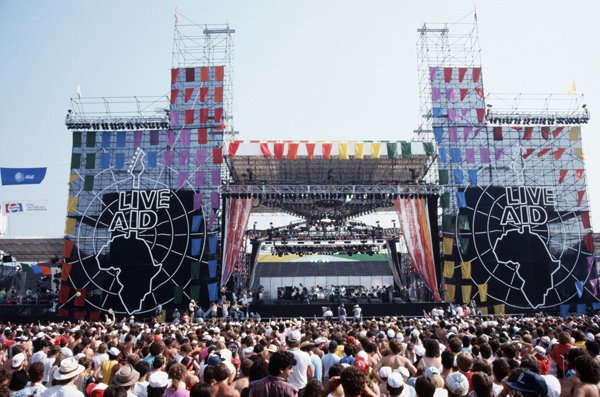
After Band Aid in 1984, 1985 gave us Live Aid - the Global Juke Box - the 12 hour pop marathon, watched by an estimated 1.5 billion people worldwide...

The events took place at Wembley Stadium, England, and the John F. Kennedy Stadium in Philadelphia, USA, on 13 July 1985. It was a massive event, unparalleled in rock history.

You'd got your ticket...

You'd got your T-shirt...

And suddenly you were there...

...with Charles and Diana, Bob Geldof, U2, Spandau Ballet, Nik Kershaw, Sade...

... Freddie Mercury and Queen... and oodles of other notables.

Yes, it had been a pain queuing for the loo; yes, it had been grotty when the girl in front of you had stepped back on to your big toe... but you still went home in a blissful daze...

It had been a day of colour, light, sound, energy... a day that made rock and pop history... a day that saved lives...

And if you were at home, watching the spectacle on the telly, it was still a fantastic experience...

Even via the small screen, Live Aid was pure magic.

Bob Geldof (referred to as "Sir Bob of Geldof" in certain quarters) had been driven, a man possessed by his dream right up to and, indeed, throughout the concert (remember his cussin' and blindin'?).

The 1980s - the decade of greed?

With the launch of the Children In Need telethon on the BBC in 1980, the Band Aid single in 1984, Live Aid in 1985 and Comic Relief - which was launched in late 1985 - that cannot be correct.

Greed unlimited is far from being the true picture.

The 1980s was the decade of contrasts.

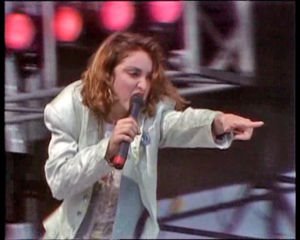
Madonna on-stage in Philadelphia, experiencing rucked-up shoulder pad syndrome.

How the Sunday People reported events - 14/7/1985:

A thunderous roar erupted when the Greatest Rock Show on Earth got under way yesterday with the arrival of Prince Charles and Princess Di.

And the Royals raved it up with the rest.

Princess Di was clearly thrilled to meet her pop idols as the couple were introduced backstage to 60 of the stars.

And as Prince Charles watched the jean-clad rock fans enjoying the party, he said:

"I'll have to buy myself a pair of denims."

Part of the show at the preliminaries was stolen by two-year-old Fifi Trixie-Belle Geldof, daughter of Boomtown Rats star Bob, who masterminded the event.

She was supposed to present Di with a bouquet, but fled, overcome by shyness.

The royal couple clapped and tapped their feet along to the music.

Nearly two billion people were estimated to have tuned into the extravaganza.

The £10 million target for the twin Live Aid concerts at Wembley Stadium and Philadelphia could eventually be trebled when the cash is totted up from donations, TV rights and souvenir sales.

Geldof summed it up: "To me it is not a pop concert. To me it is not a TV show. To me it is simply a means of keeping people alive."


Quotes from the day:

Gary Kemp, of Spandau Ballet, who arrived by helicopter: "It was the most incredible sight from the air. Quite wonderful. This is going to be the greatest audience in history. It won't happen again, ever, at least not with this generation of performers."

U2 vocalist Bono: "The money spent on defence could turn the deserts of Africa into fertile land. The technology is with us... but the technocrats are not."


17 March 2012

Marilyn

It's been a fascinating experience to relive the 1980s through the newspapers of the decade - brilliant to escape from the BBC and Wikipedia's "We Glorify The '70s" nonsense, and to see the '80s as they really were again. Brash. Noisy. Violent. Glamorous. Technological. Outrageous. "Stylish" (note the speechmarks). Contrasting. Money loving. Caring. Fast moving...

But sometimes the newspapers rose above the roar and clatter of the decade and contained unquestionably wonderful things like the photograph of the two monkeys above, featured in the Daily Mirror in February 1984...

Hugging each other and clinging on to life, these monkeys are a real handful.

Since they were born three weeks ago, they've left their best friend Molly Badham with scarcely any spare time. Molly, who named the inseparable pair Peter and Pop, has bottle-fed them every three hours at her zoo in Twycross, Leics, because their mother rejected them.

Happily, Peter and Pop are doing fine.

I was, for some reason, deeply moved by the photograph... those adorable little faces, those intelligent eyes, the way they were hugging each other for comfort. Just like humans...

I felt tears pricking into my eyes and began to ponder the mysteries of life...

Then my eyes moved briefly to the right:

Marilyn has his handbag pinched

Only in the '80s!

My reflective mood trailed off into a very un-high minded explosion of raucous laughter...

Pop star Marilyn had his handbag, containing £500 in cash, snatched last night as he sat in a London restaurant.

And the singer, who wears outrageous clothes and make-up on and off the stage, is offering a reward for its return.

"It's awful," he said. "It had my address and my diary in as well as my wallet and all my keys.

"It had every appointment for the next six months in. I just don't know what I'm going to do.

Two men lifted the black rubber bag with grey trimmings from a seat as Marilyn sat with a woman friend in a restaurant near Oxford Circus.

"The fact that someone can actually do that is beyond me," he said. "I know the money's gone but I'm desperate to get the address book and diary back."

Poor Marilyn. Did he get his things back? If you know, drop me a line...


From the Daily Star, October 2, 1984:

Breakfast TV beauty Selina Scott was faced with her spitting image when she ran into chart-topper Marilyn yesterday.

The look-alike couple were among the celebrities at the Variety Club banquet in honour of Radio One.

And even guests who could tell one from the other were stumped when it came to deciding who looked prettier.

However everyone agreed they made an incredible double act.

1980s Shoulder Pads

Jason Donovan of Neighbours and Stock, Aitken and Waterman fame sports some very big and lovely shoulder pads. And a mullet.

Ah, shoulder pads! Ah, the 1980s! So where's the link? As if we didn't know! Studying fashion via vintage mail order catalogues and fashion shop ads in my local newspaper archive is where I began my work of learning the realities about popular clothing of various decades.

By this, I don't mean the ultra sophisticated garb of the super rich, as seen on the posh fashion show catwalks (very Jan Howard!).

No, I mean what Sharon and Gary (or you and me) were wearing down at the "local", and which pop or TV stars they (or us) had been inspired by.


So, what about those shoulder pads? Well, '80s shoulder pads actually began as a chic retro revival. They were first around in the 1930s and 1940s. 

Of course, the 1980s had bigger ones!

If you watch a TV programme from 1980, you will note the very ordinary-looking shoulders of the good folk on-screen. Shortly after this, small shoulder pads became prevalent. But, by the mid-1980s, COLOSSAL shoulder pads were everywhere. Nowadays, they make very amusing viewing.

It's tremendous fun to view several seasons of an '80s era American soap and watch those shoulders grow over the years!

Joan Collins of Dynasty fame was partly responsible, and where Dynasty flew, the rival American soaps followed as the female cast members howled for higher costume budgets and more "stylish" gear!

Shoulder pads became a required part of the power dressing image for women, and men also cottoned on to the trend. Well, those kindly pads tended to detract from a beer belly!

1940s shoulder pads had often been big. 1980s shoulder pads were usually bigger.

Sometimes absurdly so.

The era of the truly massive shoulder pad began around 1982/1983 and stretched on into the early 1990s.

Personally, I used to like them in a nice pastel linen jacket, with the sleeves pushed up.

Unashamedly an '80s fashion victim!

And why not?

The '80s are sometimes called "The Style Decade". But the trouble was the styles were often too brash, too "in your face". A lot of us were "dead common" back then. And a lot of the styles - like those oh-so-stylish shoulder pads were horrendously OTT!

Fun, though...

Kate (Susan St James) of the American sit com Kate And Allie wears very clearly defined and MASSIVE shoulder pads. Very smart indeed!

Nik Kershaw

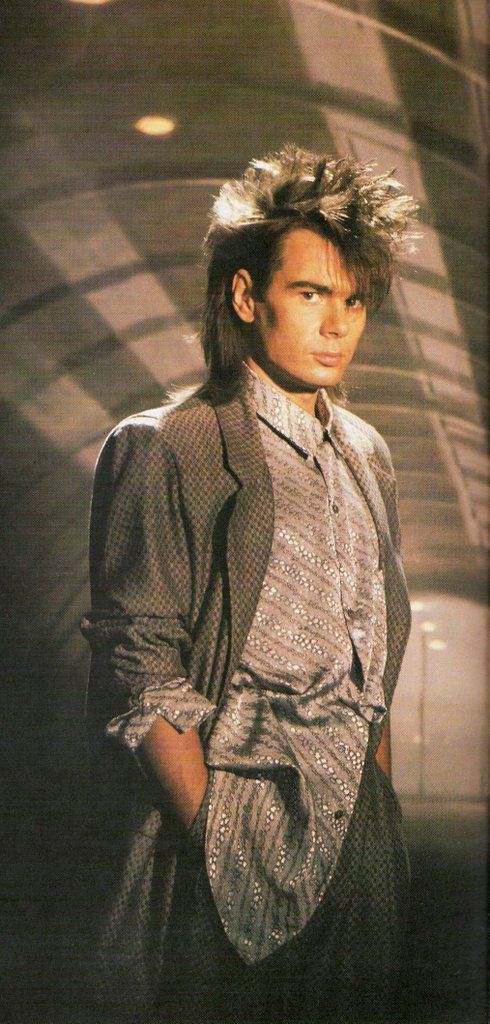
Nik Kershaw in 1985, sporting that popular mid-'80s look probably best labelled "I-was-going-somewhere-posh-but-got-dragged-through-a-hedge-backwards-on-the-way".

After a brief school days dalliance in a band called Half Pint Hog, Nik Kershaw went to work as a clerk at the DHSS in Ipswich from 1975 to 1978 ("I spent all day handing out Giro cheques to people on the dole, it was really depressing. You'd see the same people every week, and you'd watch them going slowly downhill, yet all I could do was fob them off with a cheque.").

He later worked at his local Co-op hardware store.

Nik was also a member of a band simply called Hog - a spin-off from Half Pint Hog. He then joined an Essex jazz-funk band called Fusion, which split up in 1982.

Deciding to concentrate on song writing, Nik borrowed a friend's Portastudio cassette machine, and began writing and recording at home.

He was getting nowhere - rejection followed rejection, so he advertised for a manager in Melody Maker, got himself a gent called Mickey Modern, and a record deal soon followed.

Wouldn't It Be Good entered the Top Forty at Number 38 in February 1984 and Nik briefly knew tremendous success - becoming a pop idol.

This down-to-earth bloke actually wrote terrific pop songs - and they weren't just "pop pap" (I Won't Let The Sun Go Down On Me had wonderful anti-nuke lyrics).

Excellent. Whenever I hear one of Nik's 80s hits on the radio, a big daft grin spreads right across my face - from ear to ear.

Happy memories!

Max Headroom

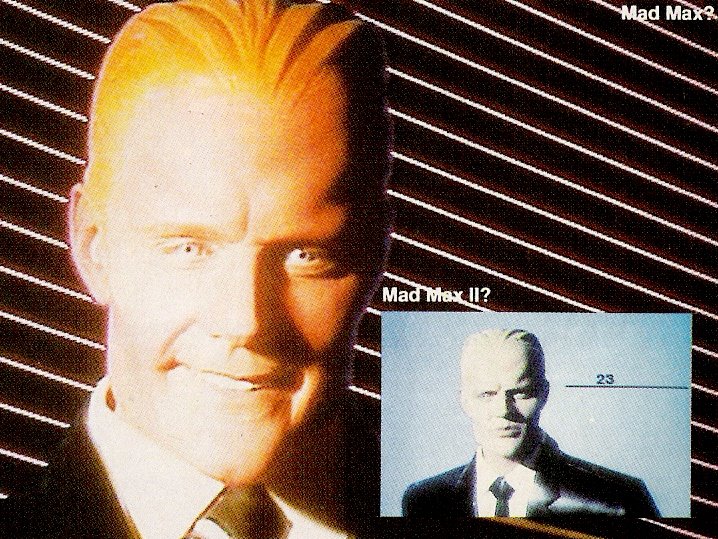
Super weird TV presenter Max Headroom... Now what was all that about? I found the lowdown on Mr Headroom in a magazine article from May 1985...

"When we suggested a computer instead of a human being as a TV presenter, Channel 4 were DELIGHTED. A computer! No hangovers, no union disputes, no gossip column stories... and NO SALARY! It seemed so perfect. Nobody could have foreseen the trouble we'd have with him..."

Peter Wagg is the producer of the "Max Headroom Show" (Saturdays, 6.00pm) - Channel 4's newest pop video programme, a collection of 'the best of the new and the old' videos, linked by a bizarre stuttering character who's apparently part machine, part human being. Is he really a computer copy of a human brain? Is he a man with make-up? Is he just a puppet tarted up with a bit of computer graphics?

"Max is all those things," says Peter Wagg darkly, "and more..."

In fact his creators refuse to divulge how he works. "A trade secret," they say. "He's a series of techniques joined together."

They claim instead that Max was first created from the brain of super-sleuth journalist Eddison Carter and rescued from the corrupt Network 23. He was simply glad to be alive and of some small use to his rescuers. But Max has taken to media stardom like a duck to water, and Peter Wagg is afraid that it has turned his head...

"He really is very difficult. All we want him to do is be jolly on the telly and introduce the videos. But he's rather political and keeps getting digs in that aren't in the script. And he's so VAIN."

But intial reaction to the "Max Headroom Show" has proved too favourable for his creators to pull the plug on him now and, if Max gets his way, his show will soon be shown all over the world.

"It's world domination or nothing now," says Peter Wagg, sadly. "I'm afraid we've created a monster."

PERSONAL FILE ON MAX HEADROOM

Name: Maximum Headroom 2.3m

Born: In Finchley, North London.

Starsign: Vegetarian.

What would you do if you weren't a TV presenter? Kill myself.

First record ever bought: "Digital Watch Tunes Volume 2", by Bronco

Are you going out with anyone? Come come now. We hardly know each other! Just get on and do the interview. 'They' want me to say that I'm happily married and in love with my wife. Hah!

Have you ever had a supernatural experience? I ate a Big Mac once without taking it out of the box...

Best thing about being a celebrity: Being invited on the "Terry Wogan Show".

Worst thing about being a celebrity: Meeting Terry Wogan.

What's in your pockets? My pockets? No they're definitely not 'in'.

16 March 2012

British Telecom Arrives...

In 1980, Post Office Telecommunications became British Telecom and would become a totally separate public corporation on 1 October 1981.

A popular saying of the late '70s and early '80s, a play on the "make someone happy with a phone call" ads, was "make someone happy - wring Buzby's neck".

Sounds hard, eh? Well, I don't think we really hated Buzby. Perhaps we just saw too much of him.


October 1981 - Buzby tops "hate" poll!

Treasure Hunt


Skyrunning with Anneka Rice. Destination: a ship at sea? The top of a lighthouse? The narrow deck of a submarine freshly risen from the deep blue ocean? No problem for Anneka and her team or pilot Keith Thompson.

The intrepid Anneka with her intrepid sound and camera men, Graham Berry and Frank Meyburgh.

1982 brought us Channel 4, a new telly channel with lots of fresh goodies - including Treasure Hunt - the first series was filmed in '82 and the first programme on-screen in late December, with the rest being screened in early 1983.

The idea for Treasure Hunt came from France - the creative genius in this case was one Jacques Antoine. In 1980, he came up with the idea for a brand new series called La Chasse au trésor and filmed a pilot episode - which was not intended for broadcast. Much work on the concept was still needed - in the pilot episode there was just a single contestant and no helicopter, plus other differences to the format that would later captivate TV audiences. Refined and honed, La Chasse au trésor was first broadcast on 15 March 1981, and refined and honed further for its second season in 1982. Over here in the UK, with Channel 4 cranking up for its November 1982 debut, it wasn't long before the idea was spotted...
Of course, there were some differences between the French and British versions of the show, but basically all Treasure Hunt devotees owe
Jacques Antoine a big "Thank You" for coming up with the basic idea in the first place.

Anneka Rice, she of the colourful lycra outfits, was quite sedate for the first Channel 4 series or so, as she sped around the British Isles - and occasionally further afield - in a helicopter, looking for clues so that studio bound contestants could win a cash prize. But it didn't take long for her lively personality to assert itself and soon she was shrieking her head off, chattering away ten-to-the-dozen via a radio link with former news reader Kenneth Kendall and the contestants in the studio or, face-to-face, with the general public, helicopter pilot Captain Keith Thompson, and camera and sound men Graham Berry and Frank Meyburgh.

She livened things up no end - a great 'people person' and just what the show needed.

Members of the "Treasure Hunt" team, including Anneka, Graham and Frank and pilot Captain Keith Thompson (far left).

In series one, clue and course setter Ann Meo popped in at the beginning of each show and exchanged some faintly astringent banter with Kenneth. Ann would later set questions for Blockbusters. In series two, Annette Lynton ("Nettie" to Kenneth) joined the show as on-screen adjudicator, plotting the helicopter's course on a large map and keeping contestants informed of the time remaining to complete the course. 

TV-am weather girl Wincey Willis arrived as adjudicator for the 1985 series and remained until the show ended. The show's final season in 1989 saw professional tennis player Annabel Croft taking over Anneka's role as "skyrunner" for some more highly enjoyable outings.


 Kenneth Kendall with two contestants and a floor manager at the Limehouse TV studios. The programme was made by Chatsworth Television.

Treasure Hunt is a show I remember very fondly.

Some fascinating facts about the series from the 1988 Look-In annual...

Each new series involves no less than 13 months of hectic organisation, and the process begins in November when ideas for new locations are considered. Local maps are checked, guide books are read and tourist offices are contacted about any special events which may be happening during filming. The following month, a list of 15 proposed locations is completed after confirmation that general flying conditions in each area are satisfactory.

In January, two of the team set out for an eight-week tour of the locations to see if they look good, to assess the interest of clue sites, and to establish a good route. Approaches are made to secure landing permissions, and the co-operation of site owners.Channel 4 broadcasts an announcement inviting hopeful contestants to write in, then application forms are sent out, and replies considered, in February.

In March, the best 15 courses are worked out and presented to the producer and director, and then the final 13 chosen. From the thousands who write in, 250 pairs of applicants are invited to attend an interview session.

By April, the task of obtaining permissions from all involved at locations is still under way. Captain Keith Thompson, the chief pilot, contacts local airfields to get the go-ahead for landing and flight paths from local air traffic controllers. Contestants’ interviews are held in various parts of the country.

The final selection of contestants is completed in May; one pair per programme plus one stand-by couple in case the first can’t take part. The producer, director, researcher and clue writer are flown to each location by Keith Thompson for a 10-day period to carefully test each idea. A communications expert organises the rental of special telephone lines from British Telecom and talks to the Independent Broadcasting Authority about the use of local broadcast frequencies. Both are crucial factors to the programme; without them Kenneth Kendall and company back in the TV studio would have no contact with the crew out on location.

During May and early June, dates and locations are confirmed with everyone involved, from the police and the Civil Aviation Authority to property owners. Work begins on clues and Chris Gage, the director, organises the Ordnance Survey maps to be used in the studio. Camera scripts are prepared.

The middle of June is crunch time: it’s when each series is recorded over five intense and hectic weeks during which the location crew work and live closely together. With the filming completed, the painstaking task of editing begins in August. And ends in November! By December, everyone breathes a sigh of relief when the finished programmes are presented to Channel 4 for transmission.

Although bad weather is a constant hazard, only rarely has a shoot had to be postponed. Such a time was when a sudden, heavy fog descended on the helicopter after a tricky landing made by Captain Keith Thompson in a car park. Anneka had to run into a nearby factory in search of a clue when Keith decided that further filming should be abandoned. Two days later, filming was resumed in bright sunshine, and as Anneka ran out of the factory she said: “My goodness, it’s cleared up a bit while I’ve been in there!”

Anneka has to be prepared for literally anything on the programme. “Malcolm [producer Malcolm “The Captain” Heyworth] often rings me up and makes a casual suggestion that I could learn some new energetic pastime which might be called for in one of the programmes,” she grins. “Last time it was scuba diving. I spent many weeks at the bottom of my local baths with tanks on my back for two hours at a stretch until I mastered it.”

The whereabouts of the “Treasure Hunt” clues are shrouded in such secrecy that Anneka is confined to her hotel until the day of the shoot. The only advance information she has then is the starting point of her take-off!

Anneka has nothing but admiration for Graham Berry and Frank Meyburgh, who never leave her side during recordings. “They have to stay with me every step of the way,” she says, “and theirs is a more strenuous job than mine because they have to carry all their equipment, whether it’s up a mountain or to a rock out to sea."

 
 The Treasure Hunt book, 1986. From Anneka's introduction: 

People seem to watch Treasure Hunt for different reasons. For some, it is the excitement of solving the clues before the contestants;  for others it is the glorious countryside, and the stunning aerial photography. For us the Treasure Hunt team, the most important part of the programme is you, the audience.

I am constantly amazed and touched by your letters - I've never worked on a series that inspires so much loyalty among its viewers: I recognise some of the names and handwriting from our first series. As long as you  keep watching, we'll keep rnning. Who knows, in 2010 Graham, Frankie and I may be charging around in motorised bathchairs.

12 March 2012

Post Box: Coronation Street: Renee and Alf Roberts - When Lorries Attack...

Renee (Madge Hindle): Beware of the lorries!

A lovely e-mail from Wendy, who says:

I've been watching episodes of Coronation Street from 1980 and I've reached July, which contains the death of corner shop keeper Renee Bradshaw/Roberts. She's killed by a speeding lorry after stalling her husband's car in a country lane. It seems bizarre to me that Alf, her hubby, was almost killed by a lorry crashing into the Rovers Return pub the year before. It's almost like lorries were out to get Mr and Mrs Roberts!

Lol - I remember it all well, but can't say the strangeness of it registered until you mentioned it! It is most peculiar! Renee (Madge Hindle) had reigned at the Corner Shop for four years, marrying Alf (Bryan Mosley) halfway through. The production team decided that the marriage was boring and as producer Bill Podmore had always seen Alf as a Mr Green, the grocer, it meant Renee had to go. A great shame because I was very fond of the character (although I agree with the then production team that the marriage was monotonous!). The trouble was, Madge Hindle was (and I'm sure is) a brilliant character actress and she invested Renee, the astute businesswoman, with a likeable warmth and faint air of daffiness which made me miss her presence in the show a great deal.

Did you know that Madge's daughter, Charlotte Hindle, was a friend and companion to Gilbert the alien in children's series Get Fresh and Gilbert's Fridge?

Enquiry - Depeche Mode: Enjoy The Silence - 1989 Or 1990?

Shanice writes:

Please, please, please answer my question! I've been getting into Depeche Mode and I know the band formed in Basildon, Essex, in 1980, and so on, but I'm puzzled by the dating of their single Enjoy The Silence. Some people say 1989, some say 1990. Do you know which year it was?

The mighty Mode (how do I love them? Let me count the ways...) recorded Enjoy The Silence in 1989, Shanice. It was released as a single in early 1990 - so, it's a 1989 song and a 1990 release. It also featured on the band's 1990-released album Violator.

Lovely to hear from you and a pleasure to answer your enquiry. Here at '80s Actual our motto is:

Sound and caring,
Help the helpless,
But always remain
Ultimately selfish...

Guess where we got that from! xxx

11 March 2012

Fashion 1989 - Beach - And Other Wear...

Twirling back to 1989 and the final year of our decade of uproar with a look at fashion. Chris Rea, of course, knew all about being on the beach, and so did the young lady above, in her highly lovely wetsuit-style fitted swimsuit with fluorescent pink trim. WOW! And what about the round the middle garb? Pass. And the wrist garb? Sports band? Wrist warmer? Pass again! Anneka Rice had a jump suit of a similar colour scheme to this costume in the hugely popular Channel 4 Treasure Hunt series.

All-in-one baggy fit trousers with braces back. Terrific.

Into the sea, you and me... lovely stretch jeans and colourful rugby tops. The jeans on the left were available in two washes and had ankle zips - so practical. Many jean legs were so narrow in the 1980s it was clear the designers had never heard of feet.

An array of lovely swimming costumes for that up-to-the-moment look. The two on the right would create a very interesting tan line!

Another all-in-one. Not sure why these were popular really.

Step out in leggings. From around 1982 onwards these things were all the rage and seem as much an '80s fashion statement as shoulder pads to me!

"Hot off the West Coast, beachboys and girls hit the streets and shores with the latest surf inspired style. A cult rather than a craze, the look injects colour into casual fun looks."

Goodness - what an industrial looking belt - and as for the ear-rings!

Nice shoulders... enjoy the power-dressed look in cool cotten.

Flourescent pink newsprint swimsuit. Gorgeous!

Here's Lorraine Chase having her own collection in the 1989 Look Again catalogue: "Glamorous good looks come easily with careful planning. Plan now with this fabulous collection of stylish separates and you just can't go wrong!" Not 'arf!