Total Pageviews

Pages

31 May 2011

EastEnders: Sue And Ali Osman, 1988...

January 1988, and Sue and Ali Osman (Sandy Ratcliff and Nedjet Salih) are the stars of the cover of Woman's Own. The tragic fictional couple are facing the arrival of a new baby and perhaps a bright new future...

Bright new future? Well the past had been anything BUT bright. Turkish Cypriot Ali Osman had come to England in 1975 and married his English wife, Sue, in 1982.

By early 1985, the Osmans were living in a thoroughly grotty flat in Albert Square, Walford, E20. Ali worked as a taxi driver and Sue ran the cafe in nearby Bridge Street.

The light of their lives was their baby son, Hassan.

Sue had been the child of older parents, both of whom never lavished much warmth or affection on her. She grew up emotionally insecure, and was often to be heard accusing Ali of being unfaithful to her.

Good natured Ali had his own problem - he was teetering on the brink of becoming a compulsive gambler.

Insecure Sue had a simple philosphy in life: get at people or be got at.

As well as bubble and squeak, hot tongue and cold shoulder were always on the menu at the cafe and Sue liked to make sure that the likes of Lou Beale (Anna Wing) got a large helping if required.

She worried over Ali's gambling, and sometimes her rants were fully justified. On one occasion, Ali risked the cafe on a bet!

But that bet paid off, showering them in money.

And then, just afterwards, Hassan died.

A cot death.

Sue and Ali were shattered. After her chilly upbringing, Sue found it hard to let her emotions have free reign, Ali experienced sexual difficulties in the wake of the tragedy.


The state of play in 1987: Ali's brother, Mehmut (Haluk Bilginer) and sister-in-law Guizin (Ishia Bennison) are now participating in running the business with Sue and Ali - and the Ozcabs taxi firm is underway (remember Dot Cotton (June Brown) answering the phone for Ozcabs in her "posh" voice?!).

Sandy Ratcliff wasn't terribly happy with stuck-in-the-mud Sue. In a 1987 interview, she said:

"Sue really annoys me sometimes because she's got no guts. I'd love to liven her up a bit, dress her in some of Angie's clothes, get her out of that cafe, set her up in a business of her own and allow her to make something of her life."

Sandy was into women's rights, and thought Sue should be, too:

"I was under the impression she'd become more assertive. I had visions of a bunch of feminists walking into the cafe one day right in the middle of a typical Sue and Ali fight, and them asking her why she puts up with him.

"No doubt Sue would screw up her nose and ask: 'What do you mean?' But she'd think about it, want to hear more and gradually begin to change her ways to become stronger, more independent!

"I get cheesed off with Sue. She isn't me at all."

And then, in October 1987, Sue announced she was pregnant again.

After years of trying following the death of Hassan, the Osmans were once more to be parents.

The couple's dearest wish.

So, we could be forgiven for thinking that a happy era was on the way for the troubled couple?

Certainly, Sandy Ratcliff and Nedjet Salih believed so when they were interviewed for the January 16th 1988 edition of Woman's Own...

"It's going to be the making of Sue and Ali," said Sandy.

"Neither of them has ever got over the death of Hassan but hopefully the new baby will fill the void in their life."

"Ali is over the moon about being a dad again. It's time they got lucky, isn't it? Hassan has been gone for more than two years and I think Ali was beginning to think Sue would never get pregnant again," said Nedjet.

"The marriage was going downhill. Ali is no angel, but he's had a lot to put up with and has been very tolerant about Sue's depressions. Sue hasn't been easy to live with, she's been such a misery. No wonder he's been looking at other women... although to be honest it's all bravado. He'd get cold feet when it came to it. It's really only Sue he loves and wants."

Some viewers were very involved. Back to Nedjet:

"We've had baby gifts sent in (which will all go to charity), letters of congratulation and wherever I go people stop me in the street and say, 'Well done!' "

"Sue's getting pregnant has put me in a dilemma," said Sandy. "I knew nothing about the baby plans until a few weeks ago when I came back from my holidays and was told that Sue was pregnant again. Sue has gone through enough in the last couple of years. I'm glad she's got her dearest wish. I think she'll make a great mum and I'm sure Ali will be supportive. Hopefully, the story-lines will open up for me, but it also means that if the pregnancy goes well and the baby is fine, it would be very difficult for me to leave without there being another tragedy in the Osman family. I don't think that would be fair on the show or the viewers."

Sue's sour puss attitude and downbeat life were the cause of Sandy's thoughts about leaving the show.

"She's been such an unhappy woman since Hassan died. And it was beginning to rub off on me. I'd go to work, six days a week, be stuck in that grim little cafe and be permanently miserable. I got to the stage when I started to ask myself if I really wanted to spend all my working life playing a misery.

"Now Sue is pregnant and happy I feel differently about the role. So maybe it would be fun to stick around for a couple more years - if I'm wanted."

Sandy linked arms with Nedjet as the interview came to a close.

"I think Sue and Ali are going to be blissfully happy and very successful. Who knows, they might even become Yuppies!"

"Why not?" grinned Nedjet.

Stranger things have certainly happened in Albert Square! commented Women's Own.

Of course, being Albert Square, even way back then, blissful happiness was as unlikely as a tiny shoulder pad in 1988.

Shame really.

Many of us daft viewers were certainly hoping that Sue and Ali would be OK.

So, what DID happen?

Well, in a nutshell, the baby brought with it bad times indeed and the Osmans story ended with Sue taking the child ("Ali junior"), and leaving Ali, Ali snatching the child back, and Sue then having a nervous breakdown and being admitted to a psychiatric hospital. Before the end of 1989, Ali had left Albert Square, and Sue had disappeared into the hospital.

And so the state of blissful happiness envisaged by Sandy Ratcliff never happened.

Bleedin' typical!


28 May 2011

EastEnders: Roly The Poodle

Remember Roly Watts, the poodle who scampered around the Queen Vic, upstairs, downstairs, in and out of the ructions between Den and Angie in the mid-to-late 1980s?

I loved Roly. So interested in him was I that I remember wondering if his name was actually Roland? Surely Roly was always short for Roland? But the love of my life (that week) convinced me that such thoughts could lead to madness - he was Roly, he was a dog, so normal rules didn't apply, and I didn't actually write to the BBC to ask as I had intended.

And I'm glad I didn't - the official EastEnders cast card above, which I discovered recently, seems conclusive evidence that he was actually simply called Roly.

Roly was a real star of the show. He listened with apparently higher intelligence than most of the locals to conversations around him, caused poor Naima to prang Ali's taxi when she was out for a driving lesson with her husband, joined forces with Ethel's little Willy to scoff down the meat intended for the Vic's pub grub pies, and did Pauline and Arthur Fowler a tremendous favour when he tore up the dreadful knitted robe Ethel had concocted for Martin's christening.

Angie rather disgracefully tried to blame Roly for the noises Sharon heard when Ange was "entertaining" Tony Carpenter in a "sauce for the goose" get-back at Den moment. Roly had been very restless that night, she porkie-pied. Sharon was not convinced.

Angie could be a bitch at times, describing Roly as a "mangy, half-wit mongrel" and a "shag pile on wheels", but the fact that, in the story-line, Roly had been a present from Den to Sharon shortly before the series began might have coloured her feelings somewhat. She and Den were fighting a bloody battle for Sharon's affection, each trying to win their adopted daughter's love.

And sympathy.

Actually, it concerned me for a while that Sharon appeared to be unduly influenced by Roly when it came to her hairstyle, but taking a quick look around me at the real world, I encountered such a battery of weird and bad taste barnets (including my own) that I decided it was just a coincidence. Sharon didn't actually aim for the Roly look, although there were times when her "best friend" Michelle Fowler, in the on-going battle for Kelvin Carpenter's affections, thought that Sharon was a right dog anyway.

Roly was in the limelight when the mystery of the father of Michelle's baby was finally solved. Michelle arranged to meet the man down by the canal, and several locals were seen receiving telephone calls and hurriedly leaving the Square. But it was Roly jumping out of Den's car that finally gave the game away.

On-screen, Roly was the complete professional. Gretchen Franklin, who played Ethel Skinner, once commented that he wasn't a strong dog, and couldn't do as much as Ethel's little Willy, but there was no evidence of this when the camera was rolling.

Den and Ange were originally to have had an Alsatian called Prince, but finding a pooch of that type lightly coloured enough so as not to blend in with the pub's colour scheme and the other dowdy interior sets proved very difficult indeed.

Then Janimals, a company which specialised in providing and training animals for television and films, called EastEnders producer Julia Smith with the news that they had a seven-month-old apricot standard poodle and it would take them three weeks to train him.

The poodle, dear Roly, got the part, became the property of the BBC, complete with his own I.D. card, and went to live with Julia.

The 1987 book, EastEnders - The Inside Story by Julia Smith and Tony Holland reveals that Roly and Willy were regarded as EastEnders cast members, not props.

Roly in the mid-1980s, pictured with his fictional home, the Queen Victoria public house, Albert Square, London, E20, and his real life landlady, EastEnders producer Julia Smith.

The canine character outlived the 1980s. He was killed off in the early 1990s, run over in the Square.

In real life, Roly was not in the best of health and died in 1995.

He remains my favourite EastEnders canine of all times (sorry, Willy, loved ya too, but!) and, in fact, probably my favourite telly dog as well.

Those '80s days with Roly, Den, Ange and Sharon at the Queen Vic still make great viewing.

And, somehow, the idea of Den and Ange having such a dog (an Alsatian called Prince would have been so much more appropriate) added a delicious touch of the absurd and slightly surreal to the proceedings.

The explanation that Roly had been bought for the already poodle-haired Sharon was convincing, but he still didn't blend in with his dog rough surroundings, and seeing macho man Den out walking him often reduced me to giggles!

1985 - Den (Leslie Grantham) and Angie (Anita Dobson) slug it out whilst the wonderful Roly looks on. I often wondered what he was thinking at times like that...

23 May 2011

EastEnders: From The Albertine Wine Bar To Albert Square - Well Heeled Left Wing Preaching To The Masses

1980s EastEnders could be wonderful - the picture above reflects some of the show's triumphs. But it could also be patronising propaganda straight from a bunch of well-heeled left wing scriptwriters.

As we know, Julia Smith and Tony Holland were determined that EastEnders was to be set in the 1980s, uncompromisingly (their word) in Thatcher's Britain.

Uncompromisingly? Implies disapproval, doesn't it?

Much as I loved early EastEnders, having just watched a slab of episodes from 1985, I ended up wanting to smash the TV screen.

I mean, bloody hell!

As Julia Smith and Tony Holland made plain in their book, EastEnders - The Inside Story (1987), the Albertine Wine Bar was an important hang-out for them during the show's early stages. And they cleared orf to Lanzarote to write up the EastEnders characters.

I couldn't afford to go there, but I did manage to rent a video recorder and liked the flash side of '80s life (the C&A and Tracey's Nite Spot version, that was!).

The trouble with 1980s EastEnders is a tendency to preach which occasionally comes through to sledge hammer effect. Anti-Thatcher comments sparkle like diamonds, but it's the tendency of the well-heeled (in comparison to the real life Arthur Fowlers and Sue Osmans) production team to clumsily deliver patronising propaganda story-lines that really gets up my nose on watching 1985 episodes again after all these years.

And when one follows hard on another, I really want to be very ill indeed.

Take Andy and Debs - she upwardly mobile bank clerk, he children's nurse. After a burglary, they were deprived of their TV set, record player, newly acquired video recorder and other household sundries.

So devastated were they, they went all limp and pathetic, before before being told off by Tony Carpenter - they were two young people with their health, jobs and a whole house to themselves. They should be thankful!
Meanwhile, another victim of the "consumerist society" was Punk Mary, fed up with living in one room (her treatment was so unlike any single mother I knew in the '80s), and seeing adverts for nice things, things she was apparently supposed to want, she went shop lifting and got "had up" in court. £50 fine and the story vanished - point made. The consumerist society was BAD.

Meanwhile (again), the Square was suddenly afflicted by a power cut. Fault of the government, someone suggested? Eh, we were in 1985, weren't we, not the 1970s?

Meanwhile (yet again!), nurse Andy suggested to Debs that he brought a little boy - a patient - home from the hospital. Debs was horrified, but Andy pointed out it was always happening because of the cut-backs and nursing staff turning a blind eye.

As somebody involved in care/nursing work during the same era, I never saw it. Cut backs, yes, but things were never so bad we took patients home.

What on earth was that little story-line based on?

Reality from Planet Zog?

EastEnders was of the '80s - every bit of it. But unfortunately it represented a very prevalent and highly biased view of working class life as seen by those who hung out in wine bars and got inspiration in places like Lanzarote. As, unfortunately, did a lot of BBC left wing propaganda back then.

At the time, I applauded every second of it, but now it makes me angry.

That's not to say that all early EastEnders was bad. Far from it. It was - and is - in the main - wonderful to view. In my humble opinion, of course.

But the views of leftie BBC "haves" being foisted on to licence paying "have nots" is not an attractive scenario in retrospect.

It was so bloody patronising - and often so grim as to be totally unlike life as thoroughly working class me and my friends lived it back then!

And yet it's taken my years to get things into perspective enough to be able to see it.

10 May 2011

EastEnders: Were Andy and Debs Yuppies?

Shirley Cheriton as Debbie Wilkins. Was Debbie one of those swaggering, ostentatiously rich yuppie people?

An interesting e-mail from "80s TV Lover":

You write quite a lot about EastEnders on here, but I'm not sure you've done the show justice, considering its impact and intial revolutionary soap techniques. Please, Please, PLEASE can we have more 1980s EastEnders stuff on here, and can I ask a pressing question? Were the characters of Andy O'Brien and Debbie Wilkins yuppies? Shirley Cheriton has described Debbie thus in recent years, but I never saw them that way at the time. Upwardly mobile, yes, but not yuppies!

Well, 80s TV Lover, I'm currently writing more EastEnders articles, intended to focus on Ali and Sue Osman (Nedjet Salih and Sandy Ratcliff) and Debbie Wilkins and Andy O'Brien (Shirley Cheriton and Ross Davidson) so I hope you will continue reading!

Certainly, I have made mention of the show's gritty story-lines and groundbreaking approach, along with Brookside, which saw soaps venturing into previously "No Go" territory.

As for Andy and Debs being yuppies, well, I know that Shirley Cheriton has commented that Debbie was, and the use of the "yuppie" word became quite nebulous after its early 1980s coinage. But I don't think Ms Wilkins and Mr O'Brien were actually yuppies, and didn't at the time. Upwardly mobile, yes, but not yuppies, as you say.

Consider this from The Times, October 1987, in the wake of Black Monday:

"I've lost my shirt today as well as the money of a lot of other guys," said one stereotype of the Yuppies who swarmed to the financial world to reap the benefits of the Reagan boom.

The term was originally American, and a yuppie was somebody who sought to make all they could out of the Reagan/Thatcher era, anybody could attempt to make it big, and yuppies sought to become ostentatiously rich.

Yuppies were associated with upwardly mobility, of course, but upwardly mobility was a much older concept. The yuppies sought to make all they could out of the favourable dosh-making conditions wrought by the Reagan/Thatcher era. The upwardly mobiles were usually far more modest, aspiring to a home of their own car, foreign holidays, nice car, etc.

As the '80s continued, usage of the yuppie word was applied to just about anybody who seemed to have done remotely well, often resentfully by those who hadn't (like me!), but in the strictest sense, you couldn't consider a nurse and a bank clerk (the occupations of Andy and Debs) to be yuppies (a nurse is particularly nonsensical). Nor, indeed, Colin Russell (Michael Cashman), a graphic designer who made Albert Square his home. My father-in-law was a graphic designer, but in no way could his upwardly mobile success be described as propelling him into yuppie status.

As an aside, I was a great fan of the Andy and Debs characters, I thought they were well-acted and made a fascinating contrast to the other EastEnders characters, but were absolutely wasted by the show's writers. I'll write more about that soon!

Read all our yuppie material here.

28 April 2011

1981: The Riots And The Royals...

Riots rocked inner cities across the country - etching names like Brixton and Toxteth on all our minds...

... and, wildly contrasting, Prince Charles married Lady Diana Spencer, causing an epidemic of Royal Wedding fever...

Oh the romance, the pomp the ceremony...

There is a glowing moment every bride remembers. When she steps into the sunlight for the first time - as a wife.

For Lady Diana Spencer it was something more. She walked into St Paul's Cathedral as the daughter of an earl. She walked out as the next Queen.

Charles and Diana starred on a very special Rubik's Cube, featuring images of them both and the union flag.

There was a flood of memorabilia...

Royal Wedding - the tray.

And here we have a lovely book about the Royal Wedding. Oh, I'm sorry - it's Not.

The Kids Of 1981 - Rubik's Cube, Fish 'n' Chips, Hide And Seek And Nuclear War...

The Rubik's Cube - UK kids' favourite toy of 1981.

A UK survey on the interests and attitudes of parents and children, carried out for the Walls Ice Cream Company in 1981, made some of the newspapers when the results were published in April 1982.

POWER TO THE KIDS, THE SUN, 21/4/1982.

Children are winning the battle for power in the nation's homes, according to a survey out yesterday.

It reveals that a growing number of youngsters now make the decisions over which hair-styles and clothes to wear - and what to do with their leisure time.

A third of 1,057 seven to seventeen year-olds quizzed claimed they had total freedom over their choice of clothes.

Half made up their own mind over what to do with their spare time - and a third decided what TV programmes to watch.

The favourite toy last year was the Rubik Cube - and hide-and-seek was the top game, followed by chase and cops and robbers.

But the survey - carried out for the Walls Ice Cream Company - showed that youngsters do not get all their own way.

Mums still rule the roost in the kitchen by deciding what food is served.

Fish and chips followed by ice cream was the favourite in most homes last year.

Dads also have the final say over what time children come home at night and go to bed.

The under-tens are in bed between 7.30pm and 8.30pm and six out of ten teenagers have to be in by 10.30pm on weekdays and midnight at weekends.

Only one in six parents interviewed admitted that their children dominated the family's TV viewing habits.

THE BIG WORRIES

Children and their parents share the same big worries about life, the survey reveals.

Both are very concerned about cruelty to children and animals.

Youngsters also fret a great deal about the dangers of smoking and the threat of nuclear war.


Mums and dads are more worried about youth unemployment and rising prices, vandalism, cutbacks in education spending and drug-taking.

The family is the most important thing in the lives of 92 per cent of mothers - and 83 per cent are very happy with their homes.

Most are also satisfied with their standard of living.

But the recession has forced the majority of families to cut back on outings.

26 April 2011

Charles And Diana, 1981: Video 2000 - The Best Choice For The Royal Wedding...

July 29, 1981, saw Lady Diana Spencer marry HRH Prince Charles, and what a day it was. The wedding was a glorious spectacle of pomp and ceremony - and just look at the train on Diana's dress!

1981 was a highly memorable year, with the
Royal Wedding, the Rubik's Cube craze, illegal CB radio usage going into overdrive before legalisation in November, and the inner city riots which rocked England.

It's a year I'll never forget - and it seems almost impossible to accept that it is now thirty years ago. Yes, THIRTY!!!

And we have another Royal Wedding in the offing for 2011.

Were you one of those glued to the Royal Wedding on the telly back in 1981? Did you video it? If so you were lucky because not many people had a VCR in 1981. 5% of the population in 1980 were lucky enough, and the Royal Wedding did cause a small leap in sales and rentals of VCRs, but I didn't know anybody that had one. They were very uncommon in 1981.

By early 1985 the figure stood at 25%.

Still, some were lucky enough to be able to use this uncommon device on that very uncommon occasion.

I was fascinated to find the ad below in the Daily Mirror, July 13, 1981, for Video 2000.

Video WHAT?!!! you splutter.

Well, for a time in the early 1980s, Video 2000 was a serious competitor for VHS...

THE PERFECT MATCH. THE PERFECT REPLAY.

Some souvenirs of the royal wedding will be more authentic than others, like the Video 2000 cassette. Philips have spent six years developing the only cassette that will record the whole event. It's all part of the new Video 2000 system.

THE ONLY VIDEO CASSETTE THAT CAN GO THE DISTANCE

No ordinary video cassette can contain all the emotion of a royal wedding.

Especially when proposed TV coverage is 7 hours long.

The unique Video 2000 cassette will record up to eight hours, because it simply flips over like an audio cassette.

Hour for hour it is one of the cheapest forms of video recording around. It leaves the others waiting at the church.

THE MOST ACCURATE PICTURE EVER

To improve your video picture Philips have invented a totally new tracking system: Dynamic Track Following. It actually lays down a pilot signal during recording.

On playback the video heads continually compare the video track with this original pilot. The result is the most accurate picture ever.

Video 2000 is so accurate that it needs no tracking control - the knob other video users have to twiddle when playing a tape recorded on another machine.

Your video 2000 machine will play any Video 2000 cassette perfectly. And that goes for pre-recorded cassettes too.

A ROSY FUTURE

Video 2000 is here to stay. It has been adopted by over twenty major European brands. Why not see the Philips VR2020 recorder at your Philips Video dealer. It will handle July 29th royally.

Philips Video. Simply years ahead.

VIDEO 2000. If you've been waiting for Video, it's arrived.

Daily Mirror, July 30, 1981:

There is a glowing moment every bride remembers. When she steps into the sunlight for the first time - as a wife.

For Lady Diana Spencer it was something more. She walked into St Paul's Cathedral as the daughter of an earl. She walked out as the next Queen.

How certain things seemed back then. And what a day of joyful optimism the twenty-ninth of July, 1981, was - even for the vast majority of us - those without video recorders!

1980 And 1981: Prince Charles And Lady Diana Spencer - How It All Began...

We'd never even heard of Lady Diana Spencer at the start of 1980. But by the end of that year she was the focus of intense public and media interest. Why? Well, basically, she was seeing Prince Charles and the question was: would she become his wife?

Prince Charles had first come to view Lady Diana in a "romantic" light in the summer of 1980, and that type of thing didn't remain secret for long.

The popular press went overboard. The shy young aristocrat, who worked in a very exclusive kindergarten, was the subject of thousands upon thousands of newspaper and magazine articles. No detail of her life, no matter how tiny, was left unexamined.


And when the popular press was desperate, well, they could always print stuff like this:
Daily Mirror, November 15, 1980:

JUST THE TICKET

Lady Di is booked for parking... and the Mirror told you so

It was her boyfriend's 32nd birthday...
The day some said would end with the announcement of a royal engagement. But as the gifts poured in for birthday boy Prince Charles, what did Lady Diana Spencer receive? A parking ticket.

Of course, she could have saved herself the £6 fine if she had checked her own birthday stars in yesterday's Mirror. Under the sign of Cancer, astrologer June Penn wrote: "There's danger of a parking ticket or a small fine, so be careful. Some of you will be asked to an anniversary or other celebration."
Well, she got the parking ticket. The party was to follow later.

The unwelcome sticker was clipped to the windscreen of 19-year-old Lady Di's blue Renault 5.
A traffic warden had spotted it parked on a yellow line just around the corner from her £100,000 Chelsea flat. Of Lady Diana herself there was no sign.

One of the three girls with whom she shares her first-floor mansion flat said: "Diana went out early this morning - before 7 o'clock." Had Lady Diana been invited to a birthday party at Sandringham? The flatmate said: "I don't know where she went or how she intends to spend the day."

A famous sunny day picture of Lady Diana.

The country waited in breathless anticipation. Was an engagement about to be announced? And what was Lady Di like? Daily Mirror, November 19, 1980:

The little school where Lady Diana Spencer spends her working day is not much to look at. It is just a modest church hall and there's a slightly out-of-tune piano to the right of the stage, a hint of dust about and lots of happy noise when the three to five-year-olds crash in through the swing doors.

Assistant teacher "Miss Diana" - as the children call her - loves every living, brawling "Please-may-I-go-to-the-lavatory," and "Jessica's-just-hit-me" moment.

The privileged kindergarten - £150 per term - includes such sprigs as Harold MacMillan's great-grandson, Agriculture Minister Peter Walker's little boy, plus a clutch of merchant bankers' off-spring.

The school, patriotically and simply named Young England, sits opposite Pimlico School, where the working-class children thunder out, pausing occasionally to thumb their noses or make rude noises at the nannies and the slumbering Bentleys lined up outside the tiny place opposite.


Miss Diana - the girl almost everyone thinks will perch on the Throne next to King Charles III - takes it all very easily.
She is a good, affectionate teacher, and one liked and respected by even the occasional anarchic little Tory cabinet minister in training. "Come along, Elizabeth," she will admonish gently, "You're hanging behind." Or "Please, James, don't do THAT! It's not very nice, is it?"

Having delivered such mild rebukes, she will come out with her natural trademark - a brilliant blush.


Lady Diana Spencer may well blush in front of parents and children alike, but during the last few weeks she has demonstrated a remarkably cool and mature approach to the no-holds-barred degree of personal publicity to which she has been subjected...


Now Prince Charles has come out with a potentially significant statement. While week-ending at Sandringham, where Lady Diana was a house-guest, he told a small congregation of the world's press:
"I know you were all expecting some news on Friday (his 32nd birthday) and I know you were disappointed. I can promise you that you will all be told soon enough"...

On paper, of course, she would appear to be the ideal girl. Both sides of her family are highly aristocratic - including four direct links to King Charles II and one to King James II.
Her father, the 8th Earl Spencer (the family name is Althorp and is pronounced Althrup in that perverse way the upper-class English have of saying things differently) is directly related to the Churchill family...

Meeting her one would assume that she was just another quiet, rather unsophisticated, upper-class girl one often meets at smartish London parties.
Very pretty eyes, not a great conversationalist, a trifle nervous, seemingly cool - and (best indication of her character, perhaps) a great laugher. She can look intensely serious one moment - then if someone cracks even a mild joke her face lights up like a beacon of laughter and joy.

Additionally pleasing is her voice. It is not one of those braying, high-pitched, nasal, horsey, pinched howls so typical of that Sloane Ranger set who inhabit London, complete with scarves knotted precisely on their chins and out-of-fashion Gucci shoes clanking away with enthusiasm.
She is quietly spoken, not particularly posh even. It is a pleasant, even classless accent. It is certainly not in the Princess Anne league.

She is something of a domestic fusspot. One of the things she apparently cannot stand is washing up that has not been done. Indeed, she is even known to rush off into the kitchen and do the washing up while a party is going on...


It had finally happened, or so it was reported in some newspapers, just before Christmas 1980: a romantic proposal of marriage from Prince Charles to Lady Diana in the vegetable patch near the farmhouse of his two close friends, Lt. Col. Andrew and Camilla Parker-Bowles. And in early 1981, it was reported, Lady Di had disappeared from the scene to consider the proposal.

From the Daily Mirror, February 17, 1981:

Lady Diana Spencer's vanishing act was explained yesterday.

She had gone away to decide: Shall I marry Prince Charles?

Friends believe that the couple have been asked for a make-or-break decision.

A source close to the Royal Family said: "Lady Diana had to get away from all the pressure and think."

That pressure has been fiercely on Lady Di since Christmas. All sides, including her own family, have urged her to make a statement.

She is believed to have told the Royal Family that she needs time on her own, relaxing in the sun, to finally make up her mind...

And from inside the Daily Mirror, February 17, 1981:

Prince Charles proposed to Lady Diana Spencer just before Christmas - in the vegetable patch outside the farmhouse of his close and trusted friends, Lt. Col. Andrew and Camilla Parker-Bowles.

On the day in question Charles had been out hunting with Andrew and Camilla Parker-Bowles near their home at Allington, near Chippenham, Wilts.

Now it was early evening on a clear, beautiful winter day. Prince Charles and Lady Diana were holding hands. Charles, Lady Diana has told friends, seemed "strangely stifled."

Then he asked her: "If I were to ask you, do you think it would be possible?"

Lady Diana has since told friends: "I immediately felt the immense absurdity of the situation and couldn't help giggling. I still think the situation is absurd, but I just don't giggle anymore"...


From the Sun, February 25, 1981:

MY SHY DI

Charles presents his bride-to-be

The look of love is there for the world to see... as Prince Charles presents the girl he will marry. Lady Diana Spencer, 19, and the 32-year-old heir to the throne stepped out together in the grounds of Buckingham Palace yesterday - just hours after their engagement was announced.

Shy Di smiled and blushed as she displayed her dazzling engagement ring - an oval sapphire surrounded by 14 diamonds in 18 carat white gold. And there was no disguising her love for the Prince as she looked up at him and said: "I think I coped all right."

The account of the marriage proposal is different here - we move from Camilla Parker-Bowles' vegetable patch just before Christmas 1980, to Charles' private quarters at Buckingham Palace in early 1981:

Delighted Prince Charles revealed last night how he popped the question to Lady Diana over a romantic dinner.

He asked her to be his bride three weeks ago as they ate in his private quarters in Buckingham Palace.

The anxious heir deliberately timed the proposal to fall just before Lady Diana was due to fly to Australia for a holiday.

He explained: "I wanted to give her a chance to think about it - to think if it was all going to be too awful."

But Lady Diana settled the matter there and then.

And she chipped in yesterday: "I never had any doubts about it."

The paper further reported that the Royal romance had begun in July 1980, and that Diana would live at Clarence House, home of the Queen Mother, until the wedding.

The Sun's centre page spread on the same day:

Lady Diana Spencer, the English rose who has captured Prince Charles' heart, was born to be a queen.

From babyhood she has known the ways of royalty - the protocol, the courtesies and the taboos, as well as the over-riding responsibility of public duty and discretion.

The nation has fallen in love, too, with the beautiful strawberry blonde whose blushes are so endearing.

Shy Di, as she is known to close friends, has the pedigree of one of England's great families - and something about her of the Queen Mother's aura.

She is witty, well bred, friendly and unsophisticated, and she adores children. Above all, she is well liked by the Queen.

To the Royal Family she was really the girl next door.

She was christened at Sandringham and was brought up in rambling Park House on the royal estate.

As a child Lady Diana, with her two elder sisters, joined the royal children at the same birthday parties and shared the same friends .

And the Spencer children were invited on regular visits to Windsor Castle and Balmoral.

But Diana's playmates were the younger princes, Andrew and Edward. With a 13-year age difference, Charles treated her as a sort of kid sister...

The romance did not start until last autumn, shortly after her 19th birthday.

The couple spent a weekend together at Balmoral. She watched Charles fish for salmon.

Diana was barely back in her London flat when the telephone rang. It was Charles. Flowers followed and the message was believed to be signed "with love".

In the run-up to the great event, Royal Wedding fever struck - Charles and Di appeared on a huge variety of items, including clocks, trays, tea cups and a very special Rubik's Cube, featuring images of them both and the union flag...

I always remember 1981 as being the summer of the three R's - Royals, Rubik's and...

... Riots - the Sun, July 6, 1981.


And here we have a lovely book about the Royal Wedding. Oh, I'm sorry - it's Not - Not The Nine O'Clock News, of course, the brilliant BBC TV show giving its own unique view of events in book form. Rowan Atkinson takes Prince Charles' place for the cover pic.

On 29 July, Charles and Diana were married...

Daily Mirror, July 30, 1981:

There is a glowing moment every bride remembers. When she steps into the sunlight for the first time - as a wife.

For Lady Diana Spencer it was something more. She walked into St Paul's Cathedral as the daughter of an earl. She walked out as the next Queen.

How certain things seemed back then. And what a day of joyful optimism the twenty-ninth of July, 1981, was.


24 April 2011

Neighbours And Wikipedia - Inaccurate Information Regarding Channel Nine And 1982?

Mrs Mangel appears to frighten the Neighbours off!

Sandie has written:

According to Wikipedia, Reg Watson, Neighbours creator, originally pitched the idea to Australian TV network Channel Nine in 1982. The Herald Sun has taken up the info from Wikipedia - or the other way about! Is this true? All the Neighbours material I have, including interviews with Mr Watson, indicate that he first pitched the idea to Channel Seven two years later.

Thanks for that, Sandie. My information also indicates that 1984 and Channel Seven was the first "pitching". Much was written about the show's origins when it initially achieved success, including the excellent book by James Oram - "Neighbours - Behind The Scenes" - and the Channel Nine/1982 information was never mentioned. Wikipedia is not a resource I use or would quote, so until I'm told by an absolutely reliable source (and no newspaper, no matter its quality, is absolutely infallible), 1984 will remain the year that the idea for the Ramsay Street saga was first put forward to an Australian TV network.

Here is an extract from Mr Oram's book, which contains the "origins of Neighbours" story I am familiar with:


In 1984 Ian Holmes (president and managing director of the Grundy organisation) was thinking about soaps. So was Reg Watson, head of TV Drama at the Grundy Organisation. Born and raised in Brisbane, Watson went, like so many creative Australians, to Britain because of the work limitations at home. He set up ATV's first game show, 'Hit The Limit', wrote several early episodes of 'Emergency Ward 10', then worked for several years on 'Crossroads'. Always in his mind was the idea of a serial like 'Neighbours'.

"I first got the idea for 'Neighbours' in England watching 'Coronation Street',' he said. 'I spent long enough in England to know that 'Neighbours' was just right for viewers over there too."

In fact Holmes and Watson (that duo has a familiar ring) were so confident it would be a success in Britain they wanted to co-produce it with the BBC and include several English characters. "But that was scrapped when the BBC failed to get its daytime schedule together by the time we were ready to go with 'Neighbours'," said Holmes.


Interviewed by the Perfect Blend website in 2005, Reg Watson said:   

'In pitching the show to Seven and Ten I blithely said, “This concept can run for twenty years”. I knew from the looks on their faces that they thought they'd heard it all before.'

And by the way - if Mr Watson ever states that he did pitch the basic idea for Neighbours (for a basic outline would have been all it was) to Channel Nine in 1982, I will be more than happy to accept it. I simply don't feel at ease with rewriting the Neighbours history on the current evidence. Yes it's trivial, but on a site called '80s Actual, I've got to keep it ACTUAL, haven't I? :)  


The Herald Sun "Slippery Soap" article - which is not even on-line, does not cut it as a definite statement of fact.  What was pitched in 1982? Does the "pitching" still insist in original form? Was it a similar concept? Something very different? The article is based on one person's memories. How the memory can play tricks! However the pitched item had turned out, it would not have been the Neighbours saga we all recall. 

And curiously...

Why does Wikipedia ignore the fact that the Neighbours concept was definitely pitched to Channel 7 in 1984? Why is that year missing from the Wiki page? All highly odd, and very non-encyclopedic! The Wikipedia Neighbours page appears to be under very tight control by at least one rather obsessive editor, so it's probably best ignored.

Beware the perils of Wikipedia! :)

22 April 2011

EastEnders: Angie Watts, Her Shaggy Perm And Ever Changing Moods, Sue Osman At The Cafe, Lou Beale In Brighton and "Thatcher Is Killing Us All!"

Good grief - I've just been watching the first eight episodes of EastEnders from 1985, and I'm absolutely stunned! Clearly influenced by the subversive Liverpool saga Brookside, which had begun in November 1982, the Albert Square saga was, however, far more seething, far more "in yer face", far more downbeat.

Obviously the downbeat part was a teensy bit overplayed: there we were, in the mid-1980s, with Thatcher in her second term of office after her landslide of 1983, and many BBC types were out to portray just how grim life was for us plebs under her rule. How I applauded at the time. But it isn't the truth. It wasn't like that for everybody - far from it. And young Punk Mary Smith (Linda Davidson), being moved into a Victorian hovel room, complete with iron bedstead, does not echo the experiences of young single mothers I knew back then. Indeed, many of the older generation were complaining that these young women were given far too much by the State.

Sue and Ali Osman (Sandy Ratcliff and Nejdet Salih) made a memorable couple as they slugged it out in the cafe.

The teenagers, apart from Sharon Watts (Letitia Dean), who appeared good for a giggle, were far too dowdy and miserable, and all-in-all the "Thatcher is killing everything good" vibe ("Community spirit went out when the Tories came in!" "It's that cow in Number 10!") is a little bit laughable.

The Square obviously hadn't begun its tumble downhill in the few short years of Maggie. But, that aside, early EastEnders is compelling viewing: Anna Wing as horror bag Lou Beale ("I've missed me bingo!"), Wendy Richard as a surprisingly chirpy Pauline Fowler ("I need a fag!"), Gretchen Franklin as lovely, dippy Ethel Skinner ("The last time I had beef, we had a different Prime Minister!"), Sandy Ratcliff as miserable, bitchy but somehow touchingly vulnerable Sue Osman ("ALI!!"), Ali Osman, the aforementioned's ever loving ("SUE - pack it in!!") and Anita Dobson and Leslie Grantham as Angie and Den Watts of the Queen Victoria public house ("Seventeen years since our marriage was consummated. Except it wasn't!" "You're barred!") particularly light up the screen for me.

And although Albert Square was rather too grim to be total reality, it certainly made compelling viewing and uncompromisingly pulled many issues of the day out of the closet and shoved them in our faces.

It was a shock.

Favourite characters? Well, my all time favourite EastEnder has to be Lou Beale - what a terrific battle-axe she was! I recall almost bumping into actress Anna Wing outside Boots in Brighton on a very hot, sunny day in the early 1990s. Lou, the character, had been dead since 1988, but suddenly coming face to face with Miss Wing, and being heavily hung over and dazzled by the sunshine at the time, I saw only Mrs Beale, and fully expected to get a terrible mouthful for almost knocking into her. I changed course and stumbled up the steps into Boots, although I'd had no intention of going there originally! With shaking hand, I sought out a hangover remedy and retired back to my hotel for a long lay down!

Number two favourite has to be Angie Watts - Anita Dobson. I know actors are supposed to act, but how on earth did she do it? At the beginning of a scene, we might find Angie crying. Then, suddenly, she was happy, all teeth and smiles. Then she was blazingly angry. Then she was frightened, heavily made-up eyes wide with fear. Then she'd suddenly laugh and turn playful...

Angie's wardrobe and snazzy '80s shaggy perm were also highlights.

And where would we have been without the sneering and surprisingly complex Den?

And Sue Osman - could be quite a bitch, but seemed so insecure I always wanted to give her a comforting hug.

Thoroughly engrossing viewing.

What a shame the BBC doesn't bring out some official DVD releases of '80s 'Enders.

Read what happened when Anita Dobson took to the pop charts and opened a bingo hall in the town where I live in 1986 here.


18 April 2011

1980: The "Type K" Pillar Box

1987 - the embattled residents of Brookside Close, stars of Phil Redmond's groundbreaking Channel 4 serial, and the production team, with a very interesting pillar box (far left). This box was a permanent fixture on the Close, but differed from many dotted across our green and pleasant land. It was kind of steamlined... kind of modern... it looked... kind of like a lipstick.

So, what was it?

The answer is a "Type K" pillar box, introduced on 31 July 1980.

A new pillar box for a new decade, and felt to be "more in keeping with the times in which we live".

Of course, it would have taken more than a modern pillar box to cheer up the Brookside folks, particularly legendary grouse Harry Cross (Bill Dean). Bless 'im!

The Type K ceased production in 2000 but examples can still be spotted here and there.

Post Office official souvenir cover - introduction of the new style posting box, 31 July, 1980.

The accompanying blurb reads:

It is just over 100 years since the cylindrical pillar box was generally introduced.

In redesigning the pillar box the opportunity has been taken to create a product more in keeping with the times in which we live and takes advantage of modern techniques. The box has been designed by Tony Gibbs a Fellow of the Society of Industrial Artists and Designers and is being made by Lion Foundry of Kirkintilloch, Glasgow.

03 April 2011

Orville's Song - And Beyond...

Charting on 25/12/1982 (what a Christmas present!), Orville's Song reached its chart peak on 15/1/1983 at No. 4.The song was written by pianist Bobby Crush.

Interviewed in the 1990s, Keith Harris recalled his heady days of pop stardom: 

"Bobby Crush wrote Orville's Song - I Wish I Could Fly - and we recorded it at Abbey Road Studios in 1980. I thought if Abbey Road was good enough for the Beatles, it'll do for Orville and me! The major recording companies laughed when I suggested we had a hit on our hands and Orville's Song was 'buried' for two years until it was released in 1982.

"It sold three quarters of a million copies, reached number four in the Top 20 and won us a gold disc.

"We appeared on Top Of The Pops. I don't know who was more gobsmacked - Orville and me or the groups on the same show. They couldn't believe they were sharing the same stage with a 'vent' and a dummy. Brilliant."

Some 1982/83 people sang a very unkind version of Orville's Song...

"Orful, who is your very best friend?"

"You are."

"I'm gonna help you mend your broken NECK!"

But then some people were/are just plain insensitive.

Some 1980 blurb on Keith Harris reveals that he had wanted to be a ventriloquist ever since he was a small boy. Apparently he'd worked all over the world and starred in TV programmes including Cuddles and Co, and two series of the Black and White Minstrel Show.

In 1980, Keith was sharing his home in Bournemouth with his wife, Shari, Orville the green duck ventriloquist puppet, and Cuddles - his ventriloquist puppet monkey. Keith's hobbies then included designing puppet characters, interior decorating and tennis. He hated violence and cruelty to any living creature.

For those wanting to follow in his footsteps, he advised: "Be original and have plenty of practice."

The Sunday Mirror article above, from 9 June 1985, contains concerns that some of Orville's material was rather too adult.

I never noticed that.


I couldn't stick Orville - green ducks with soppy voices were not and ARE not my thing, but my sisters (and my mum) loved him dearly. I think they still do!
What do I know, anyway? Cynical little swine...

Advertisement from the "TV Times", 1987.

It's A Lot Less Bother Than A Hover Causes Bovver...


One of my favourite TV ad slogans of the 1980s was "It's a lot less bovver than a hover" - from the Qualcast lawn mower ads. It seemed like a bit of fun to me as a viewer who didn't even own a lawnmower, but was apparently causing no end of angst for the folks at Flymo, who made the hover mowers. The article below, from the Sun, April 29, 1983, reveals that the Flymo workers were taking their concerns to the House of Commons.

One Flymo employee said: "There is no bother with our hover - and we have two Queen's Awards to Industry in the past year to prove it."

Computers and games 1983

Pac-Man 2, Donkey Kong, Astro-Wars, Scramble - 1983 mail order catalogue heaven!

Delights here include Speak and Spell (note the 1980-introduced membrane keyboard), Speak and Maths, Major Morgan and Simon.

A Rumbelows ("We save you money and serve you right") newspaper ad from May 1983. "We have the technology," but the usually smiling Mr Rumbelow doesn't look any too sure about it all! Featured here are the Texas TI994A, the Commodore VIC 20 and the good old Speccy!

From a spring/summer 1983 mail order catalogue. The Atari video system cost £119.99 - very expensive back then. The blurb read:

Connect it to your TV in seconds - sit back - and get ready for a new experience! Every system includes console, two joy stick controllers, mains adaptor and 27-game combat cartridge. There's action, adventure, excitement. Pit your wits - against the computer or up to three opponents. On-screen scoring, different levels of difficulty, realistic sound effects... start sharing in the fun now!

The TV games, including Space Invaders, Pac-Man, Asteroids and Haunted House, cost from £15.99 to £31.99.

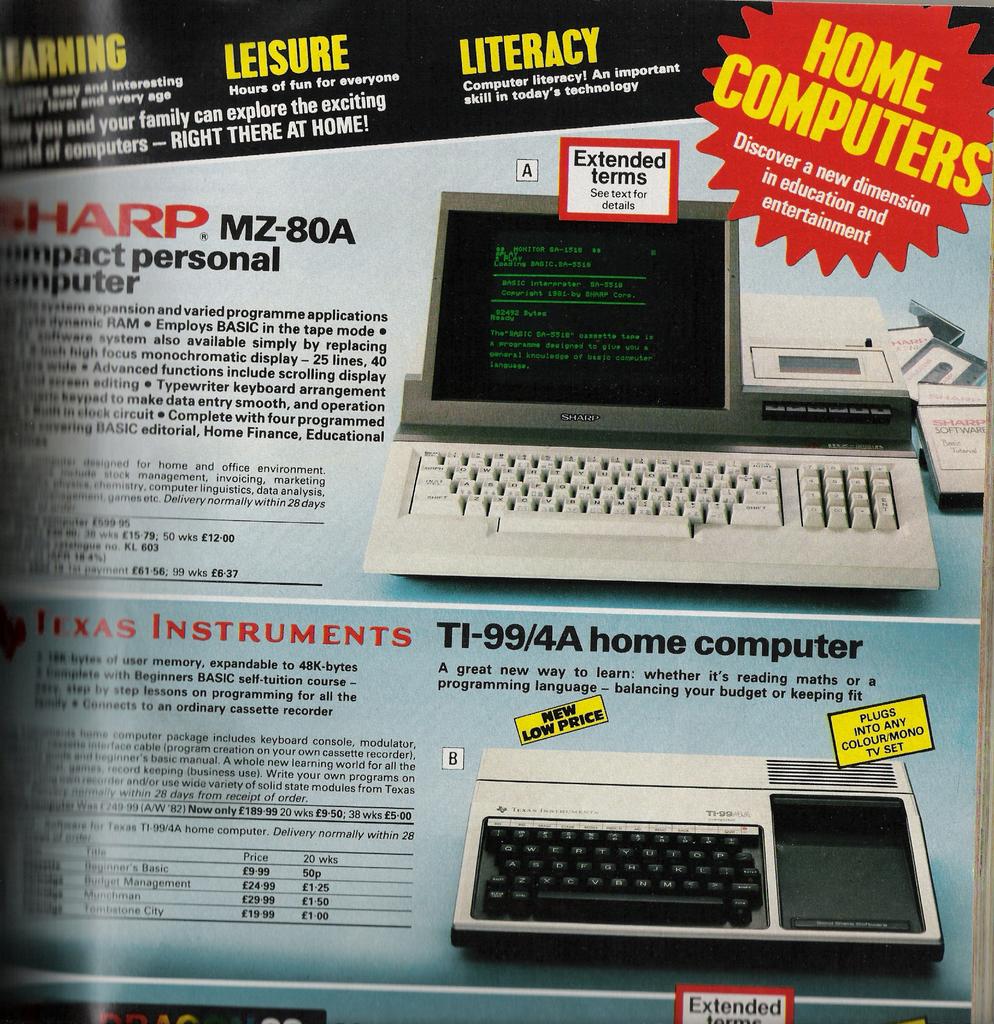
Crumbs - the little darling at the top of this catalogue page cost £599.95. So, what did you get if you could afford it? The blurb, maestro, please!

Flexible system expansion and varied programme applications; 48K byte dynamic RAM; employs BASIC in the tape mode; PASCAL software system also available simply by replacing tapes; 9-inch high focus monochromatic display - 25 lines, 40 characters wide; advanced functions include scrolling display rolling and screen editing; typewriter keyboard arrangement with numeric keypad to make data entry smooth and operation simple; built in clock circuit; complete with four programmed cassettes covering BASIC editorial, Home Finance, Educational and Games.

And in simpler terms?

Sharp computer, designed for home and office environment. Applications include stock management, invoicing, marketing analysis, maths, physics, chemistry, computer linguistics, data analysis, home budget management, games etc.