Total Pageviews

Pages

Showing posts with label Gay Issues. Show all posts

13 June 2018

1985: A Glimpse of The Sun... AIDS - 'The Wrath Of God' And 'Bongo Bongo Bust-Up'...

From this 1985 Sun front page, we learn that a vicar had just declared AIDS "the wrath of God"- against gay men (the paper was happy to describe it as "the gay plague") - and Unemploy... sorry, I mean Employment Minister Alan Clark was trying to qualify for a part in Love Thy Neighbour. Crass git.

Fortunately, he was several years too late for Love Thy Neighbour.

30 March 2011

EastEnders: Colin and Barry - Gays In Albert Square - And The First Gay Kiss In UK Soaps...

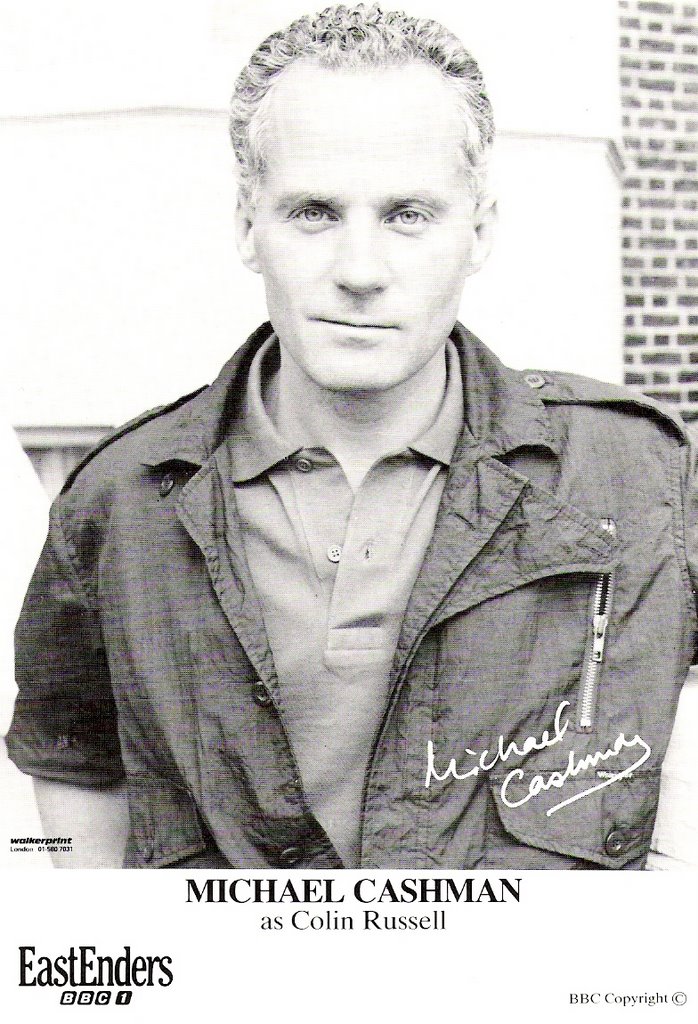
In 1986, EastEnders introduced Colin Russell, a gay man, into the Albert Square mob.

Neat in his ways, armed with a Filofax and one of those trendy keyrings which beeped if you whistled for them, Colin was still subjected to homophobic bigotry by other residents of the Square. That guardian of Walford morals Dot Cotton was shocked by the "goings on" at Colin's, especially when he took up with young east-end lad Barry Clark.

Back then, Barry was "under age" too - he was under 21!

Michael Cashman, himself a gay man, and Gary Hailes, were excellent as Colin and Barry.

And soon that now reformed homophobe Dot was a good pal of Colin's.

Why were gay men such an "issue"? Well, until 1967 in England and Wales, and the early 1980s in Scotland, homosexual acts between men - even in private - were illegal.

The 1980s saw several very significant steps forward in English soaps, which simply didn't "do" gays before then. Oh sure, there had been a shock confession of homosexuality from a character in BBC radio serial The Dales in the late 1960s, and its successor Waggoners' Walk flirted with the subject a couple of times. The first story-line featured a gay character who "reformed" and got married! Waggoners' second attempt - in 1980 - was more promising, but the BBC promptly axed the show.


Afternoon TV "drama series" (note: not soap!) Together (1980-1981) introduced a gay storyline.

My memories of that are all very hazy, and the show, tucked away in the afternoon schedules, attracted little attention, only ran to two series, and soon disappeared - as did Southern TV, which produced it. Together had quite a cosy, traditional atmosphere on the whole.

Brookside was the first major early evening UK TV soap to feature a regular gay character when young Gordon Collins (Nigel Crowley/Mark Burgess) "came out" in the mid-1980s. But the discovery that Gordon was gay coincided with the original actor's departure from the show, and a recast version didn't appear until a year or two later.

For me, Colin and Barry were special. They made me think a bit, opened my eyes a little.

With gay characters appearing in two of the TV soap operas, and many openly gay pop stars flitting through the pop charts, it was an interesting era.

AIDS was being touted in some tabloids as a "gay plague", but work elsewhere in the media was ensuring that gays were getting a fairer deal, and making many of us question our attitudes to the gay community.

Colin and Barry were merely allowed a kiss on the forehead in 1987 - which caused outrage, but in January 1989 Colin and his next partner, Guido
Smith (Nicholas Donovan), shared the first mouth-to-mouth gay kiss in UK soap.

Steam was coming out of the ears of at least one tabloid newspaper.

The whole Colin/Barry/Guido story-line was absolutely groundbreaking. I shall always remember the 1980s EastEnders gay characters.

They contributed to the phrase "woolly-woofter" dropping out of my vocabulary - forever.

14 June 2009

Frankie Goes To Hollywood: The "Relax" Ban

"Relax" by Frankie Goes Hollywood sent shockwaves through the pop-picking population of England...

Although used to scantily clad young women "flaunting themselves", as my auntie Maggie always put it, on "Top of the Pops" since Pan's People first strutted their stuff in the 1960s, nobody was prepared for the saucy lyrics of the "Relax" song and "downright disgusting" (Auntie Maggie again) visuals of the "Relax" video (see above)...

And as for simulated gay sex acts, well, civilisation was obviously on its last legs!

From the Daily Mirror, 25/1/1984:

Britain's number one record has been banned from "Top of the Pops" tomorrow night.

BBC TV chiefs won't play the smash single "Relax" because, they say, the lyrics are sexually explicit and not suitable for family viewing.

The record is by Liverpool group Frankie Goes To Hollywood. Their song is now banned by both BBC TV and radio - although it owes much of its popularity to both. "Relax" was performed on "Top of the Pops" three weeks ago and was played more than 70 times on Radio 1.

But two weeks ago DJ Mike Read refused to play it on his breakfast show, and Radio 1 executive producers extended the ban to all their programmes.

The group's lead singer William "Holly" Johnson said the song simply "encourages people to go out, have fun and relax."

The only other No 1 banned from "Top of the Pops" was the 1969 hit "Je T'Aime... Moi Non Plus" by Jane Birkin and Serge Gainsbourg.

01 April 2009

"Jenny Lives With Eric And Martin", Clause 28 and Militant Lesbians Invade The BBC News Studio...

"20,000 people, of all sexualities, marching through the streets of Manchester on a cold February afternoon is not something we are going to forget easily. Nor can we forget the close relationship which was forged between the Campaign and the gay scene. 1988 made us all finally realise that very powerful forces were out to get us."

Gay Life, January, 1989.

So what was Clause 28? How did it happen?

Many people will have you believe that the era before the 1980s was totally liberal, totally free of discrimination or malice. Then the 1980s arrived, slammed on the shoulder pads, stuck the cigarette in the holder, narrowed their eyes and went to work to undo everything and set the clock back.

Of course, that's not true. Some 1960s teenagers, mourning the loss of that decade and their youth since the start of 1970, have been very vocal (for such a kind, sharing and caring generation) in proclaiming just how superior they are to the generations that have followed. Meanwhile, the 1970s have been rewritten as a continuation of the "wonderful 60s". So heavily have the 70s been tweaked and repackaged, I hardly recognise them.

Let's look at the UK reality. In 1967, the decriminalisation of homosexual acts between consenting men in private was passed in England and Wales. Homosexual acts between women had never been illegal.

Although many gay men rejoiced at the news, there were sombre warnings that their new rights should not be "abused". Lord Arran, one of the major advocates for law reform, made the following speech in the House of Lords in 1967:

"I ask those who have, as it were, been in bondage and for whom the prison doors are now open, to show thanks by comporting themselves quietly and with dignity. This is no occasion for jubilations, certainly not for celebration. Any form of ostentatious behaviour now or in the future, any form of public flaunting, would be utterly distasteful and would, I believe, make the sponsors of the bill regret what they have done."

Fast forward to the late 1970s, and queer bashing was as much a sport as ever and gay men on TV were the traditional stereotypes. Accusations were made that much of the momentum behind the American "Disco Sucks" campaign came from racism and homophobia.

The decriminalisation of homosexual acts between men in Scotland took place in February 1981, and the London Weekend Television (LWT) series Gay Life was broadcast that year - although it was not networked.

The decriminalisation of homosexual acts between men in Northern Ireland took place in 1982.

In 1983, the 1981 book Jenny Lives With Eric & Martin, by Danish author Susanne Bosche, was published in England. The book was intended for primary school children and told the story of Jenny, a little girl who lived with her father and his male lover.

It was quickly banned from schools after protests from parents and politicians who feared that it might encourage children to "experiment with homosexuality". And yet parents were allowing their children to display posters of openly gay pop stars like Boy George on their bedroom walls, and indeed buying their children Boy George dollies! It really was an era of contrasts!

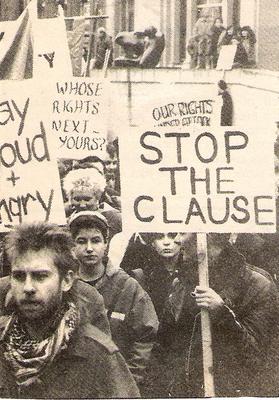
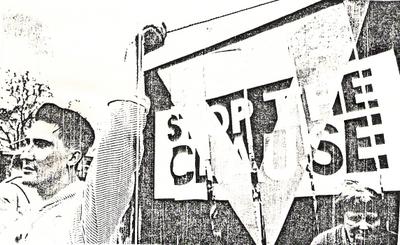
Jenny Lives With Eric and Martin is widely accepted as a major milestone on the road to Section (or Clause) 28, which came into effect on 24 May 1988. The emergence of AIDS as a growing epidemic, with gay men as a "high risk" group, was another.

Being well grotty, the "Clause" contained such gems as: A local authority shall not:

(a) Intentionally promote or publish material with the intention of promoting homosexuality.

(b) Promote the teaching in any maintained school of the acceptability of homosexuality in a pretended family relationship.

The "Clause" has now gone. But have books like Jenny Lives With Eric and Martin come back, I wonder, and if so what has been the reaction of the "wonderfully liberal" people of the early 21st Century?

Published in England by the Gay Men's Press, December 1983.

Jenny has a strop. .

I was very interested in the launch of Jenny Lives With Eric & Martin and bought a copy of the book. It may seem trite, but a memory that remains with me to this day is how shocked some older members of my family were with the suggested nudity in a couple of photographs in the book. We can be terribly smug, superior and "21st Century" about that now (it happens a lot), but it's worth noting that this country was a very different place in 1983!

Grumpy Mrs Jones sticks her beak in.


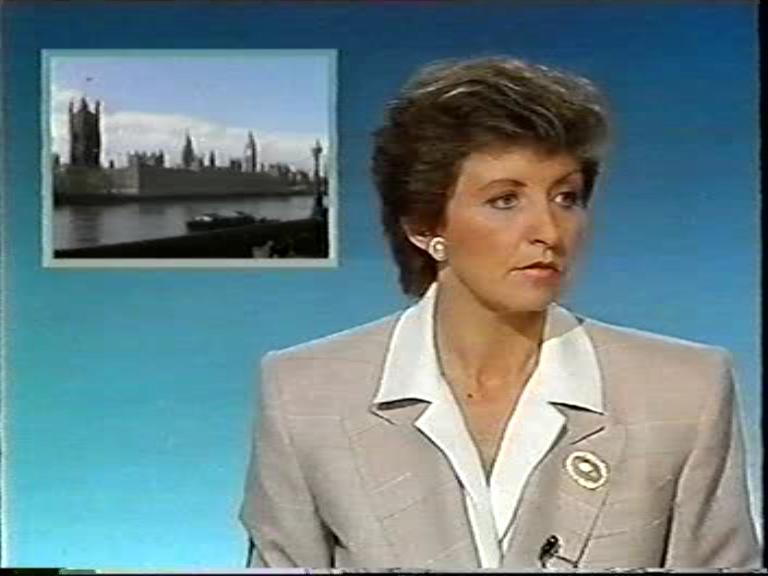
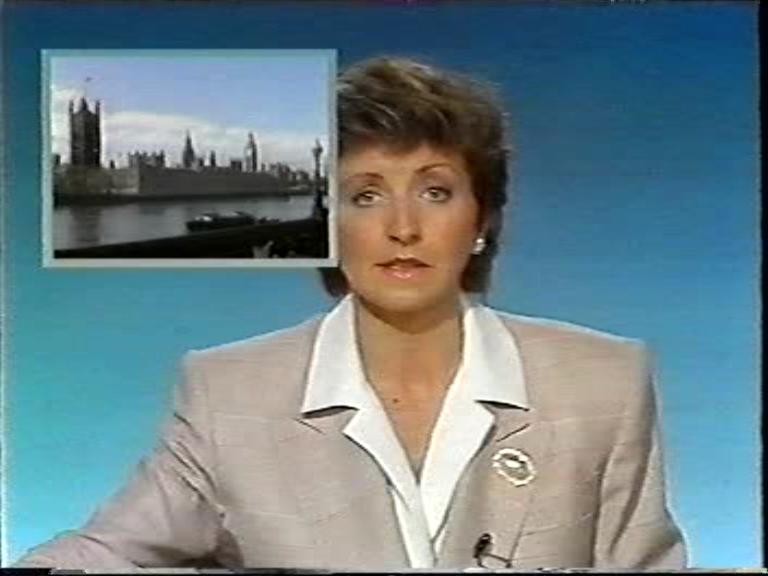
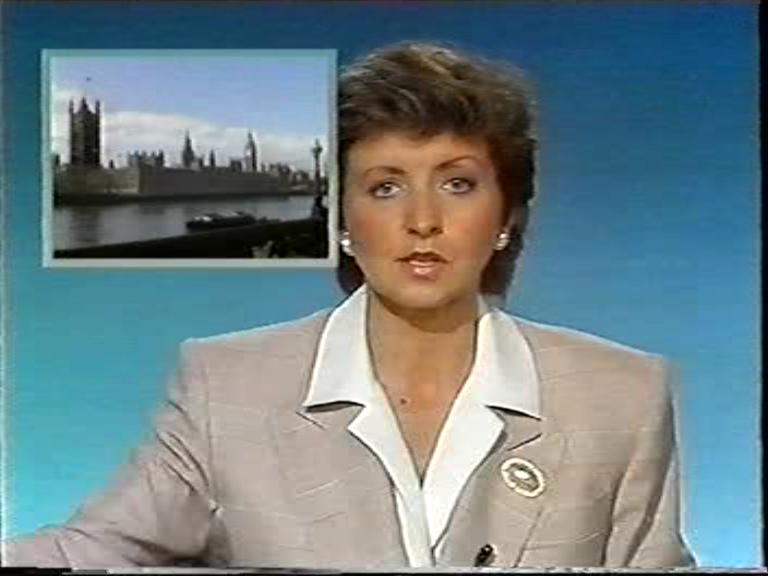
23rd May 1988 - and militant lesbians, protesting about Clause 28, invade the BBC newsroom. 

Gay men attempting to gain admission to protest at various times were, of course, roughly expelled/blocked.

Equality!

Sue Lawley struggled on with the news, whilst Nicholas Witchell sat on one of the protesters. Sue said: "...I do apologise if you're hearing quite a lot of noise in the studio at the moment. I'm afraid that, um, we have been rather invaded by some people who we hope to be removing shortly."

Sue Lawley battles on with the news, as the studio technology goes rather wonky...

30 May 2005

1984 - Band Aid, Trivial Pursuit, Computer Mouse, Moon Boots, V, Spitting Image, Agadoo, Madonna, Growing Shoulder Pads, Mrs Antrobus In Ambridge...

1984 saw us moving into the Yuppie era. For many, the financial hard times were over. They had been grinding on since the early 1970s, and suddenly people seemed to be going a bit money mad.

But it wasn't all jam. The miners' strike began in protest at their latest pay offer and planned pit closures. A long and bitter time lay ahead for them and their families. Over the next few years, we also heard a lot about the "North/South Divide". Whilst the South of England boomed, things in the North of this country, and in Wales and Scotland were not nearly so good.


The North/South Divide was nothing new, but traditional industries in some parts of the UK had been declining for years, and the policies of the Thatcher government were doing nothing to alleviate the situation.

It wasn't all bad news, at least for those not living in England: public spending in Scotland, Wales and Northern Ireland was higher than in England, and had been for several years, via a system called the Barnett Formula.

Back in 1984 I was suffering from Thatcher phobia and couldn't even bear to hear her voice on the TV or radio. The merest sight or sound of her was enough to send me diving for the "off" button.

MAGGIE! MAGGIE! MAGGIE! OUT! OUT! OUT! GRRRR!!!!

1984 saw the blossoming of the openly gay pop star era in England. Paul Rutherford and Holly Johnson of Frankie Goes To Hollywood, the brilliant Bronski Beat and Boy George (who had declared himself "bisexual" and a "poof with muscles" in an interview with Titbits magazine in late 1983), all showed the way forward.

I remember back in the summer of 1980, reading in a Sunday tabloid that a well-known male pop star was bisexual. I recall my mother's shocked expression and my stepfather's angry growls at the news. A few years later, they bought my little sister a Boy George doll and were allowing her to display posters of openly gay pop stars on her bedroom wall.

And this during the era of "AIDS - the gay plague" in certain tacky newspapers. The 1980s really were a multi-faceted time. Looking back, the decade often seems chaotic and exhausting.

Frankie Goes To Hollywood stormed the charts with Relax. Banned by the BBC for its saucy gay references, the song went to No 1. But that wasn't the only reason - it's a brilliant piece of dance music. On the back of Frankie's success, "Frankie Say Relax" T-shirts flew into the shops.

"Sell him your soul, sell him your soul - never look back!" Propaganda, the totally brilliant German electro-pop group, gave us the absolutely awesome Dr Mabuse. Loved it. Still do.

Of course, this was 1984, and the Eurythmics' Sexcrime (Nineteen Eighty Four) drove me completely barmy on the dance floor. Music was getting faster. Harder. We were in the era of what I call "80s clatter pop", and I was head-over-heels for it.

But let's come back down to earth, shall we? All together now: "Aga doo doo doo..." This song, with its attendant silly dance, drove us all potty. However, I hold my hand up to dancing to it, doing all the movements, and enjoying it on more than one occasion after a few pints. Blush, blush.


Shoulder pads, 1984-style, were getting beyond a joke. Slowly growing since around 1982, they hadn't quite reached critical mass yet, but Chaka Khan, Alexis and Krystle were certainly looking a little burdened.
Miami Vice began in America and the Don Johnson look became a trend - linen jackets with shoulder pads, the outline of the pads clearly defined through the thin material, so men were not left out.


Shoulder pads were part of the "Power Dressing" image. The phrase was first recorded in 1980, according to the Twentieth Century Book of Words by John Ayto (Oxford, 1999). Back then, it meant a smart, efficient look for executive women. But as the 80s continued the shoulders grew and grew.

Colourful Moon Boots were another fashion sensation of 1984.

Mullets were starting to move into the Yuppie era by becoming big and bouffant, though it would be a few years before they reached maxi-size. The name "mullet" for this popular hairstyle would not come into use until the 1990s.

The aforementioned combinations of bright and drab colours - like yellow and grey - were becoming more and more popular in decor and clothing. Lycra was being worn more and more outside of gym, aerobics or Yoga sessions. The new lycra dresses showed off the "fit for business" figure of the mid-80s woman.

Computers took a great leap forward in 1984 - the Apple Macintosh came with its own "mouse".

In Russia, then still very much "behind the Iron Curtain", Tetris was invented.

Did you pursue the trivial in 1984? Many people did as the British edition of Trivial Pursuit
made its debut in January.

We bid farewell to Sale of the Century this year. Never "hip", even at the start, it was, none the less, preferable to the American style gameshow The Price Is Right. Hosted by Leslie Crowther, the hysterical contestants and audience drove many to the "off" button.

And then there was 60s singer Cilla Black and Surprise, Surprise. Cilla had become a TV presenter when her singing career folded, and her TV career continued throughout the 70s and 80s (and 90s). On Surprise, Surprise, she sat on the "Cilla sofa" seeking to reunite long lost loved ones and bring the odd bit of light into people's lives by popping up in filmed sequences with a song. Lovely.

Spitting Image was brilliant, savage satire. If only there were programmes like it nowadays...


The skies over England are usually full of rain clouds, but was that an alien mother ship I saw in 1984? Diana and the V invasion on ITV made a pleasant alternative (for some) to the Olympics coverage on the Beeb.

In the BBC Radio 4 serial The Archers, Mrs Marjorie Antrobus (Margot Boyd) put in her first appearance, giving a talk on "The Colourful World Of The Afghan Hound" to the Ambridge Women's Institute.

The charity record Do They Know It's Christmas? was, of course, Christmas Number One. It was the brainchild of one Bob Geldof, formerly of the Boomtown Rats. Bob had been deeply moved by TV news footage of famine stricken people in the Third World, and enlisted the help of Midge Ure to put the song together. They then assembled the great and the good of the pop scene to sing it - "Band Aid", they called it. Boy George arrived late, but the record was on shop shelves in time for Christmas.

29 May 2005

The Blow Monkeys and a Defence of 1980s Pop...

Some people believe that pop music in the 1980s lost touch with politics and reality in general. The fire went out, and pop stars ceased to reflect what was happening in the world - drifting off into a rosy never-never land. Even in the 1980s this complaint was sometimes heard. But I disagreed then and I disagree now.

It is not true to say that the last time in the 1980s the pop charts reflected social/political realities was with the Specials’ Ghost Town in 1981. Anti-Tory as I was, and much as I loved that song, I could see that not everybody was having it grim. Far from it. And as for the “boom town” they sang about, when was that? It certainly hadn’t been in the 1970s.

Billy Bragg, the Smiths, Depeche Mode, Suzanne Vega, amongst others, highlighted political and social concerns in the 1980s, and those swanky “never never land” pop stars, like Duran Duran, reflected the fact that there was then a boom going on. Not everybody benefited, but in the mid-to-late 1980s it was real, it was happening.

I liked both sides of the 1980s pop coin. My youthful, idealistic nature had led me to take up a poorly paid job as a social services residential care assistant, but I loved to pose about in the evenings at my local Nite Spot to the likes of Pet Shop Boys.

But the Pet Shop Boys lyrics were rooted in mid-to-late '80s reality - witty, jaded, often poking fun at the plush world of yuppiedom.

'80s music did reflect '80s realities. As with any pop decade, there are plenty of exceptions, but any serious examination of '80s pop will reveal the social trends of the decade shining through in its music.

I was a great fan of modern folk hero Billy Bragg, but some of my favourite '80s music allowed you to pose whilst also having topical lyrics.

One of the greatest purveyors of what has been described elsewhere as '80s “sophisti-pop” was a band called the Blow Monkeys, which formed in 1981 and took its name from the Australian slang for someone who plays the didgeridoo. One Bruce Robert Howard (known as “Dr Robert”, a nickname from his boarding school days) was the band’s singer/songwriter, with Tony Kiley on drums, Neville Henry on saxophone and Mick Anker on bass. In 1984, the band started recording with RCA records.

The Blow Monkeys found success with their second album Animal Magic in 1986.

Dr Robert was vehemently left-wing and anti-Thatcher and this often came across in his lyrics. The single (Celebrate) The Day After You was banned by the BBC until after the 1987 General Election because of its perceived anti-Conservative lyrics!

The Blow Monkeys allowed me to pose to their music whilst also making me cheer with anti-Thatcher/anti-establishment lyrics. Was irony present? Sure, but the music brought together two sides of mid-to-late '80s life for many teenagers and twenty-somethings - political angst and the powerful desire to pose on the dance floor!

Why did I like to pose on the dance floor and wear “poser” (chain store bought) '80s gear? I put it down to my dog-rough '70s childhood. We were so poor it hurt and so much back then seemed to be about gobbing off - from the football stadium style chanting of glam rock to Punk. For some of us down in the depths the whole thing was just too grim. We didn’t need gobby music to add grit and vigour (what some might call “meaning, darling!”) to our lives. We were too busy worrying over little things - like heat and food.

The “get out there and pose” mid-to-late '80s made a terrific change. I never threw my principles out of the window, but I did love the swank thing. Even today, I’m partial to shoulder pads, colourful jackets and pushed-up sleeves.

Trouble is, if I wore them nowadays I’d get laughed out of town!

It'll get you in the end, it's God's revenge - the "Sun", 1985.

Back to the Blow Monkeys: one of my all-time favourite pop songs is their 1986 hit Digging Your Scene. Luxurious. Polished. Over the top sophisti- pop. In 1986, I often heard the song drifting from open-topped yuppie cars and posh wine bars when I visited London.

The song had charted in March, but was around a lot in the summer. It was perfect warm, sunny weather music…

But listen to some of the lyrics…

“What in the world is this feeling,

To catch a breath and leave me reeling

It’ll get you in the end it’s God’s revenge

Oh I know I should come clean

But I prefer to deceive

Every day I walk alone

And I pray that God won’t see me

I know it’s wrong, I know it’s wrong

Tell me why is it I’m digging your scene

I know I’ll die…”

The song is about AIDS. And yet many people I knew were playing it as “feel good” music, totally unaware of the meaning of the lyrics. And how do you dance to it? I defy you not to pose!

Like the owls in Twin Peaks, this was not what it seemed!

Recently interviewed by the BBC, Dr Robert said:

“'Digging Your Scene' was me tipping my hat to the club scene, and then specifically the gay scene within the club scene that… in the early '80s, that were to me the most exciting thing that was happening at that point in my life. 'Cos I'd kind of broken up with my first wife and I was in-between, and I was kind of enjoying myself. And it was a great scene for me to be involved in. Although I wasn't gay. You know, 50% of the people in there weren't. it was just a really refreshing kind of attitude there. And the song was written basically about AIDS and the way that it was beginning to kind of happen to people that I knew within that scene.”

Digging Your Scene was one of the earliest songs about AIDS - the subject was also alluded to in Bronski Beat’s 1985 single Hit That Perfect Beat (“Touch and kiss a stranger if all else fails - hiding from the danger that’s been sent from hell.”).

The Blow Monkeys had their biggest singles chart success with It Doesn’t Have To Be This Way which charted in January 1987 and peaked at No. 5 (“When you walk out the door, you’re gonna ask for more, from society…”).

The 1980s continue to be a controversial topic of conversation and are often regarded as the “Greed Decade”. Fair enough in some ways. But I can see why the '80s happened - the '70s and early '80s had been hard times indeed. The change of political ethos and sudden influx of money (and new technology bursting into our lives) turned heads. A lot of the posturing and posing was like an over-the-top pantomime.

Some people had it extremely good, some people had it extremely rough, but there is no denying that for a great number of us in the middle life got better. My family and I were as poor as church mice, but still our diets and general lot in life improved tremendously during the 1980s. We weren’t rampantly materialistic, couldn’t afford to be, but changes such as the modernisation of the council estate where my parents lived, which included the removal of the long-condemned (and crumbling) 1950s prefab kitchens attached to the back of each house, a brand new brick-built kitchen, and the installation of central heating, meant far more comfort. And this occurred in 1987 - the peak and start of the meltdown of the 1980s greed era!

There is plenty to criticise about the 1980s. I wouldn't dream of saying otherwise. But the decade is not the root of all evil and I wish that some of the political activism of those days would re-ignite. Some of the acts carried out by the modern day government would have caused a furore in the 80s, but nowadays are allowed to pass virtually unchallenged.

Devolution, for instance, has created dreadful inequalities within the UK.

But people seem too busy rewriting the 1970s as absolutely lovely and the 1980s as greed personified, basically playing “heroes and villains” with past decades, to pay attention to NOW.

It’s a huge shame.