Total Pageviews

Pages

23 September 2008

Michael Fagan: The "Prowler" At Buckingham Palace...

On the 9th of July 1982 an intruder entered the Queen's bedroom at Buckingham Palace.

From the Daily Mirror, 12/7/1982:

An intruder at Buckingham Palace got into the Queen's bedroom, it was revealed last night.The man sat on the Queen's bed for ten minutes and she engaged him in conversation. Eventually she found an excuse to fetch a footman, on duty in the corridor outside, and the prowler was detained.

Early this morning Buckingham Palace would only say: "It is entirely a police matter."

But the apparent ease with which a stranger managed to reach the Queen's side - she unprotected and he undetected - casts grave doubts about the efficiency of security at the Palace.


The drama happened early in the morning and the Queen remained calm.

She was eventually able to get help when the man asked for a cigarette.

The Queen said there were none in the bedroom and offered to have some brought.

Once the intruder's confidence had been gained, the Queen opened her bedroom door and beckoned a footman outside in the corridor.

The footman pretended to bring the cigarettes, opened the bedroom door and detained the intruder.

Prince Phillip, it is reported, was in a separate bedroom at the time of the incident.

Lapses in security at Buckingham Palace during the past year have caused grave concern for the Queen's safety.

Action to improve security is already under way.

On Saturday a barbed-wire barricade was put up as part of the new safety measures. The wire tops iron spikes already protecting the palace walls.

The palace has been invaded by strangers several times in the last year.

Three West German tourists camped in the grounds for twelve hours, thinking they were in a public park.

A man claiming he was hopelessly in love with Princess Anne was found wandering in the grounds.

Last month a member of the Royal Household reported seeing an intruder at the palace shortly after American President Ronald Reagan arrived.

A top-level police enquiry into security has been ordered by Metropolitan Police Commissioner Sir David NcNee...

24/9/1982:

Yesterday, in just about the craziest case since the trial of the Knave of Hearts in Alice in Wonderland, a court of law solemnly declared open house at the Queen’s residence.

The Sun declared that the decision to clear Michael Fagan of the charge of burgling Buckingham Palace was “BONKERS!”


… Michael Fagan, the prowler who had a bedside chat with the Queen, was sensationally cleared yesterday of burgling Buckingham Palace.

An Old Bailey jury took just 22 minutes to acquit 32-year-old Fagan.

He had told them that “a little voice in my head” had ordered him to break into the Palace twice this year.

Fagan added that he did it to prove that the Queen’s security was lax.

He said: “I wanted to show that the Queen was not too safe… I could have been a rapist or something.”

The jury of seven men and five women cleared him of trespassing at the Palace, and stealing half a bottle of Californian wine belonging to Prince Charles.

Fagan - whose break-ins earned him the nickname “Spiderman” among Palace staff - beamed with delight at the verdict.

But last night he was still behind bars at London’s Brixton Prison facing two other charges - of taking a car and of assault.

Fagan’s wife Christine and mother Ivy were in the public gallery to hear of Fagan’s two break-ins - on July 7 and July 9 this year.

He appeared in the dock in the crowded Number One Court wearing a red pullover, navy slacks and white open-necked shirt.

Fagan, of Copenhagen Street, Islington, North London, was flanked by three prison officers and replied “Not Guilty” when the charges were read out.

Fagan told how he first got into the Palace on June 7 - after disturbing housemaid Sarah Carter. He said: “I went round there with the children and heard security was a bit lax. So I decided to show that someone could get in.

“I disturbed a young lady and then walked around the place…”

At this point Recorder James Miskin, QC, urged him not to talk so quickly as he had to write the evidence down. Said Fagan: “OK - did you get it?”

Fagan, who started most of his sentences with “yeah”, said he was surprised he was not captured right away after disturbing the housemaid.

He added: “I could have been a rapist or something.

“I stayed there about half-an-hour without being captured. I even had time to have a drink because I was thirsty.”

Fagan said during his roaming he noticed names on various doors.

“Princess Anne was on one room and Captain Mark Phillips on another. I decided not to disturb them,” he said with a laugh.

He said he opened another door with “Prince Phillip” on it, adding: “But they were out seeing President Reagan.”

Fagan described how he went into a post room and drank from a bottle of Californian wine he found there.

The court heard the wine - and a pair of baby bootees - had been sent to Prince Charles and Princess Diana before the birth of their son.

Fagan slumped forward and rested his arms on the edge of the witness box as his counsel, Mr Richard Slowe, quizzed him about his activities.

He said: “I was in the room for half-an-hour waiting to get pinched.

“In my opinion I have done the Queen a favour. I proved her security was not one up.”

Mrs Barbara Mills, prosecuting, suggested to Fagan that the wine had not been his to drink. He replied: “It was not my palace to get in, was it?”

He went on: “There was no tap… I was thirsty. I had done a good day’s work for the Queen showing the security was bad.”

Earlier Miss Carter told how she came face-to-face with Fagan.

She told the jury she was sitting on her bed after 11.00pm when she heard a noise.

“Turning towards the window I saw some fingers on the outside of the frame. They were a few inches up from the sill itself.

“I saw a fleeting glimpse of a man’s face. Then I ran out of the room into the corridor shutting the door behind me.”

She told two other housemaids in nearby rooms about what she had seen and added:

“As I talked to them I heard a small noise in my room. But I decided against opening the door.”

The three girls then alerted a duty police officer.


Det Sgt Geoffrey Braithwaite admitted that at first he did not believe the girl’s story because of the climb involved.

Mrs Mills told the court it was 55ft from the Palace courtyard to Miss Carter’s window.

But later pigeon repellent - from window ledges - was found on a carpet and a full scale alarm raised.

But, despite a big search with the help of police dogs, no trace of the intruder was found.

Then, on July 9, Fagan made his second visit to the Palace and was finally arrested.

Fagan was cornered in a pantry near the Queen’s bedroom by footman Paul Whybrew.

Mr Whybrew, who has been at the Palace for six years, said in a statement that Fagan kept insisting that he wanted to talk to the Queen… “My queen.”

He added: “I tried to keep him calm and he said he was all right.

“He said it was urgent and tried to pass me but I got in his way. I also noticed his breath smelled of alcohol.

“I laughed and tried to be casual and friendly and said: ‘How did you get here?’ He replied: ‘I just want to talk to her.’

To stall for time, Mr Whybrew told him: “All right but let her get dressed first.”

Mr Whybrew said Fagan appeared to be “not coherent or rational. He seemed very tense.”

The footman asked him if he would like a drink and Fagan replied: “Yes please, I would like a scotch.”

Fagan was given a glass of Scotch - and then PC Cedric Robert arrived in the pantry.

PC Robert said Fagan “appeared scruffy and was wearing a grubby grey sweatshirt and jeans. He was barefoot.”

As they grabbed his arms to lead him away, Fagan said: “I want to see the Queen - let me go back to talk to her.”

On his way through the Palace, Fagan became very abusive and said his name was Rudolph Hess, the Nazi war leader…

Of the charges laid against Mr Fagan, the Sun informed us:

Fagan was accused of “burglary contrary to Section 9 (1)B of the Theft Act 1968, the particulars being that between the sixth day of June and the ninth day of June, 1982, he entered Buckingham Palace and stole therein a quantity of wine.”

He was NOT charged with entering the Queen’s bedroom - which happened during his second Palace escapade - because, says the Director of Public Prosecutions, no criminal offence was committed.

Remembering '80s Technology...

I wasn't a great technology fan in the 1980s. In fact, the sort of things that were zooming into our homes and work places as the decade progressed seemed highly weird and a little bit suspect to me. I spent my leisure time down the local pub or Nite Spot, "done up like a dog's dinner", quaffing back the "Reassuringly Expensive", pushing up my linen jacket sleeves (they would keep sliding down!) and caressing my designer stubble. Sadly, the stubble made me look like a "well dodgy geezer" and had to go, but my blonde highlights, cerise vest and obvious shoulder pads ensured that I was still at the height of fashion. Lucky old me!

I was slightly the wrong age for the '80s technological revolution - when I left school in the early '80s, computer studies were just coming in, and the only time I'd glimpsed a home computer game was when Tristram got the "Pong" TV game as a present in an episode of George and Mildred shown at Christmas 1979.

The office I worked in in the early-to-mid '80s was absolutely computerless.

Some pals of mine were interested in what was happening and kept up with the incoming technology (or at least as much as they could afford to). But not me.

So this blog is something of a voyage of discovery for me. And like my other blogs is based on hard facts, recollections and material from the decade concerned.

By the late '80s, the new technology popping up everywhere was impossible to ignore. But I still wasn't keen.

Sky Clearbrook, a fellow blogster - the man behind the excellent "Avenues And Alleyways" blog, was much more "of the times" when it came to technology, and shares some memories and suggestions for this blog below...

Sinclair ZX81 - My mate had one of these.

* The keys were similar to that of a Speak 'n' Spell.

* It had 1K of memory which could be upgraded by purchasing the 16K RAM Pak.


* The 16K RAM Pak sat upright at the rear of the computer often caused what became known as the RAM Pak wobble.

* Completely monochrome display.

* The graphics for any game you bought for it would have usually consisted of Xs firing off Is to shoot the invading Os.

Sinclair ZX Spectrum

* Almost proper keys this time. Rubberised - became notorious for collecting dust.


* Came in 16K and 48K varieties. A 128K version in differently-styled casing came along a couple of years later.

* Featured colour graphics. It was only possible to have two colours per character (8 pixels by 8 pixels), so games very often suffered from what became known as "colour clash" when a number of characters moved in front of each other.

* Manic Miner and Jet Set Willy became huge hits. There were two versions of Manic Miner. It was originally released on the Bug Byte label, and then later with some changes on Software Projects. The two games made Matthew Smith very rich indeed. There were always stories about hidden levels and rooms, but I think these were mainly urban myths.

* Worth doing a few features on some of the software houses....

* Ultimate - Play The Game were based in the exotically-named Ashby De La Zouch (just like KP crisps!). They were very secretive, releasing very high quality games only periodically. "Sabre Wulf", "Atic Atac", "Lunar Jetman" and "Knight Lore" were probably their biggest hits for the Speccy.

* Ocean Software fairly churned them out. Saturated the market with their US Gold range (licensed from the likes of Midway et al) and film/tv show tie-ins which were a bit hit-and-miss.

* Imagine - The Name Of The Game were the subject of a BBC documentary. They released quite a few good games, but famously went bust - well worth digging into that.

Magazines

* Sinclair User. Often published page after page of BASIC programs for the reader to type in. You could literally spend hours typing something in, only to run it and find that there were bugs somewhere in it. Cue loads of laborious rechecking. More often than not, the next month's issue would feature loads of corrections for previously published programs!


* Crash. The absolute dog's b******s. Written by real gaming enthusiasts, they would have loads of exclusive features, cheats and walkthroughs, etc. They subsquently launched versions of their mag for the Commodore 64 (Zapp 64) and the Amstrad (can't remember the title). There was one famous issue of Crash (summer 1985?) where they did a really good piss take of Sinclair User called... Unclear User. It was absolutely hilarious - right down to the logo, fonts and formatting, but it got them into quite a bit of hot water. The issue was pulled and then re-issued minus the offending pages. Anyone with a copy of the pulped version probably has a bit of a collector's item on their hands.

Phew. There's a fair bit there. I'm sorry these are really only suggestions for research rather than hard facts, but I hope the steer proves useful. If I think of anything else, I'll send you another mail.


Thanks, Sky - keep in touch!
-

"The Kit"

From the Cambridge Evening News, August 1982:

A Willingham businessman has hit the jackpot with his new concept in drumming.

Mr Mike Coxhead set up a company, MPC Electronics, based at his home in Willingham four months ago specifically to launch his idea, which is called "The Kit".

It is a small machine which electronically produces drum sounds to match those of a full-size drum kit. The drummer taps out the sound with his fingers on touch-sensitive pads giving a limitless range of rhythms.

Now Mr Coxhead and a partner, Mr Clive Button of Norwich, have captured orders worth £250,000 world-wide.

"The Kit" and its sister machines, "The Tymp", "The Clap" and "The Synkit" have gone into production at the Medco electronics plant in Ainsworth Street, Cambridge.

Mr Coxhead said the firm had had to take on ten more workers to cope with the orders and another twenty were expected to be employed by Christmas.

When he unveiled the prototype in April he told the "News" he was quietly confident it would sell abroad.

He is delighted with the response gained through the New York distributors. "I could end up a very wealthy man," he said.

The production model has been redesigned into a smoother looking unit. Mr Coxhead said it "went down big" in the USA where 2,000 were ordered before the product was in the shops.

"They have got the money over there and they are into synthesised music and the electronic idiom," he said...

Japan has also proved to be a viable market. "It's good to beat the Japanese at their own game. They are in the shops over there and selling well."

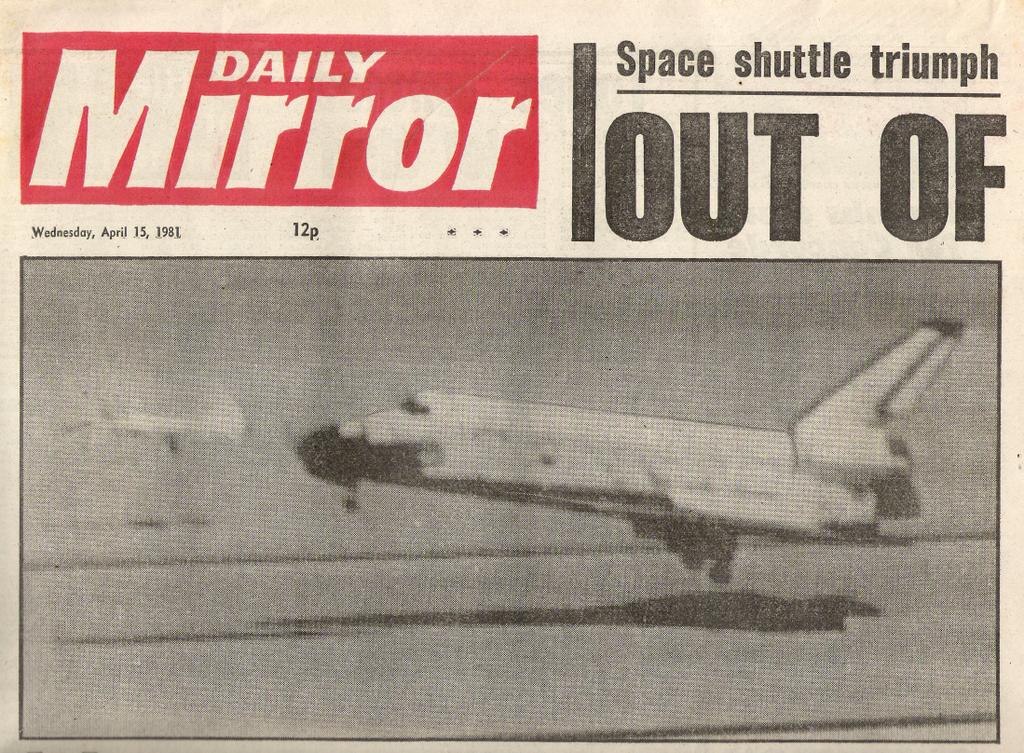
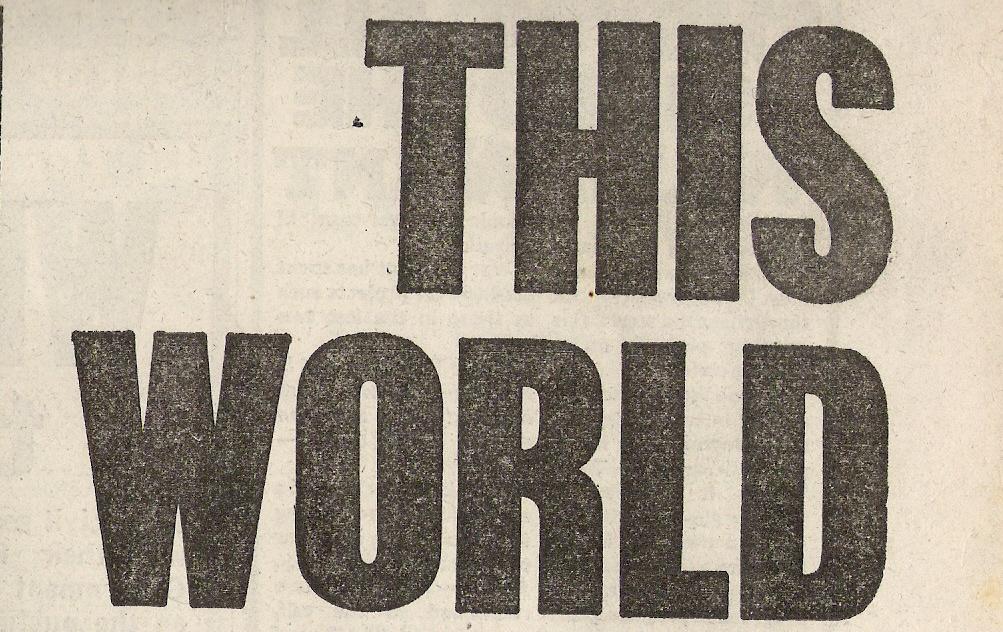
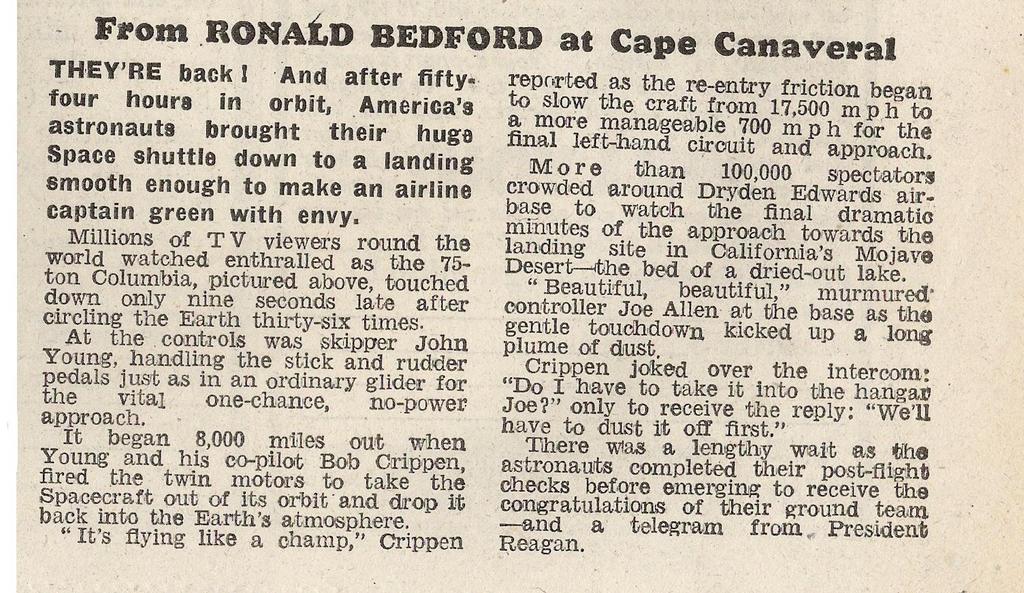
1981: The Space Shuttle's Maiden Flight...


Snippets from The Daily Mirror, 15/4/1981. The space shuttle Columbia has returned from its maiden flight, nine seconds late!

13 April 2008

Rubik's Cube History

Bűvös Kocka - Magic Cube.

Erno Rubik, a lecturer in the Department of Interior Design at the Academy of Applied Arts and Crafts in Budapest, Hungary, was passionately interested in geometry - the study of 3D forms - in construction and in exploring the hidden possibilities of combinations of forms and material in theory and in practice.

Rubik’s favourite teaching method was to communicate his ideas using models, made from paper, cardboard, wood or plastic, challenging his students to experiment by manipulating clearly constructed and easily interpreted forms. It was the realisation that even the simplest elements, cleverly duplicated and manipulated, yielded an abundance of multiple forms that would eventually lead to the Rubik's Cube.

Rubik set out to create a three dimensional object, of high aesthetic value, which was not only richer in configuration variations and more of a mental challenge than any puzzle in existence, but would also continue to be one, self-contained whole, throughout its manifold transformations.


This objective at first seemed absolutely impossible. After conceiving the idea of the 3x3x3 Cube, Rubik first tried to hold together the elements of a simpler, 2x2x2 cube, by means of an elastic rubber construction that threaded its way through all 8 elements. But he simply could not get the device to work.

Inspiration struck on a sunny summer day in 1974 as Rubik was watching the River Danube flow by. His eyes were attracted by some pebbles, whose sharp edges have been rubbed and smoothed away in the course of time, producing rounded shapes of great but simple beauty. He decided that the interior of the Cube elements had to have the same rounded form.

The interior mechanism, which is basically cylindrical, took some time to construct. For ease of manipulation, the balance between tightness and looseness had to be just right, tolerances had to be exact. Finally, the fifty-four outer surfaces of the individual elements were given their colours.

Lots of different decorative patterns, with numbers and symbols as well as diverse colour combinations were tried, but none of them worked as well as six simple but distinct colours, one for each face of the Cube.

Erno Rubik demonstrated the Cube to his students. He allowed some of his friends and students to play with it and the effect was startling: once somebody had handled the Cube it was difficult to get them to give it back! People found the Cube absolutely compelling right from the very beginning.

The compulsive interest of friends and students in the Cube surprised Erno Rubik a great deal, and it was months before any thought was given to the possibility of having it manufactured for sale.

Rubik took out a Hungarian patent for the Cube in 1975 - he named it "Bűvös Kocka" - "Magic Cube". Eventually, toy production firm Politechnika took on the job of equipping itself for mass production and making the puzzle available to the Hungarian public.

Given the complex interior structure of the Cube, and the economic conditions in Communist Hungary, this was no easy undertaking. Fortunately, Politechnika, President Lehel Takacz and Chief Engineer Ferencz Manczur, saw tremendous potential in the Cube and were happy to accept the challenge.


The process of turning Rubik’s hand-made Cube into thousands of low cost, mass manufactured units was, however, despite the best efforts of all concerned, painfully slow.

It took almost three years, but at last, towards the end of 1977, the first test batches of Magic Cubes appeared on the shelves of Budapest toyshops.

During 1978, without any promotion or publicity, the Magic Cube began very slowly to gain in popularity. By the beginning of 1979, there was growing interest in the Magic Cube throughout Hungary.

Hungary was firmly “behind the Iron Curtain” at the time and the growing popularity of the Cube did not permeate the Western World for quite some time.

Two men of Hungarian origin living in the West were absolutely integral in initiating events which eventually enabled the Cube to make the journey from behind the Curtain.

Dr Tibor Laczi, born in Budapest, was employed by a major German computer manufacturer and discovered the Magic Cube on a business trip to Hungary. He was absolutely fascinated by it, and sensing its potential consumer appeal, brought it to the Nuremberg Toy Fair in February 1979 in the hope of finding an interested German toy distributor. He was unsuccessful, but met up with an individual at the fair who was also destined to make a crucial impact on the Cube’s history.

Tom Kremer was a successful and respected toy and game inventor himself and ran his own marketing and licensing company, Seven Towns Ltd, in London, England.

The two men made a decision, there and then, to join forces and try to reproduce the Hungarian success of the Cube internationally.

Dr Laczi went back to Hungary to set to work on the prevailing Hungarian bureaucracy whilst Tom Kremer set off on a world tour of toy manufacturers.

He was convinced that to realise the Magic Cube's full commercial potential it had to have the marketing muscle, the promotional power and distribution network of a major international company. Unfortunately he found none of the movers and shakers in the field shared his enthusiasm. Although impressed by the Cube, the general view within the industry was that its prospects were poor. It was too difficult to manufacture, too “quiet” and “cerebral”.

After many rejections, Tom Kremer succeeded in persuading Stewart Sims, Vice President of marketing at the Ideal Toy Corporation, to come to Hungary to see the Magic Cube in its homeland. It was September 1979, by which time the Cube had gained a sufficient degree of popularity to be seen out and about on the streets of Hungary occasionally - and it was immediately plain that the puzzle was a source of absolute fascination.

After five days of negotiations between Mr Sims and the Communist organisation, which was largely ignorant of the operation of a free market, with Tibor Laczi and Tom Kremer working flat out to keep the negotiations afloat, an order for one million cubes was signed.

As the New Year of 1980 loomed, the Magic Cube was at last heading for wide-spread distribution in the West.

In the meantime, word about the Magic Cube had been spreading to academic circles in the Western World. David Singmaster, a mathematician based at the South Bank University in London, England, first encountered the puzzle at the International Congress of Mathematicians in Helsinki in August 1978, and brought some to England for distribution amongst interested friends and colleagues, mainly in academic circles.

He wrote a newspaper article about the Magic Cube in June 1979, the first to appear outside Hungary, which helped bring the puzzle to the attention of academic circles world wide.

A small number of Magic Cubes had found their way beyond Hungarian borders, but the vast majority of people in the West remained ignorant of the puzzle’s existence.


Bridget Last wrote "A Simple Approach To The Magic Cube" in 1980 - and it was published by small company, Tarquin Publications of Diss, Norfolk in a limited print run. Small numbers of Magic Cubes had seeped beyond Hungarian borders, via academics and puzzle fans. But numbers were terribly small and the vast majority of people were ignorant of its existence. Still, was this the first Cube book published in England? Meanwhile, Pentangle, a small niche puzzle company of Over Wallop, Hants, imported small numbers of Magic Cubes, but nowhere near enough for it to enter mainstream pop culture. However, nobody could guess what would happen next!

The Magic Cube made its international debut at the toy fairs of London, Paris, Nuremberg and New York in January and February 1980. Erno Rubik was on hand to demonstrate his creation, and the Cube made an immediate impression on trade buyers.

Orders came in thick and fast, but there was one major problem - the Hungarian Cubes did not conform to Western quality standards and packaging norms. Drastic changes were needed in the manufacturing process. The implementation of these changes was slow.

Finally a new, lighter Cube, easier to manipulate than before, emerged. There are significant differences in the look, weight, and ease of manipulation of the Magic Cube and the Rubik's Cube. Magic Cubes are rare, but if you have managed to find one, compare.

Ideal Toys decided to rename the Magic Cube. "The Gordian Knot" and “Inca Gold" were considered, but the company finally decided on “Rubik’s Cube” - simple, distinctive and giving credit where it was due. The first Rubik's Cubes were exported from Hungary in May 1980.


One of the first Rubik's Cubes - Toy of The Year 1980 and 1981 in the UK. The first consignment arrived here just before Christmas 1980 and the British association Of Toy Retailers, noting the intense interest in the product, voted it top toy. A shortage in supplies resulted in many cheap imitations appearing. The country was finally fully stocked with Rubik's Cubes in the spring of 1981.

The Rubik's Cube swept the world in 1981 - and even made it onto the cover of the "Sunday Times" review of the year!

For more '80s Actual Cube stuff, please click on the "Rubik's Cube" label below.

03 December 2007

Boy George And Culture Club

3D Pop Stickers - "Join The Craze". If only I'd known! By 1984 Boy George was one of our best known pop stars - his image in great demand. But back in 1981 things had been very different indeed...

This young unknown was George O'Dowd, appearing in a Daily Mirror article on New Romantic fashion in April 1981. In Paris, New Romantic-style clobber by the likes of Gaultier was wowing people at the fashion shows, and fetching large sums of money once in production. In England, Vivienne Westwood was promoting the new look at World's End, her London shop, and youngsters were looking at cheap ways to achieve New Romantic style. Soon-to-find-fame George, then 19, was wearing Chinese slippers (£3.99), old school trousers he'd tapered himself, and leg warmers. A 1920s dress (20p, Oxfam) was draped around his waist. The tassle belts, the long scarf, and Oxfam beads around his neck, cost him a few pence, the crimplene blouse came from his mum and the wooden cross from a friend. A black felt hat and assorted earrings completed his outfit. 

Original? Well, when you think about it, the Boy was not, of course. He'd been a cloak room attendant at the Blitz Club in London and they all wore old fogey clothes, tried to look 'outrageous' and took more than a bit of their lead from David Bowie. And investing everything in image seems bizarre to me. It's simply... weird...

Of course, from 1982 onwards, George O'Dowd was better known to the world as Boy George. The Boy, with his band, Culture Club, first hit the singles chart on 25 September 1982 with Do You Really Want To Hurt Me? I mean YUCK! 

Awful old cobblers, and as somebody said in the early 1980s, the Boy was just a modern version of Danny La Ru. But he had a caustic wit and there was more to it all than that.

Mad about the Boy! George's fan base spanned school kids to elderly people.

Culture Club's drummer Jon Moss - he and George had a relationship.

Mikey Craig - bass guitarist.

Roy Hay - guitarist.

From the Daily Mirror, February 9, 1983.
-
One is a girl called Alf. The other is Boy George, looking as much like a girl as ever.
-
But there was no mistaking their winning smiles last night as they celebrated triumph in the British Rock and Pop Awards.
-
Boy George, from Culture Club, walked off with the "Daily Mirror" Readers' Award for the Outstanding Music Personality at London's Lyceum Ballroom.
-
Culture Club finished second in the Best Group section...
-
Of course, 20th Century men had worn make-up and feminine outfits before Boy George - just look at the likes of Danny La Rue and David Bowie. But image wasn’t what made the Boy stand out for many of us.

Boy George light heartedly declared himself to be "bisexual" and "a poof with muscles" in an edition of Titbits in late 1983 and, although at first he seemed to dodge the question of his sexuality, it was soon clear to even the slowest amongst us that heterosexual he certainly was not.

Several gay friends of mine believe that Boy George is under appreciated. They say that he helped kick-start the whole openly gay pop star thing, at a time when the first rumblings of AIDS were being heard in the distance, and that George also helped to humanise gays to the heterosexual audience at a time when the risk of a backlash because of the supposed “gay plague” was growing.
-
They also cite the work of other 1980s openly gay pop stars like Bronski Beat and the Pet Shop Boys as major forces for good during that turbulent era.
None of my gay friends believed that the cutesy “Do you really want to hurt me?” image projected by Boy George in his early days of pop stardom was real, but some believe that it was very helpful indeed as far as appealing to the finer instincts of heterosexual audiences was concerned.

I have always felt that the 1980s were a complicated time, much as some people would like to dismiss the decade as small “c” conservative, and I think that much progress was made by the gay community, despite - and perhaps partly because of - hugely adverse - but unifying - factors like Clause 28!
For heterosexuals, this was the time of the sensitive 80s man (or New Man as they were also known) and much more freedom in the way everyday men dressed, the colours they wore. Things were changing for men, regardless of sexuality.

The arrival of regular gay male characters in English soap operas and Channel Four’s gay magazine show Out complemented the high gay content of the pop charts.

In 1980, I recall reading in a Sunday tabloid that a well-known pop star was probably bisexual. My parents were absolutely shocked - my stepfather was particularly vehement in his disapproval. Yet, in the mid-1980s, my little sister had pictures of openly gay Boy George on her bedroom wall and slept with a Boy George doll - with the complete approval of my parents!

Nope, small “c” conservative does not describe the 1980s. The decade was confusing, endlessly multi-faceted.
-
Personally, I loved a lot of the ’80s gay music, apart from George's, and was fascinated by the likes of Colin and Barry in EastEnders. I found my own inbuilt anti-gay prejudices thawing rapidly during the decade and, before its end, I was having a great time with newly acquired gay friends.

But only on the dance floor, of course. Know wot I mean, mate?!
-
Let's take a look at Boy George as he appeared in the Press in the early to mid 1980s - a frequent, colourful and often controversial presence...
-
Daily Mirror, 23/7/1983:

LARGER than life singer Helen Terry has just been elected a permanent member of Culture Club. Helen sang backing vocals on the band’s last hit, “Church of the Poison Mind”.

- Boy George, who has a soft spot for big women, says: “Once we used a number of session singers like Captain Crucial. This move to a fixed member is part of our musical direction to delegate ideas and make our music more diverse.”

Helen is very prominent on their next album, “Colour By Numbers”, which they finished recording yesterday. It should be in the shops by October.

Daily Mirror, 30/7/1983:
-
Pretty pop star Boy George left Britain yesterday. And his parting words were pretty rude.
-
He shouted at photographers at Heathrow Airport: "F- off. F-ing well leave me alone and stop f-ing well harassing me!"
-
But his mood had softened by the time he arrived by Concorde in Washington.
-
He explained sadly: "I'm sick of feeling like Princess Di."
-
And he explained the reason for his earlier outburst.
-
"Do you know, I was up half the night sewing sequins on my band's costume.
-
"I was very tired when I arrived at Heathrow. I'd been up since six o'clock.
-
"People think I just sit around on my backside all day eating grapes. But I've worked very hard for what I've got and I value my privacy."
-
Naughty Boy George's amazing shouting match came as he left London for an American tour with his band Culture Club.
-
His dress for the £1,226 flight consisted of black kaftan, green socks - and just a dab of make-up.
-
He glared at a group of forty fans, some of whom had brought parting gifts, and said loudly:
-
"Go away. You lot make me sick.
-
"All you want is my fame. I rode to fame on my voice."
-
Then he shook his handbag at waiting photographers and shouted: "There is no way you vultures are going to get my picture today!"
-
In Washington it was a different story. He said plaintively:
-
"My remarks were aimed at all the photographers who were bothering me. Being photographed all the time is boring, boring, boring.
-
"How many times can you be photographed in a paper for just catching a plane? It's ridiculous.
-
"The same thing applies to Princess Di... it gets you down to keep getting photographed for doing nothing that's newsworthy. I know how she must feel.
-
"But any suggestion I insulted my fans is totally untrue. I think the world of those kids and they know I'd never insult them. It was the photographers I wanted to be rude to.
-
"But, who knows, I'll probably be charming to them when I fly back. I have moods, you know."
-
Karma Chameleon - this was number one in the pop charts on my 18th birthday! And on my 21st? Every Loser Wins by Nick Berry!! The main problem with George was his bloody awful cutesy music - so unoriginal. And Every Loser Wins? PURLEASE!!!

Daily Mirror, 22/2/84...
-
BOY GEORGE won the “Daily Mirror” readers’ top music personality of the year award again last night. And his group Culture Club also took the prize for best single of the year with “Karma Chameleon” at the glittering Rock and Pop awards.

The Sun, 31/5/84:

BELT UP, MARGARET! GEORGE IS NO TART!

He wins "Sun" poll

Princess Margaret got a rollicking from angry “Sun” readers yesterday for calling their pop hero Boy George “an over made-up tart.”

And by a two-to-one majority they decided that the Princess deserves a raspberry for her tarty jibe.

The row started when she refused to be photographed with the Culture Club singer at an awards ceremony, saying: “I don’t know who he is but he looks like an over made-up tart.”
The “Sun” asked: “Do you agree - is Boy George a tart?" And an astonishing 3,269 people jammed our special lines, manned by Audience Selection, to have their say.

Some 2,112 readers aged from seven to seventy chorused “Boy George, we love you” while 1,157 rang to support the 53-year-old Princess’s view.

One 66-year-old granny said she believed the 22-year-old singer was a delicious strawberry tart… while the Princess was more of a gooseberry one.

The pro-George readers’ comments included:

He puts a lot of money back into this country and this goes towards paying for her luxury.

George should give Margaret make-up lessons because her age is beginning to show.

Her ancestors used to walk around in wigs and make-up, so why should she criticise George?

He’s the best thing to happen to this country since Winston Churchill.

I’d like to hear her talk to Danny La Rue like that, George is just a younger version.

He’s so beautiful I just sit and draw his portraits.

I’m a 78-year-old polio sufferer and people like him keep me alive.

Yesterday Boy George stood up for himself by saying: “If Princess Margaret is representing the country she should behave better.

“I bring more money into the country than she does.

“I think she’s very unhappy.”

The Princess’ supporters countered:

Good job the British Army hasn’t got any of his sort - the Russians would be here tomorrow.

He’s done for pop music what Arthur Scargill has done for the miners - nothing.

If ever she earned her money she earned it then.

He’s a disgrace to British manhood. The world will think we are a nation of poofs. -

George was a 1980s hair-o!

The Sun June 14 1984:

Pop star Boy George was sitting pretty yesterday with his dummy double at Madame Tussaud’s. Delighted George - 23 today - waxed lyrical as he said: “I love it, but it’s not as pretty as the real me.”

George’s spitting image will rub shoulders with pop “greats” like Elvis and David Bowie.

A soundtrack with the model tells visitors: “I prefer a nice cup of tea to sex - and if you believe that you’ll believe anything.”
-
On the cover of a 1984 TV Times, with another likeness. Boy George dolls were highly popular. Quite a lot of people actually dressed up like the Boy, too - George clones were in the news.

The Sun, 6/2/1985:

George said of Simon Le Bon: “He’s just another pop star. The music business hasn’t got any personalities apart from me.”

Of his Recording Artist of the Year award, George said: “I deserve it. Having a big mouth pays off in the end!”

He added: “Now I suppose everyone will want to sleep with me.”

29 November 2007

The Bottled Water Boom

Fom the Sun, 14 October 1980:

Have we gone completely soppy in the brain? This year we will spend £12million... on water.

Bottled water is surging out of super-markets, springing out of off-licences, pouring out of pubs!

It is estimated that nearly half a million housewives include mineral water on their shopping list each week.

We hadn't seen nothin' yet! Of course mineral water was nothing new, it used to be the province of posh wine merchants and posh hotels, but it was starting to increase in popularity in no uncertain terms. This was down to the cries of "don't drink the water!" on holidays abroad, and the ever increasing number of people taking cheap package holidays abroad since the 1960s.

So, why do it at home? Snob value? Because you appreciate the taste? Because it's good for you? To avoid the additives in tap water?

In the early 1980s, thoroughly working class little old me had never even considered the notion of bottled water. Neither, as far as I know, had my thoroughly working class family or thoroughly working class neighbours. None of us could afford to go abroad on even the cheapest package deal. Bottled water would have seemed a potty concept to us back then. Mum may have liked a gin and tonic at the local Labour Club on a Saturday night but that was as far as it went.

I recall, c. 1984, The non-alcoholic drink to drink if out and about in hot weather was a Slush Puppy, a gloriously sweet, gloriously icy fruit drink which was briefly "all the rage". Well, it was round my neck of the woods.

It was really during the yuppie boom years of the mid-to-late '80s that we began to hear of bottled water. It was sooo trendy. So health giving. So swanky. I boggled at the idea. If I was out and about and felt dry, a pint of Stella at the nearest boozah or a bottle of Coke from Sainsbury's was my saviour. I wasn't going to waste money on water. And as for the argument that so much of our tap water was recycled, well - it had seen me right so far!

The type of twits who were wasting money on water were also the type of twits who were spending a bundle on nouvelle cuisine. How twitty could you get?

You wouldn't catch me doing it...

And yet, by the early '90s, if thirsty whilst out and about, I often would swig back a nice little bottle of Plonky Downs or Malvern Spring or some such - much better for you than all that sugar in fizzy drinks, and didn't it have rather a delicate taste? Mmm, rather tickled the taste buds - know what I mean, darling? All the same I never drank it at home. My fridge remained bereft of Perrier.

Nowadays the light has really dawned, although it took time. I still don't swig yuppie water at home, but I do avoid all those absolutely dreadful sugary fizzies when I'm out and about on the hoof.

I take a couple of bottles of tap with me.

Scrummy, darling!

Cosmopolitan magazine, July 1983: "Good Food Costs Less At Sainsbury's" - and don't forget the fancy water! Sainsbury's had its own varieties - from Shropshire and Perthshire - in 1983.

19 September 2007

1982-2007 - 25 Years Of The Smiley

On September 19 1982, at 11:44 am, Carnegie Mellon University professor Scott E Fahlman posted this - :-) and the "smiley", the first of the emoticons, was born.

The first smiley was posted in a message to an online bulletin board, the topic being the limitations of online humour and how to denote humorous comments.

Fahlman wrote: "I propose the following character sequence for joke markers: :-)
-
"Read it sideways."

Over the years, some have claimed to have got there before Professor Fahlman.
-
"I've never seen any hard evidence that the :-) sequence was in use before my original post, and I've never run into anyone who actually claims to have invented it before I did," Fahlman wrote on the university's Web page dedicated to the smiley face. "But it's always possible that someone else had the same idea -- it's a simple and obvious idea, after all."

For us poor saps in England back in 1982, smilies were unknown. Mind you, we had deelyboppers, so we weren't complaining...

07 June 2007

The Sinclair ZX80 and ZX81

Computer 'for all the family' is launched

From the Cambridge Evening News, 29/1/1980

The ZX80 personal computer was launched by Sinclair Research Ltd of Cambridge today.

It can be used in the office, the factory and the home.

And the creator, Mr Clive Sinclair, said: I should think any child of 10 with normal arithmetical ability could use it."

Mr Sinclair claims the new machine is smaller than anything of comparable performance and also four times as cheap.

"It's the biggest leap we've ever made in terms of price and technology," he said.

Mr Sinclair founded Sinclair Radionics Ltd of St Ives. He was the first on the market with a pocket-sized electronic calculator and with a mini television set, the Microvision.

He left Sinclair Radionics last year to set up Sinclair Research.

The machine has been developed by a team based at Sinclair Research's King's Parade [Cambridge] offices - but will be made by a West Country firm.

Kit forms will come on the market next month at £77.95 and a completely built version in March at £99.95.

Mr Sinclair said: "We couldn't find a manufacturer nearer with the production and test facilities we require, so that's why we had to look further afield."

He believed experts would account for 80 per cent of production.

The new machine uses a Japanese chip to drive its mathematical functions. It can be plugged into an ordinary television set, standard computers or print-out machines if a permanent record is required.

The "software" - that is the programs - can be operated through a standard tape cassette, as found in home music centres and small portable tape recorders.

With the ZX80 comes a 130-page step-by-step manual written by the leader of the computer group at Cambridge Consultants, Mr Hugo Davenport.

A full page magazine advertisement for the Sinclair ZX80, The Sunday Times Magazine, December, 1980.

Advertisement from the Daily Mirror, 13/7/1981...
-
Sinclair ZX81 Personal Computer

£69. 95

Including FREE course in computing, FREE mains adaptor, AND VAT.

Inside a day, you'll be talking to it like a new friend.

If computers interest you, you'll find the ZX81 totally absorbing.

But more than that, you'll find it of immense practical value. The computer understanding it gives you will be useful in any business or professional sphere. And the grounding it gives your children will equip them for the rest of their lives.

The ZX81 cuts away computer mystique. It takes you straight into BASIC, the most common, easy-to-use computer language.

You simply take it out of its box, plug it in to your TV, switch it on at the mains - and start. With the manual in your hand, you'll be running programs in an hour. Within a week, you'll be writing complex programs of your own, with confidence and competence.

All for under £70!

The features that make the ZX81 easy to learn on, also make it easy to use.

The ZX81 is deigned with special considerations for the beginner. So it has built in a uniquely simple way of entering commands - and of spotting mistakes before it's too late to correct them easily.

But this doesn't mean it's a a junior computer. The ZX81 is a very fast and powerful computer, quite capable of the work you associate with much larger, more expensive personal computers.
How can anyone offer a real computer for only £69.95?

In a word - design! We've taken the conventional computer and packaged it onto just four extremely powerful chips.

The outcome is not just a computer, but the heart of a computer system. As your skills and needs develop, your ZX81 keeps pace.

You can add 16 times more memory with the Sinclair 16K-byte RAM pack.

Very soon, we'll have our own printer.

And you'll receive details of ZX software (programs pre-recorded on cassette) with your ZX81-games, junior education and business/household management.

Your course in computing.

The ZX81 comes complete with a new 212-page guide to computing. The book assumes no prior knowledge and represents a complete course in the subject, from first principles to quite complex programs.

It's structured to balance theory and practice - you learn by doing, not just by reading. It makes learning easy and enjoyable.

Price includes mains adaptor, TV and cassette-recorder leads and VAT.

Your TV, black and white or colur, is all that's needed as a display. Normal reception is not affected.

Your ZX81 comes complete with leads and plugs for immediate connection to the aerial socket of any domestic TV.

The price also includes a compatible mains adaptor (worth £8.95) and connections for a portable cassette recorder - if you choose to use one as a useful extra for storing programs on ordinary blank cassette tape.

ZX81 specifications:

Z80A micro-processor - new, faster version of the world-famous Z80 chip.

Unique 'one-touch' key word eliminates much tiresome typing.

Unique syntax-check and report codes identify programming errors immediately.

Full range of maths and science functions accurate to eight decimal places.

Graph-drawing and animated displays.

Multi-dimensional string and numerical arrays.

Up to 26 FOR/NEXT loops.

Randomise function - useful for games as well as more serious applications.

Cassette LOAD and SAVE with named programs.

1K-byte RAM expandable to 16K bytes with Sinclair RAM pack.

Able to drive the new Sinclair printer (not available yet - but coming soon!).
-
The illustration above, and the two below, are from an advertisement featured in Your Computer magazine, February,1982.

1980 saw a genuine breakthrough - the Sinclair ZX80, world's first complete personal computer for under £100. Not surprisingly, over 50,000 were sold.
-
In March 1981, the Sinclair lead increased dramatically. For just £69.95 the Sinclair ZX81 offers even more advanced facilities at an even lower price.
-
Initially, even we were surprised by the demand - over 50,000 in the first three months.
-
Today, the Sinclair ZX81 is the heart of a computer system. You can add 16-times more memory with the ZX RAM pack. The ZX printer offers an unbeatable combination of performance and price. And the ZX software library is growing every day...
-
For '80s Actual stuff on the launch of the ZX Spectrum - click here.

For a look at some computers on sale in 1983 - click here.

For some newspaper publicity for the 1985 C5 car - click here.