Total Pageviews

Pages

03 November 2010

Coronation Street 1980s: Part 1

Coronation Street celebrates its 50th anniversary on 9 December, and here at '80s Actual we've been getting all dewy-eyed remembering The Street in years gone by.

With the help of our sister blog, Back On The Street, we've got some glimpses of Coronation Street as it was in the 1980s. We're beginning late in the decade and working backwards!

Eee, 1988 on't Street... Do you remember, chuck? Derek Wilton (Peter Baldwin) and Mavis Riley (Thelma Barlow) made it to the altar - oops, I mean registry office - second time lucky - though Mavis wasn't impressed by a couple of smutty comments from Sally Webster (Sally Dynevor) at the Corner Shop when she and Derek returned from honeymoon. Marriage was not just about that sort of thing, she lectured Sally.

Quite right too...

Meanwhile, Rovers barmaid Gloria Todd (Sue Jenkins) had been feeling her biological clock ticking for some time. So, when she fell for a fella, perhaps marriage - maybe even kids - lay around the corner? Trouble was, the fella belonged to Rovers cleaner Sandra Stubbs (Sally Watts). Gloria couldn't help herself, although she felt terrible. She began seeing Sandra's fella and they really seemed to "click". Gloria was horrified when Sandra turned up for a natter at her flat one evening when she was entertaining Mr Wonderful.

Finally, she confessed all to Sandra and got a pint of beer in her face for her trouble. Gloria left the Rovers after the incident.

Alan Bradley (Mark Eden) had left Rita Fairclough (Barbara Knox) and was living in a bedsit away from the Street. Rita was completely besotted with the man, and begged him to return to No 7. Alan refused, but changed his mind when the bank refused to finance his business's move to new premises. Alan returned to Rita and daughter Jenny (Sally Anne Matthews) for his own benefit - with a plan in mind. He also secretly continued to see Carole Burns (Irene Skillington).

Here's some Corrie trivia for you: Did you know that Mark Eden first appeared in the show in 1981, playing a man Elsie Tanner (Patricia Phoenix) rather liked? He was called Wally Randle and sadly, did not feel the same way about Elsie!

Terry Duckworth (Nigel Pivaro) made Vera (Liz Dawn) so proud when he began work for Mike Baldwin (Johnny Briggs) in 1988. His work was mainly chauffeuring (Mike had been banned from driving), but there were prospects. When Terry took a married girlfriend out in Mike's Jag and her husband sprayed "STAY AWAY FROM MY WIFE" down one side, the writing was on the wall as far as Terry's career at Baldwin's Casuals was concerned. Vera was distraught. Terry left the Street just before Christmas, feeling that he no longer had much in common with old pals like Kevin Webster (Michael Le Vell) and that it was time to move on again.

Pump Up The Jam...

Flippin' 'eck! 1989! What a year it was! Rita Fairclough was nearly smothered by Alan Bradley, and a tram dominated the end of that saga... but what ELSE happened down Weatherfield way?

Well, one half of the Street disappeared and new buildings rose in its place, courtesy of one Maurice Jones (Alan Moore).

Deirdre Barlow (Anne Kirkbride) (note her squarer framed glasses and nice '80s perm below) found out that Ken had been up to naughties with former town hall mole Wendy Crozier (Roberta Kerr). The icy atmosphere at No 1 ruined Tracy's Christmas.

The McDonald family moved into No 11 and Jim and Liz (Charles Lawson and Beverley Callard) made their first visit to The Rovers Return, where they tried to suss out their new neighbours and soon began making friends.

Meanwhile, the Corner Shop suffered a direct hit - from a football, causing the front window to fall out. The McDonald twins, Steve and Andy (Simon Gregson and Nicholas Cochrane), were responsible. The Roberts household was already under strain as Alf and Audrey's attempt to buy a new house had fallen through and they'd gone to live in the flat above the shop. Audrey (Sue Nicholls) was not pleased. "It's only temporary," wheedled Alf (Bryan Mosley), taking her a nice early morning cuppa. "LIFE'S only temporary!" snapped Audrey.

And for Curly Watts (Kevin Kennedy) his new job as assistant manager (trainee) at Bettabuys Supermarket, which he began in October 1989, was fraught with complications. Manager Reg Holdsworth (Ken Morley) asked him to write reports on all the staff, and then announced his intention to use them as the basis for making redundancies in January 1990.

Curly was gobsmacked - particularly as his landlady, Vera Duckworth (Liz Dawn), was on the redundancies list.

The Duckworths had much to celebrate earlier in 1989 (well, at least Vera did!) when they had their house stone clad!

27 October 2010

'80s Actual - Why Do I Do It?

'80s pop culture items - Gilbert The Alien Bendy Toy from 1989, a mid-1980s ghetto blaster, a clockwork Pac-Man, two mobile phones, a Weetabix lunchbox, a 1981 Rubik's Cube mug, a compact disc in "jewel case" and a mid-'80s "Smash Hits"!

Sharon has written:


Can I just ask you what inspired you to write this blog? I do enjoy it by the way!

Sure, Sharon. I started the blog because I was a little bored by the rewriting of recent history that was going on a few years ago (it's still a bit of a problem) and because I wanted to design a place where people who actually remembered the 1980s could come and have a wallow in nostalgia.

I was inspired by various TV programmes, web sites and books which either implied or stated that the 1980s were not worthy of examination and, in fact (being the era of Thatcher and Reagan), stank to high heaven. I was intrigued that these TV programmes, web sites and books tended to rewrite history, moving important inventions and developments and fondly remembered pop culture of the 1980s to the 1970s or 1990s. At the same time, the 1970s were suddenly being touted as paradise on earth!

And I'm afraid, like the 1980s, they were far from it.

But the 1980s seemed to be becoming the scapegoat decade, blamed for all modern ills.

So, I thought: Let's have a blog for people who want to either recall the 1980s - or learn about them - as they actually were - to visit and enjoy.

Hence the title '80s Actual.

Glad you enjoy it. I love writing it - if only I had more time!

06 October 2010

The Sun Page 7 Fella

A Sun newspaper "Page 7 Fella" from February 1985. Note the 1980s bouffant mullet hairdo! 

The Sun Page 7 Fella caused a stir when he arrived in the early 1980s. Was this equality at last? No! said some - a male torso was in no way as revealing as a woman's breasts - many of which were to be seen on Page 3 over the years. But then 95% of workplace deaths being male and feminists' constant looking at a 'Glass Ceiling' and never a 'Glass Cellar' isn't equality either. And neither is the fact that domestic violence by women gets such scant attention. And sexual harassment. I've had some of that myself. 

The trouble is, in my 'Ever so 'Umble' opinion, both men and women are amazingly stupid: women for believing feminist ideology, which involves massive amounts of narcissism, misandry and self delusion, and men for immediately siding with anything the 'ladeez' say and dashing forward to be chivalrous white knights, while throwing their own sex under the bus.

But the human race is so funny - for all our posturings and belief in our greatness. Me included.

By 1988, the Sun had its own women's section - Sun Woman - and so at last there was a male Page 3, rather than a page 7. This particular "fella" dates from September '88. But, some complained, it wasn't really equality. A male torso was in no way as revealing as a woman's breasts. But then what is equality? The gender workplace death gap? The 'glass cellar' jobs gap? The gender custodial sentencing gap - massively skewed against males? The fact that until recently women retired five years earlier than men? Life is a lot more complex than the constant misandry spewed by the so-called equality movement, which has been so long accepted by the vast majority of people. I recommend a look at Janice Fiamengo and Karen Straughan's videos on YouTube for anybody who might like to investigate further.


25 September 2010

The Early 1980s - Fads And Toys...

The Rubik's Cube dominated 1981.

Christine has written to ask me about the early 1980s:

You seem to have a great deal of knowledge, and I enjoy this blog, although I didn't experience the 1980's decade, in fact I was born in 1990! I'm currently studying early 1980s pop culture and fads and I wonder if you would list the toys and fads of that time - 1980 to 1983 - in chronological order. It was a fast-moving time, and I'd be grateful if you could give me a "feel" of how it all began?

I'll do my best, Christine!

BBC Radio 1 magazine, summer, 1980.

The first major craze I recollect from the 1980s in the UK was Space Invaders. Invented in Japan in 1978, the first arcade machines were exhibited at UK trade shows in 1979 and the little beasties were attracting attention before the end of that year. In the early 1980s, the craze took off and 1980 and 1981 and 1982 - and beyond - rang to the sound of the machines . In 1981, handheld versions of the game were arriving in the UK.

We have a Space Invaders feature here.

Chronologically speaking, the second major 1980s craze was the Rubik's Cube. Exhibited as the "Magic Cube" at the toy fairs of London, Paris, Nuremberg and New York in January/February 1980, this Hungarian creation, the gift to the world of Erno Rubik, was then re-manufactured (made lighter and easier to manipulate) and re-named. The remanufacturing and ease of manipulation would play a major role in the new Cube's fortunes - paving the way for speed-cubing.

Ideal Toys, trusted purveyors of family favourite games for years, toyed with new names like 'The Gordian Knot' and 'Inca Gold' but finally settled on 'Rubik's Cube'.

There had been a small seepage of Magic Cubes beyond its native Hungarian borders since the first test batches had been released there just before Christmas 1977, via academics and small niche puzzle companies, but most people in the UK and elsewhere were unaware of its existence.

The Rubik's Cube trademark was registered in the UK in May 1980, but due to a tremendous shortage, the first Cubes did not begin arriving until the autumn.

The shortage stretched on into the spring of 1981, but from then on it was Cube mania! Noting interest in the puzzle, the British Association of Toy Retailers named it Toy of the Year in 1980, when the Cubes were in very short supply, and it won the title again in 1981 as the craze raged. The reason why the Cube is such an icon of the decade's popular culture is because the craze was so intense.

Our Rubik's Cube material is here.

In 1980, the Sony Stowaway, the UK's first personal stereo, arrived. In 1981, it was patented under its original name - Sony Walkman - and as prices fell, these became must-haves. By about 1983, they were everywhere.

Daily Mirror, July, 1981.

'80s Actual Walkman mania here.


Daily Mirror, December, 1981.

Next on our list is CB radio. CB radio had first been used (illegally) in the UK in the 1960s, but successive governments seemed loath to legalise. In 1980, a huge illegal craze sprouted. There were news stories about CB radios intefering with other equipment - including fire and police communications and hospital equipment. CB was finally legalised in November 1981, and became wildly popular - even featuring in story-lines in Coronation Street and Terry And June in 1982.

Read our CB radio post
here.

Sunday People, November 1981.

The next biggie was Frogger - appearing on arcade machines in late 1981, and touted as a peaceful alternative to the warring Space Invaders and the like.


From a spring/summer 1983 mail order catalogue. "Everyone's gone Atari..." Not in my district, they hadn't!

The Atari games system was also climbing into the ascendancy in the early 1980s, but I can state, with all honesty, that being bog standard working class and poor, I never saw one at that time.

A magazine advertisement from December 1982. Mr and Mrs Middle-Class and their kids experience the joys of modern technology.

1982 saw the arrival of deely-bobbers or deelyboppers (the deely-bobbers name was patented in 1982 - with claim of usage since 1981, and had previously been applied to a children's toy - interconnecting building blocks - bearing no relation). The boppers were originally an American craze, but came over here very quickly, arriving in the summer of 1982. Boing! Boing!

See how it all began here.

I'm not sure when Pac-Man first made his UK debut. The first arcade games (then called Puck Man) were released in Japan in May 1980, but it took a year or two for him to appear here. Once again, an absolutely mega craze! WACCA - WACCA - WACCA!

Shake hands with the little fella here.

From the complete non-sophistication of deelyboppers to something quite different - the ZX Spectrum was released in 1982. The computers were coming!

1983 saw the Hip Hop era beginning and boomboxes or ghetto blasters swept in. For many, they soon became a must-have.

As did Cabbage Dolls late in the year.

Take a stroll through the Cabbage Patch here.

What wasn't in...

VCRs: only 5% of UK households had them in 1980, around 25% in 1985.

Microwave ovens - released in the 1960s, became prevalent in the mid-to-late 1980s.

Compact discs: in the shops from 1982/83, the price of a player was prohibitive.

Cell-phones: the first was unveiled in America in 1983. The first UK mobile phone call was on 1 January, 1985, with comedian Ernie Wise doing the honours.

My young nephew read this post through yesterday, and said:

"Uncle Andy, the early '80s were medieval!"

Though they weren't quite that, it's true that many youngsters sent back there would experience a severe shock!

"Where's my mobile?" "Where's my ipod?" "Where's my DVD?" "Where's my PC?"

"Wot you on about?" would be the reply...


14 September 2010

Steve Wright On BBC Radio One

He joined Radio 1 in January 1980 to do a Saturday night show. After a spot of hopping around the schedules, in 1981 he got the weekday afternoon slot and so Steve Wright In The Afternoon was born. By 1989, he was flying high - having introduced us to the likes of Sid the Manager, Damien the social worker and, of course, Mr Angry of Purley.

Yep, it's another true story on '80s Actual - we take a look back at Mr Wright's arrival and early years on the BBC here soon.

03 September 2010

Alexei Sayle: 'Ullo John! Gotta New Motor? And Toshiba: 'Ullo Tosh, Gotta Toshiba?

Alternative comedian Alexei Sayle gave us novelty chart hit 'Ullo John! Gotta A New Motor? in 1984. Apparently originally released in 1982, the song bombed - Mr S. was simply not famous enough, it seemed. But, re-released a year or so later, it was a different story.

It sounded bloomin' awful and I loved it to bits.


Mr Sayle also had an album released in 1984 - The Fish People Tapes, based on a series called Alexei Sayle And The Fish People, broadcast on London-based Capital Radio in 1981. Both the radio series and record apparently featured a few digs at the Government.

Good job, eh?

One of the tracks included - That's Milton Springsteen - was a parody of the Jam's early 1980s song That's Entertainment.

'Ullo John was included on the album and was soon tweaked for a fondly remembered 1985 TV ad - "Hello Tosh Gotta Toshiba?"... or should that be "'Ullo Tosh..."?

Ian Dury provided the main voice over for the ad...

"'Ullo - ullo - ullo Tosh gotta Toshiba?
'Ullo Tosh gotta Toshiba?"

"That's an FST."

"RIGHT!!"

"That's an FST."

"RIGHT!!"

"It's the flattest squarest tube.
It's the flattest squarest tube."

And what did the flattest squarest tube give you? A flatter screen and sharper picture. It was a good development.


Return to the mid-1980s with the 'Ullo John! video and the Toshiba ad below...


02 September 2010

Some 1980s Television Sets...

Let's take a look at some 1980s televisions. Forget those silly programmes you've watched which infer that we were all watching funky, late '60s designed space-age tellies in the '70s and early '80s. I've never clapped eyes on one and I was born in 1965. For yonks, most people watched bog-standard tellies with plastic wood effect surrounds or, when it came to portables, white plastic surrounds were popular. The tellies above were featured in the Brian Mills spring and summer 1983 catalogue. It was during the 1980s that remote control tellies became prevalent, but the prices listed above were certainly not cheap in those days.

And what's all that What Is Teletext? stuff at the top of the catalogue page? Surely Teletext had been around for years? Well, yes, it had, but it had never really caught on. Cost again, I suppose. According to 40 Years of British Television, by Jane Harbord and Jeff Wright (Boxtree, 1995), only six per cent of UK homes were receiving Teletext in 1984. Hence all the exciting catalogue hype.

I was less of a technophobe than I am now (well, there wasn't half as much technology about back then!), but decided there was nothing on Teletext I couldn't get from the daily paper, ordinary TV broadcasts, or the radio. However, taking a close look at the catalogue page above, I see that Teletext listed materials needed for each day's activities in Play School - which, on the two days featured, included "materials for doctors and nurses game" and pipe cleaners. Fascinating. I don't think you could get that information elsewhere.

So, obviously Teletext did have its uses. I stand corrected. Youthful arrogance, that's all it was.

From the Brian Mills Spring & Summer 1983 mail order catalogue.

The Pye Tube Cube radio/black and white TV/cassette/digital clock combination - an exciting new piece of technology, launched circa 1982. These were great - CONSUME, CONSUME! Nah, t'weren't like that in early 1983 when I bought mine. The big booming bit of the '80s was yet to arrive. The simple fact was that my seriously old telly (I was still a black and white guy in the early 1980s) had a horizontal hold so "gone" people on screen looked like eggs on legs, and the wood effect plastic surround was peeling off.

So, I put it out of its misery and bought a Tube Cube (again black and white) from my aunt's mail order catalogue, paying for it in minute weekly amounts.

Captures from an advertisement for the Tube Cube featured on TV-am's first broadcast in 1983.

"Wake up to what Pye is doing. The Tube Cube - your next clock radio, cassette recorder and breakfast TV all in one."

I got on very well with mine and had it until the early '90s - when I sold it.


The 1983 Tube Cube ad.

A Teeny TV That Suits Your Pocket

Britain launches an £80 mini-marvel

Daily Mirror, September 17 1983.

A tiny TV with a big future went on show for the first time yesterday.

It's the size of a paperback book - and at £79.95 its price will also fit most people's pockets.

What's more the TV is British - the invention of electronics wizard, Sir Clive Sinclair. It has a revolutionary flat screen and measures only 5 1/2 in long, 3 1/2 in high and 1 1/4 in deep. It will run for 15 hours on a special £3 battery.

The set, which is black-and-white, has only two controls and will automatically adjust to any TV system in the world except the French.

Multi-millionaire Sir Clive told a London news conference: "This represents a number of firsts. It is a major breakthrough."

He said the launch was partly held up by a strike at the Dundee factory where the TV tubes are made.

This allowed Japanese rivals to win the race to the shops with their own mini-sets - but at far higher prices.

Sir Clive said that his set would be the best, the brightest, the easiest to use and the cheapest.

"We had the flat tube long before anyone else in the world and the only way the Japanese can match our price is by selling at a loss," he said.

Sir Clive, who is already working on a colour version, hopes to sell up to a million of the new sets each year.

1984: here's that "Wake Up To What Pye Is Doing" slogan again - this time being used to plug a 22" Teletext TV which apparently put manual tuning "firmly in the past":

Teletext information is received as clearly as it can be. You see your favourite programmes spot on the signal every time...

-
André Previn plugging the Ferguson TX "Best picture of all time" in the Janet Frazer mail order catalogue, autumn and winter 1984/5.

Nice Pye Red Box portable - went very well with black ash furniture! It was first on sale c. 1984.

A mid-1980s black ash telly cabinet. Ooh, lovely! Note the snazzy colourful 1980s specs, too!

The Tatung Designer series, 1986. In the mid-1980s, we began to move away from wood surround effect TVs or the white plastic surround portables. These portables are colour sets, some with that marvel of 1980s TV technology, the FST (flattest squarest tube). Remote control 21 inch models would set you back £379.90 and the 20 inch standard TT £279.90.

There was a choice of five designer colours - electric blue, jade green, laser red, artic white and ebony black. Black became a highly popular colour for TV surrounds in the late 1980s, a trend which lasted throughout the 1990s.

The 22 inch Teletext TV costs £429.90, the 26 inch Teletext £549.90 and the 20 inch Teletext £389.90.

A range of tellies featured in the Argos spring and summer 1985 catalogue.

Great ad from the mid-1980s featuring the voice of Ian Dury...

... and based on Alexei Sayle's 1984 hit 'Ullo John Gotta New Motor?

'Ullo, Tosh, Gotta Toshiba? They ain't 'arf built well! It was the FST - flattest, squarest tube - sharper picture, know wot I mean, it was the dog's... er, pyjamas! See the ad below.


From the spring/summer 1986 Argos catalogue.

1987 - the Sony Watchman - two or four inch pocket TVs.

Argos, autumn and winter 1987. TVs with black plastic casings - like the Pye and Phillips models featured, were becoming popular. Black was the colour most associated with sets in the late '80s and throughout the '90s.

26 August 2010

Kate & Allie

American newspaper ad for a brand new comedy series - Kate & Allie, 1984.

Created by Sherry Coben, Kate & Allie was a groundbreaking and tremendously likeable American sitcom, which debuted in the States in 1984 and in England (on Channel 4) in 1986. The show told the story of two women who had first met as kids.

Baby boomers Kate McArdle (Susan Saint James) and Allie Lowell (Jane Curtin) were high school friends, but later drifted apart. Let loose upon the "Peace and Love" scene of the 1960s, Kate became a free wheeling, peace loving, protest marcher - and married an actor. Meanwhile, Allie became a neat suburban housewife - she married a doctor.

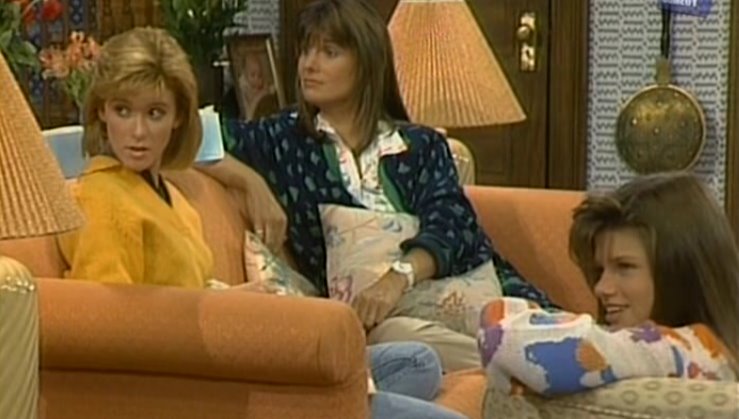
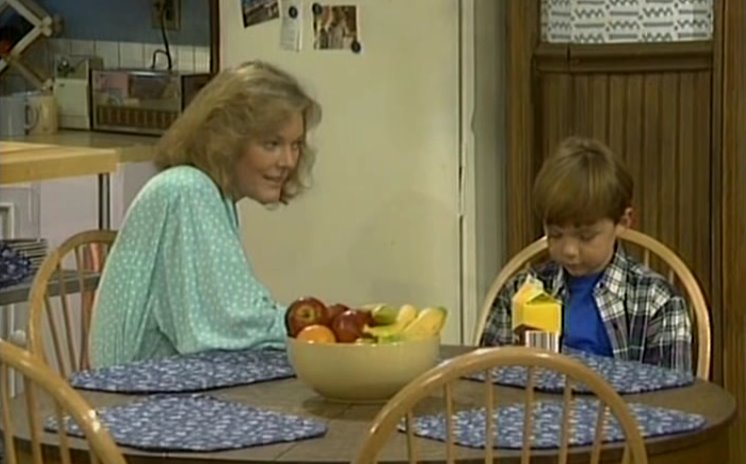
In 1984, now both divorced, Kate and Allie merged their two families - comprising Kate's teenage daughter, Emma (Ari Meyers), Allie's teenage daughter, Jennie (Allison Smith), and her younger son, Chip (Frederick Koehler).

Kate's apartment in Greenwich Village, New York, was now home to everybody, and we had an interesting alternative family set-up.

Creator Sherry Coben had been inspired by a high school reunion she had attended, where she observed a couple of unhappy divorcees who found comfort in sharing with each other. One of the most groundbreaking things about Kate & Allie was that the show never became some trendy, issue-led thing, Feminist ideology brainwashing or 'hey - this is hip and happening - let's do it!' garbage - as some previous shows had done. 

The show was character-led, it was based on changing social trends - the rising divorce rate in particular - but not chattering classes' nonsense. The characters were beautifully defined. Perhaps there was one episode towards the end of the run which didn't sit quite right, and an established character was briefly mutated into somebody quite different to suit Feminist ideology, but that's still excellent going for those times.

Allie was tightly buttoned and conservative, but underneath she was insecure and lacking in self respect. Her husband's affair and subsequent remarriage had severely shaken her.

Kate was laid back and happy-go-lucky, able to cope (well, usually!) with Allie's well-ordered suburban ways and occasional hysterical outbursts.

All was not portrayed as eternally peaceful in this alternative family, but Kate and Allie's friendship won through.


Could there be life after marriage for Allie, seen here with her ex-husband, Dr Charles Lowell (Paul Hecht)? She had still to meet Claire (Wendie Malick), the woman Charles had left her for, and when she finally did, the news that Charles and Claire had made love in Allie's marital bed, before the marriage had broken up, on Allie's designer sheets with the motif of little windmills, stunned her. Charles, meanwhile, was unhappy when Claire presented him with a new baby son, Stewart. Wasn't he too old for this? Didn't he deserve some peace and a nicely paced life which suited his age?

A landmark episode in this groundbreaking series, Kate and Allie face a huge rent increase when the landlady discovers that her one family apartment is now occupied by two families. Our heroines seek to wriggle off the hook by claiming to be a lesbian couple, winning the landlady's sympathy as she is herself gay. But the truth finally outs in a thought provoking scene which poses the question: just what constitutes a family? Is it only Mr and Mrs Average and 2.4 kids? The answer is - of course not!

Peace, love and protest were Kate's scene as a student in the 1960s. In the 1980s (just look at those shoulder pads!), she tried to rally her fellow customers at the local bank to protest at the establishment's attitude towards its customers, but was quickly removed by security guards!

Whilst Kate worked for a travel agent, Allie was at first housewife homebody, though later returned to college to get a degree. Kate commented that Allie had saved Emma (and herself!) from being latchkey kids. 

Later still, Allie and Kate pooled their resources to start a successful catering business.

Note the strange design of the matching wallpaper and curtains. Dot. line. Squiggle. Dot. Was it some kind of code, I used to wonder?

Also note that Allie has shoulder pads in her dressing gown!

Emma decides to make divorce the subject of her "Our Changing World" high school project, and finds the best subject material is to be found at home.

Kate found romance with Ted Bartelo (Gregory Salata), a plumber who was afraid of spiders. The two fell deeply in love, but split up repeatedly, realising that they both wanted different things out of life - Ted a family, Kate a continuation of her career. Finally, Ted found somebody who wanted the same things as him. Kate was devastated.

Kate and Allie was well written, and imaginative: one episode began as reality, before becoming Allie's imagination - something we only began to suspect as the plot became more and more bizarre; another saw Chip returning to the about-to-be-demolished apartment in the early 21st Century with his son and reminiscing about his childhood there in the 1980s; a further stand-out-in-my-mind episode centred on Chip - and soon his entire alternative family - befriending Louis, a young homeless man with learning difficulties.

Louis (Michael Countryman) found friendship and sewing lessons at Kate and Allie's apartment. The character was rehoused in supported living accommodation and developed romantic feelings towards Kate, before finding happiness elsewhere.

Something amiss... Jennie, Kate and Emma wonder what Chip has been up to...

So does Allie... surely he couldn't possibly have been using the oven door as a trampoline?! When the door comes off in her hand, Allie believes it...

Kate & Allie ran until 1989 - by which time Allie had remarried. Her new husband was a man called Bob Barsky (Sam Freed) who spent each week working away as a TV sportscaster, returning home only at weekends.

So, Kate moved into Allie's marital home to keep her company.

It wasn't the same. Perhaps it was the absence of the "Dot. Line. Squiggle" wallpaper at the new place, perhaps all the angles had been covered, but it soon became clear that Kate & Allie had run its course. The original premise of two divorced women merging their households had been groundbreaking; the set-up of the final series - divorced woman living with married friend and her often absent husband - was different, but not fascinating.

However, the show at its best was, in my very humble opinion, excellent and even towards the end, with the "Dot.Line.Squiggle" wallpaper sadly absent, there was some highly imaginative writing and the characters remained as likeable as ever.

Fondly remembered!