Total Pageviews

Pages

Showing posts with label Power Dressing. Show all posts

15 October 2022

The 1980s and Shoulder Pads

My, what big shoulders you have, Mr Robinson. Sorry, I mean Donovan. 

Shoulder pads were part of the "Power Dressing" image. The phrase was first recorded in 1980, according to the Twentieth Century Book of Words by John Ayto (Oxford, 1999). Back then, it meant a smart, efficient look for executive women. 

What brought about the 1980s shoulder pad fixation? Well, it all began with a 1940s revival towards the end of the 1970s. The current Wikipedia article on shoulder pads and the 1980s reads like a page of a very poor amateur essay - the pads fashion revered of the power dressing crowd was not 70s/80s - it was '80s - and was inspired by a number of things. 

The first was the 1970s love of retro. Very few fashions are original. If you read this, you will perhaps be surprised to learn that huge flared trousers and huge platform shoes were not original fashions of the 60s/70s.

Ah... galumphing around in huge flared trousers is so... 1930s!

In the 1970s, we had had the continuation of big trousers from the 1960s (not original - do check out some 1930s/mail order catalogues for some absolutely flared whoppers), the platform shoe revival (30s/40s again), the down to the feet, puffed sleeve Jane Austin style dress revival, the country chic smock top revival, the 1950s Teddy Boy revival (which began in the '50s with a revival of Edwardian style suits!), the 1960s mods and rockers and Ska revival, then fashion designers at the end of the decade began to play with shoulder pads again. They'd already been back in fashion once earlier in the decade, but not big ones.

A tailored look had already returned, but in 1979 at least one British women's magazine was trumpeting the return of the 1940s.

Some catwalk fashion designers favoured huge pads - or other structures to give big shoulders, others little ones, but not many out in the real world were in any sort of mood for them. We were in a deep recession, and so watching early 1980s television is a disappointment for pad searchers.

The events of the 1980s propelled the pads beyond a 1940s retro fixation. Dynasty happened, and the Reagan yuppie thing happened and spread beyond America, and then shoulder pads flew. There were big, very big, very, very  big and absolutely jumbo colossal. In 1985/86 they were at screaming point. Shoulder pads were even appearing in T-shirts! When they began to pall, there was the strange 'drop off' shoulder pad, at the end of the shoulder, sagging down.

Some link the shoulder pad/power dressing thing of the 1980s to Feminism. At the time, it just seemed like a fashion pantomime. We wanted to get dressed up to the nines, and we had poor taste. 

Some men (like me) got in on the act. The pads had to be large. We wanted BIG, BIG shoulders. Many of us guys had them already, of course, because the majority of heavy, dangerous 'glass cellar jobs' were being done by men. As they are today.

But us slouchy, weakling men who got the padded look thought we looked great - and our gigantic shoulders made our beer bellies (not that Jason Donovan had one!) look much smaller.

Bliss. OTT power dressing was a fashion trend prompted by the excesses of the decade. It was a fashion that, like so many other eras, sometimes has a false importance attached to it and historians who are keen on the 1970s try to backdate it (the internet '70s years are the blackhole of eras, sucking in trends from the 1960s and 1980s). 

Simply looking at the media of the early 1980s reveals what was in fashion. In 1980, the mainstream fashions were rather boring, even in Dallas. By 1985, the massive shoulders were in, power shoulders, and the media of the time reflects that. Just look.

Ugly, but very much part of the mid-decade polarised society, and very much part of the time, which included the moussed and gel-propelled hair fashions.

Mind you, I loved those wicked pads at the time - especially in a neon pink or blue jacket, with the sleeves pushed up, and with gel or mousse and blond highlights in my hair, and a cerise mesh vest, and a pair of docksiders with no socks and...
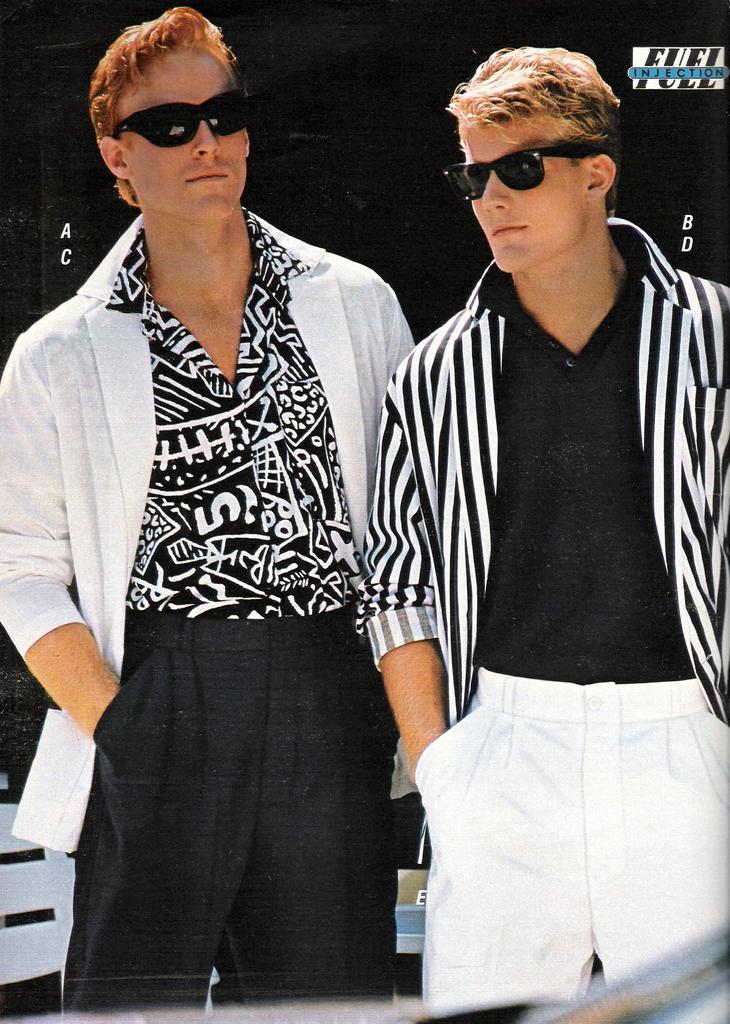
Men's fashion as featured in a 1987 advertisement... I loved it all... why are you laughing?!
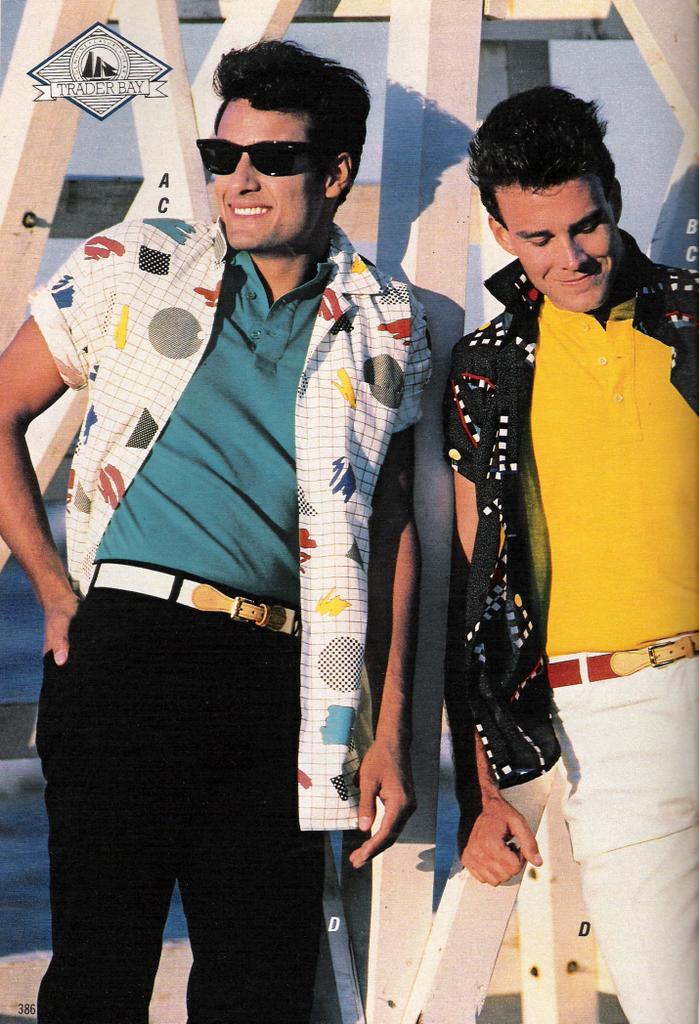
- More absolutely gorgeous 1987 clobber - and unpadded. For a change.
And as we leave the subject of shoulder pads for a while, Phil writes to say:

I've been reading on line that Margaret Thatcher, UK Prime Minister from May 1979 to November 1990, influenced the trend for huge shoulder pads. Did she? Was she the original power dresser?

No, Phil. Piffle and bunk on-line we're afraid.

Power dressing was a trend Margaret Thatcher followed in the 1980s, but did not help to create. The jacket she wore after her first general election win in May 1979 illustrates this. It is simply a neatly tailored blue jacket, with totally non-excessive shoulders. It was a boring garment in 1979 - and would even have been boring in 1969. As the 1980s wore on, Thatcher simply adopted the fashion of that time. Compare her neatly tailored and somewhat timeless look of 1979 (top) and her whopper shoulders of 1987 (bottom) for details.

Cynthia Crawford, Thatcher's personal assistant who was responsible for seeing she was smartly dressed and groomed, stated in 2013:

'In 1987 she was going to Russia for the first time and I had seen a wonderful coat in Aquascutum's window and I went to get it. A lot of her clothes up until that time had been homemade by a lady. She made all those dresses and blouses with bows and things. Mrs Thatcher went to Russia and she looked absolutely fabulous. I said to her: "If you are going to fight an election in June, why don't we ask Aquascutum to make you up some working suits." She agreed, so we ordered these suits. It was when the power shoulders were in and it just revolutionised her. She looked fantastic. She enjoyed all the new outfits and got away from the dresses. She never wears trousers, not even today. She always likes formal clothes, even at home. She hasn't got a lot of casual clothes.'

Thatcher was a follower, not an innovator, as far as fashion was concerned. I don't recall anybody wanting to look like her. The handbag, for a start, was so naff!

Some Feminists say Thatcher was an inspiration in the fashion line for 'oppressed woman out to break the glass ceiling'. But Thatcher didn't even like Feminism.

To quote her: 'The Feminists hate me, don't they? And I don't blame them. For I hate Feminism. It is poison.'

Mind you, Mags could be a bit of a female chauvinist. She also once said: 'In politics, if you want something said, ask a man. If you want something done, ask a woman.'

And in the glass cellar jobs, where the men don't need shoulder pads? Where are all the modern Maggies smashing through that supposed barrier?


19 April 2018

Did Margaret Thatcher Influence The Shoulder Pads Trend? Er, No, Actually...

Phil writes to say:

I've been reading on line that Margaret Thatcher, UK Prime Minister from May 1979 to November 1990, influenced the trend for huge shoulder pads. Did she? Was she the original power dresser?
No, Phil. Piffle and bunk on-line we're afraid.

Power dressing was a trend Margaret Thatcher followed in the 1980s, but did not help to create. The jacket she wore after her first general election win in May 1979 illustrates this. It is simply a neatly tailored blue jacket, with totally non-excessive shoulders. It was a boring garment in 1979 - and would even have been boring in 1969. As the 1980s wore on, Thatcher simply adopted the fashion of that time. Compare her neatly tailored and somewhat timeless look of 1979 (top) and her whopper shoulders of 1987 (bottom) for details.

Cynthia Crawford, Thatcher's personal assistant who was responsible for seeing she was smartly dressed and groomed, stated in 2013:

'In 1987 she was going to Russia for the first time and I had seen a wonderful coat in Aquascutum's window and I went to get it. A lot of her clothes up until that time had been homemade by a lady. She made all those dresses and blouses with bows and things. Mrs Thatcher went to Russia and she looked absolutely fabulous. I said to her: "If you are going to fight an election in June, why don't we ask Aquascutum to make you up some working suits." She agreed, so we ordered these suits. It was when the power shoulders were in and it just revolutionised her. She looked fantastic. She enjoyed all the new outfits and got away from the dresses. She never wears trousers, not even today. She always likes formal clothes, even at home. She hasn't got a lot of casual clothes.'

Thatcher was a follower, not an innovator, as far as fashion was concerned. I don't recall anybody wanting to look like her. The handbag, for a start, was so naff!


17 January 2018

Some 1980s Highs... Shoulder Pads In The Broom Cupboard...

Yuppies, new technology, shell suits, power dressing, riots, hamster scoffing... it was all happening in the 1980s...

Great response to our recent post regarding your "1980s bests". Got a few "worsts" as well, but up here at '80s Actual Towers, in our turquoise and pink Great Hall, we're well chuffed, mateyboots!

So, we start with Cliff on those monstrous Power Dressing shoulder pads, complete with Velcro so you didn't "over-pad" - as if that was possible back then...

I hated shoulder pads and used to take them out of any jackets I bought that had them in. The 1950s teddy boy look that became so popular again in the 1970s was more my thing. I thought Joan Collins looked ridiculous and I never chose a girlfriend with a 1980s “power dressing” fetish. You have to admit that the shoulder pads became too big and looked hideous in the 80’s. And the idea of blokes wearing them to hide their beer guts was pathetic. The best thing was the Credit Boom. Enough said.

We quite liked 'em, Cliff - we favoured Miami Vice chic, with a few twists, but each to their own... and as for the Credit Boom... well, after spending the '70s and early '80s living so frugally it hurt, it was like Wonderland...


Gorgeous 1980s colour scheme, but are those shoulders lovely or loathsome?

And here's Karen on Miss Ethel Davis and her lodgers, and Edd the Duck...

I used to like “Number 73” on Saturdays and I thought Ethel, Dawn, Harry and Kim really lived in that house! And I loved Children’s BBC with the puppets and the presenters. It was very lively and I really believed Edd the Duck went to Cubs on Tuesdays. I preferred Edd to Gordon The Gopher actually.

Edd was quite simply a mallard god. And he DID go to Cubs on Tuesdays.


Edd with Andy Crane and Wilson the butler. Children's BBC, which began in 1985, was a must-watch for all kids aged five to fifty.


Phillip Schofield brought shoulder pads out of the board room and into the Broom Cupboard.


Sandi Toksvig? Rubbish! That's Ethel!

And here's the Naughty One:

I remember things like Pot Noodles becoming a big thing. There was a cheesy flavour that smelled revolting but tasted like heaven with a satchet of tomato sauce. And Howard Jones. What Is Love? Does Anybody Love Anybody Anyway? And bulldog clips in my hair – bright yellow ones. And break dancing outside Boots on a Saturday morning with a big red ghetto blaster. I body-popped and my boyfriend thrashed about and he and his mates tried to stand on their heads. People sometimes threw money into our pot but mostly seemed kind of bemused and this woman told my boyfriend, “stop it, you’ll hurt yourself!”

Lurved a Pot Noodle and I remember the flavour you mention. Bliss if you could stand the stink. Howard Jones was excellent, but I never got into breakdancing. Mainly because I couldn't do it.


Gis a Noodle.

And Maria remembers that a saucy title didn't always add up to a saucy film...

When I turned 18 in 1989 I went to see a movie called SEX, LIES AND VIDEO TAPE with my best friend. We both thought it would be very rude with lots of bums and panting and groaning, but it wasn’t really. We thought of asking for our money back, but didn’t dare!

Steven Soderbergh... great, great film. I went to see it too, hoping for a bit of vacuous titillation, but it was so much better than that. Although I was grossly disappointed and swore a lot at the time.

Sonia thought Boy George was so cuddly - and then along came Ecstasy...

I had a Boy George Doll in the mid-80s and I loved him very much. I was surprised to read later that he was one of the people behind ‘Everything Starts With An E’ in 1989. Totally different image!

The 1984 Boy George doll! The Boy went from Karma Chameleon to Planet Ecstasy all in one decade!

And finally for this round-up, Claire says:

My low of the 80’s pop culture was Cabbage Patch Dolls because I found them really creepy and thought they were trying to take over the world. My high was Live Aid. Truly inspiring. I was glued to the TV.

Yes, Live Aid was a WOW! and the Cabbage Patch Kids were hugely popular, but not to everybody's taste. I was afraid I might catch mumps off one.

Sunday People, December 1983: Eek!!! Invasion of the Cabbage Patch People...

Please keep the comments coming. We're having a WICKED time here. Till the next time, xxxx

03 May 2012

Miami Vice

Debuting in the States in 1984 and in England in early 1985, Miami Vice was an instant hit.

Duran Duran in the 1982 Rio video - note the prototype Miami Vice gear. Jacket sleeves had begun to be pushed up as a fashion trend around the turn of the decade - and the trend grew more and more prevalant as the decade got underway. Shoulder pads began to grow (courtesy of the likes of Joan Collins and, judging by this picture, John Taylor) and everyday men began to wear bright colours.

Miami Vice had pushed-up sleeves, pastel shaded clothing and obvious shoulder pads, but it also had designer stubble, docksiders with no socks, pastel painted buildings, two stylish cops called Sonny Crockett (Don Johnson) and Ricardo Tubbs (Philip Michael Thomas), a soundtrack of top-notch rock music and an alligator called Elvis...

The show's groundbreaking and highly distinctive look was created by its executive producer, Michael Mann.


Tubbs advises Crockett to cool it...

Crockett and Tubbs battled against evil Miami villains. The show had a hard edge.

And it also had some weird quirks - like Elvis, the aforementioned alligator, who shared Crockett's houseboat.

The guys worked hard, often finding their lives in danger...

... but occasionally found time for romance - and once even marriage. Crockett got hitched to a British pop star - the lovely Scot Sheena Easton.

Unfortunately, her character was quickly bumped off.


Serious about crime. Serious about style.

Crockett and Tubbs look-a-likes featured in the "Sun", July, 1985.

Here in England, Crockett and Tubbs clones abounded. Including me. Designer stubble made me look distinctly seedy - like an associate of Arthur Daley or Gilbert the alien. I was well into the "no socks" routine. Never try it with canvas shoes. Take my word for it - it's agony, rubs all the skin off your feet.

I was already into the pushed up sleeve look - and the colourful jackets were a delight, as were the exaggerated shoulders!

Miami Vice is remembered as one of the most iconic television shows of the 1980s. I'll certainly never forget the show's ultra-stylish presentation - nor the impact it had on my fashion sense! 

The "Miami Vice" theme by Jan Hammer charted here in December 1985.

A 1986 advertisement for a "Miami Vice" computer game produced by Ocean Software, Manchester, England.

"Crockett and Tubbs, the only cops to have Pierre Cardin warrant cards..."

A review of the "Miami Vice" game from "Your Computer" magazine, October 1986 and, below, a further advertisement.


17 March 2012

1980s Shoulder Pads

Jason Donovan of Neighbours and Stock, Aitken and Waterman fame sports some very big and lovely shoulder pads. And a mullet.

Ah, shoulder pads! Ah, the 1980s! So where's the link? As if we didn't know! Studying fashion via vintage mail order catalogues and fashion shop ads in my local newspaper archive is where I began my work of learning the realities about popular clothing of various decades.

By this, I don't mean the ultra sophisticated garb of the super rich, as seen on the posh fashion show catwalks (very Jan Howard!).

No, I mean what Sharon and Gary (or you and me) were wearing down at the "local", and which pop or TV stars they (or us) had been inspired by.


So, what about those shoulder pads? Well, '80s shoulder pads actually began as a chic retro revival. They were first around in the 1930s and 1940s. 

Of course, the 1980s had bigger ones!

If you watch a TV programme from 1980, you will note the very ordinary-looking shoulders of the good folk on-screen. Shortly after this, small shoulder pads became prevalent. But, by the mid-1980s, COLOSSAL shoulder pads were everywhere. Nowadays, they make very amusing viewing.

It's tremendous fun to view several seasons of an '80s era American soap and watch those shoulders grow over the years!

Joan Collins of Dynasty fame was partly responsible, and where Dynasty flew, the rival American soaps followed as the female cast members howled for higher costume budgets and more "stylish" gear!

Shoulder pads became a required part of the power dressing image for women, and men also cottoned on to the trend. Well, those kindly pads tended to detract from a beer belly!

1940s shoulder pads had often been big. 1980s shoulder pads were usually bigger.

Sometimes absurdly so.

The era of the truly massive shoulder pad began around 1982/1983 and stretched on into the early 1990s.

Personally, I used to like them in a nice pastel linen jacket, with the sleeves pushed up.

Unashamedly an '80s fashion victim!

And why not?

The '80s are sometimes called "The Style Decade". But the trouble was the styles were often too brash, too "in your face". A lot of us were "dead common" back then. And a lot of the styles - like those oh-so-stylish shoulder pads were horrendously OTT!

Fun, though...

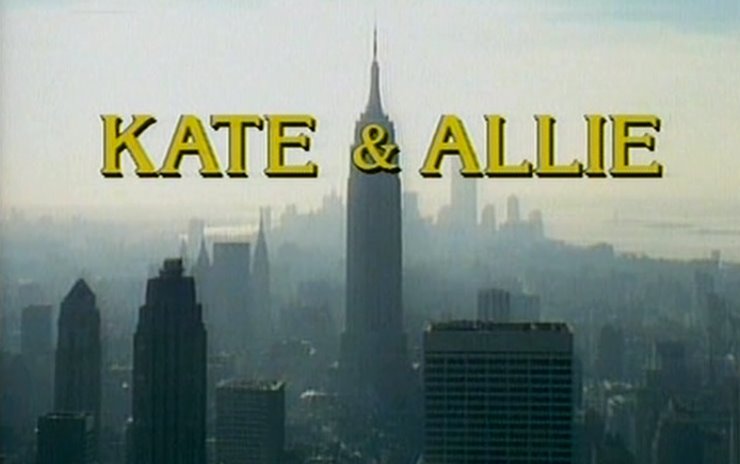
Kate (Susan St James) of the American sit com Kate And Allie wears very clearly defined and MASSIVE shoulder pads. Very smart indeed!

30 March 2011

Power Dressing For Men...

My, what big shoulders you have, Mr Robinson. Sorry, I mean Donovan. 


Shoulder pads were part of the "Power Dressing" image. The phrase was first recorded in 1980, according to the Twentieth Century Book of Words by John Ayto (Oxford, 1999). Back then, it meant a smart, efficient look for executive women. But as the 1980s continued the shoulders grew and grew. And some men (like me) got in on the act. The pads had to be large. We wanted BIG, BIG shoulders.

Us men who got the padded look thought we looked great - and our gigantic shoulders made our beer bellies (not that Jason Donovan had one!) look much smaller.

Bliss.
Men's fashion as featured in a 1987 advertisement... I loved it all... why are you laughing?!
- More absolutely gorgeous 1987 clobber!

18 December 2010

Power Showers....

Power, darling - don't you just love the idea? And Power Dressing, didn't you just love that, too?

20th Century Words by John Ayto - published in 1999 - defines Power Dressing thus:

noun (1980) a style of dressing for work and business intended to convey an impression of efficiency and confidence. Applied particularly to clothing adopted by some women to fit in with the ruthless business ethic of the 1980s, characterised by the use of shoulder-pads to create a more masculine-looking outline.

Of course, looking back at the 1980s from our current vantage point, we can see that the shoulder-padded look was also part of lots of 1980s fun fashion - and that many men employed it, too.

I did. I thought it so stylish. And the choice of colours for jackets back then, together with the patterned material inside that you could roll up your sleeves to reveal and contrast, was a wow.

Power dressing was followed by a range of "power" prefixes - you could have a power walk, power nap, power breakfast, power washes and, of course, a power shower...

There's nothing like a Power Shower - to pamper, to soothe, to invigorate, to leave you tingling-fresh.

And now they start at an even better price.

For less than £300 inc. VAT, you can have, installed - a shower with an adjustable head that puts you in control, to choose the spray that suits your mood.

A shower with a powerful pump which, when added to your gas central heating, keeps the luxurious water flow constant, and maintains the temperature you choose.

And a shower that can still cost less to take than a bath. Even more of a bargain when you remember that heating your water by gas is your cheapest option - 24 hrs a day.

The Power Shower. Saving you money all-round.

See them and other energy saving gas appliances at British Gas showrooms now.

British Gas - ENERGY IS OUR BUSINESS

I do love the black tiles with red grouting effect featured in the ad photograph. Very '80s indeed!

26 August 2010

Kate & Allie

American newspaper ad for a brand new comedy series - Kate & Allie, 1984.

Created by Sherry Coben, Kate & Allie was a groundbreaking and tremendously likeable American sitcom, which debuted in the States in 1984 and in England (on Channel 4) in 1986. The show told the story of two women who had first met as kids.

Baby boomers Kate McArdle (Susan Saint James) and Allie Lowell (Jane Curtin) were high school friends, but later drifted apart. Let loose upon the "Peace and Love" scene of the 1960s, Kate became a free wheeling, peace loving, protest marcher - and married an actor. Meanwhile, Allie became a neat suburban housewife - she married a doctor.

In 1984, now both divorced, Kate and Allie merged their two families - comprising Kate's teenage daughter, Emma (Ari Meyers), Allie's teenage daughter, Jennie (Allison Smith), and her younger son, Chip (Frederick Koehler).

Kate's apartment in Greenwich Village, New York, was now home to everybody, and we had an interesting alternative family set-up.

Creator Sherry Coben had been inspired by a high school reunion she had attended, where she observed a couple of unhappy divorcees who found comfort in sharing with each other. One of the most groundbreaking things about Kate & Allie was that the show never became some trendy, issue-led thing, Feminist ideology brainwashing or 'hey - this is hip and happening - let's do it!' garbage - as some previous shows had done. 

The show was character-led, it was based on changing social trends - the rising divorce rate in particular - but not chattering classes' nonsense. The characters were beautifully defined. Perhaps there was one episode towards the end of the run which didn't sit quite right, and an established character was briefly mutated into somebody quite different to suit Feminist ideology, but that's still excellent going for those times.

Allie was tightly buttoned and conservative, but underneath she was insecure and lacking in self respect. Her husband's affair and subsequent remarriage had severely shaken her.

Kate was laid back and happy-go-lucky, able to cope (well, usually!) with Allie's well-ordered suburban ways and occasional hysterical outbursts.

All was not portrayed as eternally peaceful in this alternative family, but Kate and Allie's friendship won through.


Could there be life after marriage for Allie, seen here with her ex-husband, Dr Charles Lowell (Paul Hecht)? She had still to meet Claire (Wendie Malick), the woman Charles had left her for, and when she finally did, the news that Charles and Claire had made love in Allie's marital bed, before the marriage had broken up, on Allie's designer sheets with the motif of little windmills, stunned her. Charles, meanwhile, was unhappy when Claire presented him with a new baby son, Stewart. Wasn't he too old for this? Didn't he deserve some peace and a nicely paced life which suited his age?

A landmark episode in this groundbreaking series, Kate and Allie face a huge rent increase when the landlady discovers that her one family apartment is now occupied by two families. Our heroines seek to wriggle off the hook by claiming to be a lesbian couple, winning the landlady's sympathy as she is herself gay. But the truth finally outs in a thought provoking scene which poses the question: just what constitutes a family? Is it only Mr and Mrs Average and 2.4 kids? The answer is - of course not!

Peace, love and protest were Kate's scene as a student in the 1960s. In the 1980s (just look at those shoulder pads!), she tried to rally her fellow customers at the local bank to protest at the establishment's attitude towards its customers, but was quickly removed by security guards!

Whilst Kate worked for a travel agent, Allie was at first housewife homebody, though later returned to college to get a degree. Kate commented that Allie had saved Emma (and herself!) from being latchkey kids. 

Later still, Allie and Kate pooled their resources to start a successful catering business.

Note the strange design of the matching wallpaper and curtains. Dot. line. Squiggle. Dot. Was it some kind of code, I used to wonder?
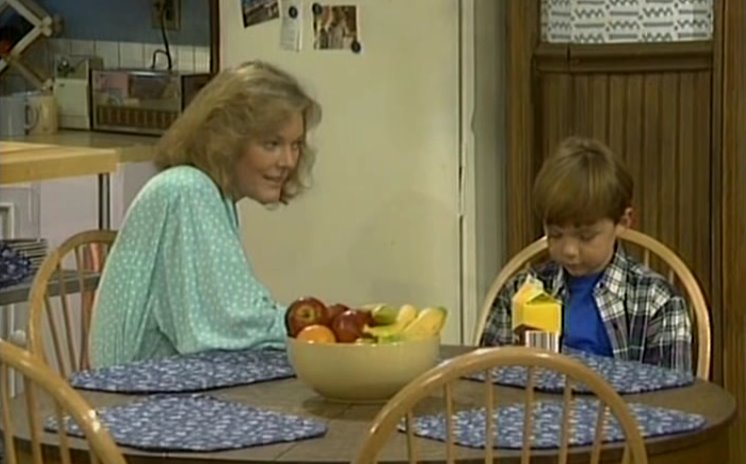
Also note that Allie has shoulder pads in her dressing gown!

Emma decides to make divorce the subject of her "Our Changing World" high school project, and finds the best subject material is to be found at home.

Kate found romance with Ted Bartelo (Gregory Salata), a plumber who was afraid of spiders. The two fell deeply in love, but split up repeatedly, realising that they both wanted different things out of life - Ted a family, Kate a continuation of her career. Finally, Ted found somebody who wanted the same things as him. Kate was devastated.

Kate and Allie was well written, and imaginative: one episode began as reality, before becoming Allie's imagination - something we only began to suspect as the plot became more and more bizarre; another saw Chip returning to the about-to-be-demolished apartment in the early 21st Century with his son and reminiscing about his childhood there in the 1980s; a further stand-out-in-my-mind episode centred on Chip - and soon his entire alternative family - befriending Louis, a young homeless man with learning difficulties.

Louis (Michael Countryman) found friendship and sewing lessons at Kate and Allie's apartment. The character was rehoused in supported living accommodation and developed romantic feelings towards Kate, before finding happiness elsewhere.

Something amiss... Jennie, Kate and Emma wonder what Chip has been up to...

So does Allie... surely he couldn't possibly have been using the oven door as a trampoline?! When the door comes off in her hand, Allie believes it...

Kate & Allie ran until 1989 - by which time Allie had remarried. Her new husband was a man called Bob Barsky (Sam Freed) who spent each week working away as a TV sportscaster, returning home only at weekends.

So, Kate moved into Allie's marital home to keep her company.

It wasn't the same. Perhaps it was the absence of the "Dot. Line. Squiggle" wallpaper at the new place, perhaps all the angles had been covered, but it soon became clear that Kate & Allie had run its course. The original premise of two divorced women merging their households had been groundbreaking; the set-up of the final series - divorced woman living with married friend and her often absent husband - was different, but not fascinating.

However, the show at its best was, in my very humble opinion, excellent and even towards the end, with the "Dot.Line.Squiggle" wallpaper sadly absent, there was some highly imaginative writing and the characters remained as likeable as ever.

Fondly remembered!

22 March 2010

1985 - Live Aid, The Mobile Phone in England, The Beiderbecke Affair, Edge Of Darkness, Windows, EastEnders, Boris Becker, Comic Relief, The C5

The year of Live Aid!

On the 1st of January 1985, comedian Ernie Wise, he of the short, fat, hairy legs, started a revolution. Standing in the middle of St Katherine's Dock, he made the first mobile phone call in England, in fact in the whole of Britain, and a little piece of history was made. More here.

After weeks of "They Are Here" teasers, EastEnders arrived. Angie and Den had a lousy wedding anniversary and Lou had a right old go at Pauline. Oh, and Reg Cox had been murdered.


1985 also saw the start of shorter-lived soap Albion Market. Loads more here.

Longer-lived was the BBC's Howards' Way, first seen in 1985.The goings-on in Tarrant kept us glued to our telly screens until the final series in 1990.

Meanwhile, in the ITV ad breaks, Julie Walters watched footage of an old '50s trout making a pot of tea. "Ooh, worra palaver!" said Julie, opting for a new Typhoo One Cup.

Over on the BBC, Troy Kennedy Martin gave us Edge Of Darkness, the highly topical nuclear thriller serial. Kennedy Martin had been frustrated by the lack of political drama on TV in the early 1980s. With the Thatcher/Reagan era changing the political landscape, Kennedy Martin began to write - with little hope of ever seeing it televised. More here.

Alternative comedian Alexei Sayle's 1984 hit 'Ullo John, Gotta A New Motor? became 'Ullo Tosh, got a Toshiba? and the Holstein Pils commercials melded Griff Rhys Jones to a lot of old film footage, featuring the likes of Marilyn Monroe.

Comic Relief was launched.

At 17, German Boris Becker was the youngest player ever to win the Men's Final at Wimbledon - and a thrilling final it was!

Everybody Wants To Rule The World, sang Tears For Fears. Perhaps not, but money was important. After the long recession, I didn't find it surprising, but I couldn't go along with the ethos. I was young and idealistic, and whilst I liked the OTT glitz and glamour of the mid-1980s (it felt like a huge relief to me after my grotty '70s childhood and the regimented fashions of that era), I couldn't stomach the Thatcher/Yuppie thing. I wanted to do something meaningful and gave up my office job to work as a care assistant in a Social Services home for the elderly.


It was demanding - the home catered for EMI (elderly mentally ill) people, and the physically frail and we often had to care for residents who were, basically, on their death beds, and make their end as comfortable as possible. It was hard work, the pay was lousy, but the sense of comradeship amongst the staff was great and I was happy.

Shoulder-padded jackets, stockbroker shirts, bizarre hair, a bop to the likes of Animotion's Obsession and a few pints of "Reassuringly Expensive" Stella Artois by night (I rarely stayed in) and comfortable running shoes, and a good supply of bed pan scrubbers and disposable plastic aprons by day. It was a good life.

The concept of advertising a drink as "Reassuringly Expensive" made sense back in the mid-to-late 1980s - "yer pays for quality, yer see!"

Controversy raged over Thatcher. She certainly wasn't loved by all and a night out at the local pub was often enlivened by a good old argument between her fans and ... er... non-fans. As you know I was very much a non-fan. I miss those days when politics were top of the agenda. If apathy didn't rule these days and people actually studied the actions of this current government a little more, Brown and co would have many difficult questions to answer...

Microsoft released Windows in 1985, another great leap forward for the world of computing.

New technology slamming into our lives was a theme throughout the 1980s. Some of it, like microwave ovens, wasn't so new - I have read that the first domestic microwave model came along in the 1960s. But it was all a matter of affordability. It was in the 1980s that these became common in England, and it was the same with video recorders.

Video taping techniques had been around for yonks, but it took time for the first domestic VCRs to make their debut. And even then, as mentioned elsewhere in this blog, who could afford them? 5% of households owned them in 1980, nearly 20% in 1983, and several more years rolled by before many of us could afford to get to grips with video recorders. And then there was the Betamax/Phillips/VHS battle to confuse us! By 1985 many of us had encountered a video. But did we know how to set it to tape programmes when we were out? Er...

The Scotch video Skeleton (first seen in 1983) gave us a new catchphrase in 1985 - "Re-Record, Not Fade Away" - more details here.

And talking of technology, there was Sir Clive Sinclair and his wonderful 1985 innovation, the C5.


Practical personal transport - powered by electricity, ran the advertising blurb.

Some original C5 newspaper advertisements can be found here.

Around this time, there were also those funny electronic key ring thingies - you remember - if you mislaid your keys, you whistled and the key ring would emit an electronic beep to inform you of its location. Good idea.

This was the year of Live Aid, the 12 hour charity pop marathon, held at Wembley Stadium in England and Philadelphia's JFK Stadium in the USA. It was watched by 1.5 billion people worldwide and millions of pounds were raised. Its instigator, Bob Geldof, was dubbed by some of us "St Bob of Geldof".

Many women and girls were favouring large hair ribbons. Worn with a shaggy or spiral perm, large T-shirt, lycra leggings and a pair of trainers, they produced an overall cartoon character effect. Very nice.

Ear rings were growing to resemble studded doughnuts, meat axes or door knockers. Just as popular were big black hoops, or cheap plastic ear rings in vile neon shades.


We met Trevor Chaplin and Jill Swinburne in the Beiderbecke Affair - the first series in Alan Plater's trilogy. More here.

Miami Vice began in the UK, having debuted in the USA in 1984, and its attendant chic quickly became trendy. More about the show and the chic
here.

Stone washed jeans had been in fashion for a year or two, but, and perhaps my memory is playing me tricks, it is not until around the mid-1980s that I recall them taking on the distinctive stone washed effect we all remember. They often came with a plastic key ring to hang on them. The brand I usually bought was called Pepe!

The narrow-legged trend had grown ridiculous by this time - it was hell getting those jeans on. Whoever designed them had obviously never heard of feet.

The growing popularity of the new hair mousse meant we could continue our evil experiments with our crowning glories.

The Goth scene had been quietly developing and was noticeable in 1985.

Power Dressing was THE thing. Could those shoulder pads possibly get any larger? we wondered. "YES!!" screamed the 1980s in reply.

-------------------------------------------------