Total Pageviews

Pages

Showing posts with label gender issues. Show all posts

19 March 2012

The New Man

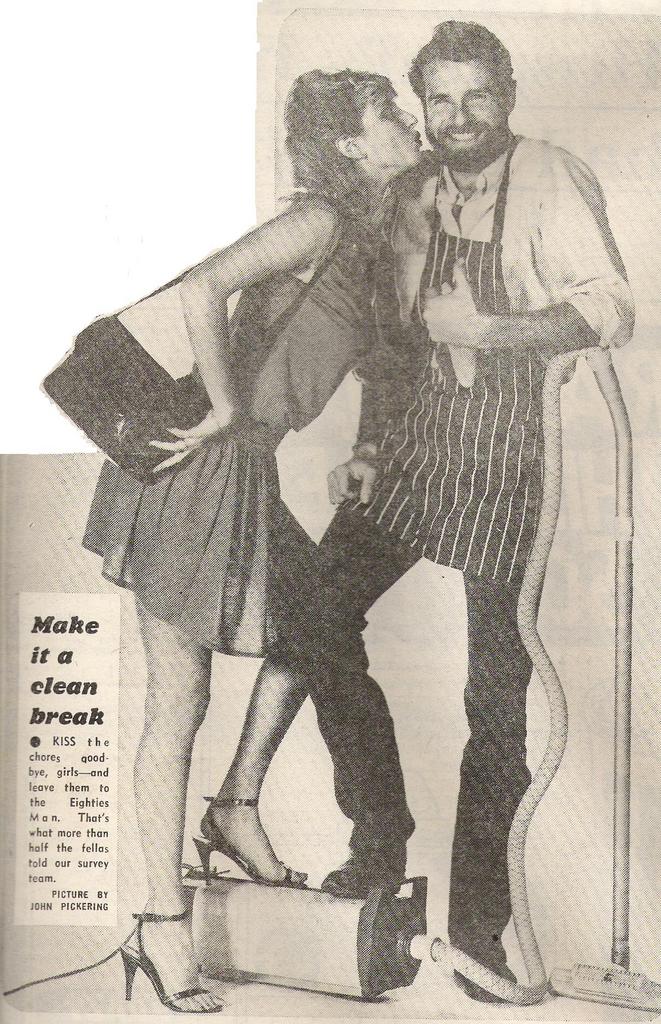
The Eighties Man: Day Two of a fascinating Sun series.

FELLAS DON'T FEEL A NINNY IN A PINNY!


They'll chip in on the chores.

The Sun, January, 1983.

Today's man does not mind a bit if he is left holding the baby - in fact he quite enjoys it.

He sees nothing odd in pushing a trolley around the supermarket, running around with the vacuum cleaner, or cooking the supper.

He believes - and his wife agrees - that looking after the children and doing the household chores should be shared equally between men and women.

When it comes to getting up to feed the baby 65 per cent of men and 71 per cent of women think that, where possible, they should take turns.

Almost as many men - 62 per cent - think shopping for groceries is a task that should be shared. And more than half - 58 per cent - say that the burden of housework should be split.

Yet a decade ago a real man would not have been caught dead with a dirty nappy and would never be seen with his hands in the sink, let alone flitting around with a duster.

What has caused this major shift of attitudes?

Partly the fact that more and more women have jobs outside the home.

In our survey almost half the women - 43 per cent - worked and four per cent were the main wage earners.

Housework HAS to be shared if it is to get done at all.

But Women's Lib was, in some ways, People's Lib. Men who felt they were missing something by leaving child-care to their wives were encouraged to lend a hand.

Yet there is still some way to go before everyone rejects the old idea that a man's place is at work and a woman's place is in the home.

And the men and women who do not believe that housework and childcare should be shared equally stick to the old patterns.

Of these, 46 per cent believe that cooking the meals is woman's work.

Forty-one per cent think the same about housework and one in three say women should do the food shopping.

But 48 per cent of all men say that painting and decorating are their work and 40 per cent feel the same about gardening.

The American "Eighties Man"/"New Man" - was a similar concept, which rose into the public consciousness c. 1982, although with more emphasis on men being allowed to develop and display emotional sensitivity then is illustrated in the article above.

20th Century Words by John Ayto (Oxford, 1999), traces the "New Man" to 1982 -

"a man who aims to be sensitive, caring, and non-aggressive and to take a substantial role in his household's domestic routine..."

Apparently, as the decade went on, the New Man began to be regarded as a bit of a wimp in some quarters:

1985, Chicago Tribune:

Does the New Woman really want the New Man?... The answer, as you might guess, is a frustrated no.

Sadly, the 1990s regressed, giving us the "New Lad".

I thought the 1980s were great from a male viewpoint. In my neighbourhood, back in the 70s/early 80s, boys who liked soap operas were considered... well... strange. But in the 80s, with the arrival of trendy soaps like Brookside and teenage soaps like Home and Away, it was OK for us to join in.

And to get emotional.

As a kid in the '70s, I always felt as though I was in an emotional straitjacket.

Also, grooming. No man in my family ever owned a hairdryer before the 1980s. It would have been unthinkable. In 1984, I became the first!

The "old Man" was often not very keen on the "New Man", as this comic strip from the Sun newspaper's women's section, September 15 1988, shows!

06 October 2010

The Sun Page 7 Fella

A Sun newspaper "Page 7 Fella" from February 1985. Note the 1980s bouffant mullet hairdo! 

The Sun Page 7 Fella caused a stir when he arrived in the early 1980s. Was this equality at last? No! said some - a male torso was in no way as revealing as a woman's breasts - many of which were to be seen on Page 3 over the years. But then 95% of workplace deaths being male and feminists' constant looking at a 'Glass Ceiling' and never a 'Glass Cellar' isn't equality either. And neither is the fact that domestic violence by women gets such scant attention. And sexual harassment. I've had some of that myself. 

The trouble is, in my 'Ever so 'Umble' opinion, both men and women are amazingly stupid: women for believing feminist ideology, which involves massive amounts of narcissism, misandry and self delusion, and men for immediately siding with anything the 'ladeez' say and dashing forward to be chivalrous white knights, while throwing their own sex under the bus.

But the human race is so funny - for all our posturings and belief in our greatness. Me included.

By 1988, the Sun had its own women's section - Sun Woman - and so at last there was a male Page 3, rather than a page 7. This particular "fella" dates from September '88. But, some complained, it wasn't really equality. A male torso was in no way as revealing as a woman's breasts. But then what is equality? The gender workplace death gap? The 'glass cellar' jobs gap? The gender custodial sentencing gap - massively skewed against males? The fact that until recently women retired five years earlier than men? Life is a lot more complex than the constant misandry spewed by the so-called equality movement, which has been so long accepted by the vast majority of people. I recommend a look at Janice Fiamengo and Karen Straughan's videos on YouTube for anybody who might like to investigate further.


01 April 2009

"Jenny Lives With Eric And Martin", Clause 28 and Militant Lesbians Invade The BBC News Studio...

"20,000 people, of all sexualities, marching through the streets of Manchester on a cold February afternoon is not something we are going to forget easily. Nor can we forget the close relationship which was forged between the Campaign and the gay scene. 1988 made us all finally realise that very powerful forces were out to get us."

Gay Life, January, 1989.

So what was Clause 28? How did it happen?

Many people will have you believe that the era before the 1980s was totally liberal, totally free of discrimination or malice. Then the 1980s arrived, slammed on the shoulder pads, stuck the cigarette in the holder, narrowed their eyes and went to work to undo everything and set the clock back.

Of course, that's not true. Some 1960s teenagers, mourning the loss of that decade and their youth since the start of 1970, have been very vocal (for such a kind, sharing and caring generation) in proclaiming just how superior they are to the generations that have followed. Meanwhile, the 1970s have been rewritten as a continuation of the "wonderful 60s". So heavily have the 70s been tweaked and repackaged, I hardly recognise them.

Let's look at the UK reality. In 1967, the decriminalisation of homosexual acts between consenting men in private was passed in England and Wales. Homosexual acts between women had never been illegal.

Although many gay men rejoiced at the news, there were sombre warnings that their new rights should not be "abused". Lord Arran, one of the major advocates for law reform, made the following speech in the House of Lords in 1967:

"I ask those who have, as it were, been in bondage and for whom the prison doors are now open, to show thanks by comporting themselves quietly and with dignity. This is no occasion for jubilations, certainly not for celebration. Any form of ostentatious behaviour now or in the future, any form of public flaunting, would be utterly distasteful and would, I believe, make the sponsors of the bill regret what they have done."

Fast forward to the late 1970s, and queer bashing was as much a sport as ever and gay men on TV were the traditional stereotypes. Accusations were made that much of the momentum behind the American "Disco Sucks" campaign came from racism and homophobia.

The decriminalisation of homosexual acts between men in Scotland took place in February 1981, and the London Weekend Television (LWT) series Gay Life was broadcast that year - although it was not networked.

The decriminalisation of homosexual acts between men in Northern Ireland took place in 1982.

In 1983, the 1981 book Jenny Lives With Eric & Martin, by Danish author Susanne Bosche, was published in England. The book was intended for primary school children and told the story of Jenny, a little girl who lived with her father and his male lover.

It was quickly banned from schools after protests from parents and politicians who feared that it might encourage children to "experiment with homosexuality". And yet parents were allowing their children to display posters of openly gay pop stars like Boy George on their bedroom walls, and indeed buying their children Boy George dollies! It really was an era of contrasts!

Jenny Lives With Eric and Martin is widely accepted as a major milestone on the road to Section (or Clause) 28, which came into effect on 24 May 1988. The emergence of AIDS as a growing epidemic, with gay men as a "high risk" group, was another.

Being well grotty, the "Clause" contained such gems as: A local authority shall not:

(a) Intentionally promote or publish material with the intention of promoting homosexuality.

(b) Promote the teaching in any maintained school of the acceptability of homosexuality in a pretended family relationship.

The "Clause" has now gone. But have books like Jenny Lives With Eric and Martin come back, I wonder, and if so what has been the reaction of the "wonderfully liberal" people of the early 21st Century?

Published in England by the Gay Men's Press, December 1983.

Jenny has a strop. .

I was very interested in the launch of Jenny Lives With Eric & Martin and bought a copy of the book. It may seem trite, but a memory that remains with me to this day is how shocked some older members of my family were with the suggested nudity in a couple of photographs in the book. We can be terribly smug, superior and "21st Century" about that now (it happens a lot), but it's worth noting that this country was a very different place in 1983!

Grumpy Mrs Jones sticks her beak in.


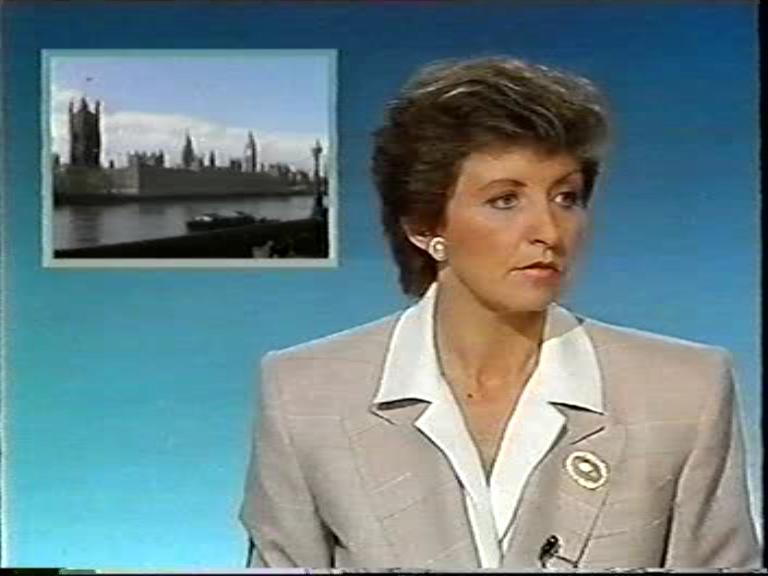
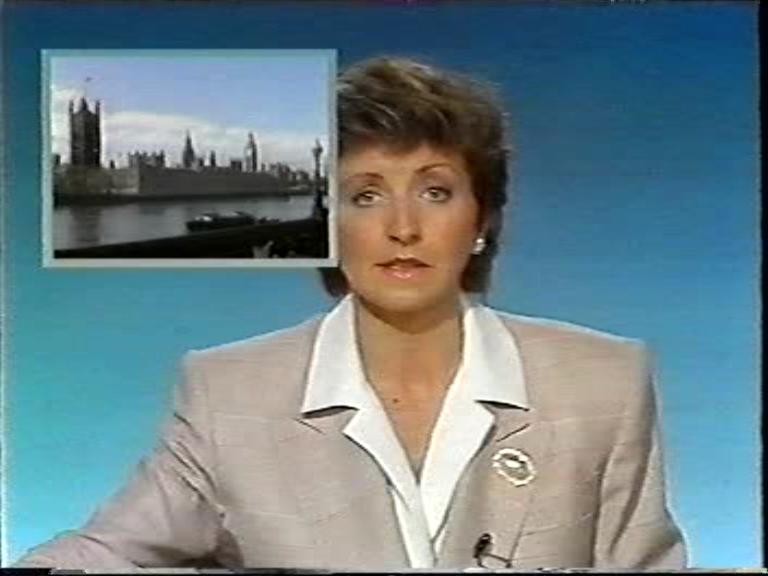
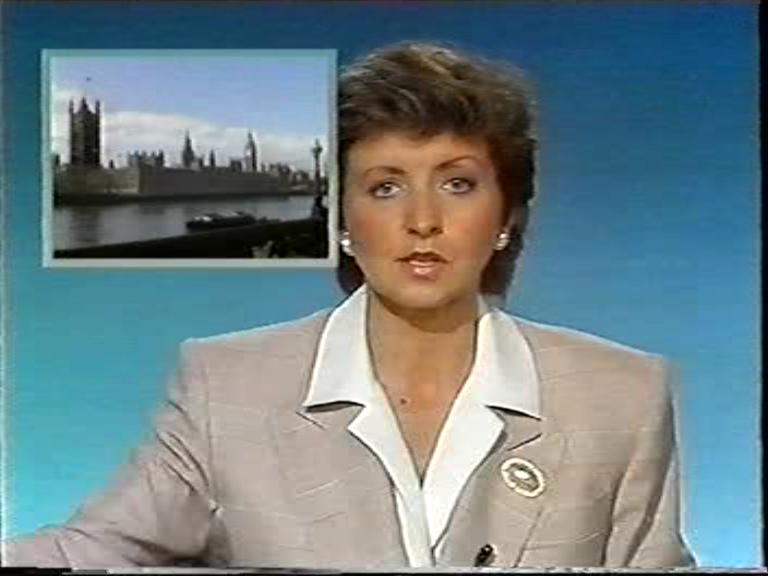
23rd May 1988 - and militant lesbians, protesting about Clause 28, invade the BBC newsroom. 

Gay men attempting to gain admission to protest at various times were, of course, roughly expelled/blocked.

Equality!

Sue Lawley struggled on with the news, whilst Nicholas Witchell sat on one of the protesters. Sue said: "...I do apologise if you're hearing quite a lot of noise in the studio at the moment. I'm afraid that, um, we have been rather invaded by some people who we hope to be removing shortly."

Sue Lawley battles on with the news, as the studio technology goes rather wonky...