Total Pageviews

Pages

Showing posts with label 1980. Show all posts

23 June 2026

Rubik's Cube

An original early 1980s Rubik's Cube. The British Association of Toy Retailers noted the intense interest in the Cube upon its arrival in late 1980 and named it Toy Of The Year as a huge Cube shortage began. There simply were not enough to go round! In the spring of 1981, the nation was finally fully stocked and the Cube won Toy Of The Year for the second year running.

I can't. 

The Cube was invented by Erno Rubik of Hungary in 1974, and he called it "Buvos Kocka" - the "Magic Cube".

"A Simple Approach To The Magic Cube" by Bridget Last, published in 1980 by a small publishing company, Tarquin Publications of Diss, Norfolk - the first Cube book published in England. The print run was so limited (for what was then a tiny niche puzzle following) that finding a copy today is like finding gold dust. Middle pictures - old Hungarian Magic Cubes occasionally turn up on eBay. There are fascinating differences in the look, weight and feel of the Magic Cube when compared to the Rubik's Cube. Far right - a magazine ad for the Hungarian Magic Cube from March 1981, dating to the time of the worldwide shortage of the new Rubik's Cubes. The book and the Pentangle (a small UK-based company) sold Hungarian Magic Cube are mine. I daren't handle the Cube in case it falls apart! Pentangle, a small company who distributed small numbers of Magic Cubes in the UK, 
seeing major potential in the puzzle and themselves as continuing distributors, were hoping that the Cube would be mass manufactured (difficult to achieve at that time in Communist Hungary), but the rights were given to Ideal Toys and it was renamed and remanufactured before that happened - and it had any widescale impact on the UK and the rest of the Western World.

The first test batches of the Magic Cube were finally released in Budapest, Hungary, then very much "behind the Iron Curtain", just before Christmas 1977. In 1978, the Cube started to become popular in Hungary. 

Small numbers of Magic Cubes passed beyond Hungarian borders, individually, via enthusiasts like David Singmaster, and in tiny batches via a small niche puzzle company called Pentangle in England. 

Barrett Developments, housebuilders, were giving Magic Cubes away as a 'promotional aid' according to a March 1980 UK newspaper report, and there was interest amongst some academics and some puzzle fans who encountered it in the Western World. But the vast majority of us remained ignorant of the puzzle's existence. 

There was no World Wide Web (invented 1989, implemented early 1990s), so no social media.

Another problem was that the Magic Cube existed in no great numbers - not even enough to impact on the mainstream popular culture of a small nation like the UK. It must be noted that the tiny numbers of Magic Cubes distributed by Pentangle in the UK in no way constituted anywhere near enough to bring about any Magic Cube craze in that nation. Check any UK newspaper archive - newspapers eagerly reflect pop culture over the years, and use them to fill their columns. There was no Magic Cube craze. The vast majority of us had never even heard of it.

It's also important to note that speed cubing, one of the major crazes of 1981 in the UK, was very difficult with a Magic Cube - they were not designed for it. However, the 1980 Rubik's Cube was lighter and easier to manipulate.

David Singmaster and Pentangle's early involvement with the Magic Cube is sometimes rather over-stressed  - turning them into major purveyors of the Magic Cube in the UK and architects of the later Rubik's Cube craze, and has been since the early 1980s, resulting in confusion and misinformation. 

One major BBC TV series, I Love The 1970s, was led by misinformation on these scores to blot its copybook well and truly and confuse Rubik's Cube - the 1980 remanufacturing, renaming and international launch - with the earlier tiny seepage of the Magic Cube. The series went overboard with a host of clips from the early 1980s, including Top of the Pops, Not The Nine O'Clock News and Cube master Patrick Bossert, and claimed something yet to be renamed and remanufactured, with a UK patent date of 7 May 1980, was all the rage in 1979. 

The BBC's I Love The 1970s series was supposed to show us the UK pop culture of each year, the TV, the music, the fashion, the fads. But as several of the fads featured in certain years either didn't exist at that time or were old news, the show became a strange, reworked '70s that many viewers had trouble recognising.

A quick look through a UK newspaper archive would have shown the Beeb researchers what was 'hot' in each year. There is no mention of the 'Magic Cube' in the British National Newspaper Archive for 1979, and no Rubik's Cube, of course - because it didn't exist.

The show had to correct the Rubik's Cube information on its website when viewers complained in great numbers. As the BBC's I Love The 1970s had contained several other inaccuracies, as mentioned previously, this did nothing to enhance its reputation among serious pop culture researchers. The series had rather 'sucked in' pop culture from the 1960s and 1980s, and this was not due to confusion, but rather poor research and a desire to 'hype' the 1970s, it was claimed. UK newspaper archives, for example, are full of ads and articles about space hoppers and space hopper races from the spring of 1968 onwards (the release date), it immediately became a craze. But the BBC popped the hopper into I Love 1971 - prompting a load of echoing misinformation around the web. 

It was as though the BBC was trying to rewrite, redesign and repackage the 1970s as a hot product. I lost a lot of faith in the BBC via this series. If a major organisation like that couldn't accurately reflect pop culture from a few decades back, then I was unsure it deserved its renowned status.

The Rubik's Cube should, of course, have featured in the BBC's follow-up I Love 1980s series, either in the 1980 episode - when it arrived a few months before Christmas but was in short supply - or, more appropriately, as the series focused on pop culture, in 1981, when the UK became fully stocked and the craze raged. There were no Rubik's Cubes before 1980, and the Magic Cube was never the talk of shops, offices, and school playgrounds. I Love 1981 was a travesty without the Cube. 

The Pentangle angle, in particular, keeps coming back to an inaccurate, disproportionate degree, every ten years or so, as successive generations of Cube fans encounter the same misinformation, think they have discovered wondrous new information, then have to discover the truth. We don't know why. Who could it possibly benefit? Pentangle's involvement with the Cube apparently stretched on into the Rubik's Cube era, but ended unhappily for the company in 1981.

One site flags up Pentangle with a slogan about the 'first Magic Cube sold outside Hungary' - attributing that to the company. We can't possibly know that. The Magic Cube fascinated many mathematicians and some, like David Singmaster, as we know, were selling them, in small numbers, to friends and colleagues after visits to Hungary. 

We have no proof of who made that first sale.

Come to that, we have no proof of who made the first sale of the 1980 Cube.

David Singmaster and Pentangle are interesting facets of the Cube's history, like squares on a Cube, but there are many of those, and neither caused the Cube to suddenly burst onto the mainstream stage in the UK.

Best to remember that the Rubik's Cube was released in 1980 and the mainstream Cube craze then began in the UK when stocks allowed, as elsewhere in the Western World. There were no Rubik's Cubes before 1980, no large numbers of Magic Cubes, and no major advertising campaigns for the Magic Cube. 

All that being said, pre-Rubik's Cube memorabilia is highly collectable. If you have a Magic Cube (easily distinguishable from the first 1980 Rubik's Cubes) you might like to check out its value. Another thing is Bridget Last's book, A Simple Approach To The Magic Cube. This was published by small publishing company Tarquin Publications, of Diss, Norfolk, England, in a limited print run in 1980. 

Despite the small seepage beyond its borders, the Cube remained one of Hungary's best kept secrets, mostly tucked away securely behind the Iron Curtain as far as the general public in the UK and the rest of the Western World were concerned.

But things were about to change. In fact, the Cube itself was about to change, both in name and manufacturing process.

A deal was signed with major US Company Ideal Toys in late 1979 for mass distribution of the Cube in the West. 

The Magic Cube debuted at the international toy fairs of London, Paris, Nuremberg and New York in January and February 1980 - with Erno Rubik demonstrating his own creation. Reaction was good, but the Cube did not conform to Western manufacturing and packing norms. 

This had to be addressed. A new version was produced - lighter, stronger (I still have a 1980 Rubik's Cube in perfect working order - but my older Magic Cube is a brittle, delicate creature) - and easier to manipulate. This opened the way to Rubik's Cube contests - with amazing speeds being achieved.

Just prior to its Western World release, Ideal Toys decided to rename the 1980 version of the Cube. "Inca Gold" and "The Gordian Knot" were two of the names suggested, but "Rubik's Cube" was chosen.

Ideal also designated it 'The Ultimate Puzzle'. With a major company behind it, a new name, advertising and media attention, the Cube was about to enter its legendary era.

Mathematician David Singmaster wrote:

... the Magic Cube is now being sold as Rubik's Cube... [the Ideal Toy Corp.] has renamed the cube as 'Rubik's Cube' on the grounds that 'magic' tends to be associated with magic.
 

The Rubik's Cube trademark was registered in England on 7 May 1980, but due to a shortage, supplies did not start arriving here until just before Christmas. By then, it had appeared on television, Jonathan King had taken one on to Top of the Pops, hailing it as the latest craze in America, and many of us were aware that it was very much one of the 'Next Big Things' in UK popular culture. Many people who were not habitual puzzle fans were entranced by it - it was an attractive and intriguing object with a highly intriguing name, but the shortage stretched on into 1981 and it was spring before the country was fully stocked. 

A few cheap imitations appeared to cash in on the shortage.

Hungarian actress Zsa Zsa Gabor presided over the launch of the Rubik's Cube in America in 1980, but, as with the UK, the shortage of Cubes meant the USA also had to wait to experience the full force of the craze until 1981.

The puzzle celebrated 25 years as Rubik's Cube in 2005.

Detail from the 25th anniversary Rubik's Cube, 2005.

-
Erno Rubik's wonderful puzzle made it on to the cover of Scientific American in March 1981, with a "computer graphical display" image of the Cube and, inside, an article by Douglas R Hafstadter.

Interestingly enough, although the Scientific American article refers to the puzzle being marketed as "Rubik's Cube" (as it was from 1980 onwards), most of Mr Hofstadter's references are to the "Magic Cube".
 
Like most of us, 13-year-old Patrick Bossert had trouble obtaining a Rubik's Cube when they were first released in England in late 1980. There was an acute shortage. He finally secured one in March 1981 and had soon gained a bit of a reputation as a Cube Master at his school. You Can Do The Cube followed - it was published in June 1981 and became the year's bestseller. By the end of the year, it had been reprinted (at least) fourteen times, and Patrick went on to make a cube-solving video. 

The man himself - Erno Rubik. 
-
The Sunday Times Magazine "photo-review" of 1981.
-
The Cube certainly made a monkey out of me!

From the Cambridge Evening News, England, 15 July 1981. The Rubik's Cube craze had swept through Cambridge schools earlier in the year, and now it was time for a competition.

-
From the Daily Mirror, 12/8/1981. The article reminds me that "Rubik's Cube" was just as commonly known as "the Rubik Cube" back then. The official name, chosen by Ideal Toys back in 1980, was the former.

A how to solve the Rubik's Cube video from 1981...

... featuring a leggy, lip-glossed female Cubist...

... an in-depth explanation of what makes a Rubik Cube twist...

... and two little boys - the dark haired one looks rather as though he's wearing hairspray to me.

The helpful narrator reminded us that we were watching a video tape (fat chance of that for most of us back in 1981) and so could rewind it if we missed any points, and a cheap disco soundtrack kept the whole thing groovin'.

By the way, I followed the tape's instructions and my Cube still ended up a mess.


As well as a plethora of "how to solve the Cube" books, there was also this...


Joan Smith's Great Cube Race was a 1982 children's story about a school's Rubik's Cube contest... 

"I'm over half way there," said Ollie pleased, going through the moves again between mouthfuls of fish pie. Brr-ik, Brr-ik went the Cube confidently.

"Not while we're eating please," said Dad. "I can't stand the sight or sound of that toy."

"They say it helps with maths," said Mum.

Ollie thought this meant that it was safe to go on and he ran through the pattern once more putting the blue and yellow edge in place. Brr-ik. Brr-ik.

"PUT THAT DOWN," shouted Dad, "or I'll scramble you up so thoroughly that even the winner of the race couldn't put you straight again."

Ollie put the Cube down beside the salt, but Dad could not bear to have it so close to him, and hid it behind the curtain.

People were doing the Cube absolutely everywhere - as this newspaper article from the "Sun", May 13, 1982, shows! 

If you were not particularly clever, not at all mathematically minded, but managed to solve the Rubik's Cube, and were sitting there, all smug and complacent, 1982 had a surprise in store for you - the release of the even harder Rubik's Revenge! Happy days!

ORIGINALLY PUBLISHED 03 FEBUARY 2010. UPDATED 27 OCTOBER 2024

05 June 2023

1980: The Sony Walkman Arrives In The UK As The Sony Stowaway: Wired For Sound...

Magazine advertisement for the Sony Stowaway personal stereo, launched in the UK in 1980. In 1981, it would be patented as the Sony Walkman. 

To say their new Stowaway gives you totally incredible sound for such an an amazingly small stereo is not Sony's style.

They say they are quite pleased with it.

This is Sony's new Stowaway, a stereo cassette player about the size of your hand.

You can be forgiven for wondering how pure stereo sound can emerge from a system so small. Sony says it's quite easy; but then they would. Apparently they took the circuitry, transistors, diodes and what-have-you from a larger cassette deck, and squeezed it into a few silicon chips.

Technically, it's rather impressive. Your Sony dealer or the chaps at Sony's Regent Street show-rooms in London, can blind you with Stowaway's sience if you're interested.

But the sound! Now there's something you can understand as soon as you slip on the hi-fi headphones (inevitably they are the smallest and lightest in the world.) Clip in a standard music cassette and you'll hear all the treble and bass your ears could desire. Should you want to share the magic with a friend you can always plug in a second set of 'phones.

The little masterpiece runs off batteries, so you can tuck it in your pocket and relax to the music of your choice when you're on a train, a plane, or the next time you're in a hotel room with a radio fixed to Voice of America. Or you can buy an adaptor to run it off the mains.

Listen to Stowaway for yourself, and you'll understand why Sony are so excited.

Sony Sowaway. 

The world's smallest stereo cassette player.
  
Note that the device has two earphone plug-in points. This fact was put to use by EastEnders story-liners in 1985, when Sharon Watts, in competition with her "friend" Michelle Fowler for the attentions of Kelvin Carpenter, shared her Walkman "magic" with him - and infuriated Michelle.

Invented by Sony in 1979 and first marketed in Japan in July 1979, the personal stereo was launched in the UK in 1980 - and was marketed as the Sony Stowaway. 1980 was also the American release year and I believe it had a different name there, too - The Soundabout!

A very early mention of the newly released Sony Stowaway (Walkman) in the UK Press - a competition in the Sunday People in July 1980.

In 1981, the personal stereo was patented here under Sony's original name - the Walkman, and we saw Cliff Richard making full use of one down at the roller disco in his video (or should that be "promo" in 1981 terminology?) for Wired For Sound.

The Ingersoll Soundaround pocket hi-fi also made a brief impact on the UK in 1981, and other copy-cat personal stereos were also arriving on the market.

Soon, the personal stereo would be everywhere....

From the Daily Mirror, 30/7/1981:

The Walkmen never walk alone... or skate alone... or even cycle alone...

They are the people who have hopped on an international craze and now roam the streets wired up to the earphones of Walkman stereo sets.

The Walkman - and its many similar, often cheaper copies - has become the skateboard of electronics. A craze that has astounded the experts - and made them rich.

But, unlike the skateboard, this one should run and run...

The demand shows no sign of slowing. Lasky's, one of Britain's biggest hi-fi dealers, say: "The demand is fantastic. Our shops just can't get enough."

To Akio Morita, Sony's co-founder and chairman, it was a machine to get the world dancing. He said: "My dream is to have Walkman parties in the jungles."

Could people there afford them? I couldn't, for some time.


Back to the article...


In Britain trade sources estimate that 100,000 personal hi-fi's were sold last year and that another 250,000 will sell this year at prices of around £50 to £125.

Most sets are fairly simple in today's technological terms - but already Japanese engineers are working on more sophisticated models.

Sony are already selling a tiny version in Japan and America which includes stereo FM radio - though there are no plans to market it here.

And as the boom gathers momentum even the sophisticated models will fall in price. Marketing experts are predicting Korean and Taiwanese versions at £15, while the uses of the Walkman continue to become even more wide-spread.

They've been seen being worn by bicycling barristers and by art gallery and museum browsers. Some teenagers even take them to discos - preferring their own music to that of the DJ.

And in America, Linda Moriarty of Illinois, regularly plays classical music, via her headphones, to her unborn child.


 "The baby definitely responds," she says.

A 1983 Tandy newspaper advertisement for personal stereos. If that's what they do to you, I'll give them a miss!
 
A magazine advertisement from November 1984 - the Walkman is now on sale at £29.95.

Post updated  05/06/23


22 June 2020

The 1980s - What Did We Do Before Fact Checkers, The World Wide Web, Wikipedia, etc, etc.

Tim Berners-Lee invented the World Wide Web in 1989. When it celebrated 30 years in 2019, I began to take a look at what it had become.


Looking back at the 1980s is to peer into a different world. The computer revolution was beginning, but the World Wide Web wasn't even invented until 1989, and not up and running until the early '90s, so what did we do in place of the things so many modern day 'clever' folk take for granted?

Well...

Let's begin...

Wow, Christmas 1982 - and if you were terribly posh and a complete nerd you might have had a Christmas like this. But it's not likely.

Fact Checkers - they check the facts so you don't have to. They back their own viewpoints and often the Establishment, pouring ridicule on anything outside of that. Say anything outside of the narrative? You're a conspiracy theorist - and all right-minded folk must shun you. You're 'far right' and, no doubt, your bum smells. Your accuser's, of course, does not.

In the 1980s: You formed your own opinions. You read various things. You might have been absolutely hidebound in your opinions, but many people were less comfortable, more investigative, more opinionated. In the main, we didn't want people to tell us what to think. We wanted to find out for ourselves. And we didn't just trust governments or organisations like the UN - which is a lot of the problem now. People can read absolutely irrefutable facts, but there seems to be some sort of cognitive dissonance in applying them when 'experts' say something else. The official narrative has to be adhered to.

Rating (in my opinion): 1980s: 10, 21st Century: 0.


Usenet began in 1980 as a tiny concern for university geeks and professors. It can't really be called a forerunner to the Web, but it did have newsgroups which exchanged fascinating information. Read the above. See what I mean? Most of the world was blissfully unaware. We took a look here.

Wikipedia: What an odd idea! Anybody can write anything? But editors are on hand to correct false information? Um, usually only if it fits their own agenda. A lot of Wikipedia is unreadable. The SJWs rule it and it's propaganda writ large. And 1980s = BAD! Very bad! It's rather like a schoolkid's effort at an encyclopedia. 

Now, I know the arguments: 'Oh, yes, but Wikipedia contains links to dependable information!' Does it? Not in a lot of my experiences with the site it doesn't! It cherry-picks and blocks dissenting voices and there is nothing balanced about it when it comes to issues like Feminism at all. In fact, the article on Feminism is like a brain washing lesson in the ideology. And, guess what? Google and the like include a little panel on searches with Wikipedia articles linked! So, many people will be innocently drawn to the site. BONKERS!

Wikipedia is not an encyclopedia at all. And the lame brained-ness of people who use it at all is one of the most worrying early 21st Century online trends - in my opinion.

In the 1980s: People read things in encyclopedias, and read other books. People agreed or disagreed with the authors. People asked questions. People didn't tell other people to 'stand away from their rage totems' if they disliked their discussion of misandry or whatever. People discussed, they argued, they sometimes had a punch-up. But they didn't face a bunch of sheeple bleating at them and blocking them, sheeple fully convinced of their own goodness, and making sure other views don't get a hearing, whilst theirs - often highly flawed and even bigoted - do, and become the narrative.

Rating: 1980s: 10, 21st Century: 0.

I'll return to this theme at some point, 'cos it's dead interesting, don't you think? No? Oh well, we're glad you have your own views on the subject!

See you soon. xxx

26 October 2015

The History Of The Yuppie Word


A couple of English mid-1980s yuppies in London. They had the big hair. They had the brains. They had the looks. They made lots of money.

Jeanne has written to ask me about how the yuppie word - an acronym pasted onto a model suggested by "hippie" came about.

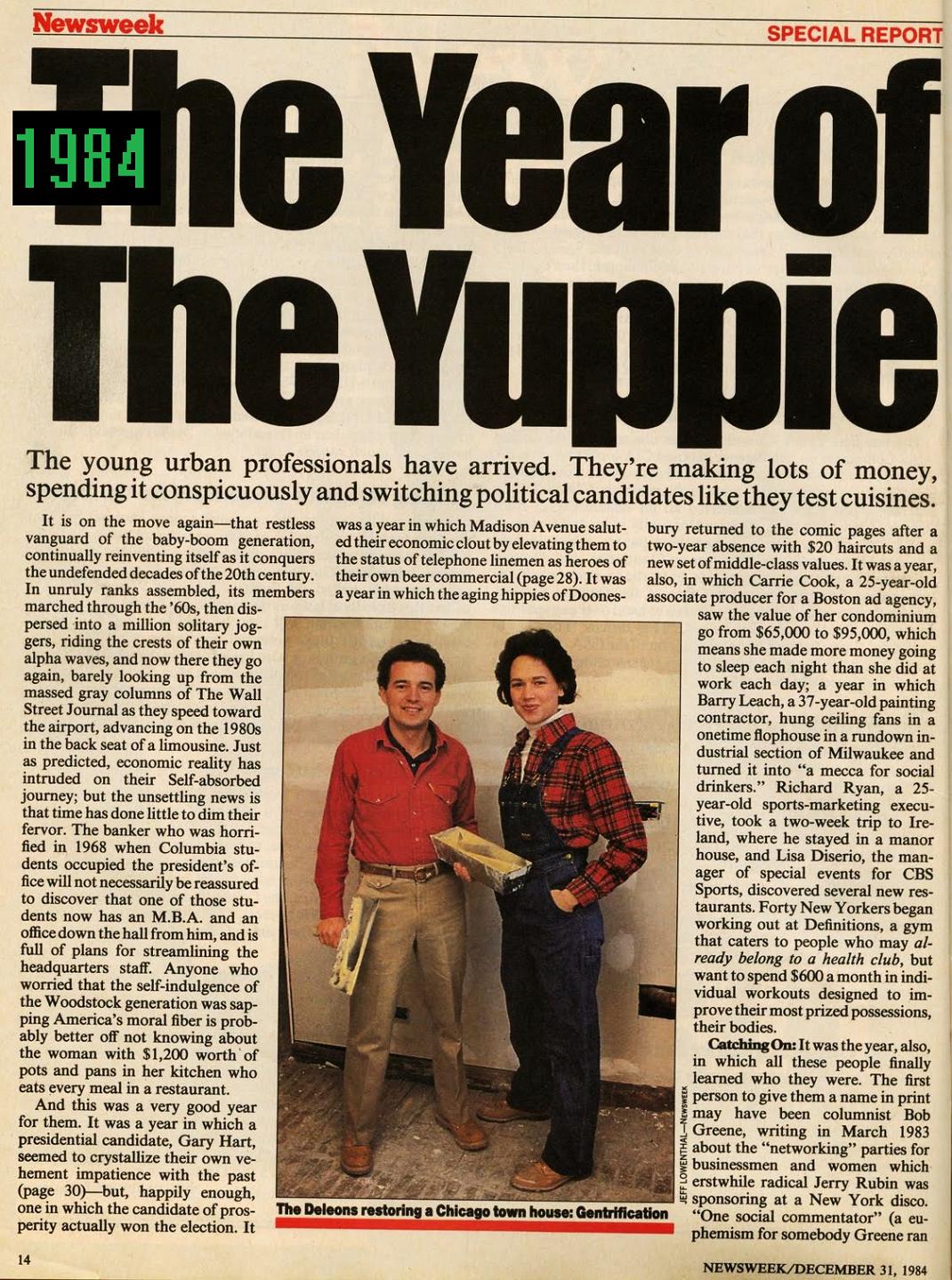
Well, Jeanne, the term first arrived in print in a May 1980 Chicago Magazine article by Dan Rottenberg, and at that point simply referred to young urban professionals who were buying up houses and apartments in former working class areas and rather destroying the feel of these places in Chicago - with trendy shops and theatres opening to service their needs where once had been old family concerns, etc. Poorer folk who had traditionally lived in those areas were being priced out.

At that point, President Carter was still in charge at the White House, and the booming busting part of the 1980s was not in sight. So, we seem to have quite an innocent local word, not an approval word by any means, but lacking the vehement condemnation and international infamy which would later follow.

After the inauguration of President Ronald Reagan in 1981 (he was elected in November 1980) this began to change. The term "yuppie" caught fire and was applied to the type of person who flocked to the stock exchange and lived a highly excessive lifestyle, taking full advantage of the new political regime.

The American 'Newsweek' magazine , in its December 31st issue, declared 1984 "The Year Of The Yuppie".  With $600  a month workouts available at the new Definitions Gym in New York (most of us lesser mortals never worked out in those days), continuing "gentrification" of quaint neighbourhoods, property values soaring, Presidential candidate Gary Hart, and the ex-flophouse in Milwaukee which became a "mecca for social drinkers" (complete with ceiling fans) what wasn't there to love?

The yuppie was still pretty dowdy in 1983, if the humorous American Yuppie Handbook and an American mug I have from the same time are anything to go by (they wanted pasta machines, Rolex watches, Sony Walkmans and a VCR), but within a few years the image had altered to that of Wall Street - "Greed Is Good".

The infamous yuppies of the mid-to-late 1980s were apparently ruthless individuals, their lives dominated by the love of money and THINGS. They quaffed champagne. They snorted cocaine. They wanted it all. And they wanted it now.

The word spread to England in the mid-1980s, and was applied to similar types, waving their wads about, who took advantage of the financial knock-on effects of the American Reaganite ethos and the prevailing, highly similar attitudes of the Thatcher governments. They bulled. They beared. They sported the new revamped and highly trendy Filofaxes and the brand new miracle, the handheld brick cell phone ("Yuppie toys!" we called 'em). They drank bottled water. They worked out. They were fit for business. Fit for life.

Of course, not all yuppies were champagne swilling, cocaine snorting, horribly greedy gits with absolutely no redeeming qualities whatsoever, but "yuppie" became a buzz word for those who were all or some of these things. The yuppies of the mid-to-late 1980s were horribly grandiose, high tec, greedy, without care. That was the popular view.

And that, as far as I'm aware, is a history of the yuppie word, how it was originally applied and how its usage altered with the changing political regimes and attitudes in America and England as the 1980s progressed.

There was a point, circa 1985, 1986 and 1987 in my home city where I could almost smell the money around about me. The night clubs went neon. The pubs went posh or themed. Glittering new office blocks rose left, right and centre. The supermarkets were full of "posh" (and strange) foods that we'd think nothing of eating now. The smell of wonga hung heavy. But, unfortunately, I never had much. Ah, well, as a care worker at least I could take the moral high ground.

But I couldn't help finding yuppies fascinating.

Read more of our material on them by clicking the "yuppies" label below.

07 March 2015

New Romantics


 August 1980 - the release of Ashes To Ashes, with its groundbreaking video, was a great moment for David Bowie - and propelled the Blitz Kids and others towards the pop scene to form the New Romantics, the first big 1980s music and fashion scene.

20th Century Words by John Ayto traces the term "New Romantic" to 1980. So, what was a New Romantic? Late 1980 saw the emergence of two acts - Adam And The Ants and Spandau Ballet - into the upper echelons of the pop charts. They gave us Ant Music and To Cut A Long Story Short, respectively, and although both songs were very different, the Ants and the Ballet blokes were both heavy on the face make-up and the dashing outfits of years long, long past.

And, suddenly, we were all talking of New Romantics.

1981 brought a flurry of them into our lives - including, of course, Duran Duran and Ultravox. Planet Earth, complete with video, was very typical of the scene - synths, futuristic setting, OTT dandy flounces, lashings of lippy, and bizarre hairdos. The movement crossed over to America and Kim Carnes sent us the divine Bette Davis Eyes

TV Times, June 1981. How would you feel if your son looked like Adam Ant? If he'd lived where I lived, he'd probably have got seriously punched. But although nobody I knew was brave enough to adopt the image, Adam And The Ants were immensely popular with us lads.

So, the first big new pop sensation of the fledgling 1980s. How did it all begin?

Well, that's not quite what it seems! Read up on it elsewhere and you'll find that it all seems to have originated from a club called The Blitz Club in London, whose patrons paid homage to David Bowie - apparently dubbing themselves "Blitz Kids". Or was it somewhere called Billy's? Or both? Or...

Anyway, it was a dressy night club scene - or a couple of dressy night club scenes - where men wore make up and/or flamboyant outfits

The UK press created the "New Romantics" tag when Adam and the Ants and Spandau Ballet first hit the pop charts in late 1980.

David Bowie, of course, had been exciting the pop scene since 1969, and was very heavy on image. Was he Ziggy Stardust? A Thin White Duke (goodness, I thought that particular image was bloody boring and so retro!), but whatever he was he attracted dedicated followers in droves and his music brought flashes of sheer brilliance. 

In 1980, David had another one of those flashes - with his Scary Monsters (and Super Creeps) album, and a single which would be included on this album, released in August 1980, although not officially classed as a New Romantic song, was what kick-started the scene. That song was, of course, Ashes To Ashes.

The video (or "promo" as we referred to them back then) was striking and hugely expensive, and featured Steve Strange, who wowed the pop charts in 1981 and 1982 with Visage hits like Fade To Grey and Mind Of A Toy.

But not all of those considered New Romantics in the early 1980s were part of The Blitz Club scene - Adam And The Ants for instance. 

And I can certainly state that I'd never heard of the Blitz and what attracted me to the New Romantic style was that I had simply had enough of the gobbiness and run-down seediness that had dominated the previous decade.

Several years before the New Romantics, as I lurched into my teens, I was yearning for something a bit more flash, a bit more stylish. I was depressed with the thick layer of mould up my bedroom wall, my threadbare "make do and mend", often hand-me-down clothes. 

I craved for glamour and excitement. I'm sure I was not alone! There was simply something in the air - many of us wanted a change. 

After the likes of Slade shouting their mouths off - as tacky as you please, the sleaziness of the Disco scene and the hopelessness (and, of course big gobbedness) of Punk, plus the oh-so-unoriginal 1970s revivals of 1950s style, 1960s mods and rockers (no thank you, Paul Weller!), plus the '60s ska scene and rockabilly, I was hungry to dress up, desperately hoping that the 1980s would be different.

And they were.

And probably the first manifestation of that was the emergence of the New Romantics in late 1980.

The wonderful Roxy Music, still going strong in the early 1980s, are considered to be an influence on the New Romantics, and I'm sure the group was, but the New Romantics, despite their precursors, were still startling and fresh at the time.

Boy George, of course, was part of the Blitz Club scene, he worked as a cloakroom attendant there, and he was an early New Romantic for sure -  but by the time he made his chart debut in 1982, the New Romantic thing, which had burned fiercely from late 1980 and throughout 1981, had fizzled as far as we the public were concerned. So, The Boy was, at the time, greeted as a stand alone newcomer, a unique individual, loved or loathed. Similarly, A Flock Of Seagulls, who had chart success in late 1982 with Wishing, whilst looking very New Romantic indeed, were not, at the time (as far as I remember!) labelled as such.

Let's hear it for the boy - Boy George, of course - before fame, pictured in the Daily Mirror in April 1981. Although an original New Romantic mover, shaker and trendsetter, by the time he arrived in the pop charts in 1982, the New Romantic scene was just about dead and buried. So, he was regarded simply as Boy George. And his own very personal sense of style inspired admiration, clones, and some homophobia. Soon-to-find-fame George (as seen in the newspaper picture), then simply referred to as George O'Dowd, 19, was wearing Chinese slippers (£3.99), old school trousers he'd tapered himself, and leg warmers. A 1920s dress (20p, Oxfam) was draped around his waist. The tassle belts, the long scarf, and Oxfam beads around his neck, cost him a few pence, the crimplene blouse came from his mum and the wooden cross from a friend. A black felt hat and assorted earrings completed his outfit.

Adam and the Ants.. well, Adam - AKA Stuart Goddard - has stated that his early '80s pop venture was not part of the New Romantic movement. I never knew at the time. Loved the band and saw it as very much part of the New Romantic thing way back then. Sorry, Adam! I still love you and the Ants - whatever you were!

Two groups which I was labelling "New Romantic" long after 1981 were Duran Duran and Spandau Ballet. They were always and forever "New Romantics" to me. I loved the way the Duranies dropped the frillies for those gorgeous brightly-coloured suits - and the 1982 Rio video marked a turning point in my own personal fashion statements. 

 A change of image for Duran Duran, seen here in 1981 and 1982. Loved the colourful suits with pushed up sleeves and large shoulders!

Even now, knocking on towards fifty, I still feel a stirring of youthful (if that's possible at my age!) excitement at the thought of the New Romantics and the blossoming synth pop scene of the early 1980s in general. Combined, these two factors were the first indication that 1980s music and fashion were going to be OK for me. And, as it turned out, brilliant!

17 October 2012

Rubik's Cake - A Very 1980s Birthday...

Today is my birthday - and thanks to my sister, her partner, and my two wonderful nephews for coming up with this home made surprise cake - with that ultimate 1980s icon - the Rubik's Cube as its theme!  When an obscure Hungarian puzzle called the Magic Cube  made its debut at international toy fairs in January and February 1980, nobody knew what was going to happen.

The Magic Cube was then manufactured to Western World safety and packaging norms and Ideal Toys decided a new name was needed. The Gordian Knot? Inca Gold? Hmmm...


How about Rubik's Cube, thus naming the puzzle after its inventor, Erno Rubik?

The first Rubik's Cubes were shipped from Hungary in May 1980, although arrival in  the UK was rather later, the first batches hitting our stores towards the end of the year. Even then there was a severe shortage until spring 1981.


"Have A Rubik's Day" as my sister has inscribed on the birthday cake tray.

And, from spring 1981 onwards, for  over a year, every day was a Rubik's day. I have never known a craze so intense.

Read all about the wonderful Cube here.

And, meanwhile, please excuse me whilst I get on with celebrating my birthday by tucking into the most delicious Rubik's Cube I have ever seen! 

16 September 2012

1980 - JR, Fred Housego, Our Tune, Yes Minister, Bad Manners, New Romantics, Metal Mickey, Baggy Trousers, the First Nudist Beach and "Walkies!"

The Rubik's Cube was released in May 1980 but did not arrive in England until just before Christmas. It was declared Toy of the Year by the British Association of Toy Retailers, but was in short supply until the spring of 1981. 
   -
Unemployment topped two million; the '70s hard times continued - not a Yuppie in sight. In December, John Lennon was shot and killed, sending his many fans into mourning. Ronald Reagan won a landslide victory to become President of the United States. The 1980s as we know them would never have happened without him.

Suddenly, just about everybody had the right to buy their council houses. Groan! But these were not the first council house sales. Council houses had been being flogged off for yonks.

Sales rose in the early 1970s with 46,000 dwellings sold in England and Wales in 1972 and 34,000 in 1973.

Before 1980, council house sales were discretionary. Councils which sold houses most actively were Conservative-controlled.

I lived in an area where council house sales were rampant back in the early 1970s. For more on this, see my 1970s blog here.

 -
The 1980 legislation introduced a higher discount rate and made the right to buy more universally available to tenants. 

-
The BBC launched Children In Need


The Ecover company, makers of ecologically sound cleaning products, was founded in a small cottage in a rural town in Belgium in 1980. In 1989, Ecover products finally appeared on supermarket shelves and became enormously popular in England. 
 
England's first nudist beach opened on the 1st of April - in Brighton, where else? 

 -
The newly named and manufactured Rubik's Cube trademark was registered here on the 7th of May, but stocks did not start arriving until just before Christmas. It still made Toy of the Year.  
 -
Space Invaders, first exhibited at a London trade show in 1979, were beginning to make their presence felt.

We were a breadline family, living in a breadline area, and it was no use pretending that the 1970s had been a feast of fun. They had been a time of recession, strikes and rampant inflation. I hadn't even set eyes on "Pong" until the Christmas 1979 episode of George & Mildred. It was one of Tristram's pressies. Mind you, I had better-off friends and none of them had Pong either.

Computers were for boffins,
Dr Who and making mistakes on utility bills as the 1980s began. It's amazing to look back on the way they've evolved since those days.


In 1980, just 5% of households in the UK had video recorders.

Trousers were trouble for many comp. school kids in 1979 and 1980. For years, we'd worn flares. Never questioned it. They'd been around since the hippie years of the 1960s and somehow got stuck. We didn't wear them because we were hippies - we regarded hippies as a '60s thing, and anybody calling us that would have got a mouthful - or worse. No, we wore flares simply because they "woz" fashion. And woe betide any kid who didn't wear them. There was a strong pack instinct on the council estate where I lived and you had to fit in. Or get picked on. 
-
But, towards the end of the 1970s, fashion decided enough was enough, and so we moved into straight trousers. Or at least we did when we could afford it. The recession bit deep and it was a slow transition. There were still a lot of flares around in 1980. 


The trouble was that in 1979 and 1980 whatever we boys wore in the way of trousers drew jeers from girlies smugly attired in skirts or dresses. If we wore flares it would be: "Flaredypops! Come on, pop pickers!" They had suddenly been relegated to the distant past. If we wore straights, there would be a sneered: "Ooh, I like your straights! Very fetching!" You couldn't win!

The
Ska revival tightened its grip, with the film Rude Boy, and hits like the Beat's Mirror In The Bathroom and Stand down Margaret, the Selecter's Missing Words and the Specials' Too Much Too Young. The Ska look was so in and those Rude Boys were everywhere. 


It was a golden year for Madness, which included several of their best-loved songs - Baggy Trousers amongst them. Oops Upside Your Head had us all doing the rowing thing down on the floor. The Nolans had a great year; Sheena Easton, Liquid Gold, Kelly Marie, the Cure, Adam And The Ants and Spandau Ballet all made their first chart appearances; David Bowie's Ashes To Ashes video was a New Romantic trailblazer; robotic dancing was increasingly popular. 
-
Sheena Easton, Kelly Marie and a few others helped advance the notion of colourful boiler suits as fashion. Some called them jump suits, others called them flying suits. Kelly called hers a "cat suit". 

 
Er, no, that famous 1960s garment was rather tighter-fitting!

Of course, the bravest animals in the land were Captain Beaky And His Band, and the Korgis informed us that Everybody's Got To Learn Sometime. Still sends shivers down my spine, that song. 

-
Buster Bloodvessel and Bad Manners were absolutely brilliant.

Disco had fallen victim to the "Disco Sucks" campaign in America in the late 70s, but over here we had no issues with it as the 80s began. The classic Let's Go Round Again and Stomp both charted, and we loved 'em.


In September, Ottawan gave us D.I.S.C.O.

Chas and Dave couldn't be described as disco by any stretch of the imagination, but in December they were very popular with Rabbit.


Splodgenessabounds requested Two Pints Of Lager And A Packet Of Crisps Please. Did that poor bloke ever get served?

Our Tune began on Radio One's Simon Bates Show. 


Also, over on Radio Two, the often controversial soap opera Waggoners' Walk, which had been on air since April 1969, was last broadcast in 1980 - all part of the BBC's cutbacks. More here

The saga of Ambridge continued in BBC Radio 4's everyday tale of farming folk, The Archers. Doris Archer died quietly in her armchair as actress Gwen Berryman was too unwell to continue in the role she had played since 1951.
 
Something called the Sony Stowaway crept into the country in 1980. In 1981 it would be patented here under its original name - Sony Walkman.

The number of illegal breakers swelled enormously in 1980 and a mass rally in London demanded the legalisation of
CB radio - although some model aircraft users were worried that it would interefere with their frequencies.

CB radio was invented by American Al Gross in the 1940s and has been in use in the USA since the 1950s
.

The Adventure Game began - green cheese rolls with Uncle the teapot on Planet Arg. Bliss. Yes Minister debuted and the pilot episode of
Hi-De-Hi was screened - all three shows were treats from the BBC.

Hart To Hart
first appeared here on ITV on January 27th. TV was more of an event in those days, with only three channels, and most of us looked forward to the first feature-length episode. Max, the Hart's friend and manservant, had the famous catchphrase "'Cos when they met it was murder!", spoken over the opening credits, but in the first series he said "I look after both of them which ain't easy - 'cos their hobby is murder". The better known version arrived later.

More about Hart To Hart
here.

The Dukes of Hazzard, first shown by the BBC in 1979, which was also the year they debuted in America, moved to their legendary Saturday tea time slot in 1980.

In late 1979, a series listed in the TV Times as The Minder, starring George Cole and Dennis Waterman, began on ITV.

The show (which was, of course, simply Minder) was not an immediate hit. The format was tweaked over the next year or two, and the comedy element was increased
(in fact, judging by a comment in a mid-1980s TV Times, the show's comic content was still on the increase then).

Read more about Minder here

-
Not The Nine O'Clock News had begun in late 1979, but the first series had slipped by virtually unnoticed. The original team consisted of Pamela Stephenson, Mel Smith, Rowan Atkinson and Chris Langham. It was felt that Chris wasn't quite right for the show and so, for the 1980 series, he was replaced by Griff Rhys Jones.

Not... had arrived. 

- 
Blankety Blank was in its second year and 321 in its third. Both were extremely popular with viewers.

Monkey, shown on BBC2 on Friday evenings since 1979, was becoming a cult.

Family Fortunes and Play Your Cards Right began, as did Arthur C Clarke's Mysterious World. In these programmes, Mr Clarke examined various mysteries of the world, usually ending by debunking them. "Do people really burst into flames for no reason? I don't think so." Well, that was a relief!

Juliet Bravo and The Gentle Touch began, flying the flag for England's female cops.

Ena Sharples made her last appearance in
Coronation Street in April. Actress Violet Carson had had several long absences from the programme in the 1970s, due to ill health, and this was supposed to be another break. Consequently, there was no big send off for Ena. As Ena bowed out and left our television screens for the last time, Metal Mickey bowed in. Was this progress?!

London cabbie Fred Housego won Mastermind and became a national folk hero.
Barbara Woodhouse was out for a "walkies". 

-
David Hunter was shot in Crossroads and JR Ewing in Dallas. The latter sparked huge interest and "I SHOT JR" and "WHO SHOT JR?" T-shirts, stetsons, car stickers and badges abounded.


See here for more.

And what about Dallas spin-off, Knots Landing - which told the tale of alcoholic Ewing brother Gary and his wife Valene, as they attempted to find happiness away from Southfork? The Knots pilot episode was shown in America on 27 December 1979, with a full first season of episodes to follow early in 1980. Here, we had our first opportunity to visit the Landing in 1980. It was never going to challenge its older sibling, but it was intriguing enough.

More American pot boilers were soon to follow...

12 August 2012

On Sale: Technology For 1980 And 1981...

The Tandy Electronics Catalogue, 1980-81, provides rich pickings for those wishing to relive technological memories of the first two years of the decade...

"Realistic prices"? Well, they were back then!


Love that wood effect surround - a popular feature on electronic gadgetry since the 1960s.


Note that the cheapest radio cassette recorder was £44-95 and the most expensive £129-95. Even the lowest price was a pretty serious cash layout for many people back then.

Radio cassette recorders were objects of desire for me and my mates in the late 1970s and early 1980s. Personal stereos were invented in 1979 in Japan, and although a few arrived here in 1980 under the name "Sony Stowaway" I'd never heard of them and couldn't have afforded one if I had. They weren't cheap and my family were very short on the dosh.

Ghetto blasters were further down the 1980s road, and so the big thing, the wonderful, sophisticated technology to own in 1980, was a radio cassette recorder. It took some saving for, but I convinced my parents that it would be tremendously economical in the long term. Just think of the benefits - no more buying records, you could just tape them off the radio. Actually, this wasn't as straight forward as it seemed as most DJs liked to "rabbit" over the intros and endings of the songs they played and so it was difficult to get a decent chunk of music, but we persevered and were happy with what we did get.

My radio cassette had a condenser microphone, so more fun could be had by making parodies of the BBC's radio soaps, Waggoners' Walk and The Archers.

"Oh gosh! Mr Tyson's fallen down the stairs! One must phone for an ambulance!" or "How dare you, Mr Gabriel, I'm a respectable woman, now are you going to eat those flies' cemetaries, or aren't you?"

We made dozens of episodes, with continuing storylines and daft cliffhangers.
-
Was it fun?
-
We thought so!

Tony Blackburn advertises Plustron in a newspaper ad from September 1980. 
-

Love those "new for '81" cuddly radios! 

The Tandy AM Space Radio... the personal stereo did not arrive in England until 1980, as stated elsewhere in this post, but this was an interesting alternative. The lady appears to be enjoying herself...

Radio controlled fun... Vroom, Vroom!!!


We weren't allowed to use calculators at school. I was already quite familiar with the little perishers from TV appearances, but when I first handled one at work in 1982, I was initially a little flummoxed!

The TRS 80...
-
Many developments were to take place in the 1980s which would bring computers into our homes and transform our lives, but in 1980 they were for boffins, Dr Who, ERNIE and making mistakes on your utility bills.
-
The TRS 80 looks a bit like a microwave oven to me. Microwave ovens, although first marketed in the 1960s, were something else that I had never clapped eyes on back in 1980. Way out of our price range.
-
Early in the 1980s, a cafe in my neighbourhood installed one for heating up food and the cry went out amongst us heathens: "It uses radiation! It'll kill you!"
-
By the end of the decade, microwave ovens were pretty much a part of everyday life - even my dear old mum had one! Read more about the 1980s microwave oven revolution here.


Wow - sophisticated moments - mind blowing technology...