Total Pageviews

Pages

Showing posts with label 1986 - TV. Show all posts

24 April 2018

Blind Date - Straight Talking, Non-PC - Beautiful '80s TV!

You know, nowadays we're scared of opening our mouths in case the words we're about to use aren't politically correct. You see, political correctness has become a very strange thing indeed since we first stumbled upon it circa 1987 - when it seemed somewhat droll.

I've never thought that over-analysing words is a good idea, because it doesn't really make people good or bad or indifferent. So easy to play the PC game while secretly being a nasty bit of work. In fact, being PC seems right priggish to us, love, and when it comes to earnest young girls or guys lecturing their grandparents and telling them not to use a particular word because it's not 'PC', we shudder to think what our grandparents would have thought if we'd tried it. And dread to think of what they'd have done even more. A good clump round the ear 'ole would have been the least of it.
So it's nice to watch good basic entertainment from the 1980s with clear communication.

We've been back in 1986, having a lorra lorra laffs with our Cilla and the Blind Date contestants. Remember Blind Date, which brightened up our early Saturday evenings before we went out to get... er... slightly inebriated?

It was a laff partly because a lot of the contestants had absolutely no fashion sense. Look at the three gents below. I mean, what do No 1 and No 3 look like? Number 1 looks all set to go out and trim his hedge and No 3 looks set for a naff day's junior clerking in the back office of Cloggins and Co, Boiler Specialists.

Only Contestant No 2 shows any sense of style and occasion. The shoulder pads. The bouffant mullet. The lovely shirt. The colourful shoes. The pushed up jacket sleeves.

The young lady's question for this gent was: ' 'ow would you react if I smashed your car on the first day you 'ad it?'

And the gent's reply?

'I'd kill yer.'

A simple, direct reply, and very amusing in the viewing and hearing.

The 21st Century equivalent (if the guy didn't want to leave himself open to ridiculous accusations of misogyny or anger management problems) would probably be 'I wouldn't be happy at all!'

Our verbalisations have become so deodorised it's hard to have a giggle any more. 


06 July 2014

Howard and Hilda talk '80s

Howard and Hilda Hughes in the 1980s.

We asked Howard and Hilda Hughes, two of the stars of that searing 1980s suburban life documentary series Ever Decreasing Circles (1984-1989) what they thought of the decade...

Hilda: "Well, I was in the Wrens back then (giggles). I think I quite liked Lonnie Donegan."

'80s Actual: "That was the 1950s, actually."

Howard: "Oh dear, Hilda (laughs), you got it a bit wrong there old girl!"

Hilda: "Yes, I did, Howard!" Laughs as well. "The 1980s... we decorated the Polly Wally Doodle room I seem to recall..."

Howard: "Yes, we did, Hilda. A lovely shade of pastel pink."

Hilda: "Yes! Oh, that was lovely, Howard. And we had all that trouble with the buddleia ."

Howard: "That's right, dear. It got a bit out of control, didn't it?" (Laughs)

Hilda: "It did, Howard!" (laughs too.) "Wasn't that when we made our basketwork Neddy?"

Howard: "It was Hilda. I think we should try working in basket again."

Hilda: "Yes, it was fun, wasn't it?"

'80s Actual: "That's all very interesting. But what did you think about the popular culture of the 1980s?"

Hilda: "The Shipping Forecast was very good back then."

Howard: "It was, Hilda."

Hilda: "And the rosehip syrup. I don't think it tastes the same these days."

'80s Actual: "Did you participate in the fashions of the decade? Deelyboppers? Power dressing? Shell suits?"

Hilda: "Well, I made some lovely jumpers and cardigans. Quite a lot of them were matching - Howard and I like to be matching sometimes, don't we, Howard?"

Howard: "We do, dear."

Hilda: "And I like knitwear - it keeps the draughts out. I've got a back, you see."

'80s Actual: "Er, yes... What about the political scene of the 1980s? What did you think about Reagan and Thatcher? The miners' strike? Clause 28? Perestroika and Glasnost? The Fall of the Berlin Wall and the end of the Cold War?"

Hilda: "I never discuss politics. Nasty things. Cause a lot of disagreements. My father was always very strict about that. We never do, do we, Howard?"

Howard: "Do what, dear?"

Hilda: "Discuss politics."

Howard: "No, dear."

'80s Actual: "Oh. What about the sporting scene? Botham and Becker? Lineker and Steve Davis? Zola Budd?"

Hilda: "Well, I remember that little beast at the World Cup. That "hand of God" thing. Was that when you're talking about?"

'80s Actual: "Yes, 1986."

Hilda: "Oh, well, we remember that, don't we Howard?"

Howard: "We do, dear. And I played a lot of cricket of course. And tried my hand at snooker. You could say I was something of a sportsman back then."

Hilda: "Yes! And I knitted the jumpers for the cricket team! We had that lovely wool shop in the high street back then. It's closed now of course. It's one of those coffee places now."

Howard: "Yes, it is."

'80s Actual: "What about pop music back then? Do you remember Adam and the Ants? New Order? Pet Shop Boys? Erasure?"

Howard: "No, I don't think we do, old boy. We liked Sing Something Simple though."

Hilda: "Oh, yes! We used to sing along, didn't we, Howard? Every Sunday afternoon. We always looked forward to that."

Howard: "Yes, we did, dear."

Hilda: "The neighbours must have thought we were a bit of a rowdy house when that was on. We got quite carried away at times!" (giggles).

Howard laughs.

'80s Actual (sighing): "So, is there anything else you remember from the 1980s?"

Hilda: "Well, [lowers her voice] I attacted a poltergiest. I know it was then because I kept a diary. I bought it at WH Smith's - it had a lovely pink pelican on the front cover. Hardback. I bought it because I wanted to see if there was any pattern to the supernatural activity, you see. 1989 it was."

Howard: "I don't think it was really a poltergeist, Hilda."

Hilda (getting slightly indignant): "Then how do you explain my little wooden windmill? Me predicting the Red Devil? What happened at the supermarket?"

Howard: "Don't distress yourself, Hilda. That was a long time ago."

Hilda (calming): "Yes, you're quite right, Howard. And we have a guest. I'm sorry, Howard. I'm sorry, Mr Actual."

'80s Actual: "That's fine. I think I should be going now. Thanks for answering my questions - I'll definitely feature you on the blog."

Hilda: "Would you like a nice cup of tea before you go? Rosehip syrup? A nice muffin with zero cholesterol butter perhaps and some of my homemade jam?"

Howard: "I can really recommend Hilda's cherry."

'80s Actual: "No, no, thanks - I really must go. Thanks again. It's been really..." (leaves quickly). Standing on the garden path at the front of Howard and Hilda's house, our '80s Actual "journalist" hears a voice inside the house drifting out of the open window:

Howard: "Shame we unpicked Neddy's ears, wasn't it?"

Hilda: "That was nervous tension, that was, Howard Hughes."

Howard: "Yes, it was, dear. Still, we could always fetch him down from the attic and re-basket them, couldn't we?"

Hilda (enthusiastically): "Yes, we could, Howard. That would be wonderful. And we could put him in the Polly Wally Doodle Room with the gramophone."

Howard: "And people say retirement can be boring! We've never found that, have we, Hilda?"

Hilda (giggling): "No, we most certainly have not, Howard!"

They laugh together.

Pause. Then:

Hilda: "Howard, is there such a word as 're-basket'?"

'80s Actual hastens away.

02 July 2014

Soap Opera Heroines Of The 1980s - 1: Miss Babs Of Acorn Antiques


The wonderful Miss Babs (Celia Imrie). Answering the phone in the family antiques business seemed to suit her...

Women who endure great hardship (usually foisted on them by men - what a grotty lot we're made out to be!) have always been an essential ingredient of English soap operas. Look at Angie Watts of EastEnders. Boy, did she suffer! And then there was Sheila Grant of Brookside. My gawd! And Jill Chance of Crossroads. Didn't that lass go through it? Of course, my wife says it's all very true to life and that real men are a bunch of louses, just like soap men (although I hope she has a twinkle in her eye when she says it!) but the soap opera heroine to top ALL soap opera heroines has to be Miss Babs, of the '80s spoof soap Acorn Antiques, broadcast as part of the very wonderful Victoria Wood - As Seen On TV series from 1985 to 1987.

What Miss Babs went through really doesn't bear thinking about, but we're going to think about it, just to illustrate our point about how wonderful soap women in the 1980s (forget Alexis Carrington and Angela Channing) were. Whatever life threw at her, Miss Babs carried on. And life threw a lot!

As the serial began, we found Miss Babs working in the family business, Acorn Antiques, on the outskirts of Manchesterford.

The return of her ex-love, Clifford, stunned her. He'd left her by the handbags in a well-known store. His unexpected return drew from her icy contempt: "Bored with Zurich? Or did Zurich get bored with you?" she asked. He declared his love for her, but she told him she'd changed - she had triplets now. Clifford had a startling confession to make - he went bell ringing on Wednesday nights.

Miss Babs's marriage to Mr Kenneth was unhappy. Who was the mysterious Rowena, who phoned from Kuwait? Why was he booking into the Formica Motel with Trixie ("Trixie Trouble they call me!") from the antique packing department? Trixie truly was trouble. She discovered that Miss Babs had booked into the Formica Motel nine months to the day before the triplets were born with Derek, the large, bumbling, handyman from Acorn Antiques. And then Trixie discovered some photographs, in a waterproof bag, tied to the lavatory ballcock, which revealed that she wasn't the only one with a birthmark shaped like a moped. Miss Babs was her mother.

Miss Babs kept her stiff upper lip and adjusted accordingly. Trixie stopped being Trixie Trouble and took holy orders, becoming a nun.

It seemed there HAD been some hanky-panky between Miss Babs and Derek - in one scene their passion seemed set to erupt anew. He told her he always thought of her when he was watching the show jumping or grilling a tomato. So, who WAS the father of the triplets? Or the mother, for that matter. As Miss Babs confided to her faithful char Mrs Overall, she didn't know if they were really hers - she'd only gone into hospital to have her ears pierced.

Kenneth caused further heartache for Miss Babs when he tried to commit suicide, attempting to slash his wrists with an electric razor, but Miss Babs was so used to (her) life's never ending shocks and surprises that she was completely unfazed when he phoned up, not dead at all, and told her to put the triplets in their body warmers - he was taking them to Manchesterford Zoo.

Miss Babs was a kind and considerate employer. When Mrs Overall's husband died and Mrs O asked for time off for the funeral, Miss Babs said, in a voice throbbing with sympathy: "Of course. Just pop back at five for the hoovering." So, it came as a terrible shock when Mrs Overall laced her coffee with poison in an attempt to kill her. Miss Babs bought Mrs O a new blouse, and the old charlady was soon back to her old devoted (in fact positively fawning) self.

Mr Kenneth ran off with a weird religious sect, and Miss Babs failed to get custody of the triplets - although she did get a deep fat fryer and a weekend for two in the Peak District.

Acorn Antiques appeared to have had its day when Miss Babs's wicked Spanish cousin Jerez turned up. He had been masquerading as the postman to intercept letters to Miss Babs about a new motorway which would mean curtains for the business. This did not go ahead (I forget why) but Jerez did turn out to have his uses. With Acorn Antiques facing bankruptcy and about to go up for sale, Jerez asked Miss Babs to marry him, but when Miss Babs said no (her first marriage had been nothing but trauma, from the moment two of the triplets had been born with dangerously straight hair and had to be whisked straight off to the hairdressers's), Jerez turned nasty. He stormed out of the shop, passing Clifford on the way in, who whisked the fat cheque intended to sweeten Miss Babs towards the prospect of marriage from Jerez's jacket pocket.

The show was updated during its run, with a lovely opening sequence of Miss Babs driving to Acorn Antiques and the title displayed on a set of vertical window blinds. Sounds familiar?  

Also like Crossroads in the mid-1980s, Acorn Antiques gained a new leisure centre - with sunbeds.

There was so much more the stately Miss Babs had to face - Miss Berta's marriage to Mr Clifford, for example (Miss Berta was suffering from amnesia at the time), and the death of Miss Berta's father, who got himself shot in Dakar, but was then spotted buying a padded envelope and a TV licence stamp in the local post office. And what about the time Mrs Overall was revealed as being the mother of Miss Berta and Derek the handyman, who were apparently twins? And what about the time Mr Clifford was killed by a faulty plug (never mind, he went nice and stiff and was propped up by the ironing board) and Mrs Overall choked to death on one of her own delicious homemade macaroons? Miss Babs murmured words of comfort to her faithful employee as she lay dying - assuring her that she was going to send the macaroon recipe to the Weekly News

Truly the soap heroine to top all soap heroines - not just of the 1980s, but of all time

Miss Babs, we salute you!

But don't eat any of Mrs Overall's macaroons, will you?

27 April 2013

EastEnders 1986: Dot Cotton Writes...

June Brown first appeared as Dot Cotton, chain smoking launderette attendant of the EastEnders serial, in episode 40, broadcast in July 1985. By 1986, Mrs Cotton and the show were wildly popular, but as usual in the Albert Square saga, misery could never be far away. June's portrayal of Dot was sheer genius right from the start, the character is now a TV legend up there with all the greats, but even back in the early days, poor old Dot was plagued by misery.

On 28th July 1986, Miss Brown replied to a fan letter with what at first sight appeared to be a standard letter, but the standard ending was crossed out, and Miss Brown added some insights of life as Dot at that time, in her own warm and friendly style:

I'm very glad that you like old Dot - she's getting a bit sad at the moment but I told the writers that I shall lose all my fans if they don't give her some funny stuff as well - so, here's hoping! 

Love, 

June (Brown)

Of course, Dot got an occasional slice of comedy, but in the main her life was miserable. Still, there were some good things. She had her son, Nick, and husband, Charlie, for a start. And then there was her old pal, Lou Beale, to pop round and see whenever she needed some advice...
 

26 April 2013

ALF - Alien Life Form...

Dateline: Mid-1980s...  ALF was created by puppeteer Paul Fusco. In 1986, he crash landed his space craft into the garage of the Tanner family...

Like Knight Rider, the American TV comedy series ALF (1986-1990) slipped by me almost unnoticed on life's glittering 1980s high road. So, as with the '80s Actual feature on Michael and the very fabulous KITT, I turned to a good friend of mine for help, in this case Mandy, who loves the ALF series so much she is still brimming over with enthusiasm about it all these years on! The post below takes the form of questions from me and answers from Mandy...

Who was ALF? What did A-L-F stand for?

ALF (real name Gordon Shumway) was a furry alien from the planet Melmac. He crash landed into the garage of the Tanner family. When Brian (son) asked what 'it' was, Willie Tanner (father) replied, "It's an ALF," (an acronym for Alien Life Form). ALF was mischievous, cynical, and above all a prankster. He is best known for his sarcasm. He did care for the Tanners though and his heart was in the right place (in his ear to be precise).

Who were the Tanner family?

The Tanner family consisted of Willie (father), Kate (mother), Lynn (teenage daughter) and a young son called Brian. Oh, and not forgetting their cat, Lucky. Lucky lived a hazardous existence as cats were a delicacy on Melmac, but the Tanners' No. 1 rule was "we don't eat members of the family". This didn't deter ALF from trying his luck though!!

Where did they live? Were there any other main characters in the show apart from the Tanners and ALF?

The Tanners lived at 167 Hemdale in the San Fernando Valley of L.A. Other main characters in the show were the Ochmoneks, Raquel and Trevor (very nosey and annoying neighbours). ALF befriended a blind woman called Jody who never knew he was an alien - she just thought he was a bit weird. There was also Kate's mother, Dorothy, who would threaten to turn ALF over to the Alien Task Force.

What was the story-line?

ALF's planet, Melmac, has been destroyed in a nuclear war. He follows a signal to Earth and crash lands into the Tanners' garage. The Tanners are unable to bring themselves to turn ALF into the authorities (the Alien Task Force) with the fear of them experimenting on him, so they hide him in their home. They soon begin to develop affection for him, and he has a strong bond with the kids, although Kate takes more convincing. ALF has to adapt to life on Earth and the constant learning process frequently gets him in trouble. Despite all ALF's antics, there was a rather sad undertone to the show as ALF's planet had been destroyed and he missed his friends. He always dreamed of being reunited with them.

What did you think of the show? What did it mean to you at the time?

ALF was very funny, very funny indeed. This short little alien with burnt orange fur was so endearing. I was always amazed at the variety of his facial expressions, which for a puppet were truly remarkable. I eagerly awaited every new episode and was a real fan. Buying presents for me at that time was so easy, just get something with the old ALFer on it! I had posters, mugs, t-shirts, key rings, books and my favourite, a big talking ALF (which still has pride of place in my home). The odd ALF phrase still slips out in conversation to this day. The show was aimed at kids but some of the jokes had very adult tones. The show also courted a lot of controversy, with ALF seen drinking alcohol with Brian, and ALF's taste for cats. My favourite ALF clip is when he is singing along to Bob Segar's Old Time Rock and Roll; it's typical ALF!

 Did you ever watch  other 1980s American shows (Hill Street Blues, Cagney & Lacey, The Golden Girls, Roseanne, Kate and Allie, Married With Children, etc)? How did ALF rank against other '80s American TV shows in your opinion?

Other American '80s shows were good at the time, and I watched a few. I really don't get the same enjoyment when I watch them now, with the exception of Hill Street Blues, which was a brilliant programme. Hill Street Blues was an entirely different type of show, so trying to compare ALF with the likes of shows of that stature is very difficult. All I can say is I would not purchase other such shows on DVD, but would buy the entire four seasons of ALF in a heartbeat!

Thanks so much, Mandy. Now, Mr Shumway, let's take a look at you (Andrew blasts off to YouTube)....


01 September 2012

Neighbours: A Brief History Of How It All Began

A young Kylie Minogue as Charlene Mitchell in her very first on-screen "Neighbours" appearance.


The road to Ramsay Street began when Brisbane-born Reg Watson, pictured above with the late Noele Gordon, left Australia for England in the 1950s. It was in 1959, according to Noele Gordon's autobiography, My Life At Crossroads, that Reg first suggested the idea of a daily serial to his boss at ATV, Lew Grade.

Reg was not instantly taken up on his idea, but in 1960 the next paving slab on the road to Ramsay Street was put in place when Granada Television's Coronation Street was first screened.

Interviewed in the 1980s, after Neighbours had begun, Reg stated: "I first got the idea in England watching Coronation Street."


Back to the 1960s, and in 1964 Reg became producer of Crossroads, a brand new soap set in a motel in the English Midlands, and made by ATV. Lew Grade had taken his time, but had not forgotten Reg's idea for a daily serial!

Reg gained valuable experience working on Crossroads, and, although often mocked, it became one of the most popular programmes on the ITV Network.

In the mid- 1970s, Reg returned to Australia, and, between then and 1984, created such memorable soaps as Prisoner (screened here as Prisoner: Cell Block H - late night cult viewing in the late 1980s) and Sons and Daughters.

In 1984, work began on Neighbours at the Australian Grundy organisation, where Reg Watson was head of TV drama. Although inspired by Coronation Street (humour and all), Neighbours was rather more youth-orientated than the Street of the 1960s-to-mid-1980s era. "Humour was to play a big part in it and the other important thing was to show young people communicating with older people," Mr Watson later explained, in answer to questions about the show's gestation period.

Cancelled by Channel 7, picked up by Channel 10, the early days of the Neighbours series were pretty turbulent off-screen. But what did we care? We'd never seen it. But then the BBC bought it...
-
"Neighbours" had debuted in Australia on 18 March 1985, and we got our first glimpse of Ramsay Street on 27 October 1986 - the first day of the BBC's daytime service. Des Clarke (Paul Keane) and Daphne Lawrence (Elaine Smith) are pictured.

Wild rumours that this new series would feature a stripper were rampant round where I lived...


A caring, coping female in the classic soap opera tradition, Helen Daniels took on the task of bringing up her four grandchildren when her daughter Anne died in childbirth.

Played by the late Anne Haddy, Helen was also a great support to son-in-law Jim (Alan Dale) - and was created with the notion of disproving the "interfering dragon" mother-in-law stereotype.

Helen was once described on-screen as "St Helen of Ramsay Street".

Anne Haddy spoke of her feelings about Helen to TV writer Hilary Kingsley in the late 1980s:
-
"She sometimes annoys me when she's always right. But she's a doer - and it's nice to show a grandmother can wear high heels and nail varnish, too."

Helen remains one of the fondest remembered of past "Neighbours" characters.


Daphne Lawrence was the non-stripping stripper at Des Clarke's bucks (stag) night.

A shaggy-permed, blonde-highlighted, twenty-something sticky beak - the original Julie Robinson, played by Vikki Blanche. I found her infuriatingly fabulous!

1985 - a scene from the first episode - and it looks like Paul Robinson (Stefan Dennis) is still in nappies. Father Jim (Alan Dale) is amused.


The original Scott Robinson (Darius Perkins) receives advice from father Jim.


Scott transformed - the move from Channel 7 to Channel 10 brought a new Scott to our screens - Jason Donovan, seen here with screen sister, Lucy (Kylie Flinker). Like Scott, Lucy changed faces - she was Sascha Close later in the '80s, and would undergo another transformation in the '90s.

The Channel 10 "Neighbours" episodes gave us the glorious Madge Mitchell/Ramsay/Bishop - played by Anne Charleston, seen here with screen nephew and original "Neighbours" character Shane Ramsay (Peter O'Brien). Just look at those shoulder pads! Just look at that mullet!

Gossipy Mrs Mangel, played by the English-born actress Vivean Gray, loved her granddaughter Jane Harris, played by Annie Jones. Of Hungarian parentage, Annie had formerly played roles in the film "Run Chrissie Run" and the TV shows "The Henderson Kids" and "Sons And Daughters". Jane Harris had originally been called "plain Jane, super brain" by her contemporaries at Erinsborough High School, but soon revealed herself to be one of the beauties of Ramsay Street.
-
Eileen Clarke, mother of Des (Desmond, if you please!) was, like Nell Mangel, played by an English-born actress: Myra De Groot made the most of a brief stint in "Neighbours", greatly impressed the production team, and Eileen became a regular character. She was gossipy, prudish, gullible and excitable, but always meant so well!

Myra's death in 1988 put an end to Eileen's stay in Erinsborough - nobody else could have played her!


The "Neighbours" theme tune was written by our very own Tony Hatch, creator of such memorable TV themes as "Crossroads" and "Emmerdale Farm". The lyrics were written by his wife, Jackie Trent, and sung by Australian actor and singer Barry Crocker.


Interviewed by the Neighbours Perfect Blend website in 2005, Reg Watson said:  

'In pitching the show to Seven and Ten I blithely said, “This concept can run for twenty years”. I knew from the looks on their faces that they thought they'd heard it all before.'

22 August 2012

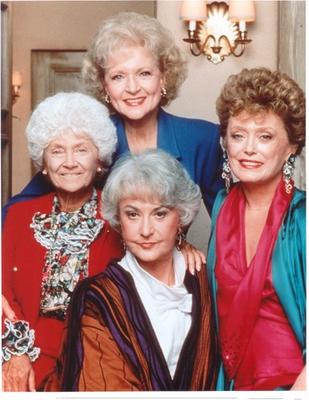
The Golden Girls - Thank You For Being A Friend...

Starring Bea Arthur, Rue McClanahan, Betty White and Estelle Getty, American comedy series The Golden Girls began in 1985, and made its way to our Channel 4 in 1986. The creator was Susan Harris, who had previously given us Soap, the hilarious spoof soap opera, and its excellent spin-off, Benson

The initial idea came from an NBC skit in August 1984 of that brand new cop show, Miami Vice. The skit was called Miami Nice and centred on some, well, let's be PC and say "mature" people living in Miami. From that tiny acorn grew the mighty oak tree of a sitcom called The Golden Girls. The show, it was said, broke new ground, portraying older women as something other than housewives, battleaxes or husband poisoners. There is a Feminist subtext to much of what has been said about the show, which always portrays women as being 'done down'.

The show was also highly topical - featuring story-lines on such "taboo" subjects as HIV, homosexuality and sperm banks. 

Susan Harris commented in the late 1980s: "At 82, Cary Grant could still have been a romantic lead, but a woman over 50 was cast as an axe-murderer. I had to write Golden Girls. It shows women can be attractive and have romances after 50."

Hmmm... a romantic lead at 82? An axe murderer? Easily disproven. Once again, Feminist posturing here, but the show's strength is that it took ordinary-looking people (apart from Blanche, of course, who was devastatingly gorgeous. I hope the cheque's in the post, Blanche) and showed that life doesn't have to stop at fifty.

The Golden Girls was the story of Southern belle Blanche Devereux, who let rooms in her home to three other women - grief counsellor Rose Nylund, school teacher Dorothy Zbornak and Dorothy's mother, Sophia Petrillo - previously of the Shady Pines Retirement Home.  


According to the background story, Sophia had spent a year at Shady Pines before the series began, it had suffered a fire in 1985, and she had arrived to set up home with Dorothy, Blanche and Rose at the time of the pilot episode. Although Shady Pines was never seen on screen, it was mentioned in most episodes and Sophia never let her daughter forget that she had "put her away" there.

The four main characters had widely contrasting personalities: Blanche "liked the men" and was as vain as could be; Rose was loving, dim-witted and occasionally prissy; Dorothy, a not-so-gay divorcee (and not quite free of her ex-husband, Stan), was champion of the witty (but crushing) remark; Sophia was sharp tongued and wasn't above robbing her daughter's handbag. Not a very likeable bunch? Wrong - excellent writing and absolutely brilliant acting turned these creations into four of the best loved TV characters ever. For a start, the girls cared about each other, and underneath the surface bitchery warm friendships flourished - in fact, here we had an alternative family set up.

 TV Times, 1988.

Sophia and Dorothy, mother and daughter, cared deeply for each other, but their relationship was spiky. Sophia called Dorothy "Pussycat", and once told her she had given her the nickname because she loved pussycats. And also because Dorothy was the only one of her children who could catch mice. Sophia sometimes despaired of Dorothy's dateless state, and Blanche often made fun of her, but ultimately Dorothy was the only Golden Girl who found a new life partner, marriage and happiness.
 
Sharp wit, health and social issues, cheesecake and, above all, the friendship between the four main characters powered the story-lines.

 The girls have a night in with the TV in 1987. It was in 1987 that they nearly went their separate ways, seeking group therapy as they were getting on each others' nerves so much. It was Sophia, famous for her tall tales of herself in years gone by (beginning each tale with something along the lines of "Picture it, Sicily, 1922...") who came to the rescue with some up-to-date pearls of wisdom:

Sophia: Picture it. Miami, 1987. A house. The only one in the neighbourhood without a pool. But I digress. Four women, friends. They laugh, they cry, they eat. They love, they hate, they eat. They dream, they hope, they eat. Every time you turn around they eat.   

Rose: Sophia, are those four women us? 

Sophia: Look in the mirror, blubber butt. The point I'm trying to make is what's going on here is living. Just because you have some rough times doesn't mean you throw in the towel. You go on living. And eating. 

Rose: I'll get the cheesecake. 

Blanche: I'll get the whipped cream. 

Dorothy: I'll get the chocolate syrup. 

As it turned out, Blanche was going to fetch the whipped cream from her bedroom, so this culinary treat did not appeal to the others, but, whilst on the surface Blanche was sometimes selfish and always sex hungry, the character had hidden depths. She deeply mourned her husband, George, who had been killed in an accident in the early 1980s, and whilst she genuinely adored sex, she was also searching for another George amongst her many gentlemen friends. Sadly, she never found one.

 The show became a comedy legend and is often repeated to this day. It was originally broadcast on Friday evenings when I was usually out, but I caught one or two episodes and became so hooked I finally rented a video recorder!

Rose, of course, hailed from a certain small town in Minnesota and her stories of that place, often beginning with the words "Back in St Olaf..." usually bored or puzzled the others rigid whilst becoming a favourite feature of the show for viewers (any one for herring juggling?). Here's my favourite St Olaf story, as told by Rose, with interruptions from Dorothy, in 1989:
Rose: Gunilla Olfstatter was a nurse at Cedars of St. Olaf Hospital. One night she was taking care of Sven Bjornsen, and he asked her if she would get him some more mouth moisteners and then kill him. Gunilla brought the mouth moisteners right away, but the killing thing, it seemed to go against everything she'd been taught!

Dorothy: You're doing beautifully, Rose. 

Rose: He begged and he begged and by her coffee break she couldn't stand it anymore, so she pulled the plug and he died. Well, she was wracked with guilt that night. Not only had she parked her car in a doctor's spot, but she was never sure whether Sven's pleading was the pain talking or the medication talking or the guy in the next bed talking. You see, the guy in the next bed was Ingmar Von Bergman, St. Olaf's meanest ventriloquist. 

Dorothy: Rose, we are going somewhere with this, aren't we? I mean, if not, I'm gonna cut out your tongue. 

Rose: Yes! Sven came back to haunt Gunilla. Since then, every Tuesday night at ten - nine Central -  

[Dorothy bangs on the table with frustration] 

Rose: ...she hears noises. Some say it's the wind, but some say it's Sven's voice whispering back from the other side, saying: "Turn around, quick! His lips are moving!"


13 July 2012

John Michie As Tony Fraser In Albion Market...

Rachel has written:

Do you have any other pics of the delectable John Michie as Tony Fraser in Albion Market? I note your interest in this 1980's soap and would be interested (very interested!) to see more of Mr Michie back in that decade. These days, of course, he's far better known for Taggart and Coronation Street!

I do have a few pics, Rachel, and have managed to locate the one above - which features Tony Fraser, cake and biscuit stallholder of Albion Market, in hot pursuit of Colette Johnson (Nimmy March), the barmaid at the market's local pub, The Waterman's Arms. Tony was not acting in the best interests of his girlfriend, Lisa O'Shea, nor his pal, Phil Smith, Colette's partner and the father of her child! This scenario was the beginning of Tony's exit story-line from the show in 1986. Hope you like the pic and many thanks for writing.

15 June 2012

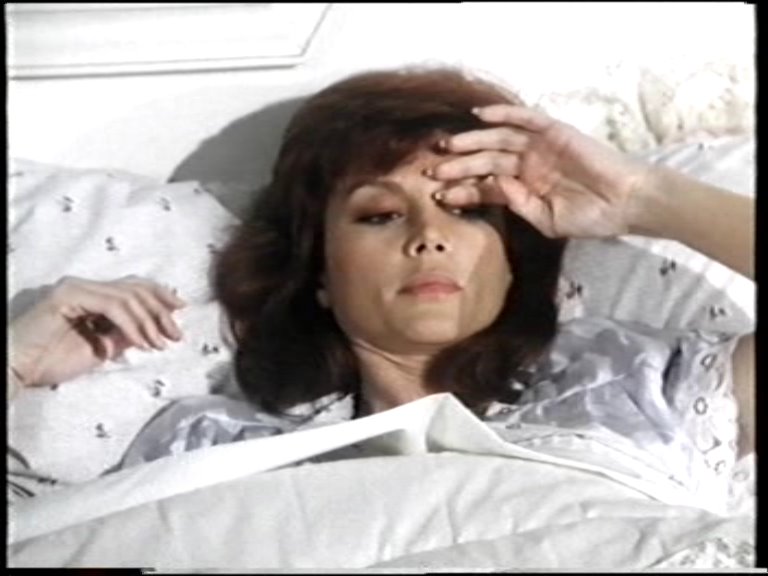
Dallas: Pam's Dream And The Shower Scene

Pam (Victoria Principal) woke up to hear sounds from the shower. Was it her new husband, Mark Graison (John Beck)?

She went to investigate and pulled the shower door open...


Imagine her surprise when she discovered that the person in the shower wasn't her new husband, but her old (and dead) husband Bobby Ewing (Patrick Duffy)...

Mention Dallas and everybody immediately thinks of the 1980 "Who Shot JR?" cliffhanger (more
here). Everything before was just scene setting, everything afterwards... well, wasn't of the same standard. It's a piece of TV history we'll never forget. 


I'm fond of Dallas. JR (Larry Hagman) was great, I loved S'wellin (Linda Gray), Cliffy (Ken Kercheval) and Miss Ellie (Barbara Bel Geddes) and so on - and, whilst 1980 was definitely the peak, it kept people talking for years afterwards.

But sometimes it overdid things...

In 1986, Pammy woke up to find Bobby (or rather "Barbee"), her dead husband, in the shower.
Only he wasn't dead at all.

But he'd been killed by Katherine Wentworth (Morgan Brittany).

We'd seen it. 

We'd blubbed over the funeral. 

Well, I had, soppy thing that I am.

But no, none of that counted. Pam had dreamt it and in fact the whole of the previous season's episodes. And they'd contained some pretty convoluted, perhaps one might even say twisted storylines let me tell you.

What about Pam's marriage to Mark Graison? 

What about the strange man with the mullet who had just blown somebody up in a car (I forget who) in the final episode of the season?

What about the woman in the weird clothes who had planted a bomb in a briefcase at JR's office which had blown up both the office and Sue Ellen in the same episode?

Suddenly, we had to face startling new facts... 

Pammy, who had always seemed so sweet and nice, had cooked the whole thing up in a dream.
What was this woman's subconscious mind like? Warped wasn't the word for it.

I never felt the same about Pammy after that. Weirdo.

25 March 2012

Albion Market - The Story Continues...

Here at '80s Actual, we pride ourselves on the ACTUAL. No hyping of the decade, investing it with things that happened in other decades (which often happens with the 1970s), a serious attempt to reassemble all the things that went to make up the 1980s and present them accurately, spiced with material from the time, my own personal views as someone who was part of the era, and the views of others.

For one of my next posts I'm asking you to let me indulge myself in a bit of fantasy. It has always been my dream to write TV drama, I'm a particular fan of pre-1990s soaps, and the 1980s presents me with a great opportunity to run my own soap on this blog.In August 1986, the Granada Television soap Albion Market ended after exactly one hundred episodes. Having fared badly in the ratings originally, Granada had tweaked the show more than somewhat, injecting a bit of glitz and glamour, a slimy new boss man set to cause endless trouble, and a much more upbeat approach. Unfortunately, the show had been dropped into very un-advantageous time slots in some ITV regions, and the programme was given the chop just as the changes had begun.

The production team gave us viewers an ending - the slimy new boss man was dispatched, and the original honest and kind boss came back. The final episode featured what could only be described as the wedding from hell, and most loose ends were tied up.

Now, let us imagine that, just as the Albion Market cast and crew were wrapping up the show in July 1986, ITV had a change of heart and decided it should continue. Having got rid of their dreadful new boss man character, who simply oozed fascinating story-line possibilities, and brought back Mr Nice to round the show off, the production team would probably have been grunting in frustration, but the show must go on and so they set to work on episode 101...

Albion Market Episode 101 will take us back to the market in 1986 and is my interpretation of what would have happened next. Expect plenty of pop culture references, and remember that mobile phones had just arrived in the UK the year before and were wildly expensive to most people in 1986 - and that the World Wide Web wouldn't even be invented until 1989! Life was very different.

For those not interested - the vast majority of my readers I'm sure - just skip it - normal service will also be continuing, but for those who ARE interested take a look at our original Albion Market post to help familiarise yourself with the location and characters.

Here's a brief "story so far":

Albion Market is a large covered market standing by the River Irwell, somewhere in the Manchester area.

Stall holder Lynne Harrison has slept with ex-market boss Alan Curtis whilst he was seeing her daughter, Lisa O'Shea. Lisa is upset and confused by the situation, Lynne regretful.

Lisa's two classic clothes stalls are doing well.

Market superintendent Derek Owen has resumed his adulterous relationship with Ly Nhu Chan.

Derek's young assistant, Keith Naylor, has married stroppy teen and ex-prostitute Louise Todd and taken on responsibility for her baby, Jenny. How will the couple fare living with Keith's mother, who doesn't get on with Louise?

Jaz Sharma can't get over the death of racist stallholder Oliver Shawcross, for which he was charged for murder. He continues working with brother Raju on the fashion stall.

Barmaid Colette Johnson at the local pub, The Waterman's Arms, has put her relationship with Phil Smith, the father of her child, Gregory, behind her and has been seeing hairdresser Sean.

Flower stall holder Geoff Travis has faced facts - his marriage is at an end. But is it?

At the cafe, Peggy Sagar continues to run the business, with chef Paul and waitress Louise - Keith's wife. Former waitress Carol Broadbent, sacked from her post, is fast receding from Peggy's mind. But has the market seen the last of Carol?

Hairdresser Viv Harker has made her mark on the market with her posh hairdressing salon, Viva. She's fallen out with Lynne, and befriended Keith and Lynne's daughter, Lisa. She has also taken on staff - temperamental Sean and trainee Debbie. Will her business succeed?

Albion Market, Episode 101, coming soon...

19 July 2011

Albion Market: The History Of Carol Broadbent...

Barbara Wilshere as Carol Broadbent, Albion Market cast card, 1985.

Ronni has written:

Very interested in your wonderful site, and enjoying all the 1980's soap stuff. I vaguely recall Albion Market and the character of Carol Broadbent as she made some sort of impact on me (judging from your article on the show, it was probably her hair-do!). Can you tell me about the character?

Happy to hear from you, Ronni. Glad you like the blog.

Carol Broadbent was played by Barbara Wilshere and was the YTS girl at Peggy's cafe on Albion Market when the show began. A lively girl with an '80s fashion sense, Carol confessed to always being in trouble at school as she was bored, but she seemed happy working at the cafe. Still living at home with her parents, Carol enjoyed experimenting with her hair and spent long periods with her head bent over pop magazines.

She was outgoing, rather immature, not academically gifted but inquisitive, and good hearted.

At the start of the series, Carol's YTS placement with Peggy at the Albion Market cafe was almost over, and Peggy was none too sure that it made good business sense to start paying the girl wages. Although enthusiastic and a definite plus when it came to the atmosphere in the cafe, being a lively conversationalist and good with customers, Carol had a sad habit of breaking things.

Carol was worried and tearful for a time, fearing a return to unemployment, but then Peggy developed a summer cold, Carol proved herself a worthy stand-in, and with a little help from Phil Smith, the cook at the cafe, was taken on as permanent staff.

Carol was good friends with Lisa O'Shea, who worked on her mother's household goods stall on the market, and disdainful of "spotty Keith" - Keith Naylor, the market superintendent's assistant.

She proved her worth when she captured Keith's escaped pet boa constrictor, which had made its way onto the market, and finally turned up in the cafe! She tried to prove her worth further by beginning a "butty run", taking sandwiches, drinks and cakes around to the market traders to sell, but Peggy was never convinced that it was a worthwhile venture.

Carol almost lost her job when she accepted an invitation to a pop concert in Brighton with some friends. Carol thought they meant New Brighton, but Brighton, Sussex, was the venue. When Carol was AWOL from work the next day, Peggy was sorely tempted to sack her, but did eventually see the funny side.

Having accepted an invitation to play squash with Jaz Sharma, a Ugandan Asian who ran the market's fashion clothes stall with his brother, Raju, Carol became attracted to him. Jaz liked to play the field and was never serious about Carol, but Carol read far more into things.

When the prospect of an arranged marriage for Jaz raised its head, Carol was hurt. She handled things badly by becoming angry with Jaz, and encouraging Keith Naylor to hit him during an argument at the cafe. When Jaz ended up hitting Keith instead, Carol was incensed, demanding that Keith got up from the floor and hit back. This was the first evidence that there was a side to this young woman which could mean trouble.

Life settled down again, and Carol studied meditation with help from stall-holder Lam Quoc Hoa, and looked on a little enviously at her friend Lisa's steamy but stormy relationship with cake and biscuit seller Tony Fraser.

When Jaz Sharma was "had up" on the charge of murdering racist Oliver Shawcross, who ran the Albion Market toy stall, Carol rushed to his aid, proving to be an excellent friend and enduring adverse comment from Oliver's fellow racists. As Jaz awaited trial, Carol proved to be one of his staunchest allies.

Unfortunately, Carol had become rather bored with her job, and her schooldays tendency to land herself in trouble re-emerged. When cafe cook Phil Smith went to live "down South" on a temporary basis to further his studies (Phil was a keen sculptor), Carol became aware that something might be happening between Colette Johnson, Phil's partner and the mother of his child, who worked as a barmaid at the market's local pub, The Waterman's Arms, and Tony Fraser - Lisa's handsome, Scots boyfriend. Carol was a friend of Phil's, a friend of Lisa's, and saw every reason to stand in judgement over Colette and Tony.

Colette had only recently moved to The Waterman's, leaving behind her friends in her old district and, feeling vulnerable, she had succumbed to the advances of Tony Fraser after Phil's departure, and regretted it ever since. But Carol could not see the finer points of the situation. Despite Carol's confident assertion that girls grow up quicker than boys, those of us "in the know" are aware that it's down to the individual. Carol gave Colette a hard time, despite Peggy's pleas for her to back off, and bad feeling took a while to dissipate.

Carol and Peggy Sagar (Paula Jacobs) look on as new cook Paul O'Donnell (Paul Beringer) attempts to produce something edible at the cafe.

When Jaz was found Not Guilty of killing Oliver Shawcross, Carol thought this was the green light for them to be together. But, although grateful for her support and friendship, a seriously shaken Jaz was not thinking along the same lines at all. Carol was angry and bitter.

More bored than ever with the cafe, and let down (as she saw it) by Jaz, Carol set her sights on becoming a hairdresser at Viv Harker's smart new salon which was just about to open on the market. She faked illness to avoid telling Peggy that she was going for interview, and was convinced, as Keith Naylor was a friend of Viv's, that she would get the job as trainee. She didn't.

Startled and angry, Carol was not prepared for Peggy to discover the fact that she had attended the interview with Viv, and told her a cock and bull story about Viv promising her a job and then letting her down.

Peggy confronted Viv, discovered that Carol was telling porkies, and told the girl she would have to go. Carol was devastated, and hoped to change Peggy's mind, working hard at the cafe and exhibiting some of the old qualities of warmth and enthusiasm which had originally commended her to her employer.

Peggy had a sometimes fearsome exterior, but was not really a hard woman. And with her own daughter living abroad, she had grown fond of Carol. But Carol had gone too far. The atmospheres she'd caused in the cafe in recent months - arguing with regulars, even arguing with Peggy, and the lies she had told over "fainting" to cover her interview with Viv, not to mention the follow-up lies regarding Viv virtually promising to employ her, meant Peggy could do only one thing - which she did with a heavy heart.

Carol was given her cards.

Peggy told her that she'd gone along with her, but Carol hadn't reciprocated. If the loss of her job served as a lesson...

Carol ran from the cafe in floods of tears, and was not seen there again.

She was missed - earlier in the series she'd brought humour and colour to the show with her daffy ways and outlandish hairstyles.

However, viewers couldn't help but agree with Peggy's decision.

Carol had become a serious pain in the neck!

The role was played by actress Barbara Wilshere, herself a few years older than Carol, with great skill. It was easy to believe in the character.

And Carol, at least for the majority of her reign, remains a fondly remembered member of the Albion Market gang - a soap opera which, I feel, was not given enough time to adjust and thrive by ITV.

I'm pretty sure it would have done, given that time - and, of course, the right scheduling.

Read our main Albion Market feature here.