Total Pageviews

Pages

28 June 2009

Thatcher And Reagan - Into The '80s...

The Sun, February 25, 1981:

It promises to be the political love-in of the year.

Premier Margaret Thatcher flies to the United States today for cruicial two-day talks with President Reagan.

She is determined to be the first European leader to be on first name terms with the new President.

And yesterday, in a radio broadcast that was heard in America, Mrs Thatcher made her first throw.

She is, she explained, the same kind of girl as he is boy... a grocer's daughter who has plenty in common with the former movie star.

She said that they think and talk alike about state spending cuts, beating inflation, chopping bureaucracy and cutting taxes.

Last night President Reagan said he wanted to discuss Russian leader Leonid Brezhnev's offer of a peace summit.

But Mrs Thatcher will warn him to tread carefully.

She believes that Russia could best improve relations by withdrawing troops from Afghanistan.

Margaret Thatcher and Ronald Reagan: she, UK Prime Minister; he, President of the USA.


And what pals they seemed. OK, there were one or two dodgy moments, but there is no doubt that from 1981-1988 Thatcher and Reagan bestrode the world stage like Godzilla and King Kong. Well, okay, maybe not quite like that, but, united, they seemed absolutely colossal!

I always recall how shocked my mother was when she heard about Reagan's election in November 1980: "But he's an actor! He was in cowboy films! He can't be President - that's ridiculous!"

The American political scene was not something my very English mother ever understood.

And it must be admitted that left wing UK newspapers like the Daily Mirror made fun of Mr Reagan's acting background...

Daily Mirror, February 27, 1981 - The Co-Stars! Below, the article inside the paper...

Guards of honour, silver trumpets, military bands and red carpets welcomed Premier Margaret Thatcher when she arrived at the White House yesterday yesterday for her talks with Ronald Reagan.

The hundreds of guests invited to the ceremony on the lawn outside the President's office were handed free Union Jacks to make the event even more colourful.

All that was missing was a credit line saying it was a production by Warner Brothers - the film company for whom the President used to make B movies in Hollywood.

Mrs Thatcher played her part perfectly.

Wearing black - an unusual choice - and a pillbox hat, she said exactly what her host wanted her to say.

"We in Britain stand with you," she declared. "America's successes will be our successes, your problems will be our problems. When you look for friends, we will be there."

There was perhaps a hint of Britain's own economic problems when she said that weaker spirits might be tempted to give way to gloom.

Then, raising her voice and turning toward the President, she said: "Others, like you, will be stirred by the challenge."

The new Washington establishment, headed by Vice-President George Bush and Secretary of State Alexander Haig, were all there to demonstrate that with Mrs Thatcher and Reagan in power the special relationship between the two countries now has a new special meaning.

Mrs Thatcher spent two hours with the President in his oval office - 45 minutes without their officials present.

They spoke particularly about Soviet President Brezhnev's proposal for a summit, the international economic situation and the growing crisis in El Salvador.

NATO was discussed, but the neutron bomb was hardly mentioned.

In the first volume of her autobiography, The Path To Power, Margaret Thatcher recalled how she first heard of Ronald Reagan's political endeavours in the late 1960s:

Denis had returned home one evening in the late 1960s full of praise for a remarkable speech Ronald Reagan had just delivered at the Institute of Directors. I read the text myself and quickly saw what Denis meant.

She met him in 1975 and 1978, and later wrote in The Path To Power:

In the early years Ronald Reagan had been dismissed by much of the American political elite, though not by the American electorate, as a right wing maverick who could not be taken seriously. (I had heard that before somewhere.) Now he was seen by many thoughtful Republicans as their best ticket back to the White House. Whatever Ronald Reagan had gained in experience, he had not done so at the expense of his beliefs. I found them stronger than ever. When he left my study I reflected on how different things might look if such a man was President of the United States. But in November 1978 such a prospect seemed a long way off.

What a difference 1980 made!

23 June 2009

The Scotch Skeleton Ads: "Re-Record Not Fade Away"

A December 1985 TV Times magazine advertisement for "New Scotch Extra High Grade Tape", designed for "when you want to watch something again and again and again".

The Scotch skeleton TV ads were launched in 1983 when less than a quarter of UK households had a VCR. The skeleton didn't sing in the original ad - he fell off his chair instead! The 1983 ad was set in the year 2021, and the premise was that a Scotch video tape bought in 1983 was still perfectly usable for re-recording in the 21st Century!

In 1985, came the famous "Re-record, not fade away, re-record, not fade away..." slogan. The ads ran for years and were highly popular.

If I remember correctly, Deryck Guyler (Corky the policeman from Sykes and the caretaker from Please Sir!) was the voice of the skeleton.

Great.

The skeleton idea was indicative of the manufacturer's confidence that the Scotch tapes were amazingly durable and could well outlast the buyer. And if every recording wasn't as good as the first, they'd give you a new video cassette. Good, eh?

Video technology had been around for ages, but by the 1980s domestic VCRs had not. In 1980, only 5% of UK households had a video recorder. They were hugely expensive for the average household to buy. Renting was not terribly popular either because, in those financially-stressed times, further commitments were unwelcome in the majority of homes. Also, as most people had never even seen a VCR, there simply wasn't the interest.

And on top of the dosh considerations, there was the confusion over which make to have - Betamax? Video 2000? VHS? My well-off aunt bought a Betamax machine circa 1983, and soon regretted it bitterly. Betamax video tapes were still on sale for several years after VHS won the sales battle, and, determined to get value for money, Auntie used her Betamax machine for taping films and Brookside until it finally conked out!

I recall, when my mother first rented a VCR in 1983, we considered ourselves very posh indeed. In that year, the year of the very first Scotch skeleton ad, nearly 20% of UK households had a VCR. The Steve Wright In The Afternoon Book, published in 1985, the year of the first "Re-record, not fade away" skeleton ad, informs us that the proportion had grown to 25% by that time.


A Scotch skeleton ad from the series' launch year - 1983 - very cleverly set in the 21st Century (then the distant future), with the video cassette featured bought in 1983 and still in use! Amazing to think that under 20% of UK households had VCRs in 1983!


The original 1985 "Re-Record, Not Fade Away" Scotch Skeleton ad.

14 June 2009

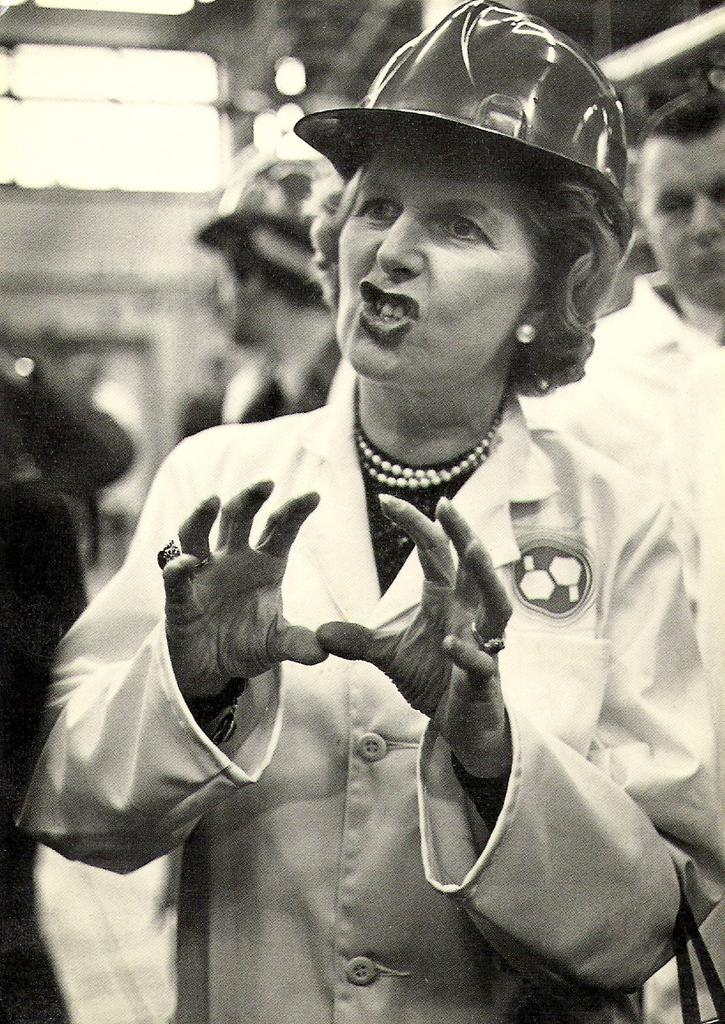
Mrs Margaret Thatcher: A 1980s Postcard Of The Prime Minister...

The special effects used in science fiction TV series V were quite terrifying.

I'll stop messing about. This is a postcard of Margaret Thatcher, UK PM, who won three consecutive UK elections in 1979, 1983 and 1987.

I bought the card circa 1988, when Mrs T was in her third term, and stuck it to the loo door.

Unflattering images of Maggie were everywhere.

And such things amused me.

Mind you, in these days of Gordon Brown and co, the political scene in the 1980s increasingly seems like something to cherish...

And I speak as somebody who wore my "The Only Good Tory Is A Lavatory" badge with pride back in that decade of big hair and big shoulders...

Frankie Goes To Hollywood: The "Relax" Ban

"Relax" by Frankie Goes Hollywood sent shockwaves through the pop-picking population of England...

Although used to scantily clad young women "flaunting themselves", as my auntie Maggie always put it, on "Top of the Pops" since Pan's People first strutted their stuff in the 1960s, nobody was prepared for the saucy lyrics of the "Relax" song and "downright disgusting" (Auntie Maggie again) visuals of the "Relax" video (see above)...

And as for simulated gay sex acts, well, civilisation was obviously on its last legs!

From the Daily Mirror, 25/1/1984:

Britain's number one record has been banned from "Top of the Pops" tomorrow night.

BBC TV chiefs won't play the smash single "Relax" because, they say, the lyrics are sexually explicit and not suitable for family viewing.

The record is by Liverpool group Frankie Goes To Hollywood. Their song is now banned by both BBC TV and radio - although it owes much of its popularity to both. "Relax" was performed on "Top of the Pops" three weeks ago and was played more than 70 times on Radio 1.

But two weeks ago DJ Mike Read refused to play it on his breakfast show, and Radio 1 executive producers extended the ban to all their programmes.

The group's lead singer William "Holly" Johnson said the song simply "encourages people to go out, have fun and relax."

The only other No 1 banned from "Top of the Pops" was the 1969 hit "Je T'Aime... Moi Non Plus" by Jane Birkin and Serge Gainsbourg.

13 June 2009

1980 And 1981: The Adventure Game And Moira Stuart - The UK's First Black Female TV Newsreader...

The Sun, 6 June, 1981...

Great, Ms Stuart was fine as a BBC newsreader. But she didn't need to acquaint herself with some of us who had met her via the TV screen in 1980. Remember? Doog yrev!

Don't know what I'm on about? Oh, very well - Moira had previously appeared in the first series of the absolutely wonderful BBC series The Adventure Game, as an alien who sometimes wore very fashionable boiler suits!

Remember Darong? And Dorgan? And Gandor? And Gnoard? And the Drogna Game? And how many Argonds Round The Pond? And the Rangdo of Arg? Was he an aspidistra or a teapot? Or both? What about the terrifying Vortex - the mind-numbing fear of being evaporated and having to walk home? Or those green cheese rolls? Or that series when Lesley Judd turned out to be a mole?

Bliss. Much better than the dreary old news!

Darong as Moira Stuart, Gandor as Christopher Leaver and Gnoard as Charmian Gradwell welcome you to the planet Arg.

11 June 2009

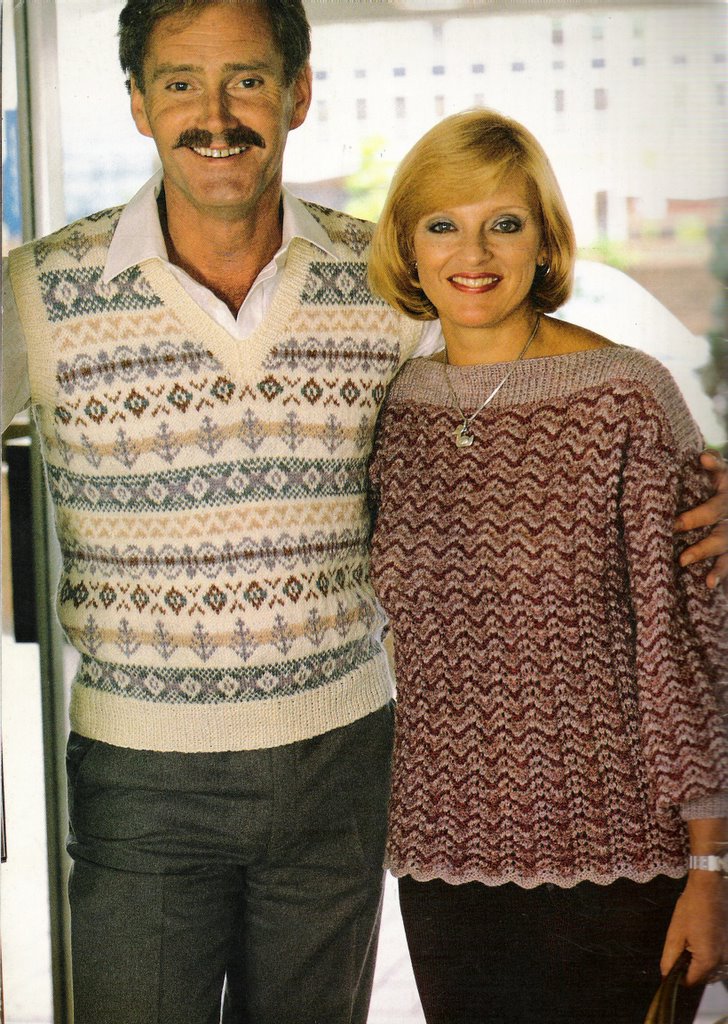
1984: Trendy Knits At The Crossroads Motel...

It was the King's Oak fashion event of the decade when, in 1984, a well-known knitwear company used Crossroads Motel staff and management to model their latest ultra-fashionable designs for a new pattern book. Mr David Hunter (Ronald Allen) and his wife Barbara (Sue Lloyd), pictured above, last made the local news in 1980 when Mr Hunter was shot in the motel office by his deranged ex-wife, Rosemary.

Sid Hooper (Stan Stennett) and Joe "Mac" MacDonald (Carl Andrews) work together in the motel garage. Mac likes Sid's sleeveless cardigan but isn't too sure about the pink shirt. Sid can't wait to get down to The Running Stag to show off his exciting new look.

Here's catering manager Paul Ross (Sandor Elès), known to the staff as "Mr Paul", who arrived at the motel in 1982 to act as a spy for one of the directors. A real "one for the ladies", Mr Paul could be described as an "un-spot changing leopard".

"Oh darling, that pullover is so you!" trills Mrs Jill Chance (Jane Rossington), one of the motel's directors.

"The woman gets daffier by the day," mutters her husband Adam (Tony Adams). "Fortunately, this should be great publicity for the motel and the knitwear people are paying us on top of that. Not a bad day's work..."

Glenda Banks (Lynette McMorrough), motel waitress, was thrilled with the rustic jumper: "I think this really suits me - can't wait for Kevin to see it!"

"Ooh, it does suit you, Glen, it's ever so nice - just the thing for the winter evenings." - Kath Brownlow (Pamela Vezey), motel housekeeper, and Glenda's mother.

"Quite right, Kath, it's turning right parky out - I said to Benny, 'Time you 'ad a new 'at, my lad'..." - Doris Luke (Kathy Staff), motel cleaner.


Bringing back Motel memories - the YouTube 1983 cliffhangers selection...

05 June 2009

1984: The Invention Of Tetris

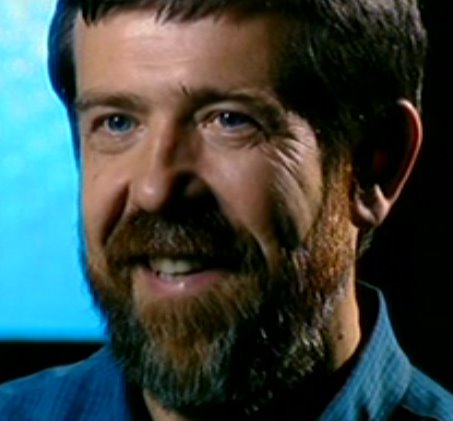
Alexey Pajitnov, the game's creator, began work on Tetris whilst employed at Moscow's Computer Centre in June 1984, and that work continued until 1986, in collaboration with Dmitry Pavlosky and Vadim Gerasimov. Online claims that the game was 'released' in the USSR in June 1984 are incorrect. 


Tetris prototype, but it would be some time before the game's fame spread to the Western World.

Today, 6 June 2009, Tetris is celebrating the 25th anniversary of its invention.

The release of the first Gameboy in the USA in 1989 set Tetris on its path to world-wide fame.

'80s Actual wishes Mr Pajitnov, the game's creator, and all the other people responsible for bringing Tetris to world wide fame, a very happy celebration!

04 June 2009

Heather Chasen As Valerie Pollard: Changes At The Crossroads Motel...

1982 - a new arrival at the Crossroads Motel...

A 1980s magazine and London Underground advertisement for a (then) new-fangled video recorder stated: "It can take 16 episodes of Crossroads (if you can!)".

As only around 30% of UK households had a VCR at the time of the ad's release in 1985, not many would have put that assertion to the test.

But the ad clearly demonstrates the contempt felt for the poor old Crossroads soap, which had been on-air since November 1964.

Yet, daft and boring though many viewers thought it, there was also great affection for the show.

In fact, some of the people who found it daft and boring were also fond of it.

Four years before the video ad, turmoil struck the Crossroads Motel: Noele Gordon, who played the leading character, Meg Richardson/Mortimer, was axed, and further changes were planned as the old motel reception set, on-screen since 1969, was burned down.

In the wake of Noele Gordon's departure from the
show, Jack Barton, producer, made it plain that Crossroads couldn't revolve around a single character in the future.

And so, over at the motel, we had Barbara (Sue Lloyd) and David Hunter (Ronald Allen) running things with Jill Harvey (Jane Rossington) and Adam Chance (Tony Adams). Not a particularly cosy set-up as David and Adam did not get along, and David could not shake off his suspicions that Adam's interest in Jill was not entirely honourable.

The closest we came to a Meg-style linchpin in this new set-up was Barbara - but she had other fish to fry, like writing best selling novels, and refused to be tied totally to the motel.

Elsewhere, we had the Brownlows - lovable, motherly Kath (Pamela Vezey), grumpy Arthur (Peter Hill), brilliantly frumpy Glenda (Lynette McMorrough) and her newish husband, Kevin Banks (David Moran) - the couple had married in 1981.

The not-so-cosy boarding house belonging to Mavis Hooper (Charmian Eyre) had been introduced in 1981- Mrs Overall, who was first seen in Acorn Antiques in 1985, was Mavis's "lookey likey".

With waitress Diane Hunter (Susan Hanson) cleaner and kitchen help Doris Luke (Kathy Staff) and the Crossroads Garage staff - including Sharon Metcalfe (Carolyn Jones), Benny Hawkins (Paul Henry) and Joe MacDonald (Carl Andrews), the motel marched on post-Meg.

And then came a stroke of genius on the part of the writers and production team.

Businessman J Henry Pollard (Michael Turner) had first appeared in the Crossroads saga in 1980, along with his daughter, Miranda (Claire Faulconbridge).

In April 1982, we finally get to meet Mrs Pollard. Mrs Valerie Pollard, J Henry's wife, who apparently loathed him dearly and had been forced to travel from her home in Bermuda to England when J Henry suddenly cut her funding.

Val, played by the very excellent Heather Chasen, enjoyed the good life - luxurious accommodation, travel-on-a-whim, wonderful food, lots of beach romeos...

And then, suddenly, there she was trapped at the Crossroads Motel, where she would stay, her ever-loving hubby informed her, and become a good and loving wife.

Otherwise, J Henry would divorce her and she could rest assured that, with his best lawyers on the case, she wouldn't be getting any wonderful divorce settlement. She would get nothing.

Valerie hit back - and hit back hard, seducing and bedding Adam Chance on his boat. Jill was devastated and Adam left the motel.

What a bitch was Valerie...

But she wasn't only a bitch. Languid and witty, she was also capable of good deeds...

And, of course, under the veneer of vehement dislike, she actually cared for J Henry very much indeed...

And he cared for her.

With daughter Miranda on-and-off the scene, the Pollards were a complicated family. J Henry was not keen on showing his feelings, Valerie could be devious and Miranda was often headstrong and immature.


But they livened up Crossroads no end! I hadn't been particularly impressed by the father/daughter J Henry/Miranda set-up we'd been treated to (on occasion, the characters were not permanent regulars) since 1980. But with Val on the scene from 1982 onwards, the Pollard "thing" really got some zing!

And, with her huge wardrobe of swish clothes, plus her tendency to toy with the peanuts and her "Pussyfoot Special" at the bar, Valerie was a very stylish person indeed.

Although the character only appeared (intermittently) from 1982-1985, the memory lingers - oh for the great telly days of the '80s!


From the Sun - £10 telly-view reader's letter, 29/5/1982:

Heather Chasen has brought a refreshing touch of good acting to "Crossroads".

Her haughty but not over-acted Valerie Pollard makes the show worth watching for a change.

Mrs DL, Norfolk.

31 May 2009

1983: Changes In Coronation Street...

Coronation Street had lost long-established regular characters Jack Walker (Arthur Leslie), Minnie Caldwell (Margot Bryant) and Jerry Booth (Graham Haberfield) from the cast in the '70s. Elsie Tanner (Pat Phoenix) had left for around three years and then returned. The Street's production team were well aware that the old order was subject to change. 1980 saw the final appearance of Ena Sharples. Violet Carson had appeared less and less frequently during the ten years leading up to her farewell.

When Ena left
The Street, bound for her old friend Mr Foster's house at Lytham St Anne's, nobody knew that she would never return. Ena made it known that she was somewhat cheesed off with Weatherfield, but that was nothing new!

In 1983, a few months short of Violet Carson's death, the
Daily Mirror was carrying an article entitled "I'll Be Back Vows Ena".

1983 saw The Street entering stormy waters indeed - the year saw the final appearances of Len Fairclough (Peter Adamson) and the newly-wed Eddie (Geoffrey Hughes) and Marion Yeats (Veronica Doran), who had met so romantically over the CB airwaves in 1982, and short-stayer Chalkie Whiteley (Teddy Turner). Actually, it wasn't quite Eddie's final appearance as he popped back to see "Mrs O" (Jean Alexander) in 1987.

Before the end of '83, we knew that 1984 would see us bidding farewell to Elsie Tanner again. And, as it turned out, '84 would see the deaths of Albert Tatlock (Jack Howarth), Bert Tilsley (Peter Dudley) and Stan Ogden (Bernard Youens).

1983 did have its up-side: the Duckworths moved into No 9. Vera Duckworth (Liz Dawn) had been a character in the show for years, although never a resident of The Street. In November 1979, we first met her husband Jack (William Tarmey), who was developed into a fully fledged character during various short stints in the show in the early 1980s.

In 1977, Vera had entered a glamorous granny contest at the community centre. But in 1983, as she at last moved into The Street, the writers gave some attention to her family background, did away with the granny concept, and introduced a crafty, cynical son, Terry (Nigel Pivaro), born in the mid-1960s.

One of the people most horrified to see the Duck Eggs move into Coronation Street was Annie Walker (Doris Speed), landlady of The Rovers Return. But sadly she wouldn't have to put up with them for long. Doris Speed fell ill in late 1983 and was never well enough to appear in the show again.

From the Sun, 1/10/1983:

Crisis-torn Coronation Street has been rocked yet again - by the collapse of actress Doris Speed in the TV studios.

Last night, as she recovered at home after three days treatment, she said: "I was very brave. I battled right through to the end and managed to get all my lines out."

It was hoped that Doris would be well enough to return to the show, but by early 1984 it was evident she probably wouldn't. So, Annie's retirement was announced on-screen, and son Billy (Kenneth Farrington) returned to run his mother's old empire. Billy's short tenure at the pub was stormy, and soon the Walker era at The Rovers was history.

But not quite. It was never part of an episode, but Doris/Annie did appear behind the bar at The Rovers again. In 1987/88, a large cheque was offered for charity if Doris would step back behind the bar as part of an ITV Telethon. She agreed.

This was a very different Rovers to her old domain - burnt down in 1986. But there was no doubt that the new bar suited her and there was also no doubt that Annie was in charge - I seem to remember Bet (Julie Goodyear) and Alec Gilroy (Roy Barraclough) standing respectfully behind her as she accepted the cheque for charity from the benefactor ("That should buy you a very large drink!") and operated the new beer pump, commenting with typical Doris Speed wit that the old pumps had required more effort and were better at developing the cleavage!

Does anybody have a copy of this Telethon footage? I would love to see it again!

The tabloids made much of the Street "Crisis"! Inside the Sun carrying the news of Doris Speed's sudden departure from the studios was the article pictured above:

Coronation Street, Britain's best-loved soap opera, has been rocked by crisis after crisis in the last few weeks.

The star cast has been drastically slashed as one after another of the big names have been axed or decided to move out of The Street.

In the next two months we will say goodbye to Elsie Tanner, Len Fairclough, Eddie Yeats and Marion Willis. Bert Tilsley has already been written out.

And the future for Stan Ogden, Annie Walker and Albert Tatlock must mean smaller and smaller parts as they battle ill health and old age.

For Coronation Street addicts, it will be almost like moving house, with a whole new set of neighbours to get used to.

Characters who have had little more to do than lean on the bar at The Rovers will find themselves on The Street to stardom as scriptwriters expand their stories to fill the gaps.

Who will be the second generation of Coronation Street stars?

The Sun has been looking at the young characters now in the series, and working out how their parts could be developed.

Most of the characters listed are long forgotten! Do you remember Pamela Mitchell or Don Watkins? I do remember Roy Valentine, who seemed set to become The Street's first regular black character:

From the Sun:

Roy Valentine, Len Fairclough's odd-job boy, played by Tony Marshall.

DEBUT: March, 1983.

A cheeky charmer out to better himself. He isn't going to let his colour stop him getting on in life or getting off with the girls.

STAR POTENTIAL:

Six out of ten. He'll be teaching the regulars how to reggae down at the new disco. And he could set the lace curtains twitching when he walks down the street with his first girlfriend.

Sadly, the departure of Len Fairclough meant the end of Roy Valentine.

Then there was:

Curly Watts, Eddie Yeats' new partner on the bins, played by Kevin Kennedy.

Debut: August, 1983.

He's single but goofy, yucky and downright plain. Still he's got the sort of cheeky Northern wit that goes down well with a pint.

STAR POTENTIAL:

Four out of ten. This spindly lad with the John Lennon specs certainly doesn't look like a heart-throb but neither did Eddie. Maybe he'll be able to laugh his way into the arms of some girl.

Of course, for the more discerning viewer, there was Victor Pendlebury:

Mavis' one and only love, played by Christopher Coll.

Debut: October, 1982.

He may have a boring job at the local council, but at heart he is a passionate poet.

He nurtured more than just Mavis' writing skills when they penned a racy short story together. Then Mavis refused to live in sin.

STAR POTENTIAL:

Six out of ten. The Street needs another married couple and Victor could be the man to save Mavis from becoming an old maid.

And what about Des Foster?

Councillor played by Neil Phillips.

Debut: July, 1983.

He's a married man with an eye for busty barmaids. Bet Lynch's earrings started quivering the moment he walked into the Rovers and fixed her with his big blue eyes. She pulled his pint and he pulled her.

But his wife in the wings made even Bet lose her bottle and she gave him the heave-ho.

STAR POTENTIAL:

Nine out of ten. He could be the cad every woman loves to hate, a natural rival for rogue romeo Mike Baldwin.

If he ditches his wife, his return to the Rovers would give Bet's big heart a flutter - and he would be fair game for any other footloose and fancy free regulars.

This young lady got ten out of ten from the Sun...

Sharon Gaskell, Len Fairclough's wayward foster daughter, played by Tracie Bennett.

Debut: March, 1982.

The best news to hit The Street for years, a real naughty girl.

Sexy Sharon had her own fan club within a month of moving into The Street.

STAR POTENTIAL:

Ten out of ten. She's only young but she's the only female around with enough sex appeal to step into Elsie Tanner's stilettos. She'll leave a lot of broken hearts - and even broken marriages - behind her before she settles down.

Of course, The Street weathered its losses. And things didn't turn out quite as the Sun envisaged!

28 May 2009

Channel 4

The notion of a second commercial TV channel had been around for at least a couple of decades. Finally, the Broadcasting Act 1980 set the wheels in motion to make that notion a reality.

Looking tremendously cutting edge, Channel Four debuted on 2 November 1982 and it was a huge national event. We only had three telly channels back then, and BBC 2 was rarely watched in households round my way - we thought its content was far too highbrow about 99.9% of the time.

We feared Channel Four might be the same, but "gave it a go" anyway...


When I saw the colourful shapes whirling across the screen, I yelped: "Oh no - not another Rubik's puzzle!" I was just getting over being defeated by the Cube and bitten by the Snake...
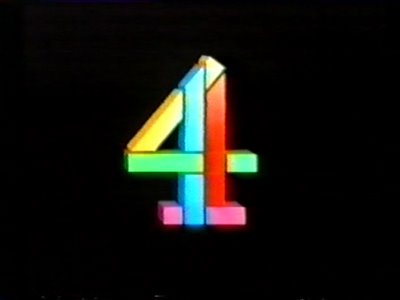
Thankfully, the shapes simply assembled themselves as Channel Four's logo. I breathed a sigh of relief - although I still thought that it had strong Rubikian (?!) influences!

The logo was designed in 1982 by the Robinson Lambie-Nairn company.

Appraised of the facts about the new channel-to-be, Lambie-Nairn decided to play on the fact that Channel 4 would be buying all its programmes in, so would be a kind of patchwork.

The idea they came up with was to try and illustrate the various elements which would make up Channel 4 coming together.

With the logo created, Lambie Nairn used a computer to animate the outlines of the blocks to the final freeze. The movements were then hand coloured and shot, but it didn't work - what was lacking was shadow and lighting.

Lambie-Nairn went to Bo Gehring Aviation in Los Angeles, USA. The company specialised in computer animation and Lambie-Nairn ordered differing sequences of the same basic symbol to be made entirely on computer. At that time, nobody provided that service in the UK.

The result, of course, was the familiar Channel 4 logo seen on the opening night and for years afterwards - a very cutting edge design and animating technique in 1982.

But would Channel 4 be a cutting edge TV station?

From the Daily Mirror, 4/9/1982.

Will ITV's Channel Four be a big turn-off?

You will soon be able to switch on to a brand new TV channel.

ITV's Channel Four goes on the air early in November.

But whether viewers will like what they see is another matter. The new channel is aiming to be experimental in content with a large output of educational and minority programmes.

In fact more like BBC-2 than ITV.

And in some quarters of the ITV companies fears are growing that this could be the recipe for a ratings disaster. For a start there'll be hardly any sport. What little there is will come mainly from America - basketball and grid-iron football, for instance.

Then each weekday night at the peak viewing time of seven, the channel plans an hour-long news programme.

Here's a run-down of what you will (or may not want to) be watching when Channel 4 flickers into life on Tuesday, November 2 at 4.45 pm.

COMEDY: From Australia, Paul Hogan. Top comedian Down Under and highly thought of by Channel 4 bosses who have bought twenty-six of his shows.

"The Optimist", a silent comedy starring up-and-coming English actor Enn Reitel and filmed in Hollywood.

And Peter Bowles stars in "The Irish RM", a six-parter based on the classic comedy stories of an Irish magistrate and set in the 1890s.

SOAP OPERA: "Brookside", an up-market "Coronation Street" set on an estate where most people own their own homes.

LIGHT ENTERTAINMENT: The Brazilian-made "Fantastico", reputedly one of the world's most spectacular song and dance shows, will run for twenty weeks at least.

NOSTALGIA: Hit American series of the Sixties such as "I Love Lucy", "The Munsters" and "Get Smart".

BLOCKBUSTER: "Nicholas Nickleby". The hit stage production of the Charles Dickens classic by the Royal Shakespeare Company.

FILMS: The silent version of "Napoleon", with a music track added, runs for six hours. Otherwise you'll be seeing golden oldies such as the 1930s gangster film "Scarface"; Eddie Cantor movies including "Whoopee".

Midnight movies on Friday and Saturday nights will run up to 2am, with a hint there will be some X-rated films.

DRAMA: Two plays ready for screening have down beat themes. "The Disappearance of Harry" stars Annette Crosbie as the wife of a man who leaves for work one morning and never returns. "Angel" is the story of a young saxophone player facing violence and death.

Channel 4's chief executive, Jeremy Isaacs, says: "it will be responsive to its audience's changing needs, lively, concerned, useful - and fun."

The target figure is a nightly audience of five million.

Will Channel 4 ever manage to attract that many viewers? Wait and see.
And so we waited. And we saw.

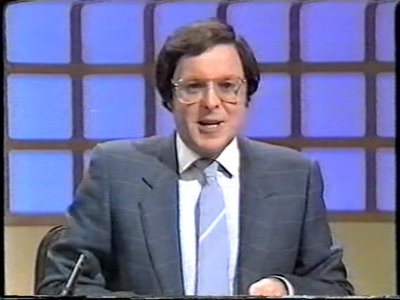
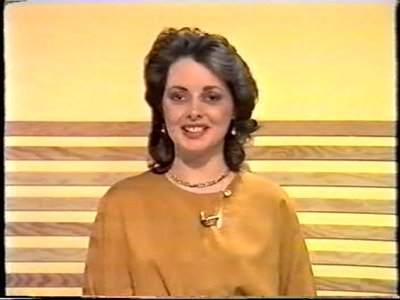
On 2 November 1982, after a welcome from presenter Paul Coia and a look at goodies to come, we settled back for the first of Channel Four's programmes - and it was "anyone for anagrams?" with Countdown.

You can see Richard Whiteley above and Carol Vorderman below as they appeared in the very first show.
Early Channel 4 was short of adverts, due to an industrial dispute: should actors appearing in ads on channels like TV-am (which was due to start in February 1983) and Channel 4, both envisaged as attracting lower audiences than the main ITV regional channels, be paid less? It took some time to sort that one out, so, in the early days of Channel 4, we got to know pictures with captions like "Brookside follows shortly" very well indeed!

The "Sun", January 20, 1983: TV critic Margaret Forwood comments on the lack of adverts and adds a few of her thoughts on Channel Four in general...


From the "Sun", February 2, 1982. Actually the provisional title for this show, which turned out to be "Brookside", was "Meadowcroft", not "Meadowcraft" and the creator was Phil Redmond not Redmund! Still, "Coronation Street" producer Bill Podmore's confident attitude is worth noting: "I enjoy competition... especially when we are going to win."


I remember watching the very first episode of Brookside and loving the electronic theme tune. But I wasn't too sure about the characters or setting. Would it take off? It all seemed a bit too real...

We couldn't have guessed on the first night, but with its gritty plots and set of real houses, Brookside would drag soap away from the cosy story lines, tight perms and brightly lit studio sets of Crossroads and Coronation Street, both fixtures on ITV since the 1960s, into the 1980s.


The characters - the moved-up-in the world Grant family, moved-down-in the world Collins family, and young urban professionals Roger and Heather Huntington, were uncompromisingly non-cosy. The language used in the early episodes was considered a little too real and had to be toned-down, but early Brookside, thought by many to be far too subversive to be a soap opera, was great. Well, OK, maybe this anti-Thatcher dog was a bit too darned shaggy. As a poor, working class geezer, I don't recall real life in the 1980s being anywhere near as grim as in Brookside, but for those of us who detested Thatcher at the time it was sheer bloody brilliance.


Gordon Collins, played by Mark Burgess, was the first regular gay character in English TV soaps; Tracy Corkhill (Justine Kerrigan) got into trouble with telephone chatlines, parents, teachers, you name it; Annabelle Collins (Doreen Sloane) faced a move down in status from the leafy Wirral to rough and tumble Brookside; but for working class mum Sheila Grant, played by Sue Johnston, the Close marked a move up in the world from a grotty council estate.

I believe that Brookside was, at least partly, responsible for some new (to most of us) slang words over the next few years. Before the 1980s, I recall nobody in my area calling Christmas "Chrimbo" and electricity "'leccy", but, post November 1982, both gradually seeped into usage.


They seemed to originate from Brookside "Scouse speak".

Sainsbury's, of course, became "Sainsboe's"!

Brookside was soon more commonly known as "Brookie", and Coronation Street became "Corrie", which, again, I don't recall before the 1980s. Soaps simply weren't trendy enough before the 80s to bother with zippy abbreviations. Brookside influenced other soaps and helped to blast away soap's fuddy-duddy image - making it respectable for youngsters to tune in.

But I digress. Back to what I viewed on that first night on Channel Four...

I remember being depressed by the opening night film - Walter - about a man with "learning disabilities" (the modern day PC phrase - not in use round my way, nor I believe anywhere else, in 1982!) who was subjected to various horrible experiences after his mother died.

Five Go Mad In Dorset was a Comic Strip Presents production, and a merciless mickey take of the Enid Blyton Famous Five books.

The show had a "surprise guest star" - Ronald Allen, David Hunter of Crossroads fame - appearing as Uncle Quentin. Dear Uncle told the children: "I'm a screaming homosexual, you little prigs!"

It was difficult not to see Ronald Allen as his Crossroads character, I don't think I'd ever seen the actor appearing in any other show before, and to hear "David Hunter" coming out with those words left me absolutely breathless with laughter.

At the end of my first taste of Channel Four programmes, I decided that it was different. Definitely different. And worth another look...

See a 1988 article on Channel Four favourite Treasure Hunt
here.
----------------------------------------------------------------------------------


09 May 2009

1986: TV Snacks And Soap Opera Stars...

Here's a nice piece of 1980s kitsch - it's 1986 and from your friendly local newsagent you could buy a copy of this handy little booklet - 90 TV Snacks - Ideas, Recipes And Soap Stars' Favourites.

On the cover was the adorable Angie Watts - Anita Dobson - of EastEnders, with big hair, big shoulder pads, and sparkling pearlies.

EastEnders had first burst on to our screens in February 1985, with Lou Beale (Anna Wing) "doin' her nut" over daughter Pauline (Wendy Richard) and her late-in-life pregnancy, a grim discovery at Reg Cox's place, and a fist through the window at the local boozer, The Queen Vic. English soaps would never be the same again...


The 1980s were an interesting time for snacking: microwave ovens had debuted in the 1960s but were not affordable to the vast majority of people until the 1980s, and the possibilities they opened up (if you weren't terrified by tales of radiation poisoning) were endless. And then there were those natty sandwich toasters. YUM!

So, what did Angie - or Anita - favour in the TV snack line?

"A bag of cheese and onion crisps".

Nice 'n' easy.

And hubby "dirty" Den Watts (Leslie Grantham)? "Mexican Tacos for me, and a glass of good wine."

Classy!

Coronation Street had debuted on ITV in December 1960, and was going great guns in the 1980s. What TV snacks did two of the regulars from The Rovers favour in 1986? Well, Kevin Webster (Michael Le Vell) was into a cheese or mushroom omelette, whilst Ken Barlow (William Roache) liked "A good salad sandwich - lettuce, cucumber and tomato in granary bread."

Scrummy.

As a quick aside, I always thought that mid-'80s Kev had modelled himself on the dark haired bloke from Hall & Oates (see inset pic).

Brookside was the first of the new breed of 1980s subversive soaps, and blasted on to our TV screens in November 1982, on Channel 4's opening night. Asked for her favourite TV snack in 1986, Sandra Maghie (Sheila Grier) went for French bread with cheese or paté and salad, Damon Grant (Simon O'Brien) favoured tuna in oil spread on brown toast, Bobby Grant (Ricky Tomlinson) said "Give me a chip buttie every time", and Sheila Grant (Sue Johnston) opted for home made chicken soup.

Typically original, Brookside sent the character of Damon Grant off into a spin-off (or "soap bubble") in 1987 called Damon and Debbie, which ended with the death of the character.

Crossroads was on our screens from November 1964 to April 1988 - an often mocked but now fondly remembered soap based around life in a Midlands motel. In the mid-to-late 1980s, shortly before its end, the show was revamped but, despite rising ratings, still got the chop.

Jane Rossington as Jill Richardson/Harvey/Chance - or "Jilly" as her hubby Adam (Tony Adams) once called her - starred in the show, with a few breaks, from beginning to end.

Her favourite 1986 TV snack was cheese with slices of apple.

Benny Hawkins (Paul Henry) liked egg and bacon sandwiches.

Me too.

And finally, Dolly Skilbeck (Jean Rogers) of Emmerdale Farm gave us her recipe for tuna and sweetcorn bake. Jean Rogers made her screen debut as Dolly, taking over the role from Katharine Barker, on 1 April 1980.

Emmerdale Farm began as a lunchtime serial in October 1972. The show underwent several momentous changes in the 1980s, dropping its seasonal breaks and being shown nearly all year round from 1985 onwards (it was not shown during the Christmas season until 1988) and being networked - shown on the same day and at the same time across the country - in January 1988.

In November 1989, the show dropped "Farm" from its title, becoming simply Emmerdale.

24 April 2009

Emmerdale Farm - The 1980s: The Golden Era Of Amos And Mr Wilks

1980s signed cast cards of Arthur Pentelow (Henry Wilks) and Ronald Magill (Amos Brearly). Here's a fascinating fact: did you know that until the early 1980s UK soap cast cards provided by TV studios were always in black and white?

Ah, those were the days... Arthur Pentelow as Henry Wilks (or should that be
Mr Wilks?!) and Ronald Magill as Amos Brearly. These two ran The Woolpack Inn and shared the living accommodation from 1973 to 1991. A now legendary soap pairing.

Actually there were a pair of Woolpacks, too. The original building was declared unsafe due to subsidence in 1976, so Amos and Mr Wilks relocated to premises elsewhere in the village.

Mr Wilks was a warm hearted retired businessman. Amos was... well... erm... it's not easy to summarise Amos. He was childish. Pompous. Usually rigidly formal. Given to rapid fads and enthusiasms. He was also naive and very good hearted. Underneath it all.

The character of Amos evolved. When he became Beckindale correspondent on the Hotten Courier in 1976, he puffed himself up like a peacock. But it took until the early 1980s before the character was refined and honed to perfection. Watch any 1970s episode of Emmerdale Farm, and I think you might agree that Amos was quieter, more restrained and dour than in the 1980s - when he was gloriously potty, pursuing fad after fad in quick succession, bridling at Mr Wilks' attempts to bring him down to earth and generally being a wonderful nuisance.

1980 was an absolutely pivotal year for the Amos character - with Seth Armstrong leaving The Malt Shovel bar to become a regular at The Woolpack, and Al Dixon joining the cast as Walter, Amos became more animated, fad-ridden and bizarre than ever before!

The '80s were a truly splendid era during which Amos and Mr Wilks story lines abounded, as the show became an all-year-round soap.

Do you remember the time when Amos got into transcendental meditation? The time he went "upwardly mobile" and took up golf with Alan Turner? The time he turned to bee keeping? The time he baked a cake? The time he was cursed by a gypsy? The time...

If all these sound like Amos-only story lines, rest assured that Mr Wilks was always there, advising, trying to moderate his friend's behaviour, and generally suffering!

Fortunately, Mr Wilks had friends elsewhere or he would, no doubt, have gone insane!

Amos and Mr Wilks have a disagreement in 1980...

... and they're still at in 1989. Dolly Skilbeck (Jean Rogers) looks on.

A pain in the neck to Amos was one of his best 1980s customers and arch enemy, Seth Armstrong (Stan Richards). How he loved to wind the big key in Amos' back! In 1980, Amos commented disapprovingly on Seth's loyalty to the Malt Shovel. Seth was just becoming established as a regular character back then, having first appeared in a few episodes in 1978. From 1980 onwards, Seth switched to The Woolpack, and absolutely loved to get under Amos' skin! Remember the time he booked two strippers (and a python!) to perform at The Woolpack - much to Amos' horror? Amos ordered them out and the pub was wrecked by irate customers!

I've recently viewed hundreds of 1980s Emmerdale Farm episodes, and watching Amos reach the peak of his peculiarity, aided by Seth Armstrong and Walter and the long-suffering Mr Wilks, has been a great pleasure.

Seth holding court at The Woolpack in 1983. Walter (Al Dixon) says nowt and concentrates on his ale. Al Dixon first appeared as the silent bar propper in September 1980.

Seth and pal.

"Sunday People", June 9, 1985. Apparently Jenny the donkey's braying could sometimes be heard when the "Emmerdale Farm" crew were attempting to film in Esholt - so it was decided to bring her into the story!

Joint Pipe Smokers Of The Year, 1986.

14 April 2009

Boardroom Blinds At Home...

Snippets from an article on window blinds, Bella magazine, January 1988.

I remember a lot of very attractive window blinds in the mid-to-late 1980s. I favoured some really snazzy red ones for the kitchen of the flat I shared with some friends, but never got round to buying them.

I like this look!

The most famous vertical louvres of the 1980s were those featured on the opening titles of the revamped ITV soap opera Crossroads in 1985.

I recall a rather posh friend of mine replacing her old horizontal blinds with vertical ones c. 1987. If my neighbourhood is anything to go by, there has been a revival of this fashion in recent years.

1982: Invasion Of The Deelybobbers/Deelyboppers/Beeny Boppers/Bonce Boppers/Space Boppers...


June 1982 - Deelyboppers, or Bonce Boppers, or Deelybobbers, or Space Boppers, or... [insert own name for this exciting early 1980s headgear] ran rampant in New York and were about to arrive here...
-
From the Rock column by Robin Eggar, Daily Mirror, 29/6/1982:
-
The young lady with the strange growths on her head is not an alien. She's just sporting the trendiest fashion accessory in New York - The Bonce Bopper.
.
New Yorkers have suddenly started to sprout spring-mounted bobbles, hearts, stars and windmills.
.
If you want to be one of the first bobble-headers in Britain, I've just had 25 sets flown in.
.
To win one, tell me who first recorded the Rolling Stones' current hit "Going To A Go Go" in 1966. The first 25 answers drawn from the bag on Monday, July 5, will receive a bonce bopper.
*
Sadly, Going To A Go Go really wasn't much of a hit - stalling at No. 26, but deelybobbers/deelyboppers/bonce boppers etc, etc, were a wow!
-
The Sun, 23 July, 1982 - the "Bonce Bouncers" are here!

We've had head-hunters and head-bangers. Now it's the turn of the bonce boppers.

In fact, it's the latest craze to bounce into Britain from America. And it's going to everyone's head.

So, hang up your hoola-hoop, scrap your skateboard and get a head start by wearing a bopper on your bonce.

It's a headband supporting two spiral wire antenna topped with hearts, bobbing balls or windmills.

When we took to the streets with luscious Linda Lusardi wearing a pair of boppers, headstrong young men came rushing up to look at her...


Page three lovely Linda gets bopping...

In August 1982, an article entitled Parting The Forest Of Headbanger Antennae appeared in my local rag (or newspaper!):
-
It is the latest craze and it has really gone to people's heads...

What is it? Well, here we encounter a slight problem. What are those things protruding from the heads of everyone under 13 years (not to mention a few people over 13 years)?

-
The answer is not easy. There seem to be as many names for these glittering balls, hearts, stars, feathers and windmills, as there are designs.
-
"What do you call those headbands with things on?" I asked a girl in one Cambridge fashion shop.
-
"I don't know," she mused... "Headbands with things on, I suppose."
-
Round the corner, the street trader who was undercutting the shop by 39p, displayed no such hesitation.
-
"Beeny (or should it be beany?) Boppers," he said.
-
Along the street another itinerant salesman had a sign saying "Bouncers," or was it "Boncers"?
-
In Green Street, Cambridge, a shop named Games and Puzzles calls them Headbanger Antennae. They are also known as Space Boppers and Bonce Boppers.
-
"The kids seem to make up their own names," said Games and Puzzles proprietor Mr Lester Saunders.
-
Whatever they are called, they are the biggest thing since the Rubik Cube. Since the start of the school holidays they have proliferated in Cambridge to almost epidemic proportions.
.
Let's quickly recap on what we learned in the main
1982 blurb:

The oddball headgear was registered in the USA, its homeland, as "Deely-bobbers" (according to 20th Century Words by John Ayto) in 1982, with claim of usage of the name since 1981.

The name (deely-bobbers, I believe) had previously been applied to a children's toy - a type of inter-connecting building block.

Did you remember all that? If so, pop on your deely-bobbers or deelyboppers (or whatever you like to call them), and reward yourself with a quick boogie to your Kids From Fame LP - you deserve it!

Did we like looking like space aliens? But of course! I remember wearing a lovely pair of deelyboppers (as I referred to them) just before Christmas 1982 at my firm's Christmas "do".

What a night! My mother discovered me at one o' clock the next morning, tinsel round neck, deelyboppers bobbing, standing underneath a lamp post and serenading the family home: "Save your love my darling, save your love..."

She's never let me forget it.

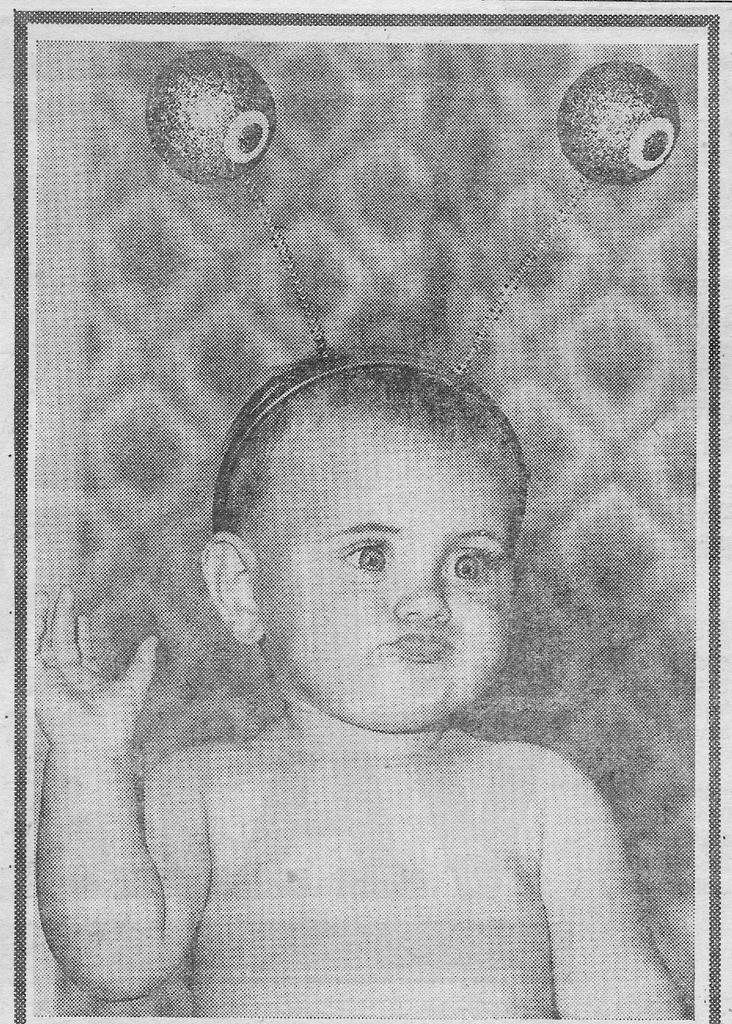
The little cherub above, pictured in the "Daily Mirror" in August 1982, won a baby of the year show. Was she wearing the headgear at the time?

An unusual way of wearing deelyboppers - the "Sun", September 1982.

See a 1982 Atari magazine advertisement featuring deelyboppers - here.