Total Pageviews

Pages

Showing posts with label hip hop. Show all posts

12 January 2013

1984: Some Popular Computers And Games - Remember Frogger, Galaxy Invader 1000, Donkey Kong, Mario Brothers And The Commodore 16?

Double page advertisement from 1984 for the Commodore 16 complete starter pack - Everything you need To start computing in one box.

Some computers and games featured in the Janet Frazer autumn and winter 1984/5 mail order catalogue.

Fun with the likes of Zaxxon and Sensor Travel Chess. The Tomy Skyfighters "brings you realistic sights and sounds. Press the top control buttons to manoeuvre your 'Skyfighters' against the enemy squadron."

The Atari 600XL and the Commodore 64.


Games for the Commodore 64, Sinclair Spectrum 48K and Atari 600XL and 400/800.

The new streamlined-look Atari 2600 console and games galore - including the delectable Ms Pacman.


Goodies here include the Philips Videopac G7000, a "boss joystick" suitable for Atari 2600 video game, Atari computers, Commodore 64 and Vic 20 computers, and lots of lovely games like Donkey Kong and Zaxxon.

Astro Wars, Star Force, Munchman, Firefox, BMX Flyer (BMX without the cuts and grazes), Krazy Kong and Multigame - "6 CHALLENGING GAMES IN ONE PLUS BONUS GAME".
 
Here are the CGL mini arcade games Frogger, Amidar and Galaxy Invader 1000. Such memories! Details are also listed of the items below.


CGL - Game and Watch - "The games you can take anywhere for those boring moments". Here are Snoopy, Donkey Kong, Mario's Bombs Away, Donkey Kong Junior, Mario's Cement Factory, Pinball, Mario Brothers and Popeye.

16 July 2012

Break Dancing, Off-The-Shoulder, and The Boy...

The soundtrack album to Breakdance, the motion picture. Could I break dance? Um...

1984 magazine ad for the "Panasonic RXC39 portable hi-fi. Part of the new RX range, it comes complete with separate automatic turntable, detachable speakers and rack. Also available without turntable."

Colourful mid-1980s Toshiba ghetto blaster/boombox. Cover it with stickers and take it to the streets!

These pictures are from the Sunday Express Magazine - 1984 - The Pictures of the Year. The blurb for the top picture reads: 

Take A Break: Take A Dance. Girls wore bulldog clips in their hair, preferably fluorescent. T-shirts bore instructions from Frankie. Leisuretime pursuits were essentially trivial. But the biggest fad of 1984 was break dancing - the latest, most violent offspring of the cha-cha-cha, the twist and rock 'n' roll. In its home, California, there were serious injuries and even one death. This expert practitioner seems simply to let it all go to his head...
.
Trendy girls watch the break dancer. Note the off-the-shoulder-showing-strap-under-dress-look of the girl on the right, which has reappeared in recent years.

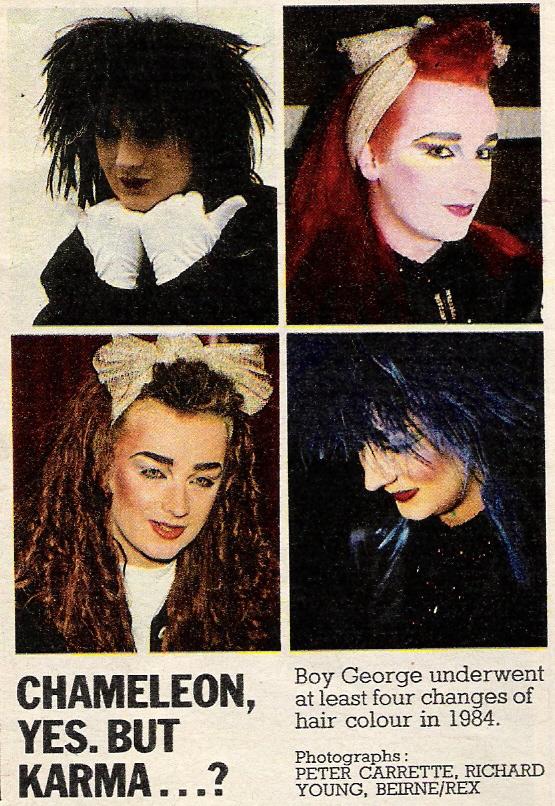
Boy George was a 1984 hair-o.

25 September 2011

Run DMC, England, 1985!

Run D.M.C. hailed from New York's Queens district. Their involvement as youngsters with the underground club scene placed them in a good position when the rap scene began to blossom into the hip-hop scene in the 1980s. "Sucker M.C.s" and "It's Like That" had been dance hits in America earlier in the decade, and soon Run DMC were merging rock with rap on releases like "Rock Box".

In early 1985, they performed at Buzby's in London.

02 July 2009

1983: Breakdancing And Body Popping - What A Feeling!

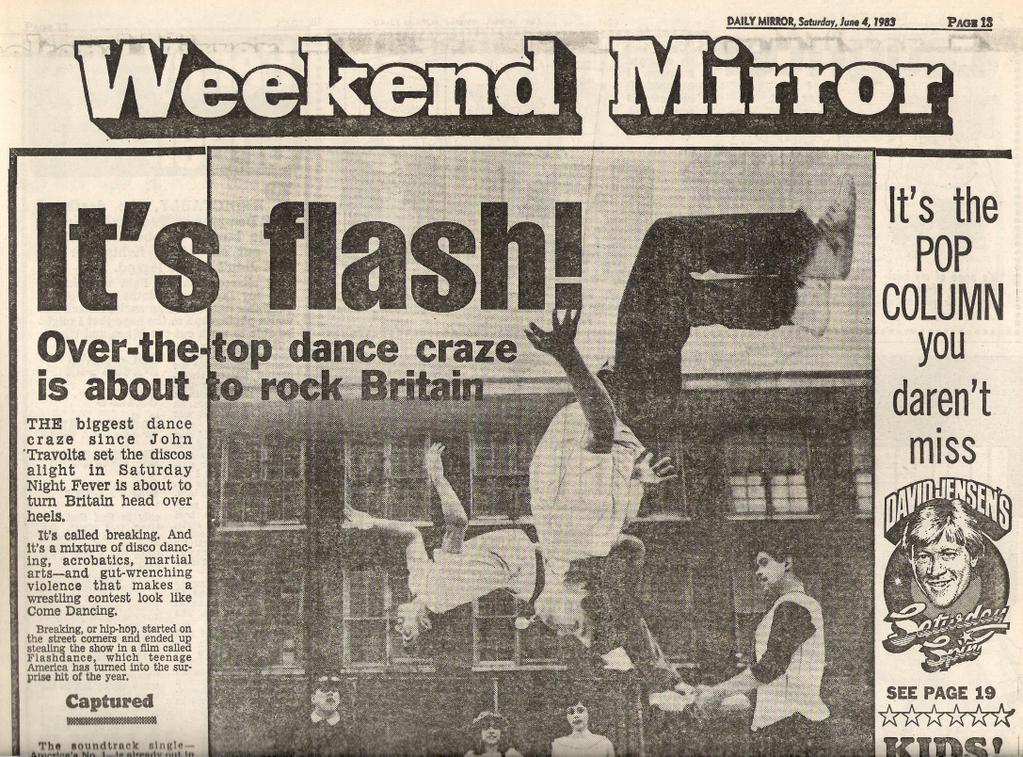
From the Daily Mirror, 4/6/1983:

The biggest dance craze since John Travolta set the discos alight in "Saturday Night Fever" is about to turn Britain head over heels.

It's called breaking. And it's a mixture of disco dancing, acrobatics, martial arts - and gut wrenching violence that makes a wrestling contest look like "Come Dancing".

Breaking, or hip-hop, started on the street corners and ended up stealing the show in a film called "Flashdance", which teenage America has turned into the surprise hit of the year.

The soundtrack single - America's No 1 - is already out in Britain, and the film opens later this month. It tells the story of a young girl, played by unknown student Jennifer Beales, who works as a welder and dreams of being a ballet star.

On the road to fame she brings her sexy, breaking-style routines to a nightclub audience, and these are the scenes that captured the imagination of teenagers and packed cinemas from coast to coast.

"Flashdance" made 20-year-old Jennifer a star overnight. But the real stars of breaking are the kids from the backstreets who created the craze.

They gather in America's big cities and launch into solo dances, or breaks, to a beat throbbing from a ghetto-blaster - a giant, portable stereo system.

They dash themselves to the ground, rolling and spinning on hands, necks and bottoms. Or they hurl themselves in the air turning back somersaults and freezing so that they land with a spine-jarring crash...

"Street dance can be just a form of aggression," said Jeff Kutash, who is touring Britain with Dancin' Machine, his troupe of street dancers.

"There's one move called the body slam, where two dancers hurl themselves against each other and bounce off on the rythm. That's popular in the punk clubs in America.

"I've seen cut eyebrows and broken bones. It's a bloodbath."

With the cult go names. In Jeff's group there is Mr X, a swaggering dancer in sequinned denim, Bad News, Sugarfoot and Ricochet Rabbit.

The street scenes in "Flashdance" are the work of the Rocksteady Crew, New York's first professional street dance gang.

Like Dancin' Machine, they perform stylised moves with names like the helicopter swipe, the coffee grinder and the frightening head roll, where a dancer stands on his head and gyrates using his neck muscles.

The milder forms of street dance are already taking off in Britain. There is Street Poppin', made up of jerky muscular spasms, and the gritty, hip-thrusting Nasty Girl and Gigolo.

As the craze spreads, the producers of "Flashdance" are dancing in the streets, too. Within two weeks of being released the 8.5 million dollar film has earned 11.3 million dollars.

The soundtrack LP - out in Britain at the end of this month - sold 700,000 copies in America in the first fortnight.

The single "Flashdance - What a Feeling", shot to the top of the charts there and went straight into the British charts at No 30 this week.

"Flashdance" opens at four London cinemas on June 30 and goes on general release a week later.
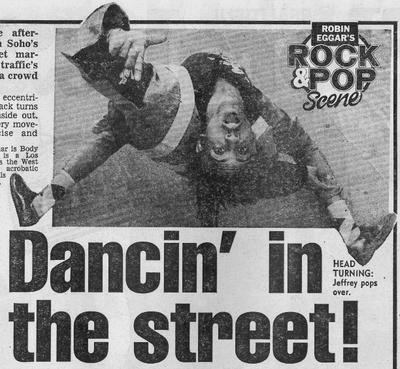
From the Daily Mirror, 21/6/1983:

Suddenly the afternoon bustle in Soho's Berwick Street market dies away. The traffic's at a standstill and a crowd has gathered.

They watch as an eccentrically dressed young black turns his body seemingly inside out. And upside down. Every movement is slow, precise and sinuous.

Jeffrey Daniel of Shalamar is Body Popping. Body popping is a Los Angeles street dance. It is the West Coast equivalent to the acrobatic "break dancing" that steals the new "Flashdance" movie.

Jeffrey gave Britain its first stunning taste of body popping when Shalamar appeared on "Top of the Pops" last June.

Until then they were just another faceless disco group. But Jeffrey's electrifying act helped push their single "A Night To Remember" into the charts.

By the end of the year Shalamar had notched up four hits in a row.

They sold out eight nights at London's Dominion Theatre and one at the Wembley Arena...

When Jeffrey is dancing it is hard to believe what he is doing with his body. One moment he glides backwards as if through quick-silver.

The next he shudders like a robot caught in the glare of a disco strobe light.

"Popping is slow and tightly conceived.

"But when it crossed over to the East Coast it became breaking - which is much more physical.

"Breaking is strictly acrobatic, spinning your body around your head or arms.

"Breakers are either gymnasts - or insane! With popping we never have to get on our heads or bounce off pavements."

31 May 2005

"Don't Push Me 'Cos I'm Close To The Edge..."

The Hip Hop scene was really taking shape in 1982. Grandmaster Flash and the Furious Five pointed the way with the gob smackingly brilliant The Message.

The groundbreaking character of The Message,
with its gritty, socially aware lyrics, cannot be doubted - and its influence on the Hip Hop scene was massive.

It’s like a jungle sometimes
It makes me wonder how I keep from goin’ under
It’s like a jungle sometimes
It makes me wonder how I keep from goin’ under

Broken glass everywhere
People pissin’ on the stairs, you know they just don’t care
I can’t take the smell, can’t take the noise
Got no money to move out, I guess I got no choice
Rats in the front room, roaches in the back
Junkies in the alley with a baseball bat
I tried to get away but I couldn't get far
’cuz a man with a tow truck repossessed my car

Don't push me ’cuz I’m close to the edge
I’m trying not to lose my head
Uh huh ha ha ha
It’s like a jungle sometimes
It makes me wonder how I keep from goin’ under

Standin’ on the front stoop hangin’ out the window
Watchin’ all the cars go by, roarin’ as the breezes blow
Crazy lady, livin’ in a bag
Eatin’ outta garbage pails, used to be a fag hag
Said she’ll dance the tango, skip the light fandango
A Zircon princess seemed to lost her senses
Down at the peep show watchin’ all the creeps
So she can tell her stories to the girls back home
She went to the city and got social security
She had to get a pimp, she couldn’t make it on her own

Don’t push me 'cuz I’m close to the edge
I’m trying not to lose my head
Uh huh ha ha ha
It’s like a jungle sometimes
It makes me wonder how I keep from goin’ under
It’s like a jungle sometimes
It makes me wonder how I keep from goin’ under

My brother’s doin’ bad, stole my mother’s TV
Says she watches too much, it’s just not healthy
All My Children in the daytime, Dallas at night
Can’t even see the game or the Sugar Ray fight
The bill collectors, they ring my phone
and scare my wife when I’m not home
Got a bum education, double-digit inflation
Can’t take the train to the job, there’s a strike at the station
Neon King Kong standin’ on my back
Can’t stop to turn around, broke my sacroiliac
A mid-range migraine, cancered membrane
Sometimes I think I'm goin’ insane
I swear I might hijack a plane!

Don’t push me 'cuz I'm close to the edge
I’m trying not to lose my head
It’s like a jungle sometimes
It makes me wonder how I keep from goin’ under
It’s like a jungle sometimes
It makes me wonder how I keep from goin’ under

My son said, Daddy, I don’t wanna go to school
'cuz the teacher’s a jerk, he must think I’m a fool
And all the kids smoke reefer, I think it’d be cheaper
if I just got a job, learned to be a street sweeper
Or dance to the beat, shuffle my feet
Wear a shirt and tie and run with the creeps
'cuz it’s all about money, ain’t a damn thing funny
You got to have a con in this land of milk and honey
They pushed that girl in front of the train
Took her to the doctor, sewed her arm on again
Stabbed that man right in his heart
Gave him a transplant for a brand new start
I can’t walk through the park 'cuz it’s crazy after dark
Keep my hand on my gun 'cuz they got me on the run
I feel like a outlaw, broke my last glass jaw
Hear them say “You want some more?”
Livin’ on a see-saw

Don’t push me 'cuz I’m close to the edge
I’m trying not to lose my head
Say what?
It’s like a jungle sometimes
It makes me wonder how I keep from goin’ under
It’s like a jungle sometimes
It makes me wonder how I keep from goin’ under
It’s like a jungle sometimes
It makes me wonder how I keep from goin’ under
It’s like a jungle sometimes
It makes me wonder how I keep from goin’ under

A child is born with no state of mind
Blind to the ways of mankind
God is smilin’ on you but he's frownin’ too
Because only God knows what you’ll go through
You’ll grow in the ghetto livin’ second-rate
And your eyes will sing a song called deep hate
The places you play and where you stay
Looks like one great big alleyway
You’ll admire all the number-book takers
Thugs, pimps and pushers and the big money-makers
Drivin’ big cars, spending twenties and tens
And you’ll wanna grow up to be just like them, huh
Smugglers, scramblers, burglars, gamblers
Pickpocket peddlers, even panhandlers
You say I’m cool, huh, I’m no fool
But then you wind up droppin’ outta high school
Now you’re unemployed, all non-void
Walkin’ round like you’re Pretty Boy Floyd
Turned stick-up kid, but look what you done did
Got sent up for a eight-year bid
Now your manhood is took and you’re a Maytag
Spend the next two years as a undercover fag
Bein’ used and abused to serve like hell
’til one day, you was found hung dead in the cell
It was plain to see that your life was lost
You was cold and your body swung back and forth
But now your eyes sing the sad, sad song
Of how you lived so fast and died so young so...

Don’t push me 'cuz I'm close to the edge
I’m trying not to lose my head
Uh huh huh huh huh
It’s like a jungle sometimes
It makes me wonder how I keep from goin’ under
Huh, uh huh huh huh huh
It’s like a jungle sometimes
It makes me wonder how I keep from goin’ under
Huh, uh huh huh huh huh…

More on the blossoming 1980s hip hop scene below - just click on subject.

Hip hop in England - 1983

Break dancing - 1983

Hip Hop as 1984 craze

Run-DMC in London - 1985


1983: The World's First Mobile Phone; Compact Discs; Garfield; Hip Hop; Flashdance; Blockbusters; Blue Monday; No. 73; Wallies; Sloane Rangers

Top of the nation's list of concerns this year was unemployment. In 1980, it had been inflation. Inflation, which had been such a tremendous worry during the 1970s, was down but the unemployment figures were going up. And up. And up...

We'd been horrified when unemployment passed the million mark, for the first time since the 1930s, in the early 1970s, but we hadn't seen anything yet... we now had three million unemployed. Yes, three million. And the 1979 Tory election slogan had been Labour Isn't Working! But never mind. Thatcher and co told us this nasty medicine was necessary. Once we had a stable, competitive economy everything would be rosy. Trust them, that was all they asked. Hmm...

The Hip Hop scene was evolving fast, born of the American rap scene. In 1983, the scene swept across England. Youngsters could be seen in city centres across the land, breakdancing and body popping. The boombox (aka the ghetto blaster) had arrived and was an essential piece of kit.

The boombox had developed from the radio cassette recorder, and the term boombox was probably first coined at the beginning of the 80s
. This was when the things began to grow rapidly in size. I recall them being called "ghetto blasters" here, and don't think I ever heard the name "boombox" back then.

In England in 1983, it was trendy to cover your boombox/ghetto blaster in stickers and no blank wall was safe from a spot of Hip Hop graffiti.

Our neighbours' eleven-year-old son painted "Hip Hop" on the side wall of his family home. I was impressed - it was a fine piece of work, like something out of a breakdance film, but his reward from his parents was a scrubbing brush, a bucket of soapy water and the loss of two weeks' pocket money. As I said to the lad, "Some people just don't appreciate art!"

I will always remember this as the year of Blue Monday by New Order. I hated it at first. Just a disorganised mass of synthy bits and guitar chords, thought I. Within a week, I not only had the record but was playing it around twelve times a day. Magic.

Sky TV didn't arrive until 1989, so I couldn't see MTV. Could anybody in England at this point? But the effects of the music video revolution were being felt - never more so than with Michael Jackson's Thriller.

Another trend that was reaching our level was continental quilts. You could buy them from mail order catalogues and pay for them in small regular amounts. But did you want them? This was debated long and hard. A conversation between two woman, which I heard in a local shop in early 1983, went something like this...

Carol: "I wouldn't want my feet sticking out. You can't tuck 'em in. It'd probably fall off in the night and you know my bedroom window doesn't fit properly - I'd freeze. And they can't be that warm either. Fancy just having one cover!"

Wendy: "The trouble with you, Carol, you don't think things through. I've ordered one from Audrey's catalogue. You can get different thicknesses, summer, winter, all that, and you can always put a candlewick over the top and tuck it in to hold it in place."

Carol was most impressed.

Flashdance, the film sensation of 1983, was a bit like Fame, but with better dancing. The film started a trend amongst the girlies for wearing off the shoulder tops.

Welsh songstress Bonnie Tyler scored a tremendous hit with Total Eclipse of the Heart.

What was the Total Eclipse video about? There was Bonnie, a singer I'd been fond of for a few years, rushing around a country house with big hair and boys in loin cloths.

What was all that about?


My mate Pete had the answer: "A headmaster's daughter who's gone off her rocker."


"Oh, right. How do you know that?"

"I read it in the paper."

"Fair enough..."

The hand-held mobile was still in the future for us here in England, but BT gave us its first cordless phone.


The first commercially available hand-held cellular phone ever was unveiled in 1983. Motorola had invested fifteen years of research and $100 million in the advancement of cellular technology, and the story stretched back much further than that. The first hand-held mobile was called the DynaTAC 8000X and was unveiled on March 6th. It was, of course, a brick. At a price of $3,995 it wasn't for everybody. More here.

It may have been late 1982 or during 1983 but Compact discs were first marketed here around this time. As with many new things, the price was prohibitive and it would be some years before they were widespread. Read all about them here.

Computers began talking the same BASIC language and the internet was on the way.

"B" was for brilliant Bob Holness as
Blockbusters began. The original American version had begun in October 1980, but our version was best - who else could host it like Bob?!

Children's TV show Number 73, which had begun in the TVS area in 1982, was networked.

A certain Mr JR Hartley went searching for a copy of his book, Fly Fishing, and found it with a little help from Yellow Pages. More here.

Breakfast TV arrived: on the BBC we had Selina Scott, Frank Bough (in some lovely jumpers) and Francis the weatherman. The style was sofa-based and relaxed.

TV-am, ITV's breakfast time service, was also sofa based but a little more formal as Angela Rippon, Anna Ford, David Frost, Robert Kee and Michael Parkinson set out with their "mission to explain". The mission never really got off the ground, and it wasn't long before "The Famous Five" had been replaced by Anne "don't call me Annie!" Diamond, former sports presenter Nick Owen, weather girl Wincey Willis and Roland Rat - "Yeeaaarrrgggh!".

Australian soap Sons and Daughters came to English afternoon telly. Lucky viewers in some ITV regions got their first look at the feuding Hamilton and Palmer families in 1983, and quickly took "Pat the Rat", played by Rowena Wallace, to their hearts. The actors were greatly admired for their ability to freeze and turn sepia at the end of each episode. Production on the show in Australia took place from 1981 to 1987.

Garfield, the American fat cat, was becoming popular over here, with a range of merchandise available at Clinton Cards.

Care Bears were the year's cute and cuddlies, but the end of the year held something quite different: newspapers from 1983 record that just before Christmas some Cabbage Patch Dolls had made their way from America to England. In great demand, they came with their own adoption certificates and, by the look of them, a nasty attack of mumps.

"Choose Life" slogan T-shirts and luminous fingerless gloves were all the rage. Thanks, Wham! But who came up with the idea for wearing odd coloured luminous socks? Don't know, don't want to know!

Some brave everyday blokes were beginning to wear pink and putting blond highlights in their hair.

Thatcher won a second term in office (Boo! Hiss!).

"Wally" was a popular mild insult and How To Be A Wally was published.