Total Pageviews

Pages

Showing posts with label 1983 -fads. Show all posts

10 June 2012

Garfield, Garfield Everywhere...

Favourite fat cat Garfield, creation of American cartoonist Jim Davis, first appeared as a comic strip, syndicated in 41 US newspapers, on 19/6/1978. The illustration above, showing Garfield and Jon Arbuckle, is a panel from that first outing. Didn't they look different?! Especially Garfield. Gradually, the characters evolved. By the early 1980s, Garfield was recognisable as the Garfield we know today, but it still took some years before he stood up on two legs. Studying pictures of Garfield over the years is fascinating.

Garfield is greedy, cynical and lazy. He has a passion for lasagna, a love/hate relationship with Odie, the dog, and is pretty loyal to his not-terribly-bright owner, Jon Arbuckle, all things considered.

This advertisement appeared in a Cambridge, England, newspaper in December 1983. The local branch of Clinton Cards was introducing the city to a flood of Garfield merchandising. 

I have had several queries about the "1978" copyright label on some Garfield merchandise. This refers to the year the character was first copyrighted. If you have an early Garfield toy, mug etc, it will have been manufactured in the 1980s. As can be seen in the illustration at the top of this post, Garfield looked rather different in 1978! 

Garfield creator Jim Davis’ company, Paws, Inc, was founded in 1981 to take care of the creative side of the Garfield licensing business.
-
This girly, wearing a "Frankie Say Relax" T-shirt with very fancy lettering indeed, nipped out to her local Bejam's one morning. On her way home, she spotted this major celebrity presiding over the re-opening of her local Post Office, which had been closed for a refit. 

Swoon, swoon!

Well, it seemed to be love at first sight, but in reality the celebrity had simply spotted the frozen lasagna in her shopping bag. We tried to warn her that it was only cupboard love - but would she listen?!

This card was received by me on my 21st birthday in 1986 and originally had a plastic "key to the door" stuck to the top right hand corner. I was quite a fan of Garfield back then and still enjoy reading the comic strip today. In the 1980s, Garfield posters adorned my bedroom wall, my tea was drunk from a Garfield mug and a Garfield cuddly toy lived under my bed. 

And sometimes in my bed, if I had nobody else to cuddle.

Did you take Garfield for a ride in your motor?!

A Christmas card from 1988.

The wit inside the card!

This Garfield phone was available in the Index catalogue from September 1989 onwards.

The BMX Craze...

Early days - above and below, a two page advertisement featured in "Look-In" magazine, 13/12/1980.

THE RACE IS ON

BMX is the bike-racing sport that has swept across America. The action-packed event that's tougher, faster and more exciting than anything you've ever seen before.

Now Puch Murray and Halfords bring BMX to Britain. And there's never been a better time to take off with a brand-new sport.

Bicycle Motocross is no place for toy bikes or tame riding. You race on a dirt-track downhill course that really separates the men from the boys.

On the left [ABOVE] is an artist's impression of a typical BMX track. It can have as many jumps, bends, hairpins and fast straights as you want.

Thunder down the straights, slam round the bends.

Fly over hair-raising jumps at full speed.

It's a real test of your skill and courage.

No other bike ride has the thrills of BMX.

ONLY THE BEST IS GOOD ENOUGH

If you thought any old bike would do for Bicycle Motocross you'd be wrong. Because most BMX courses are enough to shake any ordinary bike to bits.

When you race a motocross course you need a bike that's really hot.

That's why Puch Murray bikes are made for the job. Prices start from £79.95 for the 5310 model shown here. They have 20" wheels with track-grabbing racing tyres.

Cross braced handlebars for extra strength.

Even frames and forks are specially designed for competition riding.

And you'll find that every model is as tough as steel and lightening quick.

ALL GEARED UP

BMX is a hard sport. And a BMX course is no place to take risks.

That's why the top track stars always wear crash helmets and protective clothing when they're racing.

When you get your bike, make absolutely sure you've got the gear to go with it.

Not only will you look good, you'll be a whole lot safer too. There's trousers at £8.95, Jerseys at £7.45, Helmets at 12.50 and protect your bike with Pad sets at £4.15.

We're sure you'll agree. If you're going to win at BMX it's best to win in style.

STAY ONE JUMP AHEAD

Don't miss out on the incredible BMX action.

Get into Bicycle Motocross today.

Nobody knows more about BMX and the range of Puch Murray bikes than your local branch of Halfords. You'll find they're experts. They'll tell you which BMX bike is best for you.

And who knows, if you've got what it takes, you could soon be Britain's first BMX star.

DAREDEVIL ON PEDALS 

Daily Star, 19/5/1983
Britain's top motor-cycle rider, Eddie Kidd, has switched to pedal power... on a BMX bike.

And after his first crack at the fast-growing kids' sport, daredevil Eddie said: "It's a whole lot of fun."

He was put through his paces by five-year-old [is this a printing error?] David Maw, one of the country's most promising BMX starlets.

BMX stands for Bicycle Moto-cross, and youngsters race round obstacle courses on special rough-rider bikes.

Crash helmets are a must and so is a good sense of balance.

The craze has already swept the United States and is now taking off in a big way here too.

David, of Barnetby le Wold, South Humberside, has competed in five national events so far this season - and won them all.

But he found that Eddie could teach him a few tricks when it comes to leaping off ramps.

Said David: "Motorbikes or BMX, I think Eddie is the greatest in the world."

ET merchandise, including a BMX, on sale in the Brian Mills spring and summer mail order catalogue, 1983.

More from the Brian Mills spring and summer 1983 catalogue - some very excellent Raleigh Burners.

The bikes weren't exactly cheap in that day and age, thank heavens for mail order catalogues - a great way to spread the cost!

The BMX craze swept the country like wildfire.

Macho seems a good name for a BMX. I was a bit too old to take part in the craze and preferred Stella Artois, but there were many young lads, teeth firmly gritted, determined not to disgrace themselves by crying after taking a tumble and grazing knees and/or elbows.

From the John Myers Home Shopping catalogue, autumn and winter 1983 - the Burner GS BMX and Burner GX.

If you're a BMX fan, then this site comes highly recommended.

Raleigh BMX 'Aero Burners' - as featured in the Janet Frazer catalogue, autumn/winter 1984/5.


17 March 2010

Cabbage Patch Kids

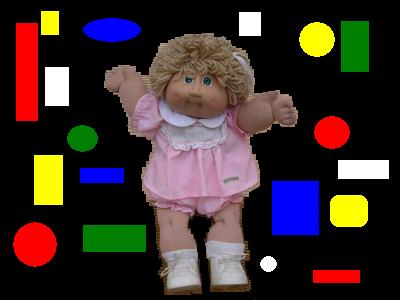
Who could forget the Cabbage Patch Kids? They were dolls which came with their own "adoption papers" and were the subject of a ferocious craze in 1983 and 1984.

The dolls from which the Cabbage Patch Kids evolved were all cloth and called "Little People" - the creation of one Xavier Roberts in the USA in 1978, and originally sold at local craft fairs. In 1982 came mass production, vinyl heads and the "Cabbage Patch Kids" name.

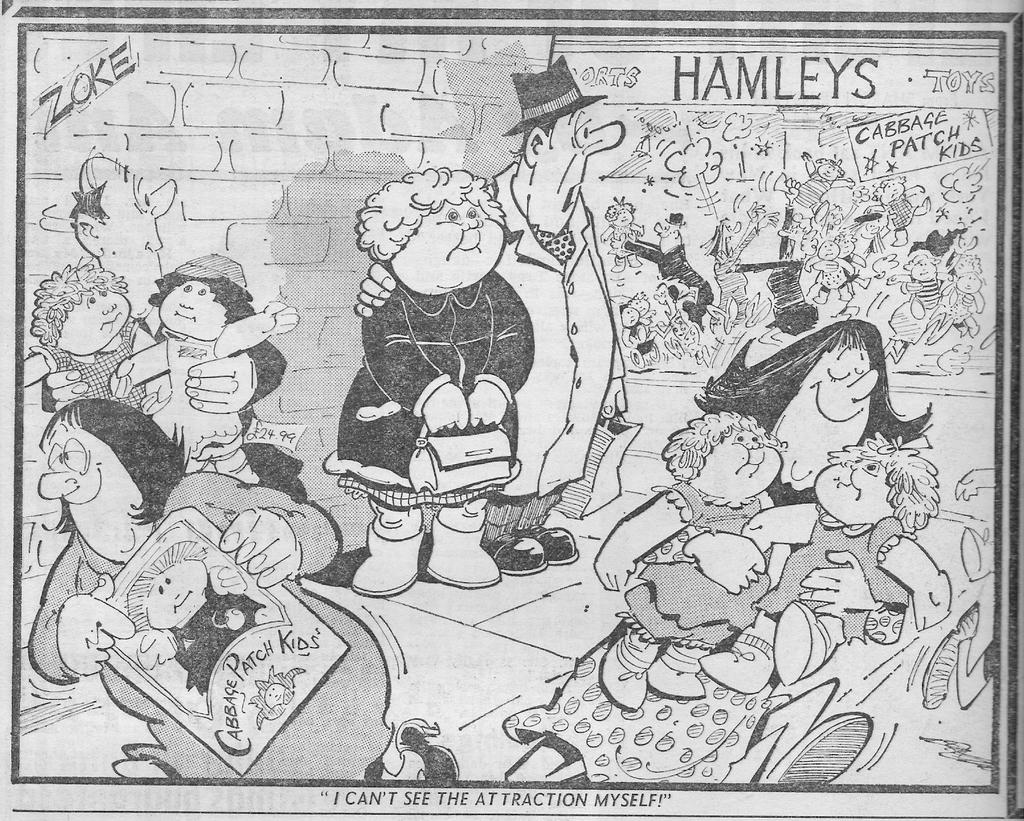
From the Sunday People, 4/12/1983:

Cabbage-Patch fever swept into London yesterday as jostling shoppers cleared out the entire stock of London's top toy shop.

It took only 90 minutes for a clamouring queue to snap up 400 of the cute Cabbage-Patch dolls which have caused near riots in America.

And five Americans paid a lot more than the £24.99 asking price - they flew in by Concorde at £2,000 each to buy a doll.

"They are like gold dust in the States," said New York accountant Garry Le Duc. "When we saw on TV that British shops still had supplies, there was only one thing to do."

They found plenty of competition for the cuddly Cabbage-Patch kids. The queue outside Hamleys started at 2am and by opening time it stretched right around the block.

Also from the Sunday People...

The Sunday People strikes again!

Evidence of rather less cynical times? I think so. Evidence of good taste? I would say not.


My local rag took a rather more down-to-earth line.

From the spring/summer 1986 Argos catalogue: The Cabbage Patch dolls have developed friends and relatives - Cabbage Patch Koosas and Cabbage Patch Preemies.

31 May 2005

1983: The World's First Mobile Phone; Compact Discs; Garfield; Hip Hop; Flashdance; Blockbusters; Blue Monday; No. 73; Wallies; Sloane Rangers

Top of the nation's list of concerns this year was unemployment. In 1980, it had been inflation. Inflation, which had been such a tremendous worry during the 1970s, was down but the unemployment figures were going up. And up. And up...

We'd been horrified when unemployment passed the million mark, for the first time since the 1930s, in the early 1970s, but we hadn't seen anything yet... we now had three million unemployed. Yes, three million. And the 1979 Tory election slogan had been Labour Isn't Working! But never mind. Thatcher and co told us this nasty medicine was necessary. Once we had a stable, competitive economy everything would be rosy. Trust them, that was all they asked. Hmm...

The Hip Hop scene was evolving fast, born of the American rap scene. In 1983, the scene swept across England. Youngsters could be seen in city centres across the land, breakdancing and body popping. The boombox (aka the ghetto blaster) had arrived and was an essential piece of kit.

The boombox had developed from the radio cassette recorder, and the term boombox was probably first coined at the beginning of the 80s
. This was when the things began to grow rapidly in size. I recall them being called "ghetto blasters" here, and don't think I ever heard the name "boombox" back then.

In England in 1983, it was trendy to cover your boombox/ghetto blaster in stickers and no blank wall was safe from a spot of Hip Hop graffiti.

Our neighbours' eleven-year-old son painted "Hip Hop" on the side wall of his family home. I was impressed - it was a fine piece of work, like something out of a breakdance film, but his reward from his parents was a scrubbing brush, a bucket of soapy water and the loss of two weeks' pocket money. As I said to the lad, "Some people just don't appreciate art!"

I will always remember this as the year of Blue Monday by New Order. I hated it at first. Just a disorganised mass of synthy bits and guitar chords, thought I. Within a week, I not only had the record but was playing it around twelve times a day. Magic.

Sky TV didn't arrive until 1989, so I couldn't see MTV. Could anybody in England at this point? But the effects of the music video revolution were being felt - never more so than with Michael Jackson's Thriller.

Another trend that was reaching our level was continental quilts. You could buy them from mail order catalogues and pay for them in small regular amounts. But did you want them? This was debated long and hard. A conversation between two woman, which I heard in a local shop in early 1983, went something like this...

Carol: "I wouldn't want my feet sticking out. You can't tuck 'em in. It'd probably fall off in the night and you know my bedroom window doesn't fit properly - I'd freeze. And they can't be that warm either. Fancy just having one cover!"

Wendy: "The trouble with you, Carol, you don't think things through. I've ordered one from Audrey's catalogue. You can get different thicknesses, summer, winter, all that, and you can always put a candlewick over the top and tuck it in to hold it in place."

Carol was most impressed.

Flashdance, the film sensation of 1983, was a bit like Fame, but with better dancing. The film started a trend amongst the girlies for wearing off the shoulder tops.

Welsh songstress Bonnie Tyler scored a tremendous hit with Total Eclipse of the Heart.

What was the Total Eclipse video about? There was Bonnie, a singer I'd been fond of for a few years, rushing around a country house with big hair and boys in loin cloths.

What was all that about?


My mate Pete had the answer: "A headmaster's daughter who's gone off her rocker."


"Oh, right. How do you know that?"

"I read it in the paper."

"Fair enough..."

The hand-held mobile was still in the future for us here in England, but BT gave us its first cordless phone.


The first commercially available hand-held cellular phone ever was unveiled in 1983. Motorola had invested fifteen years of research and $100 million in the advancement of cellular technology, and the story stretched back much further than that. The first hand-held mobile was called the DynaTAC 8000X and was unveiled on March 6th. It was, of course, a brick. At a price of $3,995 it wasn't for everybody. More here.

It may have been late 1982 or during 1983 but Compact discs were first marketed here around this time. As with many new things, the price was prohibitive and it would be some years before they were widespread. Read all about them here.

Computers began talking the same BASIC language and the internet was on the way.

"B" was for brilliant Bob Holness as
Blockbusters began. The original American version had begun in October 1980, but our version was best - who else could host it like Bob?!

Children's TV show Number 73, which had begun in the TVS area in 1982, was networked.

A certain Mr JR Hartley went searching for a copy of his book, Fly Fishing, and found it with a little help from Yellow Pages. More here.

Breakfast TV arrived: on the BBC we had Selina Scott, Frank Bough (in some lovely jumpers) and Francis the weatherman. The style was sofa-based and relaxed.

TV-am, ITV's breakfast time service, was also sofa based but a little more formal as Angela Rippon, Anna Ford, David Frost, Robert Kee and Michael Parkinson set out with their "mission to explain". The mission never really got off the ground, and it wasn't long before "The Famous Five" had been replaced by Anne "don't call me Annie!" Diamond, former sports presenter Nick Owen, weather girl Wincey Willis and Roland Rat - "Yeeaaarrrgggh!".

Australian soap Sons and Daughters came to English afternoon telly. Lucky viewers in some ITV regions got their first look at the feuding Hamilton and Palmer families in 1983, and quickly took "Pat the Rat", played by Rowena Wallace, to their hearts. The actors were greatly admired for their ability to freeze and turn sepia at the end of each episode. Production on the show in Australia took place from 1981 to 1987.

Garfield, the American fat cat, was becoming popular over here, with a range of merchandise available at Clinton Cards.

Care Bears were the year's cute and cuddlies, but the end of the year held something quite different: newspapers from 1983 record that just before Christmas some Cabbage Patch Dolls had made their way from America to England. In great demand, they came with their own adoption certificates and, by the look of them, a nasty attack of mumps.

"Choose Life" slogan T-shirts and luminous fingerless gloves were all the rage. Thanks, Wham! But who came up with the idea for wearing odd coloured luminous socks? Don't know, don't want to know!

Some brave everyday blokes were beginning to wear pink and putting blond highlights in their hair.

Thatcher won a second term in office (Boo! Hiss!).

"Wally" was a popular mild insult and How To Be A Wally was published.

My Little Pony

The My Little Pony Dream Castle, 1984...

Before My Little Pony there was My Pretty Pony, a larger toy - each one standing about ten inches high. These were on sale in the USA from 1981 onwards, until at least 1983. My Little Pony, by Hasbro, arrived in American toy shops in 1983 and then trotted over to England.

The Dream Castle packaging.

The ponies had names like Bowtie, Confetti and Peachy (sorry, I don't know the names of the two pictured above!). I seem to recall that at least one of them wore leg warmers.

Looking down on the castle...
-
The ponies appeared in their own TV series and in a film and were wildly popular, becoming one of the best selling girls' toys ever.