Total Pageviews

Pages

Showing posts with label 1989 news. Show all posts

11 May 2026

1989: The True End Of The Cold War


Faye asks:

Did the Cold War end in 1989 or 1991?


There seem to be differing views on this and I'd value yours!

I'll give you the view of Mikhail Gorbachev, who became Soviet President in March 1985, interviewed by Katrina vanden Heuval and Stephen F Cohen of The Nation Magazine in November 2008, Faye!

Mikhail Gorbachev: 

... If President Ronald Reagan and I had not succeeded in signing disarmament agreements and normalizing our relations in 1985-88, the later developments would have been unimaginable. But what happened between Reagan and me would also have been unimaginable if earlier we had not begun perestroika in the Soviet Union. Without perestroika, the cold war simply would not have ended. But the world could not continue developing as it had, with the stark menace of nuclear war ever present. 

Sometimes people ask me why I began perestroika. Were the causes basically domestic or foreign? The domestic reasons were undoubtedly the main ones, but the danger of nuclear war was so serious that it was a no less significant factor. Something had to be done before we destroyed each other. Therefore the big changes that occurred with me and Reagan had tremendous importance. But also that George H.W. Bush, who succeeded Reagan, decided to continue the process. And in December 1989, at our meeting in Malta, Bush and I declared that we were no longer enemies or adversaries.

KVH/SFC:

So the cold war ended in December 1989?

MG:

I think so.

KVH/SFC:

Many people disagree, including some American historians.

MG:

Let historians think what they want. But without what I have described, nothing would have resulted.

When you consider that after Reagan and Gorbachev first met in 1985, Reagan declared: "Gorbachev is a diehard Bolshevik!" and Gorbachev stated that Reagan was "A real dinosaur!" it seems amazing just how their relationship thawed. The dramatic events of 1989 certainly left us agreeing with Mikhail Gorbachev and President Bush that the Cold War had ended. Things no longer felt "Cold" - hadn't felt that "Cold" for a few years in fact - and there seemed no prospect of a "War".

Why this tendency persists to state that the Cold War ended in 1991 with the formal dissolution of the Soviet Union, I don't know. Nothing 'signed' in 1989? The Cold War was never signed into being in the first place. I suspect though that many of the "great and good", including many highly respected historians, have a hard time allowing the limelight to fall on the 1980s, a decade many of them like to scapegoat and revile.

So they gabble things like: "and in 1989 the Berlin Wall fell. In 1991 a whole new era began as the Cold War ended and the world looked on stunned as the dissolution of the Soviet Union took place before their very eyes..."

So, America being the only superpower was the only way the Cold War could end? Even though it had been declared over by the Leaders in 1989?

1989 - the year the Cold War ended? I'm sure that sticks in more than a few priggish gullets! It is not up to historians to revise and dictate history. I'd much rather listen to Gorbachev.

10 July 2019

Enquiries... Suzy Lamplugh, Anglia Weatherman, World Wide Web...

I'm not getting to write on here as much I want, but I've had a few enquiries relating to the 1980s, so I'll do my best to answer. The first enquiry is regarding the London estate agent Suzy Lamplugh, who disappeared in July 1986, having apparently gone to meet a client called 'Mr Kipper':

David wrote:

Hi there! Great fan of your blog. I read your piece on Suzy Lamplugh and your own memories of the summer of 1986 with fascination as I was actually born in the July of that year! Regarding Suzy, it says on Wikipedia that her name was Susanna Lamplugh, minus the 'H' which you included. What was her name? And what do you think of the latest developments, the guy who thinks she didn't go to Shorrolds Road and the dig at Pershore?

Hello, David!

Thanks for writing. Susannah was named after the actress Susannah York and actively informed her colleagues on the QE2 that it was 'Susannah with an H' - so much so that her nickname amongst some of them was 'H'. Apparently, the 'h' does not appear on her birth certificate, but Suzy much preferred it! I really hope the latest developments lead to closure for her family and friends. I'm uncertain about the Shorrolds Road theory. Certainly, a witness from 1986 claims that Suzy's company car was parked in Stevenage Road about five minutes after she'd left the Sturgis branch so it would certainly make sense that she hadn't been to Shorrolds Road. I really don't know. The fact that it's now claimed that she didn't take the Sturgis key to the Shorrolds Road property adds to the hope that perhaps things might finally become clear.

Link to the Suzy Lamplugh blog post - click HERE.

Greg says:

I really enjoyed your pieces on BC of Anglia Television (1980-2002 RIP). Do you remember the name of the main Anglia weatherman in the 1980s? He was quite a tall, thickset bloke as I recall, had a quiet sense of humour.

I think it would be David Brooks, Greg (see pic). He was at Anglia from 1972-1993. He was a nice presence at the station. I was watching his reaction to the failure of a weather screen to appear after he'd said 'let's look at tomorrow's weather,' or some such back in the day. When the manual board showing today's weather was slipped out (manually, of course!), the board beneath was completely blank. 'Good 'ere, innit?' quipped David, as the studio dissolved into laughter.

David was a huge golf fan and one of his greatest claims to fame was being struck by lightning on the Gog Magog course near Cambridge in 1979. As he said afterwards, next time he'd check the Anglia weather forecast before venturing out! He died of leukaemia in 2010.

Fran has written:

Saw all the excitement about the thirtieth anniversary of the invention of the World Wide Web back in March. 1989-2019! It's changed everything. On balance, would you say good or bad?

Definitely both, Fran! It's brought the world closer together but also exposed differences and maybe exacerbated a few! Personally, I'm allergic to SJWs online!

02 June 2019

1989: Margaret Thatcher: 'We Have Become A Grandmother!'


It was sometimes said in the 1980s that Mrs Thatcher and the Queen did not see eye-to-eye and that Mrs T had her eye on the throne.

Outrageous! Ridiculous! Wasn't it?

Nobody knows what caused the Prime Minister to use the royal 'We' while announcing the birth of her first grandchild, but it caused a lot more talk.

There she was. Three general election wins. The Iron Lady. Had it all gone to her head?

And it turned out her first grandson was a Texan. Born In Dallas. Just like JR Ewing.

Strange days indeed...

From the Cambridge Evening News, 4/3/1989:

Thatcher Baby A Texan

Baby Michael Thatcher, the Prime Minister's first grandchild, will be an American citizen because he was born in Texas.

But he will be entitled to British citizenship by descent the Home Office confirmed.

Mrs Thatcher's son, Mark, and his American wife, Diane, became parents in Dallas on Tuesday.

Of course, despite her use of the royal 'We', Mrs Thatcher did not become Queen.

But I was feeling quite tired and jaded as this colourful, contrasting and often completely OTT decade roared towards its close and wouldn't have been a bit surprised if she had!

26 May 2016

Enquiry: No, Robert Cailliau Did Not Co-Invent The World Wide Web


The original invention document for the World Wide Web, March 1989, Tim Berners-Lee. He had already produced what turned out to be a precursor project called ENQUIRE whilst working at CERN for six months from June to December 1980.

Had an interesting enquiry from Sam:

I'm studying the history of the World Wide Web and most sources state that Tim Berners-Lee invented it alone, but some say he co-invented it with Robert Cailliau, a Belgian scientist. There is currently controversy about this on Wikipedia. do you know which is true?

Yes, Sam - I can safely say I do. Sir Tim Berners-Lee invented the World Wide Web in March 1989, when he submitted a proposal to his boss at CERN. Robert Cailliau became a highly valuble collaborator later. But the ideas and the invention and the writing of the first Web browser were all Tim's own work.

Robert Cailliau has never stated that he co-invented the Web. This inaccurate information has simply been parroted by certain Web users. In using the Web, one must be "information smart", and I don't recommend using Wikipedia for a start. It's an illogical nightmare of an idea, where uninformed, wishy-washy admins and silly, ignorant kids and adults can wreak havoc. Some people are so eager to thrust their own strange and inaccurate views on others they throw their rattles out of their prams and are amazingly persistent if challenged. Anybody trusting that source  for a homework study deserves all they get! This is Tim Berners-Lee's own comment on Robert Cailliau's initial contribution to the project:

"Some commentators suggest that Robert co-invented the WWW. To set this straight, he did not invent it. It wasn't his idea. He did not write the specifications for UDIs (later to be URLs, then URIs), or for HTML, the hypertext language, nor HTTP, the protocol, or the code of the original implementation. More than a year after my original proposal (March 1989), while I was working on the code, he wrote a proposal to CERN proposing some staff be allocated to the project. This was a brave thing to do, as CERN was always chronically short of manpower for the huge challenges it had taken on. So Robert put himself out there to claim that effort on WWW was worth it."

https://www.w3.org/People/Berners-Lee/FAQ.html (scroll down to section "Robert Cailliau's Role" for further information)

And you can read our own piece on the wonderful Web here.

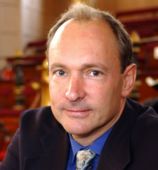
Sir Tim Berners-Lee celebrating twenty years since the invention of the Web in March 2009. The event took place at CERN.

05 March 2015

1989: The Fall Of The Berlin Wall

Thinking about 1989 the other night, two events sprang into my mind, followed by a whole battalion of others. I haven't much time, so I'll just toddle through the first two here...

The first of the 1989 events that came to mind when I focused the little grey cells on that memorable twelve months, was the invention of the World Wide Web by English software engineer Tim Berners-Lee at CERN in Switzerland.

This event passed unnoticed by the vast majority of us at the time - we would not discover its wonderful, world-altering significance until the 1990s. Read all about it here.


The second event to trot into my noddle was the Fall of the Berlin Wall...


An absolutely stunning historical moment...


Here's how the
Daily Mirror reported events on Saturday, November 11, 1989:


TOGETHER AT LAST

on the day the world became a better, braver place...

Holes were bulldozed in the Berlin Wall and East Germany promised free elections yesterday as thousands of her citizens continued to pour out to the West.

Minutes after the election announcement, East German bulldozers began smashing two more holes as exit points in the wall. And eight more border crossings will be made next week.


For the Communists it is a calculated gamble in an attempt to stem an exodus. For the East German people, already almost delirious with the pace of change, it is another giant step to freedom.


The East German Communist Party unveiled an amazing package of reforms, including free elections, changes in the economy and parliamentary control over the army.


This revolutionary programme means party bosses have now given thousands of demonstrators everything they demanded during peaceful candlelit protests.


They knew that East Germany's 16 million people would never have halted the protests unless free elections were granted.

Yesterday the East Germans were walking and driving through the Wall at the rate of 800 an hour, sounding their car horns and weeping with emotion.


For some, however, the dizzying pace was almost too much. The East German guards did not know quite how to react to the West German who stretched out the hand of friendship near the Checkpoint Charlie crossing.


But for the families who were crossing into West Berlin all day there were no doubts. They came, they saw... and they fell in love with the capitalist world they had for so long been taught to distrust.


With the toys in the shops - the Batman cars, the walking, talking, living dolls, the video games, the mountain bikes.


With the clothes. The baby wear. The range of cars.


But, most of all, with the overflowing shelves in the supermarkets.
For many who are younger than the 28-year-old wall, it was their first day of freedom. Their lives have been dominated by secrecy and shortages.

Their first taste of Western plenty was a free handout.


Police and savings banks told excited East Germans who wanted to go shopping the way to social security offices.


There they were given 100 West German marks - worth about £35 - in "welcome money."


Gunter Martin, a factory worker from Halle, waved a wad of East German marks and said: "This is completely useless to me here.


"It's the most unbelievable day of my life. I just shut up my car repair shop and jumped in my car as fast as I could."


Reinhold Haupt, a 41-year-old electrician who drove from Ashersleben to spend the weekend in West, was showered with hospitality by a crowd of West Germans giving the new arrivals a heroes' welcome.

 
Within minutes someone offered him a bed, another said he would take him on a tour, a third handed him a cup of coffee and a woman pressed a 10-mark note into his hand.

He spent his "welcome money" on bananas, oranges, coffee and chocolate, all in short supply in East Germany.


Civil servant Thomas Kolbar said: "I turned up at my aunt's house last night and she nearly died of shock."


The Communists' gamble may pay off. Most East Germans are only visiting the West, happily returning home after partying or sight-seeing in the West.


No one could count the numbers going to the West in Berlin. But elsewhere, 45,000 East Germans swarmed to the West yesterday and only 2,500 stayed.


More from 1989 soon.

15 April 2012

The Poll Tax

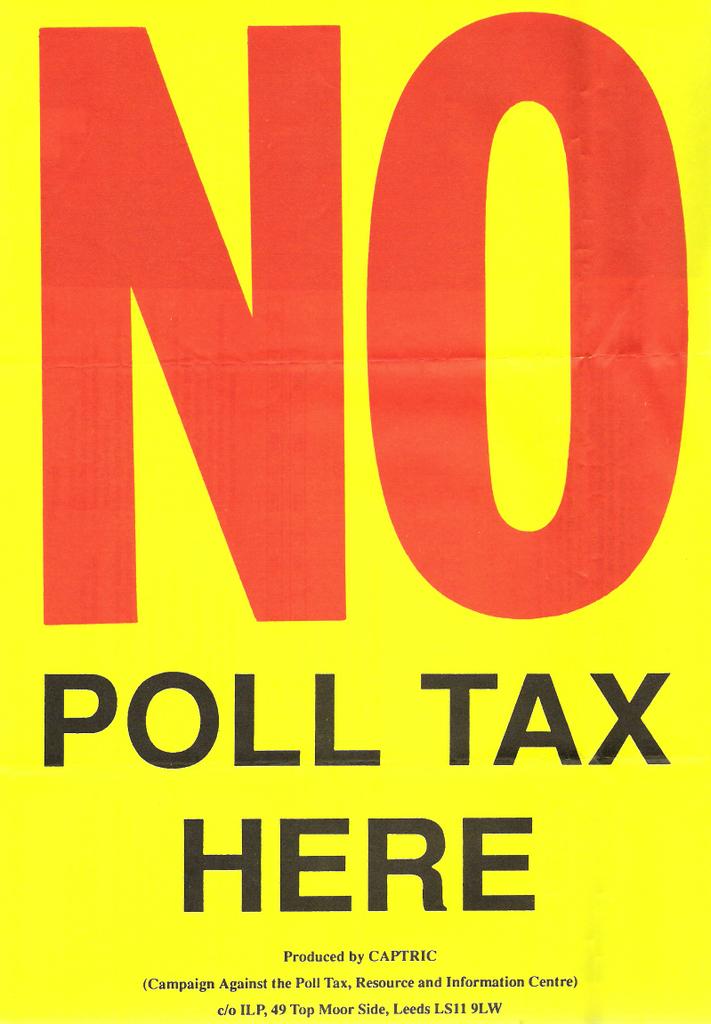
An anti-Poll Tax poster from early 1989. The introduction of the Community Charge or Poll Tax in England was set for the 1st of April 1990, and in 1989 we were not taking the news lying down...

The 'father of the poll tax' was a Scotsman called Douglas Mason. It was his brainchild. Even as the unrest raged over the new tax, he stuck by his claim that the Poll Tax was fairer than the old rates system. The Secretary of State for Scotland, George Younger, was a fervent admirer of the tax and fought for it to be introduced in 1989 in Scotland. Why should his country wait for England and Wales, he 'reasoned'?

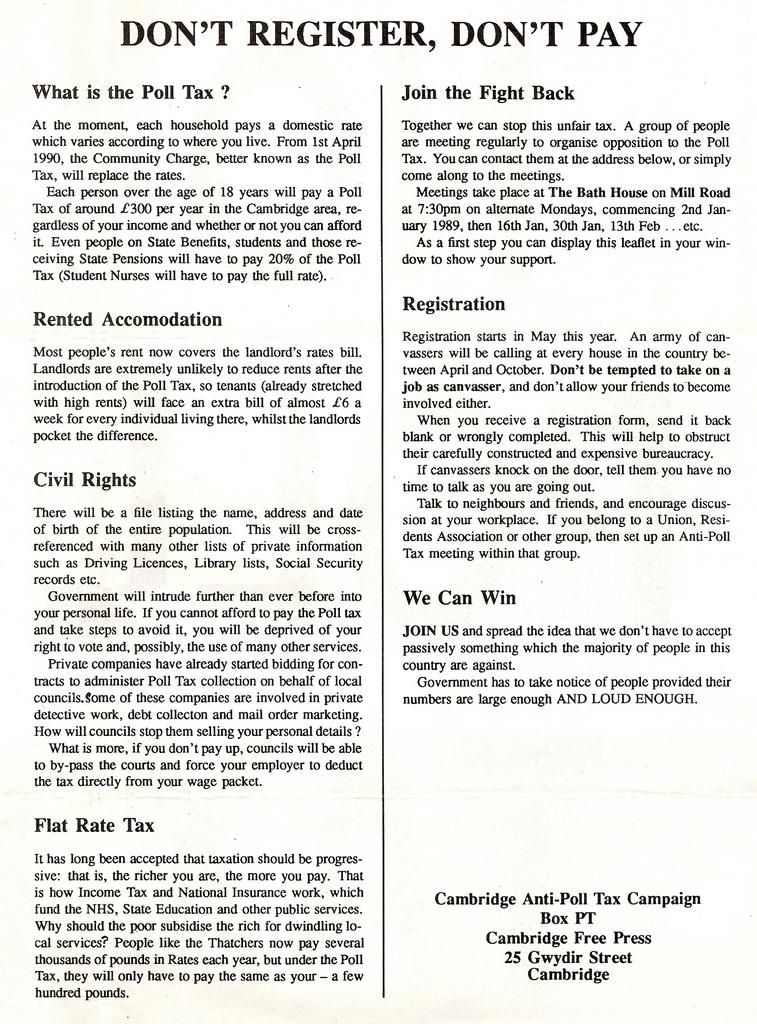
From Don't Register, Don't Pay, an information sheet circulated around Cambridge, England, December 1988. For full details, click on image above.

What is the Poll Tax?

At the moment, each household pays a domestic rate which varies according to where you live. From 1st April 1990, the Community Charge, better known as the Poll Tax, will replace the rates.

Each person over the age of 18 years will pay a Poll Tax of around £300 per year in the Cambridge area, regardless of your income and whether or not you can afford it. Even people on State Benefits, students and those receiving State Pensions will have to pay 20% of the Poll Tax (Student Nurses will have to pay the full rate).

Join the Fight Back

Together we can stop this unfair tax. A group of people are meeting regularly to organise opposition to the Poll Tax. You can contact them at the address below, or simply come along to the meetings.

Meetings take place at The Bath House on Mill Road at 7.30pm on alternate Mondays, commencing 2nd January 1989, then 16th Jan, 30th Jan, 13th Feb... etc.

Similar meetings were taking place up-and-down the country.

Back to the information sheet...

Registration

Registration starts in May this year. An army of canvassers will be calling at every house in the country between April and October. Don't be tempted to take on a job as canvasser, and don't allow your friends to become involved either.

LET'S PUT A SPANNER IN THE WORKS leaflet (Campaign Against The Poll Tax Resource & Information Centre, Leeds), early 1989.

WE ARE UNDER ATTACK

Poll Tax attacks the less well-off, community services, local democracy, and our civil liberties.

We must convince the Government that it cannot go ahead with the Poll Tax.

JOIN THE RESISTANCE

If Britain were invaded, a network of local Resistance groups would be formed to make life difficult for the enemy.

We need to defend ourselves against the Poll Tax enemy. Join your local group.

A few resistance tips from the leaflet...

ASK WHY YOU ARE THE "RESPONSIBLE PERSON"

Before you can get a Poll Tax bill, there has to be a Poll Tax Register.

Before there can be a Register, the Registration Officer has to get a "responsible person" for each household.

The Officer will send a form to someone in your household he thinks is the "responsible person". He may even have filled in the names of people he thinks live there. He wants you to check and sign it.

DON'T SIGN IT. SEND IT BACK with some questions:

Why was I chosen?

What will be my duties?

How can I appeal against being chosen?

You are perfectly entitled to ask these questions.

DEALING WITH CANVASSERS

In some areas, canvassers will call. They will want you to give information on residents in the household. They will get a bonus of 40p for every form they get filled in.

Only the "responsible person" can be required to give information. Ask the canvasser to return when the "responsible person" is home.

Of course, there is no law to say that you must answer your door if someone knocks.

Some areas have plans to alert all residents if Poll Tax canvassers appear. A bell or a drum or a loud-hailer stands ready...

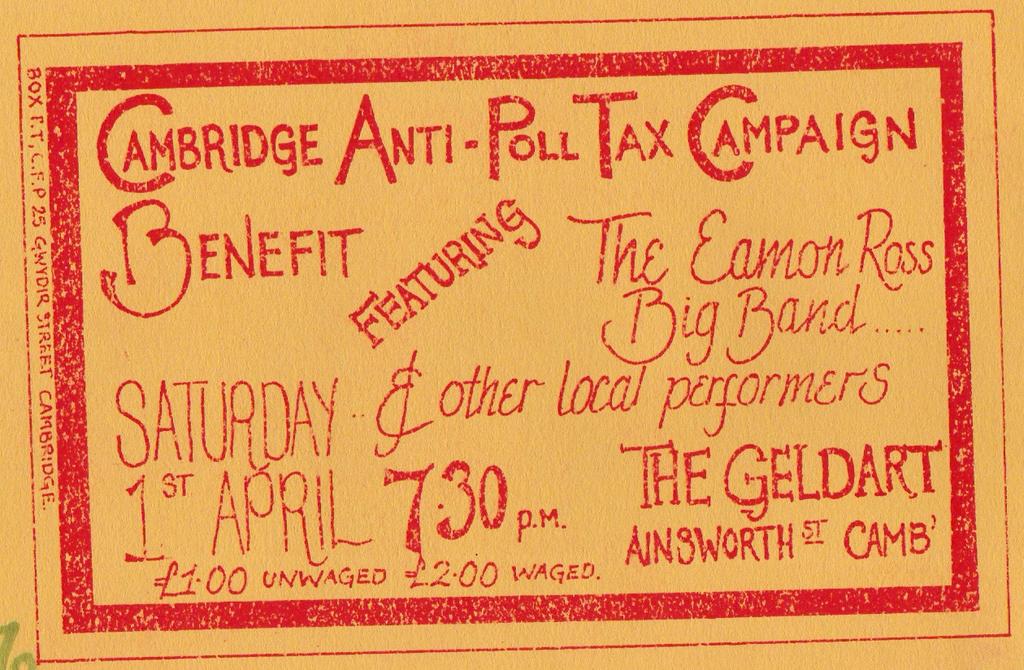
I attended this Anti-Poll Tax Campaign Benefit on the 1st of April 1989 - a year before the planned introduction of the Tax.

The Poll Tax issue was a bone of contention which would take us into the new decade.

14 April 2012

Via The Log Lady: A Twin Peaks Series Script From 1989

Welcome To Twin Peaks! Scene from the opening credits - filmed in 1989 and included in the 1989 self contained ending video release version.

Margaret Lanterman - aka the Log Lady - played by Catherine E Coulson, communes with her log.

Little town of secrets - rich widow Josie Packard (Joan Chen) was having an affair with Sheriff Harry S Truman (Michael Ontkean). But was she really a widow? Special Agent Dale Cooper (Kyle MacLachlan) was dispatched to the town in February 1989 to investigate the murder of Home Coming Queen Laura Palmer. Catherine Martell (Piper Laurie) schemed and plotted.

I was jealous to the max when a pal of mine recently chortled: "I've got an original Twin Peaks script, used by Catherine E Coulson, the Log Lady herself!"

I was slightly mollified when he told me I could scan or photograph the script, and I even contemplated the idea of starting a '90s blog to write about it. Then I discovered that - oh joy - the script dated from 1989! As this is '80s ACTUAL and we like to feature actual 1980s artifacts, it belongs here!

In our main Twin Peaks article, we covered the series's origins in the late 1980s, the pilot film, which was produced in early 1989 (most of which was used for the series pilot and dream sequences in the show), the fact that Angelo Badalamenti wrote the music in '89 and that production started on the first series, but I must say I'm surprised how far that work went. My pal's script is for episode five of series one, and dates from November 1989!

I was even more surprised to discover that the script for episode six, by Harley Peyton, was also written in November 1989.

Anyway, my pal's script was written by Mark Frost (Hill Street Blues), who co-created Twin Peaks with David Lynch.

A quick hunt around the Web reveals that a revised first draft script for the 1989 pilot film (originally to be called Northwest Passage) dates back to December 1988, and the script for episode one of the series dates back to July (first draft) and August 1989.

I hope you enjoy the photographs below! All I can burble is "WOW, BOB, WOW!" and "Damn fine coffee!"

Agent Cooper discovers little Audrey Horne in his bed at the Great Northern Hotel...

Highly confidential!

Drafts of the episode five script - and a note from Catherine E Coulson!

Agent Cooper regrets leaving his Ear-Pillow Silicon Ear Plugs behind!

22 March 2012

The Simpsons

Look kind of familiar? The Simpsons as they appeared in 1987. The characters soon morphed into the more familiar images we still see today.

Over in America in early 1987, Matt Groening created The Simpsons.

The USA's favourite dysfunctional family first appeared in Mr Groening's mind whilst he was sitting in the lobby of James L. Brooks's office, producer of The Tracey Ullman Show for the Fox Network.

Tracey was already a celebrity here in England. Think of Three Of A Kind. Think of those wacky pop hits.

I can't break away, though you make me cry...

But they don't know about us - and they've never heard of love...

And so on.

Back to the USA and 1987.

Mr Groening had originally intended to pitch for a series of cartoon shorts for Tracey's series based on his Life in Hell series. However, he quickly realised that animating Life in Hell for television would require the rescinding of publication rights for his life's work. And so his fertile mind, working on absolute overdrive in Mr Brooks' lobby, came up with Bart, Homer, Marge, Lisa and Maggie.

The Simpsons debuted as a series of cartoon shorts on The Tracey Ullman Show on April 19, 1987.


According to legend, the show's producer was concerned about the ugly appearance of these new creations, and our very own Tracey reportedly reassured him: "Relax! It's an '80s show!"

And so popular were The Simpsons cartoon shorts that, in 1989, work began on a half hour series of Simpsons shows, with the first, a "holiday special", being broadcast on December 17, 1989.

And the rest is history!

An American TV guide from December 1989...

To some viewers one of the best parts of Fox's "The Tracey Ullman Show" was the commercial breaks.

That's no knock on the talented Ullman. It's just that each set of commercials was preceeded by the antics of the Simpsons, the animated family created by cartoonist Matt Groening whose playlets were hilarious dispatches from the front lines of the ongoing war between parents and their children.

We haven't seen much of the Simpsons lately. The quiet is due not to a truce, but to the preparation of a new offensive. The Simpsons will soon debut in their own Fox series, probably next month. And on Sunday, December 17, Fox will air "Simpsons Roasting On An Open Fire", a holiday special starring dad Homer, mom Marge, brother Bart, sister Lisa and baby Maggie...

The Simpsons are a family as families really are. Homer is in a continual state of low level exasperation, with the threat of an eruption always lurking. Marge is the jumpy peacemaker, bearing a quivering white flag back and forth between the battle lines of Homer and the children. And the kids are like the first mammals in the age of the dinosaurs, peeping from the underbrush at a world of behemoths, pausing in their torture of each other only to unite against the threat of its interruption by lumbering adults whose seeming soul purpose in life is to ruin any hope of having fun.

"The most common thing people tell me," says Simpsons creator Matt Groening in a soft, friendly voice, "is that I've been spying on them."

17/12/1989 - an historic telly event for America. The first full-length episode of The Simpsons, a seasonal tale entitled Simpsons Roasting On An Open Fire, was broadcast.

02 December 2011

1989 - Tim Berners-Lee - The Invention Of The World Wide Web...

It's hard to imagine the world without WWW. but in the 1980s that's just how it was. The basis for the Internet had been invented in the 1960s and was up and running by the end of that decade - this was ARPANET, developed by the USA's Department of Defence.

During the 1980s, the home computing era got underway, but it was the invention of the World Wide Web in 1989 which would transform attitudes to computers in the 1990s and create a whole new way of life. Have you checked your e-mails? Updated your web site/blog? Checked Wikipedia's latest suspect information? No? Well, better get to it. It's as easy as shelling peas.

This is thanks to an English software engineer, Tim Berners-Lee. The origins of the idea for the Web can be traced back to June - December 1980, when Mr Berners-Lee wrote ENQUIRE, his first computer program for storing information. At this time he was working a six month stint as a consultant software engineer at CERN, the European Particle Physics Laboratory in Geneva, Switzerland.

He left CERN for a spell, returning in 1984, and in March 1989 invented the World Wide Web.

From Tim Berners-Lee's own site biography:


Sir Tim Berners-Lee invented the World Wide Web in 1989.

He is the Director of the World Wide Web Consortium (W3C), a Web standards organization founded in 1994 which develops interoperable technologies (specifications, guidelines, software, and tools) to lead the Web to its full potential. He is a Director of the World Wide Web Foundation which was launched in 2009 to coordinate efforts to further the potential of the Web to benefit humanity. 

A graduate of Oxford University, Sir Tim invented the Web while at CERN, the European Particle Physics Laboratory, in 1989. He wrote the first web client and server in 1990. His specifications of URIs, HTTP and HTML were refined as Web technology spread.

Click on the red text to go to Sir Tim's site.
 
Up and running in the early 1990s, the Web made the Internet easy for all and things would never be the same again. 


And even confirmed technophobes like me, who had looked at the emerging home computer era with trepidation back in the 1980s, are now happily surfing the Web.
Thank you, Sir Tim!

March 1989 - the historic document!

Tim Berners-Lee at the www@20 celebration at CERN, 13 March, 2009.

30 July 2011

1989: The Motorola MicroTAC - A Far More Mobile Mobile... And A Bit About GSM...

Advances in technology brought about the revolutionary Motorola MicroTAC phone of 1989 - the first step towards smaller mobile phones.

It was also massively influential, being the world's very first flip phone. The aerial, by the way, was simply ornament!

It really was incredible as, at that time, mobiles were like grandiose walkie-talkies. And you had to be a yuppie (or Del Boy Trotter) to afford one.

The decade which introduced the very first hand-held mobile, the DynaTAC 8000x in 1983, very much a brick, roared towards its end with this little beauty.

Of course it was analogue, but
the current system was on its way, and had been since 1982 when Groupe Spécial Mobil (GSM) was formed to design a pan-European mobile technology.

Behind the scenes planning often long pre-dates technology hitting the streets, and in that light it's amusing to relect that there were no hand-held mobile phones in 1982, and that the Mobira Senator, Nokia's very first mobile phone - a car phone released in 1982, weighed around twenty one pounds!

From 1982-1984, agreement on strategic targets for GSM was reached.

From 1985-1987, agreement on principles for services, network architecture, radio and speech coding in GSM was reached.

In 1986, trials of different digital radio transmission schemes and different speech codecs were carried out in several countries and comparative evaluations carried out by GSM.

1987 was the birth year of the current system, with GSM agreeing its basic parameters. This was finalised in May 1987 in Bonn. Then, in September 1987, a proposal was put forward to create an operator agreement in the form of a ‘Memorandum of Understanding’. This was drawn up and signed in Copenhagen in September by fifteen members from thirteen countries that committed to deploying GSM.

The BBC reported in 2007:

The technology behind the mobile phone is celebrating its 20th anniversary.

On 7 September 1987, 15 phone firms signed an agreement to build mobile networks based on the Global System for Mobile (GSM) Communications.

According to the GSM Association there are more than 2.5 billion accounts that use this mobile phone technology.

Adoption of the technology shows no signs of slowing down with many developing nations becoming keen users of mobile handsets.

Robert Conway, head of the GSM Association, said the memorandum of understanding signed in 1987 is widely seen as the moment when the global mobile industry got under way.

Although work on the GSM technical specifications began earlier (1982), the agreement signed in 1987 committed those operators to building networks based upon it.


"There's no doubt that at the time of the agreement in 1987 no one had an idea of the explosive capabilities in terms of growth that would happen after the GSM standard was agreed," he said.

As Paul Simon said back in the '80s, "These are the days of miracle and wonder..."


24 January 2011

1989 - Sky - The Satellite TV Revolution

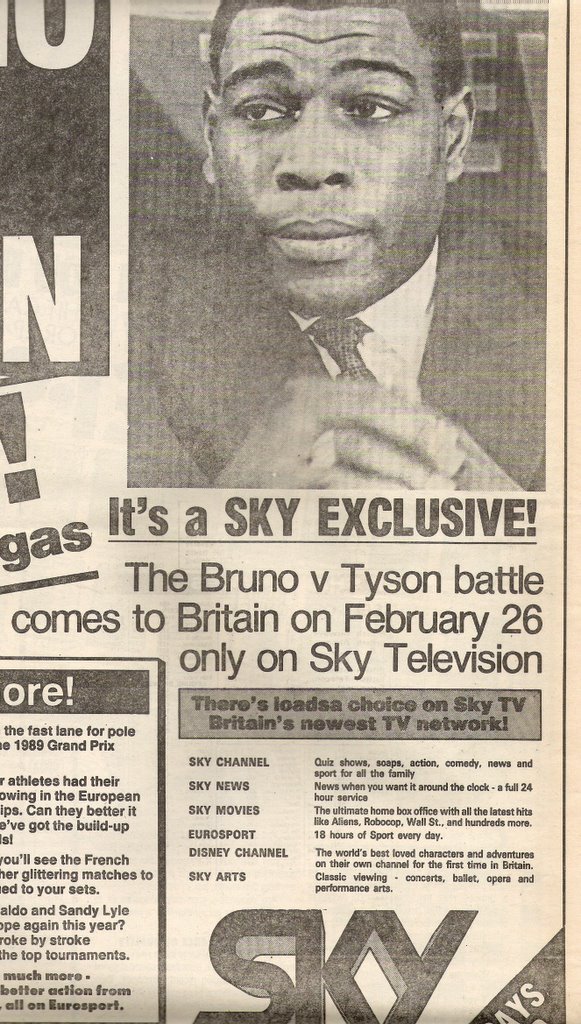
A newspaper advertisement - 10/1/1989. 26 DAYS TO GO, it promised and one of the first big attractions was to be the Bruno V Tyson fight, LIVE! from Las Vegas.

In the UK, we thought we were very lucky indeed to get Channel Four in 1982. Imagine - FOUR TV channels!

But, far more obscurely, this was also the year that another new UK-based TV channel was launched -
Europe's very first satellite and cable TV service. Wondrously beamed in from outer space and simply called "Satellite Television", it had begun a trial service in October 1981, and was launched on April 26, 1982 - beaming mainly UK programmes to Europe for two hours per night.

"Satellite Television" is not something that I, nor anybody else I know, remembers hearing about at the time. If me and my friends and family are anything to go by, Mr/Ms UK Average Person never even dreamt of having satellite TV back then.


But Channel Four, well that was something worth getting excited about - something for us!

As a related aside, whilst MTV had launched in America in 1981, quite frankly, I'd never heard of it in 1982. Nope, that old faithful 1960s innovation Top Of The Pops was still our weekly dose of TV pop heaven in 1982 here in the UK.

Rupert Murdoch's News International Group took control of the loss-making Satellite Television company in 1983 - according to modern internet sources for the grand sum of £1, plus outstanding debts - and renamed it Sky Channel in 1984.

It's Tuesday March 4, 1986 - the launch day of Eddie Shah's "Today" newspaper, the UK's first colour daily national newspaper, and the TV listings feature details of the cable and satellite broadcasts available. The Sky Channel features such delights as '80s Australian soap "A Country Practice" and the "Pat Sharp Show". As the vast majority of us didn't have satellite, we weren't bothered.

In 1986, BSB, British Satellite Broadcasting, won the Independent Broadcasting Authority's franchise and in 1988 Rupert Murdoch announced plans to relaunch Sky Channel as Sky Television.

And now the fun really began. In 1989, satellite TV was making waves in the UK as the brave new Sky era began.

Were we, the average punters, looking forward to Sky? Let's take a look at a local newspaper to get the vibe "down on the ground" in January 1989...

From the Cambridge Evening News, 6/1/1989

Satellite TV fans are making sure they are tuned into the right wavelength when the viewing revolution hits the screens next month, say city centre stores in Cambridge.

Scores of people have been popping into shops to find out more - and be first in their street to have a dish on their roof.

The first satellite station, Sky, owned by newspaper tycoon Mr Rupert Murdoch, will start broadcasting on February 5.

And most of Cambridge's stores expect to get their first stocks of dishes within the next few weeks to cash in on the revolution.

The manageress of Rumbelows in Petty Cury, Christine Nickson, said: "We have had a lot of inquiries and requests for brochures, but relatively few firm orders so far."

A spokesman for Dixon's in Lion Yard painted a similar picture. He said: "We are taking a few deposits at the moment, but we hope to install a working dish on the roof in two weeks and expect orders to really take off then."

The manageress of Radio Rentals in Lion Yard, Mrs Debbie Jamieson, also reported strong customer interest. She said: "A lot of people have been quite surprised at how small the dishes are."

The first of the new satellite stations comes onstream next month, when Rupert Murdoch launches his four-channel Sky TV. Sky programmes will be relayed from the European Astra satellite.

Three of Sky's channels will be specialist services, one each for news, films and sport. A fourth channel will offer a mixed bill of drama, quiz shows and comedy. Sky will be paid for by advertising and will be entirely free to the viewer.

Sky's main competitor is likely to be British Satellite Broadcasting (BSB), a consortium including Richard Branson's Virgin Group and Anglia TV, which will launch a rival service in the autumn.

Another group, headed by publisher Robert Maxwell, plans to launch six channels later in the year.

Experts predict four million British homes will be tuning into up to 50 satellite channels within five years.

Hmmm...

Apparently, there was "loadsa" choice on Sky TV, including Sky Channel - with quiz shows, soaps, action, comedy, news and sport for all the family; Sky Movies - the ultimate home box office; Eurosport, with 18 hours of sport every day and Sky Arts - concerts, ballet, opera and performance arts.

Hmmm again...

Sky TV listings from the "Sun", 1/5/1989. I'm not that impressed myself, but at least there was MTV... And it was early days...

06 March 2010

1988 and 1989: Eco-Friendliness - And Pop Scene News And Gossip...

Environmental concerns had grown stronger and stronger during the 1980s, even Mrs Thatcher was turning Green late in the decade - as this extract from a 1988 speech she gave to the Royal Society illustrates:

In the past when we have identified forms of pollution, we have shown our capacity to act effectively. The great London Smogs are now only a nightmare of the past. We have cut airborne lead by 50 per cent. We are spending £4 billion on cleansing the Mersey Basin alone; and the Thames now has the cleanest metropolitan estuary in the world. Even though this kind of action may cost a lot, I believe it to be money well and necessarily spent because the health of the economy and the health of our environment are totally dependent upon each other.

The Government espouses the concept of sustainable economic development.

Stable prosperity can be achieved throughout the world provided the environment is nutured and safeguarded.

Protecting this balance of nature is therefore one of the great challenges of the late Twentieth Century and one in which I am sure your advice will be repeatedly sought.

In 1989, the UK Green Party won 15% of the vote in elections for the European Parliament, but no seats because of the first-past-the-post voting system.

The Party was formerly known as "The Ecology Party" and switched to the Green name in the 1980s.

In the late 1980s, many of us were getting into buying eco-friendly products (I bought a sink cleaning fluid which left a nasty chalky deposit in its wake and I was never sure that my eco friendly bog cleaner got my bog hygenically clean, but I persevered).

In 1989, as reported by the Bizarre page in the Sun on August 29th, Sting (formerly of The Police) and Elton John had got together to stage a very expensive concert - for the planet:

Elton John and Sting are charging the highest amount ever to see them in concert... £1,000 a head.

The two superstars are to play a £500,000 charity concert to raise cash for the Rain Forest Foundation. It is being staged in the grounds of tycoon Ted Field's £4million mansion in Los Angeles. More than 500 guests will be invited to the event on November 6.

A spokesman for Sting said last night: "Ted Field is a good friend of Sting's and they share a deep concern about the destruction of the forests.

"Ted offered to stage the concert in his grounds if the guests would pay a grand to get in. Sting and Elton will also help out with extra fund-raising events, including a raffle."

Elton, 42, will play piano and Sting, 37, will be on the bass guitar - but there will be no backing band. Last night Elton - who is taking time out from his world tour for the concert - said:

"Sting has done an awful lot for the foundation and I'm happy to help him raise more. It will just be me and him on stage and will be a lot of fun.

"The environment is something I really care about."

Meanwhile, elsewhere on the Bizarre page, Pat Sharp, he of the beautiful bouffant mullet, was revealing some facts of his life:

Hobbies: After work I plan more work.

Car: A £26,000 second-hand Porsche 944 Turbo and a rare old Datsun 240Z sports coupe.

TV: There's no time to watch it.

Films: I keep 350 films in the same room as my 6,000 records. My favourite is Caddy Shack.

Star Sign: Scorpio.

Most Embarrassing Moment: When I got chased by gays outside Radio Luxembourg.

Clothes: I love Poco Loco, the Norwegian designer who make great jogging pants and T-shirts.

Pet Hates: I have never smoked, drunk or taken drugs - I don't even drink tea.

Ambition: I would love to make serious TV programmes.

Dave Stewart, one half of the excellent '80s pop duo The Eurythmics, was having some fun...

Zany Dave Leaves Scribblers In Chaos

By Piers Morgan

Dave Stewart caused chaos at a Press Conference by giving bizarre answers to questions.

The oddball Eurythmics star - back in the charts at No 30 with Revival - confused dozens of foreign journalists after the band's gig in the South of France.

But Dave, 36, had the British contingent - including me - in hysterics.

Here's what he said:

Q. Dave, is it right that you are broke?

A. Absolutely. The only reason I stay in Cannes is so I can go to all my rich friends' houses and nick all their furniture.

Q. Dave, as an environmentalist, what did you think of Chrissie Hynde's outburst saying she'd like to bomb McDonald's?

A. She should have said she she wanted to firebomb Spud-U-like. They've got a much sillier name.

Q. Dave, we hear you are going to do a cover version of an old hit soon?

A. Yes, I want to do Three Blind Mice and Custer's Last Stand.

Q. Dave, what you think of your wife Siobhan having bigger hits than you with Shakespear's Sister?

A. It's great. Her contract says she has to give me 50 per cent of every penny she makes MORE than I do this year.

That told 'em, Dave!

Actually, I was startled by Siobhan Fahey's transformation from Bananarama girlie to purring Shakespear's Sister with Marcella Detroit. Startled, but pretty darned pleased.

To round off our look at this 1989 Bizarre page, hands up all those who remember the Scots band Simple Minds?

Me too. Loved them.

Somewhere in summertime...

Won't you come see about me, I'll be alone dancing you know it baby...

Little darlin' close your eyes, there'll be no compromising...


Alive and kicking - stay until your love is...

I must confess to singing "butter on it, put butter on it, put butter oh, butter oh" to the "bah da da da, bah da da da da, bah da da oh" segment of Alive and Kicking. A lot of people did. Sorry, Jim Kerr and co.

However, despite this, I genuinely loved the band - and their atmosphere-laden music now has the power to draw me back to my youthful years, in fancy if not in fact.


In the late 1980s, another Scots band had emerged into the UK pop charts - Deacon Blue. I liked them too. But the Minds remained the favourites.

The beautifully gossipy 1989 Bizarre page (could it be trusted?!!) revealed:

Jim Kerr was a proud son last night after his mum had a bust-up in the Glasgow baker's shop where she works.

Ina Kerr saw red when a woman customer came in and slated her 30-year-old son's band Simple Minds and said she much preferred Deacon Blue. Ina chased her down the road, screaming and shouting.

What it is to have parents who love us!

More from the 1980s pop scene soon...

19 May 2005

1989 - The Berlin Wall, Sky TV, World Wide Web Invented, French Kiss, Back To Life, Pump Up The Jam,

Definitely the man of the year - English physicist Tim Berners-Lee invented the World Wide Web at CERN in Switzerland in 1989. More here.

We entered the final year of the decade. 1980 seemed sooo long ago... so much had changed... could it really have been part of the same decade?

And 1989 had more surprises in store...

Thatcher became a granny and famously told the Press: "We are a grandmother." Barking.

An asteroid narrowly missed Planet Earth.

The Berlin Wall came down. Did I dream it, or was Michael Knight of Knight Rider dancing around on top of it, singing one of his poppy songs, with fairy lights winking on and off on his jacket?

We got satellite TV. Well, some of us did. Back in 1982, the launch of Channel Four had been a national event. Now, just by sticking a dish on your house, you could have a whole range of new channels. A dish? Oh yes, these were apparently essential - although Alexei Sayle wondered if a dustbin lid and a pair of jump leads might work just as well!

I didn't "go in for it" at the time - and judging by the selected listings in the illustrations section, I'm not sorry! No, I preferred Samantha Fox and Mick Fleetwood and the chaotic Brits pop awards (the wrong people kept turning up under the spotlights) and Julian Clary mincing about on Trick or Treat.

The brave new world of satellite broadcasting? Pooh - I was impervious to its charms!

In America, the Twin Peaks pilot was made, and the first full-length episodes of The Simpsons, on screen as cartoon "shorts" since 1987. Also in America, Game Boy was released.


On children's TV in England, we first met Mossop, Tiddler and co - The Riddlers.

1989: Game Boy...

The Nintendo Game Boy was released in Japan and North America in 1989, complete with Tetris, and in Europe in 1990.