Total Pageviews

Pages

Showing posts with label 1987 - news. Show all posts

08 September 2012

Plastic Money Truly Arrives - Barclays Connect - 1987

The Barclays Connect card - the original late 1980s design.

Credit cards had, of course, been available in the UK since the 1960s. These were considered terribly posh round my way. Nobody had one, nobody would have qualified to be allowed one, and we thought we'd never have any use for plastic money. Cash point cards might be offered to the middle classes upwards, some astute working class account holders, students and the like, but as most of the working classes had no bank account, did not go to university and had no money, they were no use to the banking system.

Until the late 1980s rolled around.


An announcement from October 1986. The future it now!

Look at these ads from May 1987 - part of a major outdoor poster campaign by Barclays, showing that whilst the cat was already well and truly out of the bag about past innovations, a brand new puss was going to burst upon the scene on June 3. It seems archaic now, but when I started work in 1982, I got paid weekly and in cash. The "pay packet" coming round each Thursday was much looked forward to. I didn't have a bank account. Nobody I knew did. Most of us common-as-muck types didn't. Bank accounts woz "posh".

I opened an account circa 1987, when I began a new job. My employer wanted to pay my salary directly into a bank account. 


And in 1988 I gained a Barclays Connect Card. Still have one. Felt very odd and rather wonderful at first. I flashed it around, seeing it as something of a status symbol (I hadn't worked out the difference between credit and debit cards then and must have looked a proper twit!). 

Within nine months of its arrival in 1987, Barclays was issuing its one millionth Connect Card, and by 1989 I was rapidly becoming one of the common herd again.


Shame!


22 March 2012

The Simpsons

Look kind of familiar? The Simpsons as they appeared in 1987. The characters soon morphed into the more familiar images we still see today.

Over in America in early 1987, Matt Groening created The Simpsons.

The USA's favourite dysfunctional family first appeared in Mr Groening's mind whilst he was sitting in the lobby of James L. Brooks's office, producer of The Tracey Ullman Show for the Fox Network.

Tracey was already a celebrity here in England. Think of Three Of A Kind. Think of those wacky pop hits.

I can't break away, though you make me cry...

But they don't know about us - and they've never heard of love...

And so on.

Back to the USA and 1987.

Mr Groening had originally intended to pitch for a series of cartoon shorts for Tracey's series based on his Life in Hell series. However, he quickly realised that animating Life in Hell for television would require the rescinding of publication rights for his life's work. And so his fertile mind, working on absolute overdrive in Mr Brooks' lobby, came up with Bart, Homer, Marge, Lisa and Maggie.

The Simpsons debuted as a series of cartoon shorts on The Tracey Ullman Show on April 19, 1987.


According to legend, the show's producer was concerned about the ugly appearance of these new creations, and our very own Tracey reportedly reassured him: "Relax! It's an '80s show!"

And so popular were The Simpsons cartoon shorts that, in 1989, work began on a half hour series of Simpsons shows, with the first, a "holiday special", being broadcast on December 17, 1989.

And the rest is history!

An American TV guide from December 1989...

To some viewers one of the best parts of Fox's "The Tracey Ullman Show" was the commercial breaks.

That's no knock on the talented Ullman. It's just that each set of commercials was preceeded by the antics of the Simpsons, the animated family created by cartoonist Matt Groening whose playlets were hilarious dispatches from the front lines of the ongoing war between parents and their children.

We haven't seen much of the Simpsons lately. The quiet is due not to a truce, but to the preparation of a new offensive. The Simpsons will soon debut in their own Fox series, probably next month. And on Sunday, December 17, Fox will air "Simpsons Roasting On An Open Fire", a holiday special starring dad Homer, mom Marge, brother Bart, sister Lisa and baby Maggie...

The Simpsons are a family as families really are. Homer is in a continual state of low level exasperation, with the threat of an eruption always lurking. Marge is the jumpy peacemaker, bearing a quivering white flag back and forth between the battle lines of Homer and the children. And the kids are like the first mammals in the age of the dinosaurs, peeping from the underbrush at a world of behemoths, pausing in their torture of each other only to unite against the threat of its interruption by lumbering adults whose seeming soul purpose in life is to ruin any hope of having fun.

"The most common thing people tell me," says Simpsons creator Matt Groening in a soft, friendly voice, "is that I've been spying on them."

17/12/1989 - an historic telly event for America. The first full-length episode of The Simpsons, a seasonal tale entitled Simpsons Roasting On An Open Fire, was broadcast.

19 March 2012

1987: The Great Gale And The Stock Market Crash...

Much is made of Michael Fish's reassurances that all was well on the night of the gale, but apparently he simply reassured viewers, after a telephoned query to the BBC, that there wasn't going to be a hurricane that night. The wind never reached hurricane force, so perhaps we should let him off? Mind you, I can't help thinking that Auntie Beeb and co should have been aware that something was brewing!

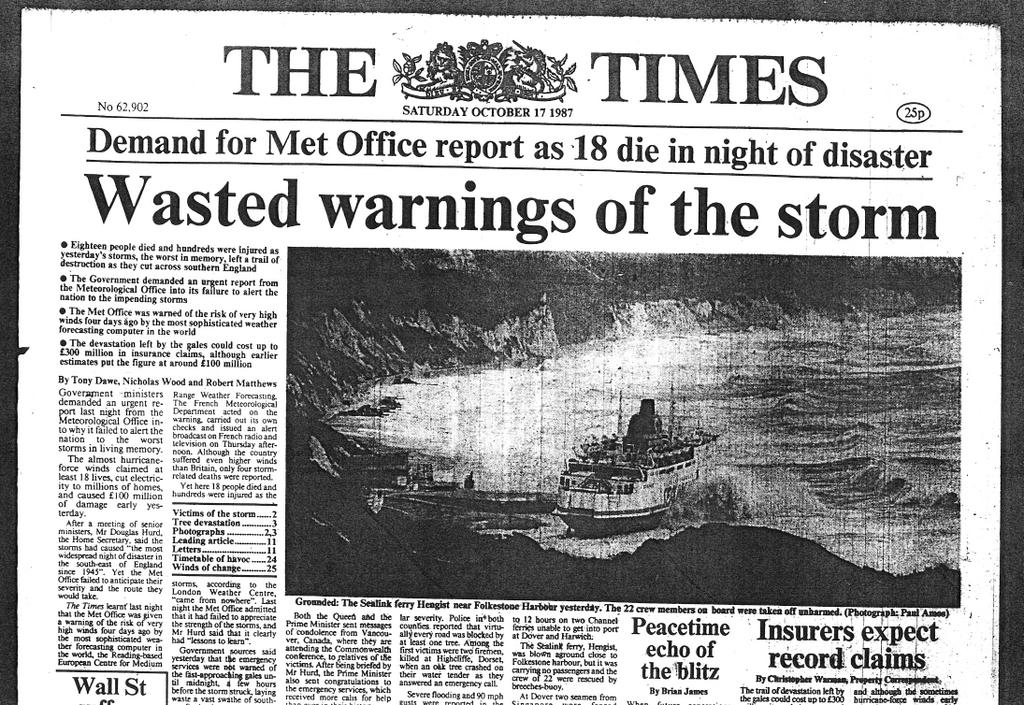
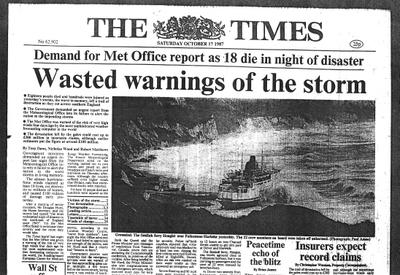
From The Times, 17/10/1987...

Eighteen people died and hundreds were injured as yesterday's storms, the worst in memory, left a trail of destruction as they cut across southern England.

The Government demanded an urgent report from the Meteorological Office into its failure to alert the nation to the impending storms.

The Met Office was warned of the risk of very high winds four days ago by the most sophisticated weather forecasting computer in the world.

The devastation left by the gales could cost up to £300 million in insurance claims, although earlier estimates put the figure at around £100 million.

Government ministers demanded an urgent report last night from the Meteorological Office in to why it failed to alert the nation to the worst storms in living memory.

The almost hurricane-force winds claimed at least 18 lives, cut electricity to millions of homes, and caused £100 million of damage early yesterday.

After a meeting of senior ministers, Mr Douglas Hurd, the Home Secretary, said the storms had caused "the most widespread night of disaster in the south-east of England since 1945"...

Extract from Peacetime Echo of the Blitz, The Times, 17/10/1987:

When future generations crowd at the knee to ask: "What did you do in the Great Wind, Daddy?" the boldest will answer for sure: "I walked." As London awoke yesterday from a night when even its bravest buildings seemed to be howling, it was to darkness and to stillness.

Then the first humans came into view. They looked footsore but triumphant, coming together in twos and threes to walk together in streets without traffic to destinations in office blocks without lights. "How's your house?" was an invariable greeting, uttered with an almost superstitious awe.

As they walked, they talked with stoic modesty: "Well, I was lucky. Got a lift in a bread van to Kingston. Then the bus came. Never been to the Elephant before, but I thought it would save me a mile or so, I thought 'here goes'. Only took me an hour after that."

They walked looking about them at the bizarre. The pot plants standing on a traffic island. The traffic cone in the window of a sandwich bar. The deckchair atop a bush in St James's Park; the racing skiff from the Serpentine, now embedded in the branches of a tree. A man in the electricity showroom pumping at a gas burner to brew tea...

Whatever next? We didn't have long to wait to find out...

The Yuppie Millionaire's Guide To The Good Life, an article published in The Times on 19th October 1987, featured news of the arrival of a new American magazine simply called Millionaire, which bore the subtitle "Lifestyles of the working rich".

To quote the article:

Even the advertisements appeal to raw indulgence. "Absolute power corrupts absolutely" goes the pitch in the full page [advertisement] for Maserati.

The publisher of "Millionaire" is Mr Douglas Lambert, the Florida millionaire who started "Playgirl". He says he is not aiming at the older, idle variety of rich, but at the younger battalions who have emerged from the business boom of the Reagan years, "the person who is out there earning money and wants to spend it on nice things".

He says: "I have no problem with that. I think the attitudes of the 1960s are gone." A brief excursion in Manhattan is enough to convince anyone that Mr Lambert is understating it. Eavesdrop on any gathering of under-35-year-olds and the topic is almost always related to money.

But the article also recorded the fact that more and more Americans felt the boom era was drawing to a close as the stock market suffered "daily jitters".

Ironically, the 19th October 1987, the very day that the yuppie millionaire's guide to the good life article appeared in The Times, will forever be remembered as "Black Monday"...

1987, which had started out as such a sleek, shoulder-padded, money-worshipping beast, had suddenly gone completely off its rocker...

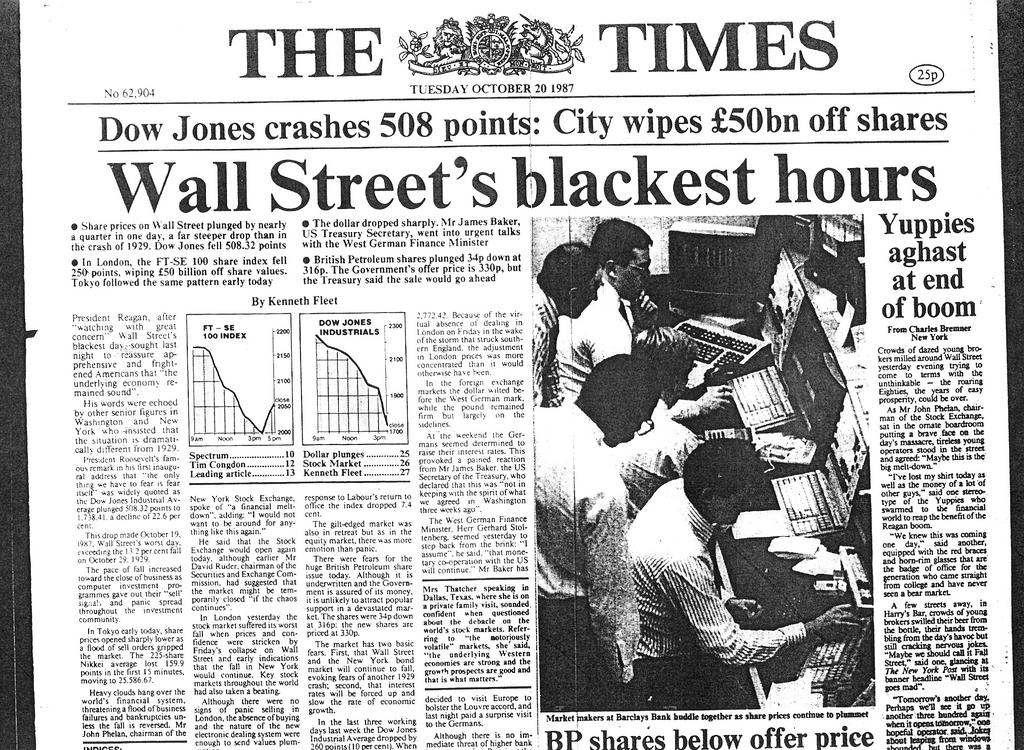
From The Times, October 20th 1987.

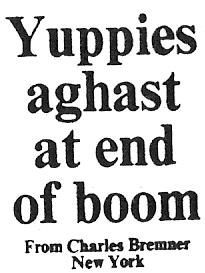
Crowds of dazed young brokers milled around Wall Street yesterday evening trying to come to terms with the unthinkable - the roaring Eighties, the years of easy prosperity, could be over.

As Mr John Phelan, chairman of the Stock Exchange, sat in the ornate boardroom putting a brave face on the day's massacre, tireless young operators stood in the street and agreed: "Maybe this is the big melt-down."

"I've lost my shirt today as well as the money of a lot of other guys," said one stereotype of the Yuppies who swarmed to the financial world to reap the benefits of the Reagan boom.

"We knew this was coming one day," said another, equipped with the red braces and horn-rim glasses that are the badge of office for the generation who came straight from college and have never seen a bear market.

A few streets away, in Harry's Bar, crowds of young brokers swilled their beer from the bottle, their hands trembling from the day's havoc but still cracking nervous jokes. "Maybe we should call it Fall Street," said one, glancing at The New York Post with its banner headline "Wall Street Goes Mad".

"Tomorrow's another day. Perhaps we'll see it go up another three hundred again when it opens tomorrow," one hopeful operator said. Jokes about leaping from windows abounded, but there was a feeling that the country was not in such bad shape as it was in 1929.

Older hands said they saw an end to the collapse provided the market came to its senses within the next few days. They pointed to the continuing strength of the economy, still growing after the longest post-war expansion.

But it was obvious nothing would be the same again after Black Monday. A black man on a bicycle seized the mood when he shouted at the brokers: "Freedom! The Reagan revolution is over. Death to Yuppies."

A tubby broker bellowed back at him: "Whoever dies with the most toys wins. We start over again tomorrow."

28 May 2005

1987 - Nokia Cityman, "You Got An Ology?", House Music, Respectable, All Night TV, It's A Sin, The Great Gale, Black Monday, "Nessie, Are You There?"

1987 saw the yuppies reaching the height of happiness. It seemed to be the year of yuppiedom. There was a feeling in the air that mankind had been striving to reach 1987 since creation, and we were now here - chortle, chortle! Nothing need ever change again. The feeling was strong, tangible. Strolling along, reeking of Mandate, bound for yet another night out, I sniffed the summer air and felt a sense of well being I'd never thought possible.

But 1987 was not what it seemed: if most of 1987 was yuppie heaven, from late-October onwards was sheer yuppie hell and, far more importantly, that month also left a trail of death and destruction...

More about 1987's month of turmoil here.

The 1980s had built up a stock of acronyms, and these were in full bloom in 1987. Were you a nimby? This stood for Not In My Backyard. You might be happy to see hostels for the homeless established, nuclear waste dumping sites found etc - just as long as they weren't in your neck of the woods. Then, of course, there were yuppies (young urban professionals). The coining of the "yuppie" tag happened in America in the early 1980s.


20th Century Words by John Ayto, traces the name back to 1982 and defines a yuppie thus:

a member of a socio-economic group comprising young professional people working in cities of a type thought of as typifying the ethos of the 1980s: ambitious, go-getting, newly affluent, young, class-free, owing no debt to the past. Originally US; a hybrid word coined probably by grafting an acronym based on "Young Urban Professional" (or "Young Upwardly mobile Professional") on to a basic model suggested by hippie.

Coincidentally, the book traces the hippie word back to 1953
! This came as something of a surprise to me as hippies and everything to do with hippiedom are usually so strongly associated with the 1960s.

Returning to the 1980s, I have read that the yuppie word was first coined in 1981, whilst 20th Century Words, as seen above, traces it to 1982. Whilst there is no doubt that it is an early 1980s coinage, yuppies were most prevalent in the mid-to-late decade.

I've also discovered that as well as plain and simple yuppies there were buppies (black yuppies), Juppies (Japanese yuppies), guppies (gay yuppies) and green yuppies
(environmentally concerned yuppies).

And then there were oinks (people with one income, no kids); dinkys (people with dual incomes, no kids yet); minkys (middle income, no kids yet); jollies (jet setting oldsters with lots of loot); glams (greying, leisured affluent middle aged); swells (single women earning lots of loot)... and it went on and on.

Perhaps you were a foodie - obsessively into food trends?


The Eighties/New Man thing was still going strong.

1987 was posh, even the crisps had gone upmarket by this time - "Cheese and onion?" "No, ta, cheese and chive for me." It was so posh that Donna Summer would have been having Dinner With Gershwin and watching Rembrandt sketch if they'd still been about. But it was also brash. The shoulder pads were at maximum stretch. The hair was too big, the puffball skirts too yucky. But we didn't realise.

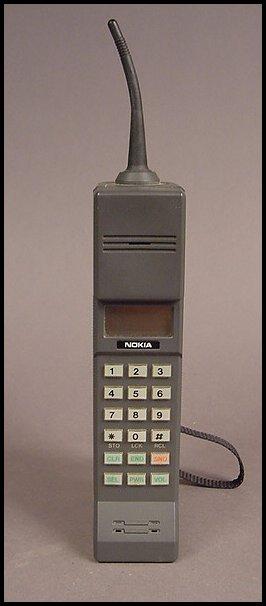
NMT, the world's first international cellular mobile telephone network, had opened in Scandinavia in 1981. In 1987, the Nokia Cityman, the world's first NMT hand portable, was launched.
More here.

Still on the subject of phones, Maureen Lipman made her debut as Jewish grandma Beattie Bellman in the famous BT "ology" ad series. For further details click here!

Musically, we were hearing an exciting new sound which was bursting out of America: House. After Farley "Jackmaster" Funk reaching No 10 in the UK singles chart in late 1986, Steve "Silk" Hurley took it to the top when Jack Your Body made Number 1 in January 1987.

Remember H... H... H... House Nation, which invaded the airwaves in September?

House was a new genre of electronic music which originated in Chicago, USA, in the early 1980s. And here in 1987 we were well and truly reaping the benefits.


M/A/R/R/S took us screeching towards the Dance era with Pump Up The Volume, we were Star Trekkin' with The Firm, Kirsty and the Pogues gave us the wonderful Fairytale of New York for Christmas, and the Pet Shop Boys told us It's A Sin.

Neighbours, cancelled by Australian Channel 7, had been picked up by their Channel 10, and we began to see the Channel 10 episodes here in 1987. This was the year we first clapped eyes on busybody Mrs Mangel. Played by the English-born actress Vivean Gray, Mrs Mangel was the type of sticky beak character essential to all good soaps. Mrs M palled up with Eileen Clarke (played by another English-born actress, Myra de Groot) and the two gave the soap some of its finest and funniest moments.

The role of Neighbours' skate boarding teen Scott Robinson was recast - a young actor called Jason Donovan stepped into the role, and soon he needed a love interest. The character Charlene Mitchell was introduced, played by another young unknown, Kylie Minogue. 1987 saw Scott and Charlene marry in Australia, however we lagged behind and would have to wait until 1988. Neighbours' popularity swelled enormously here in 1987, and Scott and Charlene's courtship kept ever-increasing numbers of us glued to the screens.
"Read All About It" here.

Soap, soap n' more soap was the order of the day. But after Pammy's dream in Dallas the previous year, could we really take any more weirdness?

In Dynasty spin-off The Colbys, Fallon was whisked away at the end of the series in a flying saucer. More here.

It was a great year for Michael Douglas. On at the flicks was the morality tale Wall Street ("greed is good"), and the chilling Fatal Attraction. The bunny was on the boil. Conveniently, I managed to spill my popcorn at several tense moments during the film, and so was spared the worst scenes.

Glenn Close put in an absolutely stunning performance as the very first bunny boiler... remember that bathroom scene, where she lies beneath the water, apparently dead, with that slightly puzzled, slightly hurt expression on her face? Then - ARRRGGGHHH!! - up she rises and, oh dear, there goes the popcorn again...

Actually, I didn't go to the pictures very often because I preferred to dance. I loved the local Nite Spot; I loved the black and chrome decor and all the full length mirrors; I loved the pink and blue neons; I loved togging myself up in my white chinos; or one of my black suits with the multi-coloured cotton flecks; or my shiny grey suit; or my bright pink linen jacket; or my smart blue jacket - which went so well with my banana yellow skin-tight trousers.

I often wore one of my stockbroker shirts or a nice cerise vest...

I was completely and utterly hooked on big shoulder pads. I was developing a very slight beer belly, and the pads detracted from this brilliantly.

All my clothes were cheap-and-cheerful- from the likes of C&A - there was some lovely... well, I suppose it might now be called "flash trash" around.

In the news, Manchester police chief James Anderton announced that God may be using him as a prophet.

There were several terrible tragedies in 1987 - the capsizing of the car-ferry Herald of Free Enterprise and the Hungerford killings to name but two.

In October, my attention was diverted north of the border as it seemed that Nessie was, at last, to be revealed. But she wasn't.

27 May 2005

The 1987 Nokia Cityman - Yup, Yup, Yup...

Overheard in a pub, c. 1987...

Two yuppies, one male, one female, were discussing pets. The male yuppie had a Nokia Cityman or similar on the table in front of him.

Male yuppie: "I love my tortoise. A friend since childhood."

Female yuppie: "Oh, I prefer cats to tortoises, James."

She eyed his brick, longingly.

"Of course, what I REALLY need is a cell phone..."

NMT, the world's first international cellular mobile telephone network, had opened in Scandinavia in 1981. In 1987, the Nokia Mobira Cityman, the world's first NMT hand portable, and Nokia's very first hand held mobile phone, was launched.

"Yuppie toys! What do they want mobile phones for? Ridiculous! Haven't they ever heard of phone boxes?!"
-----
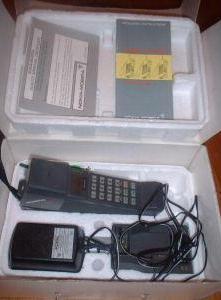
A Nokia Cityman in its box, which had a small plastic handle so, if desired, phone and charger could easily be carried around together.
-----------------------------------
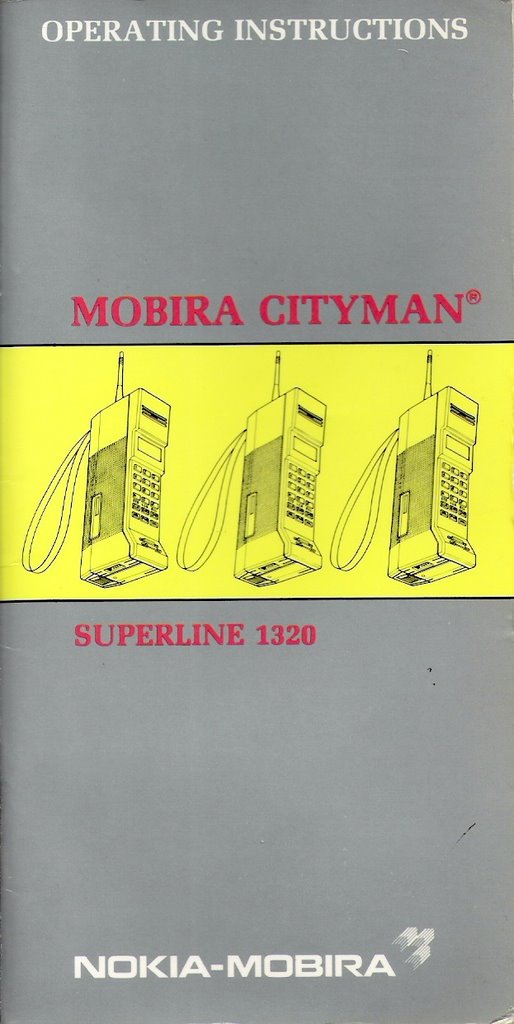
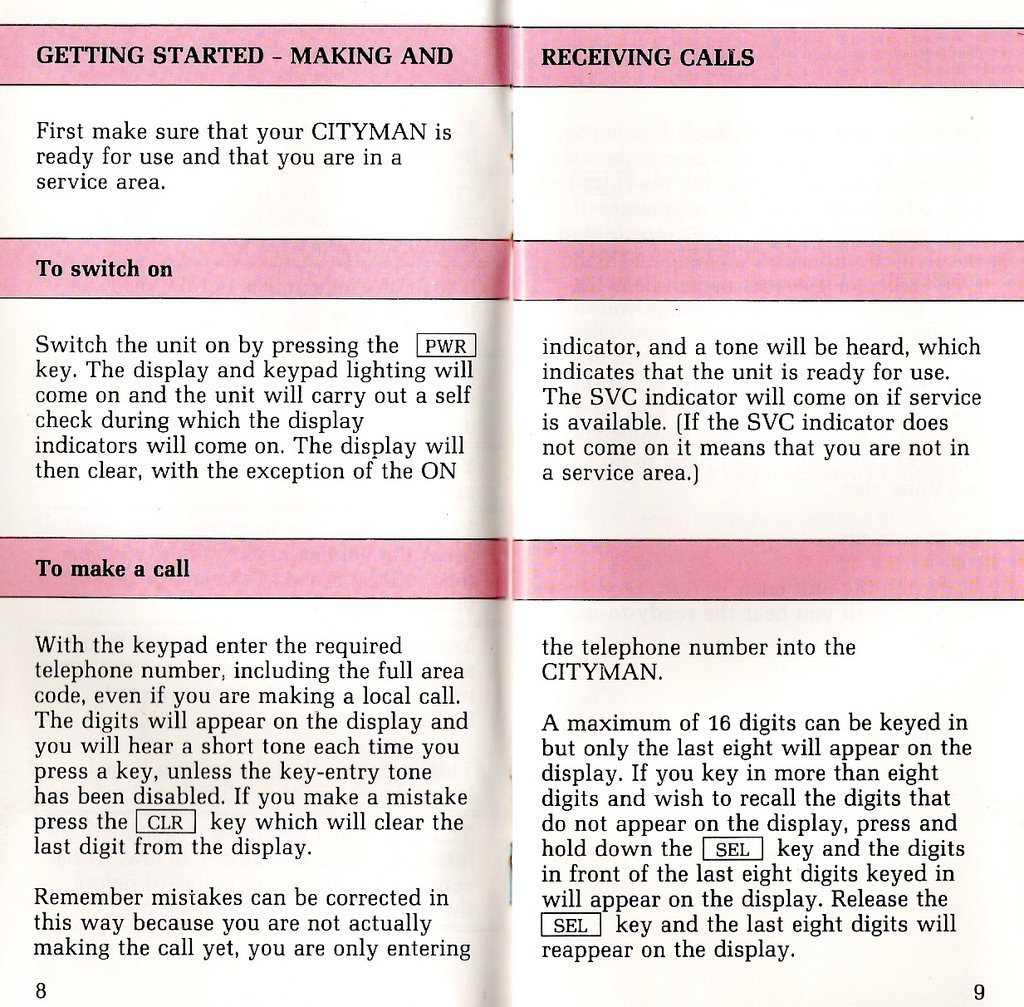
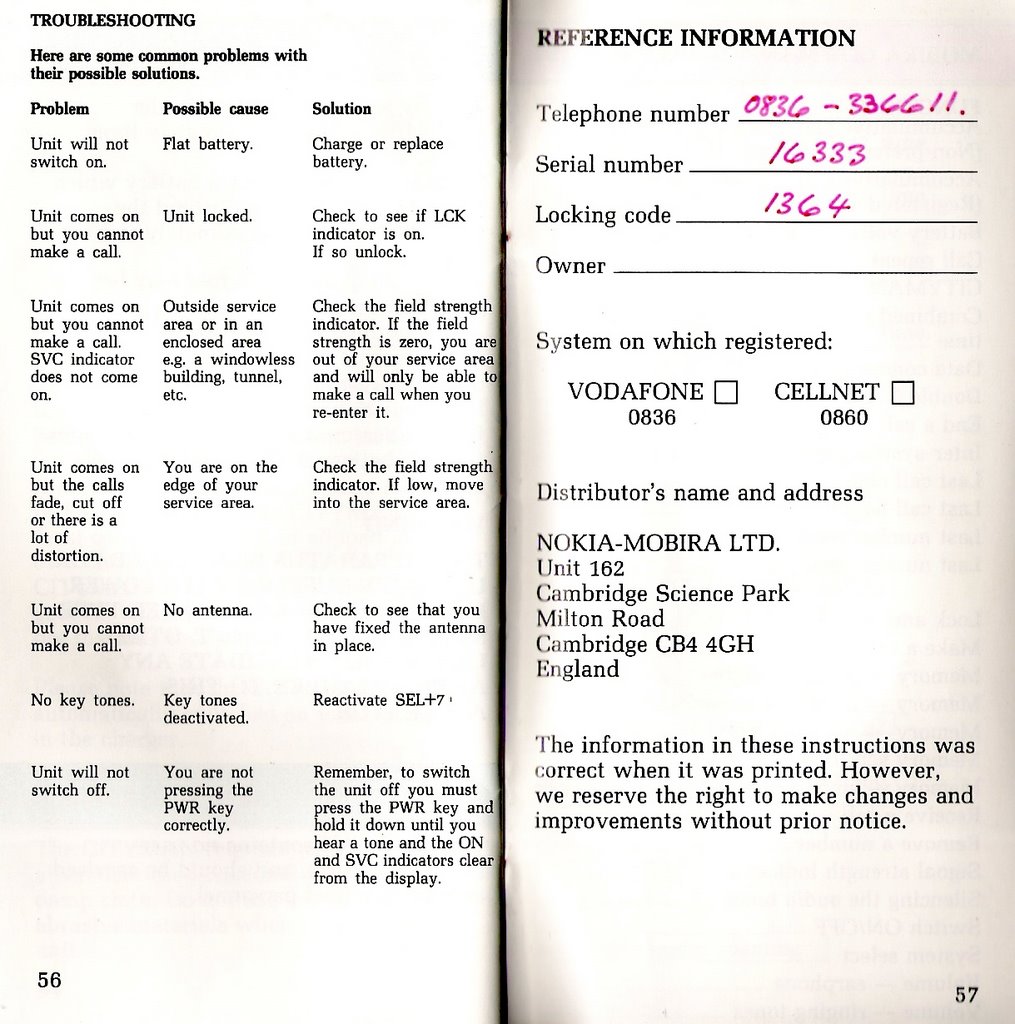
Above the cover to the Nokia Mobira Cityman instruction manual - the 1988 edition. Note the yellow, red and grey design - reflecting the 1980s trend for contrasting bright and dull colours. Below, selected pages from the manual.


The Mobira Senator, Nokia's first mobile, a not-actually-terribly-mobile car phone, was released in 1982. I'm not sure when (or if) it first appeared in England. 

It was around 1987 that I first set eyes on a hand held mobile phone. Initially, I was most impressed - amazing - imagine being able to phone people wherever you might be! This went on for a year or so, then I decided they looked rather like walkie talkies, and, judging by the number of yuppies stalking out of the pub with their bricks because the reception was lousy inside, they didn't seem that great.

So my fascination faded.

Mobiles later shrank, went digital, became dirt cheap and all singing, all dancing, but I still don't have one. I like to be away from the phone when I'm out, there's no need for me to have a mobile, so I don't.

Having been left behind, I still find myself thinking of them as "yuppie toys" at times! That's what we called them in the late 1980s.

For all its sophisticated appeal back in 1987, the Nokia Cityman was basically a clonking great brick. So when did mobile phones start to shrink? See here for more...

For captures from a 1988 television advertisement for Eagle Star investment plans, starring

Rowan Atkinson (Blackadder) and the Nokia Cityman see here. 

Go back to the unveiling of the first commercially available hand held mobile phone EVER here.
------------------------------------------

AIDS - Don't Die Of Ignorance...


The origins of the AIDS epidemic certainly pre-date the 1980s. There is still uncertainty about how or when this disease came into being, but with HIV's often lengthy gestation period, it is safe to say that some people were infected with the virus before the end of the 1970s.

HIV and AIDS were not identified and named until the early 1980s, and I remember vague rumours drifting around that the disease had originally afflicted monkeys. On the internet, there is now much material about the possible origins of AIDS, including some conspiracy theories.

In England, many of us believed that AIDS mainly affected countries far distant, until the "Don't Die of Ignorance" TV campaign of 1986. This depressing piece, shown on ITV and the BBC, featured a couple in bed together (the actors asked not to be named, fearing that they would be associated with the virus) and a tomb!

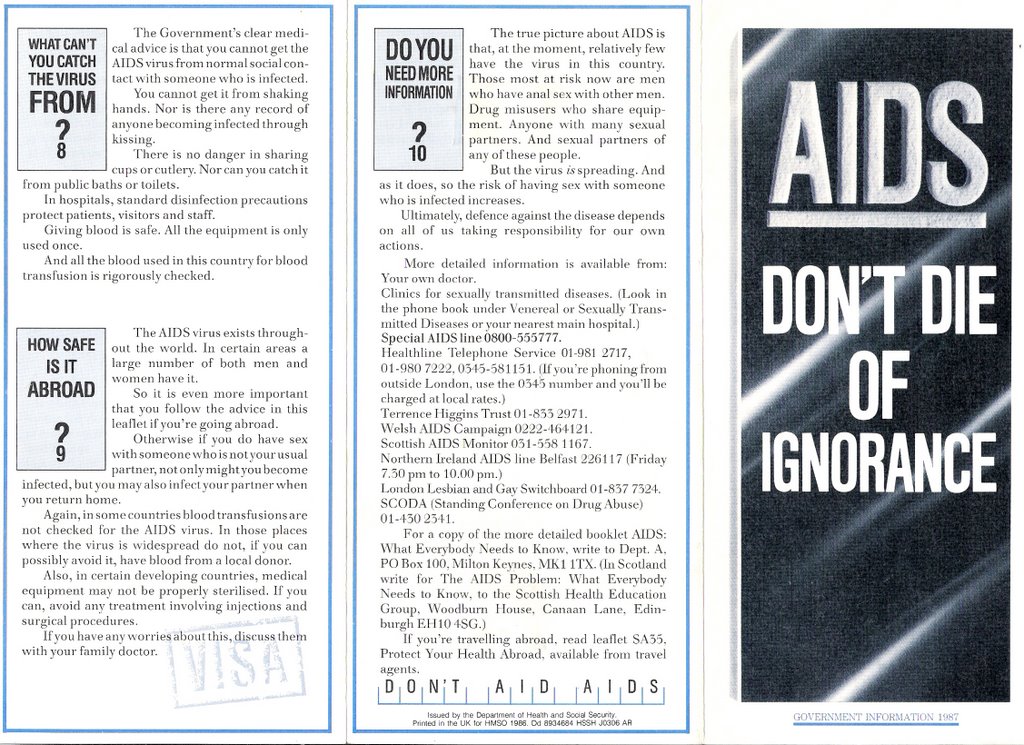
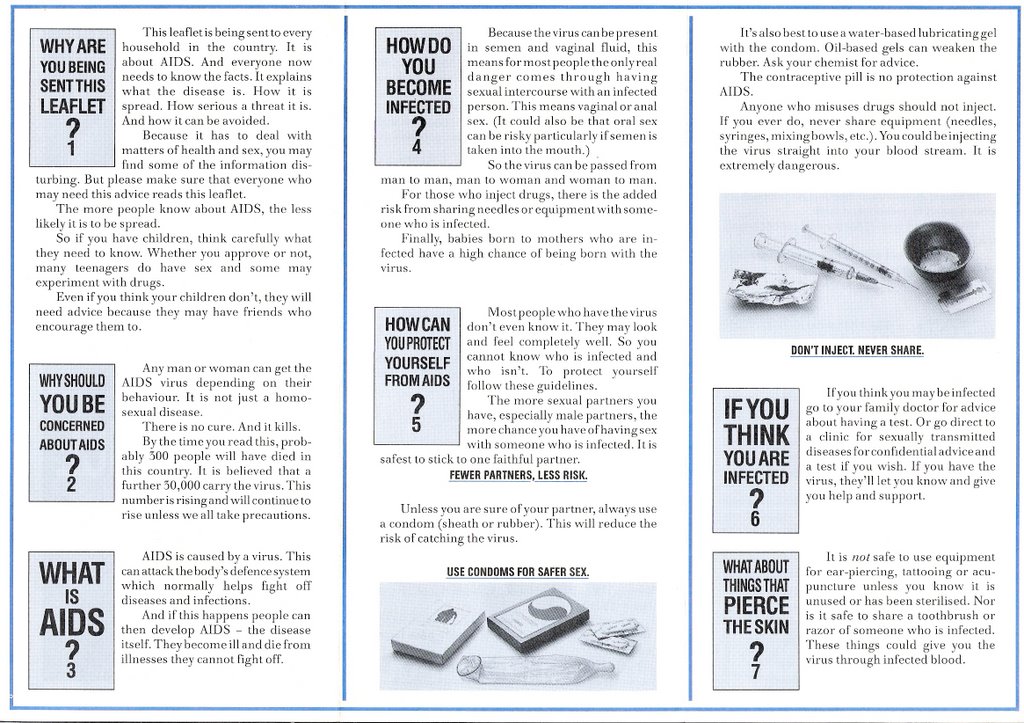
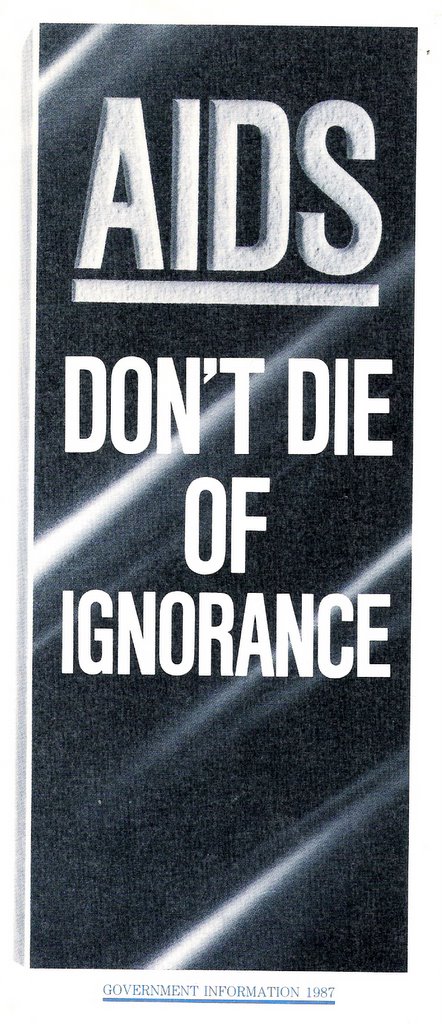
In 1987, the Government's AIDS DON'T DIE OF IGNORANCE leaflet, pictured above, was sent to every household in the country.

By the time you read this, probably 300 people will have died in this country. It is believed that a further 30,000 carry the virus. This number is rising and will continue to rise unless we all take precautions...

On TV, AIDS was much discussed. ITV gave us First AIDS, hosted by Mike Smith. This was a first - the first programme where condoms were fiddled with and twanged on screen, and inflated by blowing into them.

At least one reader of the TV Times was upset by the programme:

So "First AIDS" (ITV and C4) claims to have had a studio audience made up of an "accurate cross-section of British youth of 16-25". Allowing this improbable claim to pass, what a tragedy that only one of those who spoke questioned the assumption underlying the whole programme that every young person should regard sex as a social act with no greater significance than swigging a pint of beer. Is a whole generation really allowing itself to be quite so badly ripped off? If the AIDS epidemic is worsened by heterosexual promiscuity, it's shameful to advise the young that they use contraception to help make casual sex safe. Where, in this programme, was the voice in support of the evidence that truly creative and satisfying lives are found inside committed, lifelong relationships based on love and trust; that promiscuity is an empty vessel that spells loneliness, superficial pleasure and, ultimately, despair? My anger at the hypocrisy of a programme that was little more than a 90-minute commercial for contraceptive manufacturers drives me to hope that that there will be a hell for the wicked - not for the wretched AIDS victims; but for the spiritual bankrupts who ran this sickening show.

The BBC and ITV, for a wonder, got together for an AIDS week. Spitting Image featured Willie Whitelaw, with a condom over his head.

There was also an ITV AIDS drama serial called Intimate Contact, which told the story of a married man, destined to die after a heterosexual encounter.

I joined the local AIDS Helpline. The set-up was based on the American model, with face-to-face befrienders ("Buddies") and helpline advisors. I acted as one of the latter.

I read many articles at the time about how AIDS was bringing back old values, that people were settling down into monogamous relationships at a young age. I saw no evidence of it amongst my peer group. We simply took precautions.