Total Pageviews

Pages

Showing posts with label telephones. Show all posts

12 July 2018

Cellular Car Phones Arrive...

"Philips - simply years ahead"!

For several decades before the 1980s, a radio system of car phones existed that were wildly expensive. Eye-wateringly expensive. With the advent of the first cellular car phones in the early 1980s, car phones were still expensive. But the cellular system was infinitely cheaper than the radio version, and you could call directly, not through an operator as had been the case before. And electronic data transmissions were also possible! In the mid-1980s, the call was going up from dealers in this exciting new technology that car phones were not just for jet setters... 


From the Daily Mail, 13/8/1985:

THE CELLULAR CAR 'PHONE. AVOID THE CONS. READ THE PROSE.

Car 'phones. They're no longer the privilege of the chosen few.

The ranks of present users - politicians, play-boys, the Adnan Khashoggis of this world, are being swollen by those of us with more modest callings.

Plumbers, small company directors, travelling sales persons, farmers, builders, photographers, vets, drain cleaning operatives, Mr. Family Man and his wife. In fact, anyone who finds a stationary phone useful, finds a mobile one invaluable.

Why do I need one?

The personal benefits must be obvious, but what about business?

Well, that's where the mobile 'phone really starts to work for you.

It totally frees your telephone life. You can start the day's calls (and receive them) the moment you get into the car.

Sure, you may still get stuck in a jam but at least you won't be worrying about the people you should be speaking to.

You'll be in touch.

Which, with the Phillips M7000 series, is somehing of an understatement.

It operates on the Vodafone system, feeding directly into the public telephone network, so you're in touch with the whole country.

Or any other for that matter.

What price communication?

Although our competition often avoids the issue, we're very much in favour of spelling out the cost.

Because with the Phillips M7000, what you get for your £1,499* (you can lease it if you prefer) is quite remarkable.

Simply, you get a 'phone that's designed for the British network, with more features than any other similarly priced 'phone on the market.

Including a helpful 'one bill' payment system.

This ensures every single bill, from your subscription to your shortest call, comes from the same source.

But what of the features?

To start, it has one of the highest number storage facilities. Without lifting the 'phone, you can dial up to 40 previously programmed numbers. Unauthorised use is prevented by a clever locking mode.

There's a 'scratch pad' allowing you to store a number during your conversation, which is then available for dialling when you hang up.

How did we manage before?

(You're talking to John who asks you to call the Edinburgh office. You don't know the number of the Edinburgh office. He tells you. You tap it in as you're chatting. When you hang up, you can automatically dial it.)

And that number is visible on a 16 digit display.

Forgotten the Company Secretary's home number? Press the 'scroll facility', it will remind you.

Forgotten to turn the machine off? After six hours it will do that too. So no flat batteries.

Forgotten the name of the car 'phone that provides more features, has a better service back-up, a 'one bill' payment system and isn't afraid to print the prose and the price?

It's Philips.

*Recommended Selling Price. Price correct at time of going to press.

END OF BLURB!

Clever advertising! After Michael Harrison/Ernie Wise made those historic first phone calls on 1 January 1985 (details here), cellular phones were definitely on the way in.

But, for the vast majority of us poor peasants, the good old pay phone remained the only way to make telephonic contact on the hoof for some years to come. 

The wonders of modern technology - a 1980s Motorola car phone.


A newspaper advertisement from March 1986.
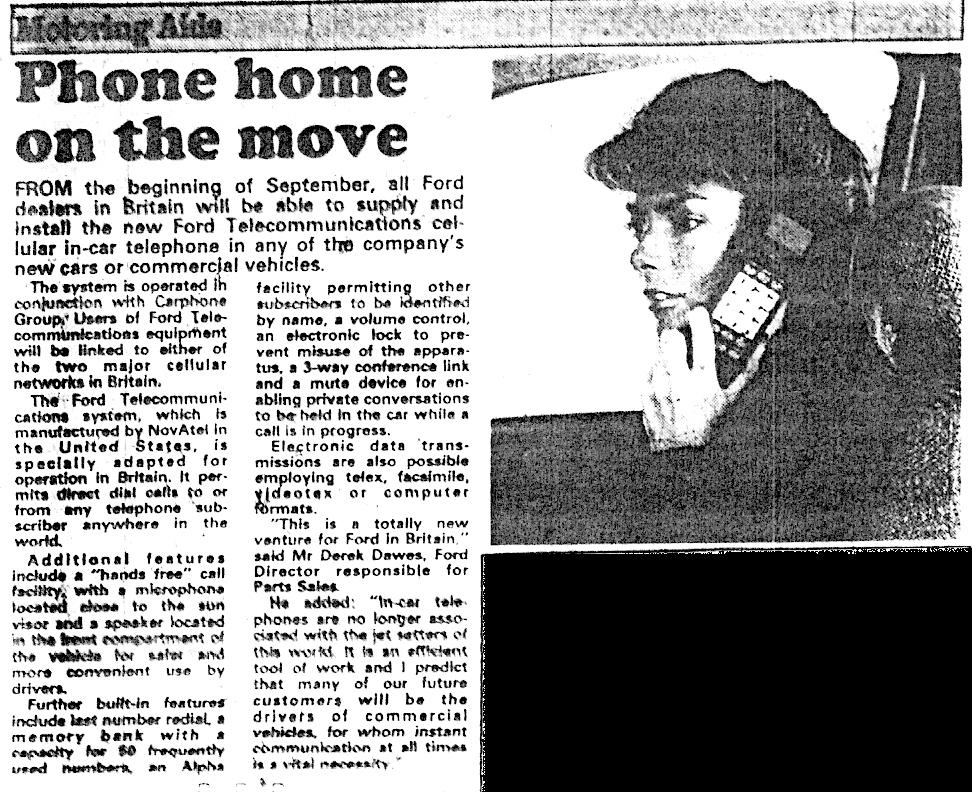
Ford car phones - August 1986...

From the beginning of September, all Ford dealers in Britain will be able to supply and install the new Ford Telecommunications cellular in-car telephone in any of the company's new cars or commercial vehicles.

The system is operated in conjunction with Carphone Group. Users of Ford Telecommunications equipment will be linked to either of the two major cellular networks in Britain.


The Ford Telecommunications system, which is manufactured by NovAtel in the United States, is specially adapted for operation in Britain. It permits direct dial calls to or from any telephone subscriber anywhere in the world.

Additional features include a "hands free" call facility, with a microphone located close to the sun visor and a speaker located in the front compartment of the vehicle for safer and more convenient use by drivers.


Further built-in features include last number redial, a memory bank with a capacity for 50 frequently used numbers, an Alpha facility for permitting other subscribers to be identified by name, a volume control, an electronic lock to prevent misuse of the apparatus, a 3-way conference link and a mute device for enabling private conversations to be held in the car while a call is in progress.


Electronic data transmissions are also possible employing telex, facsimile, videotex or computer formats.


"This is a totally new venture for Ford in Britain," said Mr Derek Dawes, Ford Director responsible for Parts Sales.


He added: "In-car telephones are no longer associated with the jet setters of this world. It is an efficient tool of work and I predict that many of our future customers will be the drivers of commercial vehicles, for whom instant communication at all times is a vital necessity."

02 March 2015

Introducing the first mobile phone - the DynaTAC 8000x

The first commercially available handheld cellular phone ever was unveiled in 1983 (although, according to Motorola, they weren't available to consumers until 1984). Motorola had invested fifteen years of research and $100 million in the advancement of cellular technology, and the story stretched back much further than that. The first handheld mobile was called the DynaTAC 8000X and was unveiled on March 6th. It was, of course, a brick. At a price of $3,995 it wasn't for everybody.

If the first commercially available mobile was a brick, boggle at the thought of the first working Motorola prototype ten years earlier which has been described as a boot! Motorola built several prototype models between 1973 and 1983.

And we ended up with a brick.

Rudy Krollop, one of the original Motorola designers, said recently: "In 1983, the notion of simply making wireless phone calls was revolutionary and it was an exciting time to be developing the technology at Motorola."


England's first mobile phone call was in 1985.

10 June 2012

Garfield, Garfield Everywhere...

Favourite fat cat Garfield, creation of American cartoonist Jim Davis, first appeared as a comic strip, syndicated in 41 US newspapers, on 19/6/1978. The illustration above, showing Garfield and Jon Arbuckle, is a panel from that first outing. Didn't they look different?! Especially Garfield. Gradually, the characters evolved. By the early 1980s, Garfield was recognisable as the Garfield we know today, but it still took some years before he stood up on two legs. Studying pictures of Garfield over the years is fascinating.

Garfield is greedy, cynical and lazy. He has a passion for lasagna, a love/hate relationship with Odie, the dog, and is pretty loyal to his not-terribly-bright owner, Jon Arbuckle, all things considered.

This advertisement appeared in a Cambridge, England, newspaper in December 1983. The local branch of Clinton Cards was introducing the city to a flood of Garfield merchandising. 

I have had several queries about the "1978" copyright label on some Garfield merchandise. This refers to the year the character was first copyrighted. If you have an early Garfield toy, mug etc, it will have been manufactured in the 1980s. As can be seen in the illustration at the top of this post, Garfield looked rather different in 1978! 

Garfield creator Jim Davis’ company, Paws, Inc, was founded in 1981 to take care of the creative side of the Garfield licensing business.
-
This girly, wearing a "Frankie Say Relax" T-shirt with very fancy lettering indeed, nipped out to her local Bejam's one morning. On her way home, she spotted this major celebrity presiding over the re-opening of her local Post Office, which had been closed for a refit. 

Swoon, swoon!

Well, it seemed to be love at first sight, but in reality the celebrity had simply spotted the frozen lasagna in her shopping bag. We tried to warn her that it was only cupboard love - but would she listen?!

This card was received by me on my 21st birthday in 1986 and originally had a plastic "key to the door" stuck to the top right hand corner. I was quite a fan of Garfield back then and still enjoy reading the comic strip today. In the 1980s, Garfield posters adorned my bedroom wall, my tea was drunk from a Garfield mug and a Garfield cuddly toy lived under my bed. 

And sometimes in my bed, if I had nobody else to cuddle.

Did you take Garfield for a ride in your motor?!

A Christmas card from 1988.

The wit inside the card!

This Garfield phone was available in the Index catalogue from September 1989 onwards.

09 June 2012

Technology 1988!

A couple of pages from the Comet stores "programme", which appeared in some magazines from 2/11/1988 onwards. Fascinating to look at the trends of the day. Since the early 1980s, a plethora of new phone designs had arrived - including the Binatone Hotline 2 MP200 - a one-piece telephone with 10 number memory. One-piece phones never really took off in this country, but this particular model was a snip at £12.99 - a saving of £2.00 on the recommended price at Comet in 1988. 

Pictured is a clunking great cordless telephone - the GEEMARC 2000, with full two-way intercom at £99.99. Not cheap.

Fancy a cellular phone? The car telephone featured would set you back £399 and a Motorola 8000s hand-held would cost you £599. The latter is described as "lightweight, stylish and compact".
Lightweight, stylish and compact?! It was, of course, by today's standards, a brick. 

Remember Only Fools And Horses and Del Boy Trotter's failed flirtation with yuppiedom and mobile phones in the late 1980s? 

Pictured is the Amstrad CPC6128 computer with 128K RAM and built in disk drive.
Wow.

Technology 1988 style was a whole different world...

30 May 2012

The Mobira Talkman

Meet The One Car Phone That Gives You Full Performance Without The Car...

The Mobira Talkman was released in 1984, and, after the first mobile phone call in England in 1985, we discover this trendy beast available "over here" in a 1986 magazine advertisement. Hefty, eh?

For the full '80s Actual low-down on 1980s mobies, simply click on the "mobile phones" label below.

30 July 2011

1989: The Motorola MicroTAC - A Far More Mobile Mobile... And A Bit About GSM...

Advances in technology brought about the revolutionary Motorola MicroTAC phone of 1989 - the first step towards smaller mobile phones.

It was also massively influential, being the world's very first flip phone. The aerial, by the way, was simply ornament!

It really was incredible as, at that time, mobiles were like grandiose walkie-talkies. And you had to be a yuppie (or Del Boy Trotter) to afford one.

The decade which introduced the very first hand-held mobile, the DynaTAC 8000x in 1983, very much a brick, roared towards its end with this little beauty.

Of course it was analogue, but
the current system was on its way, and had been since 1982 when Groupe Spécial Mobil (GSM) was formed to design a pan-European mobile technology.

Behind the scenes planning often long pre-dates technology hitting the streets, and in that light it's amusing to relect that there were no hand-held mobile phones in 1982, and that the Mobira Senator, Nokia's very first mobile phone - a car phone released in 1982, weighed around twenty one pounds!

From 1982-1984, agreement on strategic targets for GSM was reached.

From 1985-1987, agreement on principles for services, network architecture, radio and speech coding in GSM was reached.

In 1986, trials of different digital radio transmission schemes and different speech codecs were carried out in several countries and comparative evaluations carried out by GSM.

1987 was the birth year of the current system, with GSM agreeing its basic parameters. This was finalised in May 1987 in Bonn. Then, in September 1987, a proposal was put forward to create an operator agreement in the form of a ‘Memorandum of Understanding’. This was drawn up and signed in Copenhagen in September by fifteen members from thirteen countries that committed to deploying GSM.

The BBC reported in 2007:

The technology behind the mobile phone is celebrating its 20th anniversary.

On 7 September 1987, 15 phone firms signed an agreement to build mobile networks based on the Global System for Mobile (GSM) Communications.

According to the GSM Association there are more than 2.5 billion accounts that use this mobile phone technology.

Adoption of the technology shows no signs of slowing down with many developing nations becoming keen users of mobile handsets.

Robert Conway, head of the GSM Association, said the memorandum of understanding signed in 1987 is widely seen as the moment when the global mobile industry got under way.

Although work on the GSM technical specifications began earlier (1982), the agreement signed in 1987 committed those operators to building networks based upon it.


"There's no doubt that at the time of the agreement in 1987 no one had an idea of the explosive capabilities in terms of growth that would happen after the GSM standard was agreed," he said.

As Paul Simon said back in the '80s, "These are the days of miracle and wonder..."


25 January 2011

1985: England's First Mobile Phone Call...

"Pressing Towards New Horizons - British Telecom The Power Behind The Button", an advertisement which appeared in the Sunday People, June 24, 1984:

Take Your Telephone With You

This amazing new telephone system, which is being installed by British Telecom, has none of the traditional constraints of the telephone.

You will be able to dial direct from almost anywhere to anywhere - without wires, plugs, sockets or special equipment.

About the size of a paperback, the unit operates through Cellnet, the revolutionary cellular radio network. It's already under test and you'll be able to get one, starting in London, in early 1985.


Little Ern got on the blower, called Vodafone's headquarters at Newbury, and made a little bit of history.

On 1st January 1985, comedian Ernie Wise, he of the short, fat hairy legs, started a revolution. Standing in the middle of St Katherine's Dock, he made the first mobile phone call in England - in fact in the whole of Britain, and a little piece of history was made. Nice that Ernie was chosen to make it, particularly as he'd lost his long-standing comic routine partner, Eric Morecombe, the year before. Some of us were quite concerned about little Ern at the time.


In fact, it seems that Little Ern was not quite the first to make a mobile phone in England, because in recent years we've been told that in the early hours of New Year's Day 1985, Michael Harrison phoned his father Sir Ernest to wish him a happy new year. Sir Ernest was chairman of Racal Electronics and his son was in fact making the first-ever mobile phone call in England, using the network built by its newest investment, a company based round the corner from a curry house in Newbury, Berkshire.

And Ern made his call later the same day.

Never mind.

The famous 1980s hand-held brick phones, the first of which was unveiled by Motorola in 1983, began making an impact in England from 1985 onwards, but only the well-off could afford them and the rest of us had to content ourselves with the odd glimpse out on the streets.

And in the trendy wine bars and upwardly mobile boozahs.

We called them "yuppie toys".

Of course, they'd never catch on...

 
More on hand-helds here.

18 March 2010

The 1980s: BT Phones For Sale, Plug And Socket Home Phones And Card Phones Arrive...


A Rhapsody table telephone in tan leather from BT, released in 1981. Why? I dunno.

In 1981, BT began to sell telephones for the first time.

So, perhaps the 1981 leather job happened in a fit of excitement as the BT designers sought to capture the imaginations (and cash) of those looking to buy a phone?

Maybe.

Ken Masters (Stephen Yardley), the medallion man of Howards' Way, had one of these phones (or something very similar) beside his bed in early episodes of the series, which began in 1985. And that absolute charmer Polly Urquhart (Patricia Shakesby) was also seen brandishing something very like it for several seasons.

Classy.

With phones on sale for the very first time in the early 1980s, that terrific 1960s innovation, the trimphone suddenly went colourful!

Read all about it here.

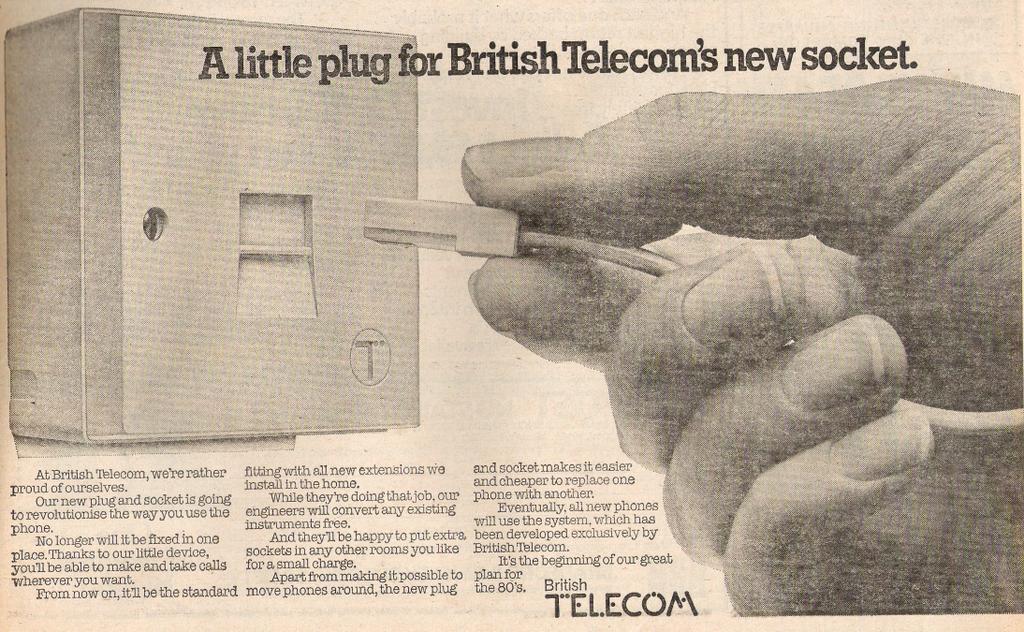
The new BT phone sockets arrived on the 19th of November 1981, and this advertisement from The Sun dates from 23/11:

At British Telecom, we're rather proud of ourselves.

Our new plug and socket is going to revolutionise the way you use the phone.

No longer will it be fixed in one place. Thanks to our little device, you'll be able to make and take calls wherever you want.

From now on, it'll be the standard fitting with all new extensions we install in the home.

Whilst they're doing that job, our engineers will convert any existing instruments free.

And they'll be happy to put extra sockets in any other rooms you like for a small charge.

Apart from making it possible to move phones around, the new plug and socket makes it easier and cheaper to replace one phone with another.


Eventually all new phones will use the system, which has been developed exclusively by British Telecom.

It's the beginning of our great plan for the 80s.


Londoners were introduced to another BT innovation in 1981, as the Times, 28/7, reported...

Plastic Money for Phones

Public telephones which use pre-paid plastic cards, are now in operation in London. (Bill Johnstone writes). They will soon appear in Birmingham, Glasgow and Manchester.

The telephones, called Cardphones, take cards of the same shape and size as a credit card. Each represents so many 5p call units. Two types are available: 40 units (value £2) or 200 units (£10).

Callers insert the card instead of coins and a digital readout on the telephone gives the value still left on the card as the call progresses.

The cards are available in London from Post Offices and some John Menzies and Travellers Fare kiosks at railway stations.

They can be used for inland and international calls. About 200 Cardphones will be in use for the trial and if they are successful more will be introduced.

Radio Times, November 1985.

08 November 2009

1981/1982: Buy A Trimphone PLEASE - We'll Give You Funky Two-Tone Colours, We'll Call Them Phoenixphones... We'll Knock £15 Off.... We'll Do ANYTHING

From the Daily Mail, April 15, 1981. British Telecom arrived in 1980 and in 1981 began selling phones for the very first time. Before that subscribers could only rent, and there wasn't much choice of styles. The Trimphone arrived in the 1960s, and with its distinctive warble was supposedly set for great things.

The Trimphone of the 1960s and 1970s came in one sludgy colour scheme (ignore Life On Mars and Margaret - they'll put you wrong - more about that later!) and I've often wondered just how popular they were? If you watch actual television shows of the era, how many Trimphones do you see?

Crossroads, the ITV Midlands soap, had one of the early sludge-coloured beauties - it was in the very trendy flat of the womanising restaurant manager (later home to Miss Diane) - and was on-screen from 1977 until the mid-1980s.

Incidentally, in a 1983 episode of
Crossroads I recently viewed, the Trimphone rang on one occasion like a traditional bell-ringer phone. This was obviously because the chap or chappess in charge of the sound effects had forgotten to use the "warble effect". None of the characters on screen appeared to notice the oddness of this event. Crossroads was endearingly batty at times!

But, apart from the very odd one in Crossroads, Trimphones were thin on the ground on the telly.

In 1981, with their desire to sell phones, that brave new entity, BT, seemed very keen indeed to flog off Trimphones. So, they gave them lovely two-tone colours. And offered £15.00 off.

From the newspaper ad above:

The Trimphone is a lightweight phone with a melodious warble. It combines the best in modern technology with a timeless elegance of design.

Normally, it costs quite a bit more than an ordinary phone, as you might expect. However, until 31 July 1981, we're offering it to you at a knock-down price.

There are two models, the press-button and a dial model. They come in a range of 3 attractive two-tone colours.

For full details, do one of two things. Call the operator and ask for Freefone 888 anytime during office hours, or fill in the coupon (no stamp required). Either way, you'll get a warble for a song.

I'm not sure how successful this marketing ploy was. Everybody I knew who had a telephone (apart from my posh auntie who had a Trimphone - but then she would) had a bog standard traditional dial bell-ringer and I noticed none of these new colourful 1981 Trimphones suddenly bursting out all over.

In early 1982, BT, seemingly absolutely determined to flog these phones, went further.

The two-tone colour gimmick of 1981 continued, but the Trimphones were now called Phoenixphones. Lord Snowdon had a hand in picking the colours, and they were all part of "The Snowdon Collection". There's stylish for you!

The Trimphone goes colourful - the 1982 Phoenix Phone, sorry, Phoenixphone, all one word, available in dial or push-button models.

I didn't see any of these new telephonic style icons on my daily rounds. And BT released such a range of telephones for sale in the 1980s that the Trimphone/Phoenixphone soon seemed positively quaint.

Bizarrely, a couple of the red trimphones - sorry, Phoenixphones - have recently, quite wrongly, appeared in TV programmes set in the 1970s - including
Life On Mars and Margaret.

They've also cropped up on one or two websites dedicated to phones as "70s" items and are often falsely sold as such on eBay
.

Odd, isn't it - just how many '60s and '80s pop culture items are attributed to the 1970s?

But then perhaps it's not so surprising - the modern day fantasy view of the 1970s largely depends on 1960s and 1980s realities to keep up its totally fake "funky" image!


27 May 2005

The 1987 Nokia Cityman - Yup, Yup, Yup...

Overheard in a pub, c. 1987...

Two yuppies, one male, one female, were discussing pets. The male yuppie had a Nokia Cityman or similar on the table in front of him.

Male yuppie: "I love my tortoise. A friend since childhood."

Female yuppie: "Oh, I prefer cats to tortoises, James."

She eyed his brick, longingly.

"Of course, what I REALLY need is a cell phone..."

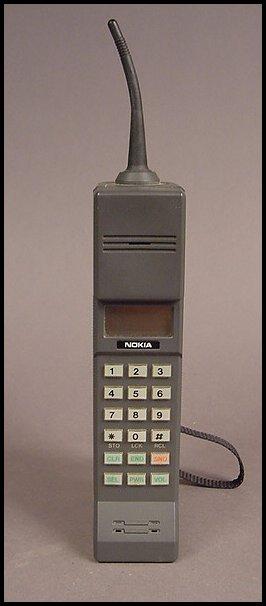
NMT, the world's first international cellular mobile telephone network, had opened in Scandinavia in 1981. In 1987, the Nokia Mobira Cityman, the world's first NMT hand portable, and Nokia's very first hand held mobile phone, was launched.

"Yuppie toys! What do they want mobile phones for? Ridiculous! Haven't they ever heard of phone boxes?!"
-----
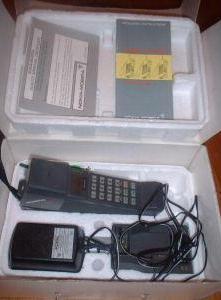
A Nokia Cityman in its box, which had a small plastic handle so, if desired, phone and charger could easily be carried around together.
-----------------------------------
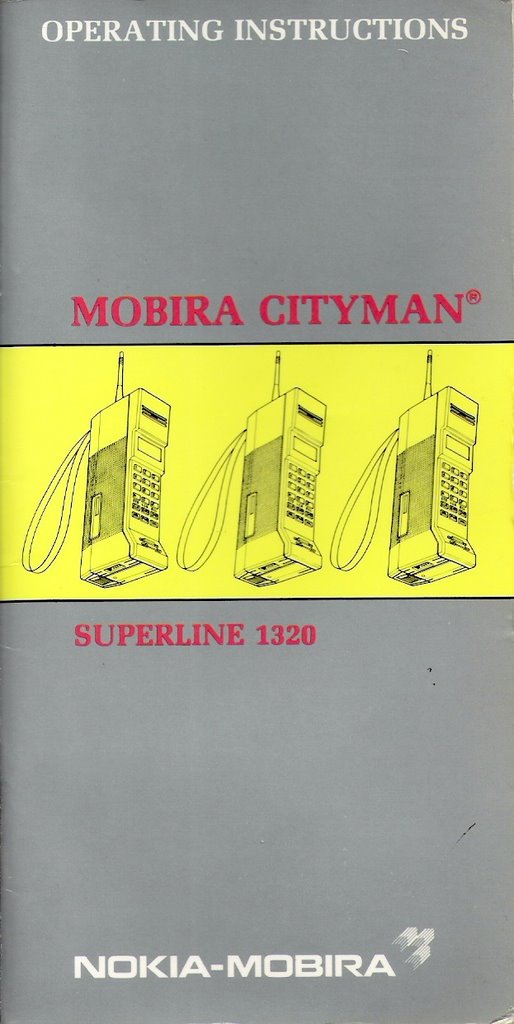
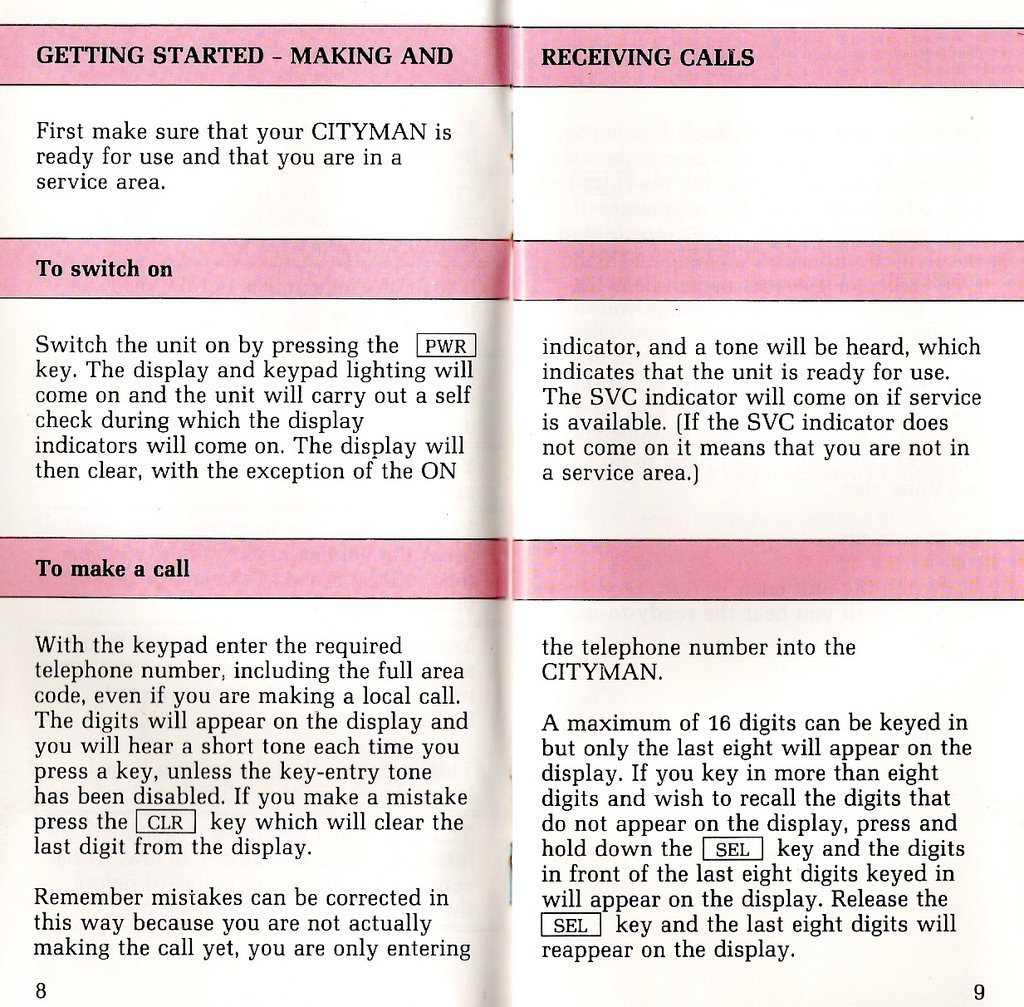
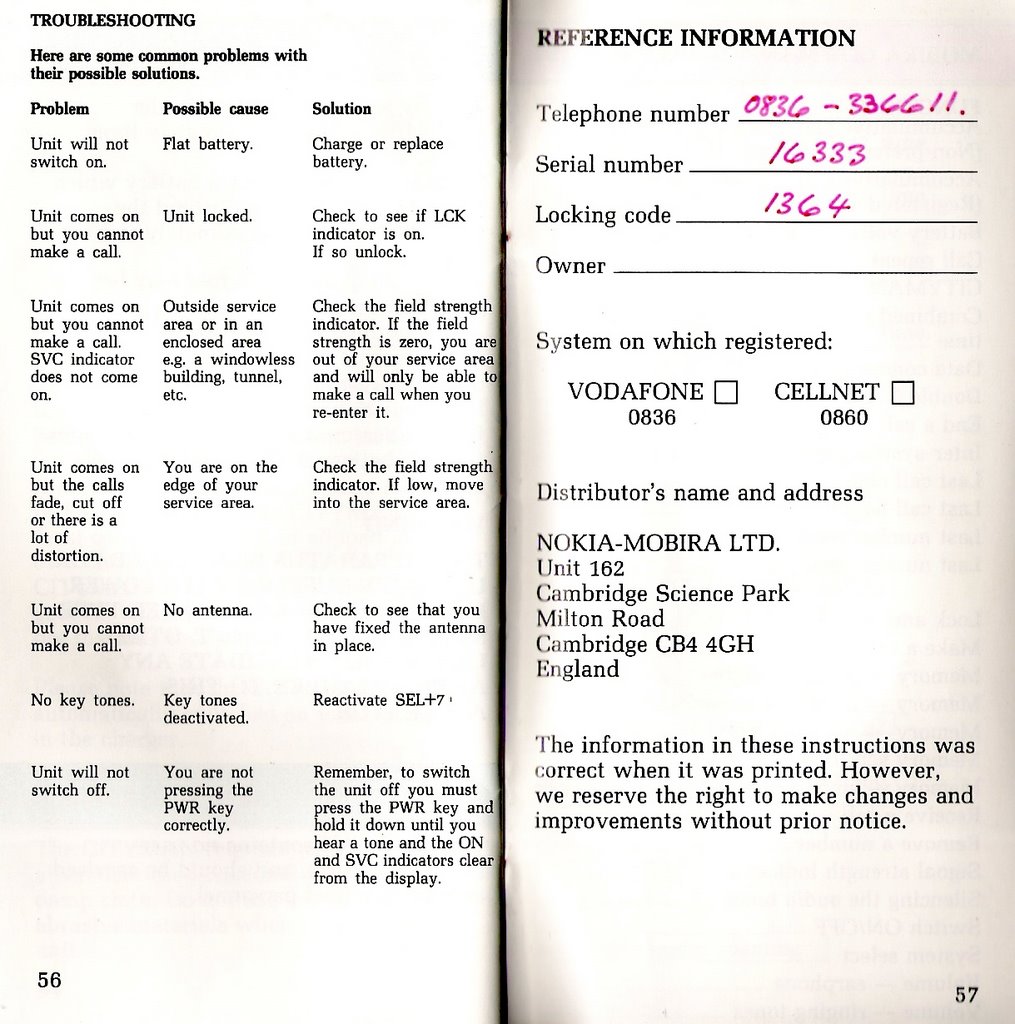
Above the cover to the Nokia Mobira Cityman instruction manual - the 1988 edition. Note the yellow, red and grey design - reflecting the 1980s trend for contrasting bright and dull colours. Below, selected pages from the manual.


The Mobira Senator, Nokia's first mobile, a not-actually-terribly-mobile car phone, was released in 1982. I'm not sure when (or if) it first appeared in England. 

It was around 1987 that I first set eyes on a hand held mobile phone. Initially, I was most impressed - amazing - imagine being able to phone people wherever you might be! This went on for a year or so, then I decided they looked rather like walkie talkies, and, judging by the number of yuppies stalking out of the pub with their bricks because the reception was lousy inside, they didn't seem that great.

So my fascination faded.

Mobiles later shrank, went digital, became dirt cheap and all singing, all dancing, but I still don't have one. I like to be away from the phone when I'm out, there's no need for me to have a mobile, so I don't.

Having been left behind, I still find myself thinking of them as "yuppie toys" at times! That's what we called them in the late 1980s.

For all its sophisticated appeal back in 1987, the Nokia Cityman was basically a clonking great brick. So when did mobile phones start to shrink? See here for more...

For captures from a 1988 television advertisement for Eagle Star investment plans, starring

Rowan Atkinson (Blackadder) and the Nokia Cityman see here. 

Go back to the unveiling of the first commercially available hand held mobile phone EVER here.
------------------------------------------

Swatch Phones and Others...

This is one of my favourite things - a Swatch phone, which has been described as "an icon of 80s design". Note the combination of grey and bright colours - how 80s can you get?!

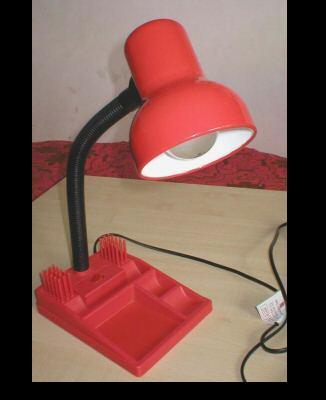
A 1980s lamp and organiser...

... and a popular BT Tribune phone, released in 1987. The Trimphone, with its electronic warble, and the first push button phones, had arrived in the 1960s, but phones had rather stagnated in the cash-strapped 1970s and early 1980s. Many people stuck to traditional dial phones with a bell ring.

Dial phones remained widespread in the 1980s, but this was the decade of choice and many new models became available, as can be seen on this blog.

By the late 1980s, push button phones were taking centre stage and the electronic warble had all but taken over, but there was still a demand for bell ring phones. With the Tribune phone you had the choice, warble or bell models were available. When BT installed a Tribune phone in my flat in 1988, I was pleasantly surprised to find it had a bell ring. The warble has never appealed to me! The phone remains in use on my hall extension to this day.

19 May 2005

Rowan Atkinson and Nokia Cityman Star in TV Ad

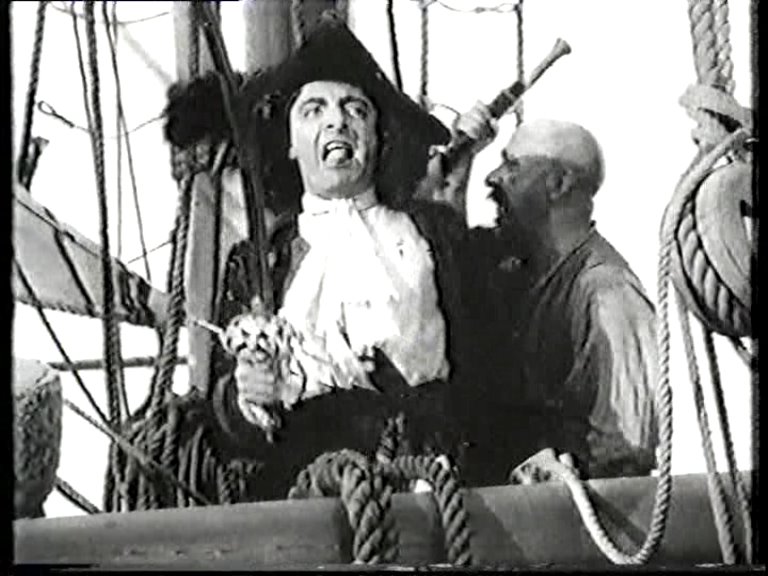
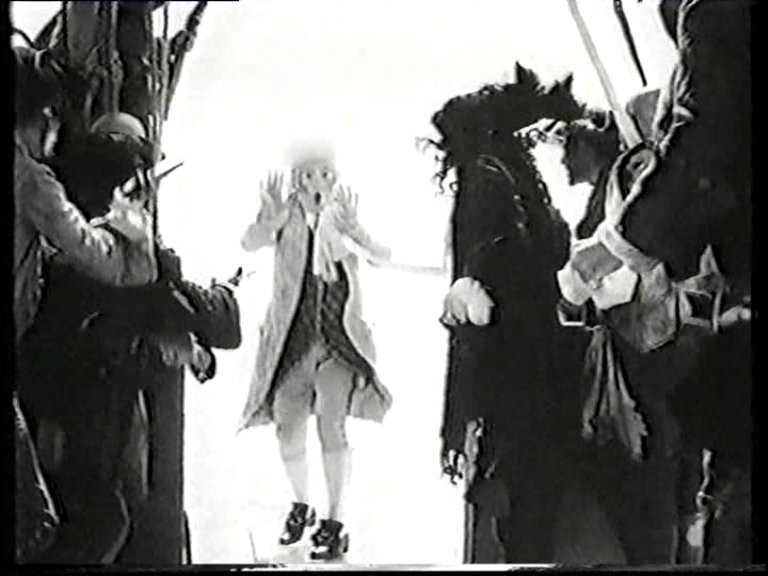
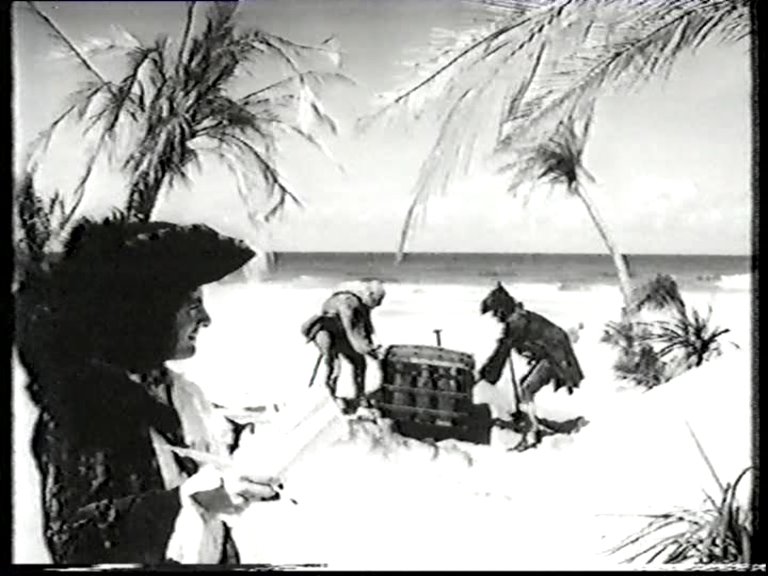
This ad for Eagle Star investment plans dates from 1988 and starred Rowan Atkinson - old Blackadder himself, as Captain Kidd, the pirate. It also starred that technological marvel of 1987 - the Nokia Cityman mobile phone!

The voice-over explained:

This man made a lot of money, travelled the world...

... became a huge success by persuading complete strangers to give him their valuables.

Unfortunately for Captain Kidd, Eagle Star weren't around at the time, so he put his money into an obscure off-shore tax haven. And when he came back, he found he'd lost the lot.

[Andy explains: Captain Kidd's men buried it on this beach, and when Captain Kidd later came back for it, he couldn't find it!].

Take care of your treasure - ask your financial advisor about Eagle Star's investment plans. Because with Eagle Star you can face the future with confidence.

And here's the Nokia Cityman - with skull and crossbones flag for an aerial.

How outlandish mobile phones seemed back then...
---------------------------------------------