Total Pageviews

Pages

28 March 2009

"I Don't Really Know!" - How Les Dennis And Dustin Gee Became Vera And Mavis...

TV Times, July, 1985.

How did comedians Dustin Gee and Les Dennis come to double-up for Coronation Street's Mavis Riley and Vera Duckworth in the famous "Well, I don't really know!" sketches of the 1980s?

Well, it all started with Russ Abbot - who began his Madhouse era in 1980. Mr Abbot, his zany sketches and characters, and line-up of supporting stars, became one of the most popular shows on telly - and two of his supporting stars were Les Dennis and Dustin Gee.

It was during a Madhouse instalment that Mr Dennis and Mr Gee first "did" Mavis and Vera.


One particular sketch featured Russ Abbot selling sketches from a barrow.

"We had to pop up from behind the barrow doing particular impressions, but we got the sequence a bit wrong," explained Dustin Gee. "Russ had already got Mavis Riley beside him and he said: 'And what am I bid for a Bet Lynch?' I said, 'You can't have a Bet Lynch, but here's a Vera Duckworth,' because I was halfway dressed as Vera. I appeared and began talking to 'Mavis' in character. After that, we began to appear more regularly, eventually on Live From Her Majesty's as well as The Royal Variety Show."

Although I have hundreds of Corrie episodes on DVD, I don't have a single one in which the real Mavis actually says "I don't really know!" But, thanks to Dustin and Les, this phrase is still widely associated with her!

Tarty, worldly Vera and twittering, innocent Mavis were an excellent combination for some good, saucy fun. "You know what you need... cock," said Dustin's Vera to her unlikely pal. The slight pause turned Vera's familiar habit of calling everybody "cock" into something rather naughtier!

Sadly, whilst the Gee/Dennis partnership was at its height in 1986, Dustin Gee died of a heart attack, at the age of 43.

But the memories - and the laughter - remain.

26 March 2009

3-2-1

In the increasingly sophisticated mid-'80s, we chucked out our 1982 deelyboppers, pumped up the shoulder pads a little more, and knew we’d made it. We only had to look around us at the wine bars, the bouffant mullets, the pastel coloured clothing (for men as well as women), the black ash furniture, the up-lighters, the glitz and gloss.

Even Dusty Bin, who'd been with us since 1978, was getting more sophisticated - as this article from 1985 shows…

Dusty Bin, the mascot booby prize of “3-2-1”, ITV’s Saturday night game show, has become famous not only as an advanced robot capable of making an amazing number of movements, but also as one of the most lovable characters on TV. Now in his eighth series, he’s a star in his own right, with a whole range of toys named after him. He lives in a converted chapel outside Leeds, the workshop of Ian Rowley.

Robotics expert Rowley had been asked to do some pretty amazing things in his time, from ‘blowing up’ a £20,000 cruiser to making a set of underwater bagpipes for comedian Les Dawson. But the day he was asked to animate a dustbin was, though he didn’t realise it, one of the greatest challenges of his career.

He also didn’t suspect he’d be working on the project over the next three years, continually adapting the £10,000 robot to do new and more adventurous things with every series.

In the 120 programmes Rowley has been involved with, his little friend Dusty Bin has juggled balls, played the piano, flown around the studio with a James Bond jetpack, escaped Houdini-style from chains, ridden a bike, sprayed host Ted Rogers with paint and driven into the studio in a tank to bomb the audience with confetti.

Rowley says: ‘Dusty allows me to do all the many things I’ve always wanted to do but would never have the nerve to. Every week I read the script and say to myself, “What outrageous things can I get him to do next?”’

Every show has fresh challenges to provoke new ideas. But thanks to 73 microprocessors, Dusty never fails to meet Rowley’s requirements. Rowley personally operates him on the show by means of a radio-controlled handset, similar to those that control model aircraft. But technology is moving fast, and he is currently working on refinements which will give Dusty programmable arms, twice the power and the ability to move at five miles per hour. “That’s fast for a dustbin,” he says.

What an era!

And Ted Rogers was still doing his 3-2-1 hand gesture on each and every show.

Wow!

Anything more would have been greedy.

23 March 2009

Neighbours: Suddenly Scott And Charlene Fell In Love...

Ramsay Street, 1986 - and Scott Robinson (Jason Donovan) catches an intruder at Madge's house...

... who promptly thumps him on the jaw...

... and turns out to be Charlene (Kylie Minogue), daughter of Madge (Anne Charleston).

Scott and Charlene have known each other since childhood, and shake hands...

... but Scott is uncertain of the grown-up Charlene.

Charlene, however, is instantly attracted to him... and soon he's pretty keen on her. Will the path of true love run smooth?

They should be so lucky (lucky, lucky, lucky)....

There were loads of ups and downs...

Charlene, seen here dealing with a snide creep of a colleague, was a tough little fighter, Scott more middle class. She wanted to train as a mechanic, he wanted to be a journalist.

Despite their differing personalities and ambitions, the two were deeply in love. And we cheered them on. But the odds seemed so stacked against them. They were too young... surely they couldn't make it to the altar?

But suddenly they did...

Surrounded by family and friends, and to the distinctive tones of Angry Anderson ("Suddenly you're seeing me just the way I am")...

... Scott and Charlene tied the knot. Where's my hankie?

"Especially For You"... just look what the two little... er, darlings gave us for Christmas!

The Neighbours wedding was screened in 1987 in Australia, and in 1988 in England. The whole Scott and Charlene saga entranced huge numbers of us. And there was also great interest in Kylie and Jason. Were they dating? The real life question interested me not a jot, but the Neighbours saga back then was an absolute must-watch.

22 March 2009

Twin Peaks 20th Anniversary, 1989-2009

It suddenly occurred to me today that 1989 is the 20th anniversary of the weird and wonderful David Lynch and Mark Frost creation Twin Peaks. In early 1989, the production team shot what would become the pilot episode and European video release.

Describing how he and Mark Frost designed the Twin Peaks scenario, David Lynch recalled: "We knew where everything was, and it helped us decide what mood each place had, and what could happen there. Then the characters just introduced themselves to us and walked into the story. The pilot was written in only nine days and shot in twenty-three."


Amazing to think that the music, characters, and iconic images - like the Laura Palmer wrapped in plastic image reproduced above - were in place in 1989, a year before the show was first broadcast!


This Warner Home Video of the 1989 Twin Peaks feature contained the pilot episode material, with an alternative ending.

From YouTube - see the beginning of the 1989 Twin Peaks feature.

Demon Bob (Frank Silva) nemesis of FBI Special Agent Dale Cooper - unexpectedly burst onto the scene during filming of the pilot in 1989!

Wake up, smell that damn fine coffee, and read our Twin Peaks tribute here.

19 March 2009

Dangermouse And Duckula (and Penfold, Of Course!)

Dangermouse had been delighting us since his arrival in 1981, and in late 1982 a fan club was on the cards. Just for teeny tots? Er, no, actually...

From the News of the World Sunday magazine, 7/11/1982:

DON'T TAKE THE MICKEY OUT OF THIS MOUSE

Bolder by far than Bond, that's secret agent Dangermouse, hero of the five-minute cartoon series, making Mondays more fun. With his faithful sidekick Penfold he saves the world - again and again. But it's not only children who are fans of the rodent hero in an eye-patch. Recently, a group of Oxford University students wrote to ITV demanding the formation of a Dangermouse Fan Club.

This naturally delights Brian Cosgrove and Mark Hall who make the programme and are now working on an all-action version of "The Wind in the Willows". Also declaring themselves fans of the cartoon hero are comedy actor David Jason (who provides his voice) and Terry Scott, the voice of Penfold. And, if you're a voice-spotter, you'll have recognised Edward Kelsey as Greenback. Remarkably, the rest of the voices are almost all by Brian Trueman.

Count Duckula wasn't your typical vampire duck. For a start, he was a vegetarian. The despair of his faithful servant Igor and the "ducky-boos" of his ever-loving Nanny, Duckula's life was far from easy.

The character was a revamped version of a vampire duck first seen in Dangermouse.

And David Jason provided the voice for the principle character again.

A wonderfully witty new show for 1988.

And another excellent reason for me not to be too grown-up at twenty-three!

He flies through the night, looking for a bite, but he's back home by daylight - Duckula!

Swap Shop Or Tiswas? That Was The Question...

Up until a couple of months ago, many of you wouldn't have seen "Tiswas" because it wasn't fully networked...

A page from the first Look-In magazine of the 1980s - Tiswas was becoming more widespread. However the Look-In ITV programmes listings revealed that a few channels, including Tyne Tees, were still lacking the show!

The marvellous Tiswasonline site history of the series notes...

Tiswas (series 7, 1980 - 1981)

When the subject of Tiswas is brought up, it is this series that is used to define the show. The opening titles, the bucket of baked beans over Sally, the "REAL Trevor MacDoughnut", the cartoon festooned studio set, this is the definitive image Tiswas has, or rather, what nostalgic clip show compilers tend to use to illustrate the impact it had on television.

The 1981-2 season was a little different, with several notables absent (the "adult" version of Tiswas, OTT, was in preparation for 1982) but the show still had many loyal viewers - as did its BBC rival Swap Shop.

On 3/10/1981, the Sun asked:

KIDS! Are you a Swap Shop Swot or a Tiswas Terror?

The Saturday morning battle to win the hearts and minds of Britain's kids starts again today.

Swap Shop (BBC 1, 9.30) returns after a six-month break to compete with Tiswas (ITV, 10.30).

Tiswas, which returned to the screens four weeks ago, has a head start. But Swap Shoppers who do not go for Tiswas's rough-and-tumble pie-throwing pandemonium will be switching back to Noel Edmunds and his team of phone-in funsters.

Is there a typical Tiswas kid, a terror who never stops looning about and does not mind a dousing with a bucket of water?

Are Swap Shop watchers swots? Are they studious, mature children who need more to grab their attention than the Phantom Flan Flinger?

We asked the kids of Britain what they thought of the Saturday morning battle for their time.

Reproduced below are a few of those views...

Brother and sister Dirk and Sandra Brusse of West London, are Tiswas fans. Dirk, seven, says: "I like the songs and the pop groups."

Sandra, eight, says: "I like it when they play Pass The Pie, it's just like pass the parcel. Only whoever gets it throws it at the person next to them. I'd like to play that."

Keith Elsender, nine, of Slatyford, Newcastle, says: "It's about time Swap Shop made some changes. I don't like Tiswas either because they make fools of children. We're not as silly as grown-ups like to think."

Benjamin Pitts, six, from Selly Oak, Birmingham, says: "I'm cartoon crazy and you get the best cartoons on Swap Shop."

Kylie Nurse, nine, of Bristol, says: "Tiswas is very, very funny, with all the pies flying about. My dad has it on and he won't let us watch the other one. But I wouldn't watch it anyway. Sally James is much more interesting than Noel Edmunds."

Rebecca Surtees, nine, of Newscastle upon Tyne says: "I haven't watched Tiswas because I've been told it's stupid. Swap Shop has its faults, like those silly phone-ins. But the rest is quite interesting. I wish people who run television would ask children what they like before deciding what we should see."

Richard Wyatt, of Bristol, says: "My gran calls Tiswas dirty. But I don't care because it makes me laugh."

And what about me, your humble purveyor of 1980s bloggie goodies? Well, I never really liked Swap Shop. I found it rather staid and middle class. Tiswas was better, but I was never really a Chris Tarrant fan for some reason. However, Sally James was a different matter! 'Phwoar!' was the very non-PC expression I used to describe Miss James back in the Tiswas era.

The delectable Miss Sally James in 1982.


Fabulous 1981 Tiswas clip, featuring the Rubik's Cube maestro Patrick Bossert, Aneka of "Japanese Boy" fame and Sally James. Look out for the coffee ad in "Telly Selly Time"!

10 March 2009

1980-1985 - Al Dixon As Emmerdale Farm's Silent Walter Of The Woolpack...

Walter's very first screen close up, October 1980.

For years, confusion reigned over the character of Walter, the silent Woolpack bar propper. When did he first appear? Did he ever speak? Why was he so quiet? What was his surname?

Well, our sister blog, The Beckindale Bugle couldn't, and can't, solve the last two mysteries, but it did manage to solve the others.

Regular readers of The Bugle will know that there were two Walters, one played by Geoffrey Hooper, on-screen from circa 1974 to early 1980, and the other, played by Al Dixon, on-screen from September 1980 to December 1985.

Geoffrey Hooper's Walter was often heard to speak - from episodes of the show available to me and my readers, I can state that he told the Woolpack about the train crash at the junction in 1976; I'm reliably informed he told Annie Sugden at a village dance that he would rather be having a drink with Amos - and an episode I recently viewed from early 1980 featured Mr Hooper's Walter telling Amos Brearly that he'd have a half - not his usual pint of beer! In fact, he wasn't particularly silent at all.

Al Dixon's 1980s Walter said much less - I heard him mumble "Thank you" when Mr Wilks handed him his change in a scene from November 1980, and he laughed out loud when Amos planned to fix the plumbing at The Woolpack - but then who wouldn't have?! But apart from that he was pretty darned silent.

Actually there was a third Walter in Emmerdale Farm, played by Meadows White in a few early episodes, but as that Walter wasn't particularly quiet, nor a Woolpack bar-propper, I assume he was unrelated to the subject of this article! According to Meadow White's IMDB entry, he died on 20 November 1973. Read it
here.

Here, in screen captures, is how Al Dixon's Walter was introduced into the story. The Woolpack was absolutely Walter-less for much of 1980. A non-silent character called Wilfred was sometimes seen at the bar, but then the Emmerdale Farm production team decided that a new Walter was required.

In Emmerdale Farm's early days, Al Dixon had posed for a photograph as Jacob Sugden, with Sheila Mercier as Annie, to be used as a prop on the farmhouse mantelpiece!

In 1980, Al was auditioned for the role of Walter and later revealed: "They asked me to take my teeth out and that's how I got the part!"

His on-screen introduction - episode 597, broadcast in early September 1980 - went like this...

Amos was ranting away to Mr Wilks - in high dudgeon about "summat and nowt" - one morning before Opening Time. As he stalked out of the bar, there was a knock at the door. Amos told Mr Wilks it was Walter knocking, it was time to open up, they had the good name of the house to consider, and so on.

Amos went into the living quarters, leaving easy-going Mr Wilks to open the pub. He made his way to the door and the episode switched scenes to elsewhere in Beckindale so that we didn't get to see Walter at that point.

Screen capture from Walter's very first scene, September 1980.

Later in the episode, Amos was putting Seth Armstrong to rights in no uncertain terms and Walter made his very first appearance, sitting quietly in the shadows. Walter would soon become associated with the corner of the bar nearest the till, but made his debut at the opposite end by the hot food cabinet. In his early episodes, he switched bar ends several times.

At first, Walter was quite low key, but he quickly became more prominent. It was in October 1980 that he got his first screen close up.

Walter's bizarre silence and highly expressive face added something very distinctive and slightly surreal to the atmosphere at The Woolpack. He contributed to Amos' growing reputation as a barmpot as the Woolpack landlord stood wittering away to him about all his latest fads. Walter never answered, but this didn't bother Amos who simply wanted to be heard and not ridiculed. Very occasionally, early on, Walter was heard to laugh at certain particulars of Amos' daft doings, but in the main Amos' chunterings were greeted by an attentive (or sometimes blank) expression and much head nodding.

Bliss for Amos - somebody who would listen to his strange flights of fancy.

Although Walter was silent, his facial expressions spoke volumes. Neither he nor Amos were at all impressed when the uncouth John Tuplin, NY Estates worker, rapped on the bar with his glass in an attempt to get service in October 1980.

Mr Wilks is bemused, bothered and bewildered by Amos' behaviour, Seth is amused, Walter is blank.

By 1983, viewers were campaigning for Walter to speak. But Al Dixon said in 1984: "I hope Walter never speaks. If he did, I think I'd be finished because the character wouldn't be a novelty any more!"

Al Dixon suffered a stroke in late 1985, and Walter last appeared on screen in December of that year, in the village's Christmas play Toad Of Toad Hall. The scenes had been recorded before Mr Dixon was taken ill.

In early 1986, Walter was reported to have gone to visit his sister in Worthing. The production team hoped that Mr Dixon would be well enough to return to the role soon. But, sadly, this was not to be and he died a few months later.

Walter was a tremendous favourite of mine - he brought a great deal of fun to the show from 1980 to 1985, and was a lovely, quirky and gentle character.

Fondly remembered.

Read further details about the 1980s Emmerdale Farm characters at The Beckindale Bugle.

09 March 2009

Albion Market - Soap Opera Of The 1980s, Car Park Of The 1990s...

A visit to Manchester in 1995, and a stroll along the bank of the River Irwell for me and the Mrs, found us lurching through a time warp... back ten years to 1985... What does the sign on that building say?!

We hadn't set out to do it, but we had discovered the set of the short-lived Granada Television soap Albion Market - which we'd both enjoyed in the mid-1980s. I can still recall transforming myself into a Miami Vice reject on Fridays back then - splashing on the Mandate, twisting in the hair gel, pushing up the jacket sleeves - ready for a big night out, whilst following Albie's plot by dialogue and occasional glimpse of the screen. On Sundays, feeling jaded after the excesses of the weekend, I'd settle back in my armchair for the latest episode.

In 1995, the cast, production team and technical paraphernalia had long departed and the old set was a car park. Sad. Just before our departure from Manchester, waiting for the train at the station, my wife darted off to get us a cuppa each, and I saw actress Noreen Kershaw, Lynne Harrison in the show. She stopped for a chat, as friendly and down-to-earth as Lynne herself, and seemed surprised that I remembered her from Albion Market as she'd done lots of other things since those days.

And, of course, she's done even more since 1995!

We'd gone to Manchester primarily to experience the Granada TV Studios Tour, but our visit, from seeing the old set to chatting to a cast member, had had an unexpected Albion Market dimension.

Excellent!

04 March 2009

Crossroads Uproar 1981 - Farewell, Meg!

The Sun, June 18, 1981. In her role as spokeswoman for Crossroads, Noele Gordon was absolutely tireless in her defence of the series against the crudities and jibes of an unkind press. In June 1981, Margaret Forwood, Sun TV critic, was on the attack after Noele had favourably compared Crossroads with Coronation Street... 

"Coronation Street is drama while Crossroads is real," said dear, deluded Noele Gordon the other day. 

Who was she trying to kid? 

In their latest bid to oust the invincible Coronation Street as telly's top soap opera, the brains behind Crossroads have knocked down poor old Benny and left him covered in blood and about to be blinded. That should have knocked his hat off at long last! 

Benny, you will recall, is the illiterate local simpleton befriended by beauty queen, unmarried mother and occasional waitress Miss Diane. He was about to be married a couple of melodramas back but his fiancee was knocked off her bicycle and killed while on her way to a clandestine assignation with her gypsy lover on the morning of the wedding. 

Then he offered to wed reclusive plastic surgery patient Alison who had been left in the lurch by former international terrorist-turned-record producer Chris Hunter. 

But she had a miscarriage and decided to become a nun instead. 

Real, Noele darling?
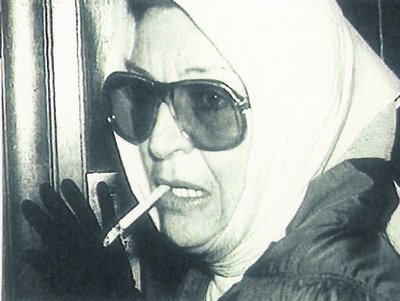
Noele Gordon after news of her sacking from Crossroads was made public.

Whatever people thought of Noele Gordon and Crossroads, there was no doubt that the two went together like bacon and eggs - and had done since the very first episode way back in November 1964.

The announcement that Noele had been sacked from the show exploded upon the media on 22 June 1981. And Crossroads fans were stunned.

The "Save Our Meg" campaign - the Sun, June 24 1981.

Crossroads boss Jack Barton yesterday faced the cast of the TV soap opera for the first time since the Big Sacking Shock.

He saw them for a 20-minute crisis meeting folowing the surprise dismissal of Noele Gordon, the show's top star for the last 17 years.

Mr Barton, the programme's producer, left ATV's studios in Birmingham refusing to comment on the talks or the decision to scrap Noele's role as motel owner Meg Mortimer.

But it is understood that the meeting was called to assure other members of the cast that their jobs were safe.

Rumours have swept showbiz that Noele's departure was only the first of many from the much-loved series.

Noele was in tears before he arrived. But she left smiling, with co-star Tony Adams, 41, who plays Adam Chance in the series.

And later it was confirmed that she had been asked to play the mother of stripper Gipsy Rose Lee in a stage show opening in November at Leicester's Haymarket Theatre...

Sunday Mirror, June 28, 1981: 

Sacked Crossroads star Noele Gordon made a dramatic eleventh-hour plea to ATV boss Lord Lew Grade to save her job. She asked if there was any way she could carry on for a further six months with a new contract. 

But Lord Grade was unable to help. 

He said yesterday that he had put Noele's request to ATV's Director of Programmes, Charles Denton. It was Mr Denton's decision to sack Noele, who plays the motel matriarch, Meg Richardson. 

Lord Grade said: "Noele's agent asked if there was any way for her to carry on. "I asked Charles Denton if it would be possible to consider it. His reply was the he didn't want to change his plans, and that it would be nice to start the next season with something new and exciting. 

"I just put the point to Charles. I didn't ask him to reconsider. 

"I am not allowed by the Independent Broadcasting Authority to interfere in any programmes."

Lord Grade also revealed that Noele had had a massive change of heart about Crossroads. 

"About a year ago, Noele came to me to say that she wanted to leave the programme, but I persuaded her to stay," he said. "She is a very sweet person, and has worked very hard for Crossroads and ATV. But I do not know whether she has any future role in the network." 

Mr Denton, 43, said that since Noele's sacking he had received hundreds of protest letters from fans, among them two death threats. 

One, he claimed, came from the Birmingham chapter of the Hell's Angels. 

"I really didn't know there were such Crossroads fanatics," he said..
. Daily Mirror, 19 October, 1981: 

 Meg Richardson and her Crossroads crew were all at sea yesterday as yet another version of her departure from the TV soap opera was filmed. Meg, played by actress Noele Gordon, waved a fond farewell to her screen daughter Jill, played by Jane Rossington, from the stern of the liner QE2. 

The storyline of the scene, filmed at Southampton, has Meg quitting her motel and emigrating to Australia. 

But it is only one of seven possible endings which have been recorded. These include a fire which guts the motel, and some scenes have shown a funeral. The actual ending is being kept a big secret. 

No one except producer Jack Barton knows the answer - and even he's not sure. "I shall be deciding which ending to use on the day the programme is screened," he said.

Daily Mirror, October 27, 1981: 

Crossroads star Noele Gordon pleaded for her life yesterday. She wants a happy ending when she is written out of the TV soap opera next month. 

So far the veteran star of the serial has filmed five endings - four tragic and one happy. They include losing her life in a motel fire, taking an overdose of pills and a graveyard scene. 

The one that will be finally used is ATV's best kept secret. 

But Noele is hoping her TV bosses will use the happy one where she sails off into the sunset on the QE2. 

She said: "During the QE2 scene the sun started to shine, the flag flapped at the right time and it all looked very pretty. That is the way I want to go." 

Noele started rehearsals yesterday for a leading role in the £250,000 musical Gypsy which opens at Leicester's Haymarket Theatre in December. But she is still bitter. 

She said: "After twenty-six bloody hard years with ATV, for someone to say to me 'All good things must come to an end and we don't want you any more' - well, I didn't like that."
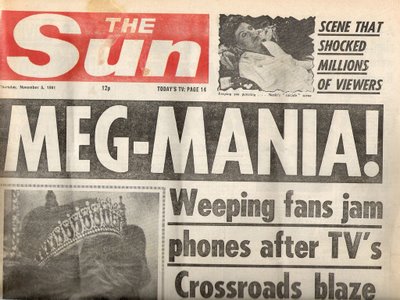
The Sun, 5/11/1981. The article, by Baz Bamigboye, read: 

Crossroads mania swept the nation last night after the TV motel went up in flames with boss Meg Mortimer apparently inside.

Hundreds of weeping viewers jammed ITV switchboards demanding to know Meg's fate.

And some became so wrapped up in the drama that they phoned hospitals to ask about her injuries.

It was a nerve-wracking episode for the TV audience. First they saw Meg - played by Noele Gordon - apparently taking a drug overdose. Then came the fire.

From ATV, the company that makes the long-running series, the message to distraught viewers was: "Keep viewing."

Fans were promised that Meg's fate would be revealed in next Wednesday's show. An executive said: "That is the crunch episode, and people should watch it."

The Sun has already revealed that last night's episode would not be the end of Meg.

And we can now reveal that Sam Hurst, the painter in the series - played by Brian Badcoe - died in the motel blaze after rushing in and trying to rescue Meg.

Producer Jack Barton said: "In the run-up, fans have been led to believe that Sam was going to start the fire, but that is wrong."

In last night's episode, viewers saw Meg Mortimer walk into her room and put some pills on the table, along with a note to her daughter Jill (Jane Rossington).

At the last minute, as the motel staff were enjoying a bonfire-night party outside, Jill glanced around to see the motel in flames. She screamed: "Mum! Oh my God!"

The ending was the signal for viewers to seize their phones.

An ATV spokesman said: "There have been hundreds of calls at ITV stations around the country."

He added that the "whole nation had gone wild" about Meg - whose sacking from Crossroads caused an outcry.

An ATV switchboard operator said: "We've had scores of people crying down the phone, making no sense at all."

Crossroads addict Mrs Lynda Belcher, of Great Shefford, Berks, said: "I wish they hadn't left us in suspense. It's terrible that they are writing Meg out of the series."

The Sun, November 12, 1981.

The QE2 ending was used and Meg sailed away, unaware that the motel was in ashes.

Opposition leader Michael Foot is inspired by the blaze at the motel in this Franklin cartoon, November 5, 1981.

Daily Mirror, August 19, 1983. A brief return to Crossroads for Noele Gordon... 

 Meg Mortimer toasts the bride and groom in a TV scene that Crossroads fans thought might never happen. 

Meg, boss of the Crossroads Motel for 18 years, was written out of the soap opera two years ago. Now, in a new episode, she is reunited with her TV daughter Jill who is honeymooning in Venice with husband Adam Chance. 

Meg, played by actress Noele Gordon, is making two guest appearances in Crossroads. But she admits there are no plans for a permanent return. 

 In 1985, Phillip Bowman took over as Crossroads producer from Jack Barton and planned to bring Meg Mortimer back as what he called a "permanent occasional" character. Plans were well advanced when Noele Gordon, afflicted with cancer, died.

1984: Egg Hits Margaret Thatcher

From the Daily Mirror, June 24, 1984:

Premier Margaret Thatcher was hit in the face by an egg yesterday.

Butter, ice cream and a tomato, also thrown by demonstrators, missed her.

The barrage came as Mrs Thatcher left a Tory meeting at which she had condemned the miners' strike and picket-line violence.

She was jeered by miners' wives outside the meeting - at Porthcawl, in Wales - but the missiles came from farmers and their wives.

The Dyfed Farmers' Action Group later claimed responsibility, saying it had hurled three dozen eggs and four pounds of butter in protest at Common Market agricultural policies.

A group spokesman said: "We threw only New Zealand butter because we didn't want to waste good British butter."

At the meeting, Thatcher described the miners' strike as:

... a "tragedy" for miners, the coal industry and the country.

Mrs Thatcher said: "The violence which recently disfigured the television screen has left us grievously anxious."

She praised the police for their "courage, fairness, patience and restraint."

"Our duty is not discharged simply by condemning violence. Our duty demands and the national interest requires that we see that violence does not pay and is seen not to."

Bus, train and ferry services in London and the South-East will be disrupted by walk-outs in support of the miners on Wednesday.

Stepping into the 1980s was rather like stepping into an exhilarating minefield. It was the decade of fast-moving fads and clonking new technology; the decade when many working class folk got some dosh or joined in the credit boom; it was the decade when some folk got poorer; it was a decade unlike any other.

But Margaret Thatcher was not destined to reign long, it seemed, in the early 1980s. As unemployment leapt whilst the government concentrated on bringing down inflation, Mrs T became very unpopular. By 1982 she was the most unpopular Prime Minister of the 20th Century. But then came the Falklands War and the Iron Lady came into her own. A strong leader, that's what many felt was needed at that point, and she was certainly that. And, on the back of the so-called "Falklands Factor", she called an early election in 1983 and was returned to Downing Street for a second term with a landslide victory.

And then the Miners' Strike reared up, Arthur Scargill and a way of life against the Iron Lady. The Strike was long and bloody and at the end of it Thatcher had triumphed.

At that time a new breed of person was appearing - the yuppie. The acronym (young urban professional) had first appeared in America in 1980, and caught light as it was applied to those taking advantage of the new political regime after the inauguration of Ronald Reagan in 1981 (he was elected in November 1980). And where America led, we followed.

The UK was changing. The world, it seemed, was changing. The mid-to-late 1980s were either a hopeless or hedonistic time, depending on your vantage point. Or a time to protest.

Did you love or hate Thatcher? Whatever you did, you couldn't ignore her and political arguments raged in pubs up and down the land. And whether you argued for or against the Thatcher government, the scoring of points was an exhilarating experience. I argued fiercely against and had some of the best pub nights out in my life!


Nobody argues like that now. And if people shook themselves out of their state of smug complacency they might just see that rather more interest in the modern day political scene, and the calling to account of our modern day political parties, wouldn't come amiss. But it's so much easier to blame the '80s for everything and do nothing!

23 February 2009

Coronation Street - the 2000th episode, The First Video Release And A New Street...

Coronation Street celebrated its 2,000th episode on 2 June 1980, and TV Times published a souvenir magazine to celebrate.

The landmark occasion was reached on the same day that Elizabeth II celebrated twenty-seven years as Queen. On the cover of the magazine were Ena Sharples (Violet Carson), Elsie Tanner (Pat Phoenix), Albert Tatlock (Jack Howarth), Ken Barlow (William Roache) and Tracy Langton (Christabel Finch). The souvenir included an introduction by Len Fairclough, a copy of the script of the very first episode, street party scenes and photographs of a trip to Singapore, featuring the producer and several cast members.

Ena Sharples made her final appearance in Coronation Street in April 1980. There was no big send-off as Violet Carson did not intend to leave at that point and several long absences during the 1970s had familiarised viewers with lengthy spells without the Hairnetted One.

In the storyline, Ena threatened not to return, but she'd done that before!

Violet had not been in the best of health for years, and had at times seemed somewhat disenchanted with the character of Ena, but I remember reading a newspaper article c. 1983, headed I'll Be Back, Vows Ena, complete with a lovely photograph of Vi at home in Blackpool, revealing her determination to don that famous hairnet again.

Sadly, this was not to be. Violet died on Boxing Day 1983.

Tracy Langton is in the lead in the egg and spoon race - and rules are made to be broken! Look at the blatant egg-gripping going on!

"Ooh, flamin' nora - fellas!!" Party animal Mike Baldwin sleeps it off.

What was happening to Len Fairclough in 1980? Well, the year had begun badly with Rita lambasting him after he'd slipped off to Molly Coggan's New Year party with a few of the lads, leaving Rita high and dry at the Rovers.

Early in 1980, Rita walked out on him, seeking to take up her nightclub singing career again. Len hit her and she left for Blackpool.

Len begged her to return and she did, but she made two things plain - Fairclough's selfish ways and the pig sty they lived in would BOTH have to change. Actually, we thought Rita herself was fairly horrible herself during this - she was no angel herself - and she suddenly seemed to have adopted a self righteous attitude that stank. Puzzling storyline - particularly as Len had collapsed at work in 1979 through overwork. Smelt a bit of misandry.

Other happenings of 1980 included Eddie Yeats moving in with Stan and Hilda Ogden, Renee Roberts meeting a nasty end in a road accident, and Bet Lynch and Elsie Tanner clashing over womanising lorry driver Dan Jackson.

He wasn't worth it.
-
Talking of Len, here's a newspaper advertisement from 1980. Video technology had been around for yonks, but domestic VCRs only a few years. In 1980, only 5% of UK households possessed a video recorder - they were far from cheap to buy outright at that point, and renting was a financial commitment many could do without in those hard-pressed times. The video revolution had to wait until a bit later in the decade to take hold.

The Magic of Coronation Street, Distant Memories - 1960-64.
-
The very first Coronation Street video release was dated 1982 and was produced by Granada Video. It contained six full episodes, including the first, and specially filmed sequences with Doris Speed, Pat Phoenix and Peter Adamson in character as Annie Walker, Elsie Tanner and Len Fairclough. My family didn't have a video recorder at the time, but I thought it was the "coming thing", so bought the Coronation Street video. Although dated 1982, I don't remember seeing the video on shop shelves until 1983, so the release date was probably late 1982 or perhaps even 1983.
-
The Magic of Coronation Street later returned to the shops in different packaging - courtesy of Vestron Video - as two separate releases, each containing three episodes.
-
This photograph from the Daily Mirror, 27/2/1982, shows an excited Hilda Ogden pointing at the new, under-construction, No 13 Coronation Street.
-
Hilda had already experienced two new No 13 exteriors. The Ogdens arrived in the programme in 1964 and in those days the Street's exterior set was actually in the studio.
-
In the late 1960s, an outdoor set was constructed - of lath and board - on the Grape Street lot near the studio. A single English winter played havoc with the flim-flam facade, and permission was granted for the Street's frontage to be built in brick. The back yards were added later.
-
For reasons of space, the outdoor facade was built far smaller than life size, as had been the case with the original studio set. But few viewers noticed anything wrong as, when seen through the TV cameras, the Street looked much larger.
-
In 1982, the Street was rebuilt, closer to life-size than it had ever been, and an entry was inserted between the Rovers Return and Albert Tatlock's bay window. For years, viewers had been writing in to say that the Rovers loo doors led directly into Albert's. They did, and the show's producer Bill Podmore used to joke: "Perhaps that's why he's always so grumpy!"
-
So, with a little bit of extra space for the ladies' and gents' conveniences (though, outside of soap reality, probably not enough), 1982 was a happy year for Albert!
-
5 May 1982 - and there's some Royal visitors at the Ogdens! The Queen and the Duke of Edinburgh visited the new exterior set and met members of the cast and production team.

The "Coronation Street" cast, all dressed in their characters' best clothes, waited to greet the VIP visitors by their respective front doors. Jean Alexander, in Hilda's best frock, was actually curler-less (yes, Hilda would take them out on special occasions!), Stan (Bernard Youens) wore his best cardie and jacket, but Geoffrey Hughes, as Eddie Yeats, was wearing a donkey jacket over his smart suit - as befitted Eddie's role as a binman.

Giggling, gap-toothed Scouser Eddie was a long-term pal of the Oggies, and became their lodger in 1980. He met his true love, Marion Willis (Veronica Doran), in 1982. The couple were caught up in the CB radio craze and carried the "handles" "Slim Jim" and "Stardust Lill". They met over the airwaves. In 1983, Marion and Eddie married and left the Street.