Total Pageviews

Pages

30 June 2011

Soap Aid 1986: EastEnders And Emmerdale Farm Stars In A Lather For Charity...

From the Sun, July 28, 1986:

Do you remember all the charity events of the 1980s? You couldn't walk out the door without colliding with a sponsored walk, a sponsored silence, a sponsored bean scoff, a telethon, a walkathon, a talkathon, a bonkathon (you should be so lucky), etc, etc.

This particular event, part of "Soap Aid", appears to have been a bit of a wash-out, but it's good to see Beckindale's Amos Brearly (Ronald Magill), Seth Armstrong (Stan Richards) and Dolly Skilbeck (Jean Rogers) hobnobbing with Walford's Angie Watts (Anita Dobson) and Michelle Fowler (Susan Tully).

EastEnders and Emmerdale Farm - both shows had titles that started with an "E" and both were soap operas, but, in 1986, they had little else in common. The Square squabbles seemed to be a million miles from the Dales tales!


29 June 2011

Acid House

One of the big "things" in 1988 and 1989 - the smiley face! Created in the 1960s and long associated by us plebs with kids' badges and jolly tea mugs, the face was suddenly the symbol of a rather frantic and frankly rather naughty progression from the House Music scene called Acid House. I was confused. House music had been created in Chicago - 1983 was 'Year Zero' for House - and the sound had not begun to go wide until midway through the decade.

And now we had ACID House. Say what?!


The smiley face was soon cropping up on T-shirts everywhere, accompanied by the slogan "Right On One Matey!" The elders got themselves into a right old stew about it all, whilst many youngsters, bored with being garishly posh, gothy, Indie or synthy, eagerly embraced the chance to get sweaty under strobe lights, and move about to weird electronic noises and samples.

And if you had to break into somebody else's warehouse or barn to do it, all the better!

Some newspapers seemed alarmed. A new drug culture, and the kids acting up again. Oh dear! Where had Acid House sprung from?

The Observer observed in 1988:

Drugs Fear as the 'acid house' cult revives a Sixties spectre


"Acid house" started in four London clubs... In the past month it has "taken off", spreading to other clubs around the country.


1988 and 1989 were wild. Absolutely evil according to some! The elders were definitely rattled!

From the Sun, August 28, 1989:

More than 25,000 youngsters - some aged only ELEVEN - went wild at a huge acid house party yesterday as the police watched helplessly.

Dozens of evil pushers raked in a fortune openly selling the mind-bending drug Ecstacy at £10 a time - with a bottle of mineral water to wash it down.

A police superintendent and WPC moved through throngs of spaced-out teenagers as dealers chanted "E, hash, weed" to the beat of the music.

School-age children rolled their own reefers.

But the officers were only there to make sure there was no trouble while notices about the noise were served on the organisers.

The 15-hour bash started on Saturday night when hordes of acid house fans converged on the village of Effingham, Surrey.

Cars, coaches and vans poured into Newmarsh Farm for the £30-a-head "Energy Summer Festival".

Youngsters from as far way as Leeds, Swindon and Ipswich screamed "Mental, mental" as lasers lit the sky.

Headlines from the Sun CONDEMMING the drug craze flashed on a huge video screen.

Party organisers made an estimated £500,000 from the bash - which cost about £50,000 to stage.
Police, who only heard of the party hours before, at first stopped youngsters entering the site.
But as thousands joined the crush, senior officers decided it was safer to let them in.

About 70 police were on duty, but there were only seven arrests - two for alleged drug offences.
Police will quiz the organisers and those responsible for the land.

A spokesman said:

* An acid house bash, tagged The Heat, was smashed at the weekend because it was a FIRE RISK.

* Around 10,000 revellers were expected to head for a disused factory at West Bromwich, West Midlands.

* But the local council won an injunction to ban the party after fire experts declared the building unsafe.

* Only 30 youngsters, mainly from London, arrived at the factory, but were promptly turned away by the police.

"There could be criminal charges."

Michael Grylls, MP for North West Surrey, said: "It is a massive indictment of parents that they allow their children to attend this sort of thing."

Fellow Tory Terry Dicks said: "These parents should be fined, if not sent to prison."
Monks at a silent order at West Kingsdown, Kent, were disturbed by 3,000 at a nearby acid house party.

Master of a little-known DJ skill called Transformer Scratching (making a record sound like a robot's voice), James Dorrell was hailed as a pioneer of "English hip-hop". Dorrell, who was also in M/A/R/R/S (Pump Up The Volume), was interviewed in 1988 and said of Acid House:

"It's really crazy, psychedelic music. There's no real tune, just lots of studio technology. You can also scratch other bits of records over the top of the beat and add to the effect. The other day I found an amazing old record by Brian Clough of all people! I used this bit where he says, "He's got a good left foot that lad!" over a serious Chicago House groove. It sounded brilliant!"
Mind you, imagination and originality were needed. Dorrell again:

"If I hear another James Brown yelp or This is a journey into sound again I'll scream!"

Despite the '60s psychedelic references (particularly the return of the lava lamp, which became HUGE in the 1990s, reaching its highest ever sales), the new drug culture (just what was this ecstacy?!) and so on, followers of Acid House were not hippies. From what I saw, they were harder, more streetwise, more working class - "On One Matey!" rather than "Peace Man!" The music too was very different. 20th Century Words by John Ayto, describes it thus:

Acid House n (1988) a type of house music with a very fast beat, a spare, mesmeric, synthesised sound, and usually a distinctive gurgling bass noise. Also applied to the youth cult associated with this kind of music, characterised by a vogue for warehouse parties, a revival of psychedelia, and the taking of hallucinogenic drugs. "Acid" may well be the slang word for LSD, although many cultists claim that it comes from the record "Acid Trax" by Phuture (in the slang of Chicago, where this music originated in 1986, "acid burning" means "stealing", and the music relies heavily on "sampling" a polite word for stealing musical extracts).

Did you join in or want to put an end to the "menace"? From the "Sun", November 18, 1988.

Sheena Easton: "My Baby Takes The Morning Train..."

We were all hoping for good things for singer Sheena Easton, who hailed from north of the border, and first came to our attention on Esther Rantzen's The Big Time show.

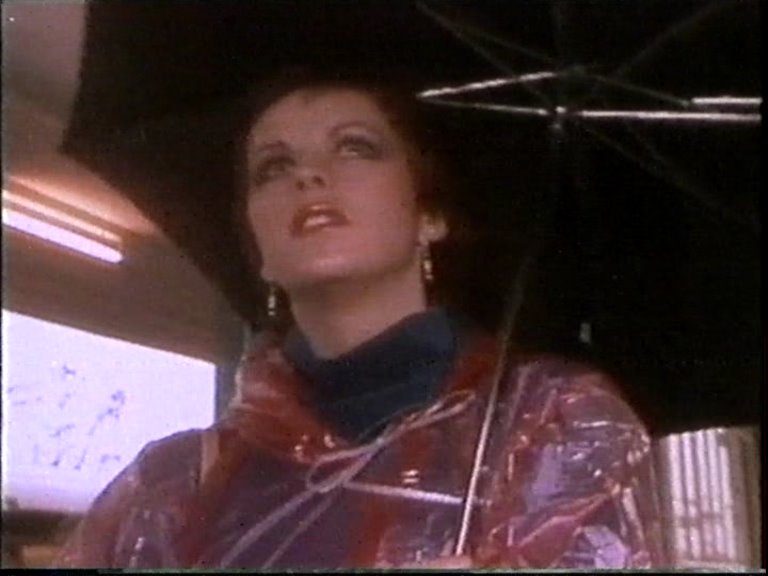
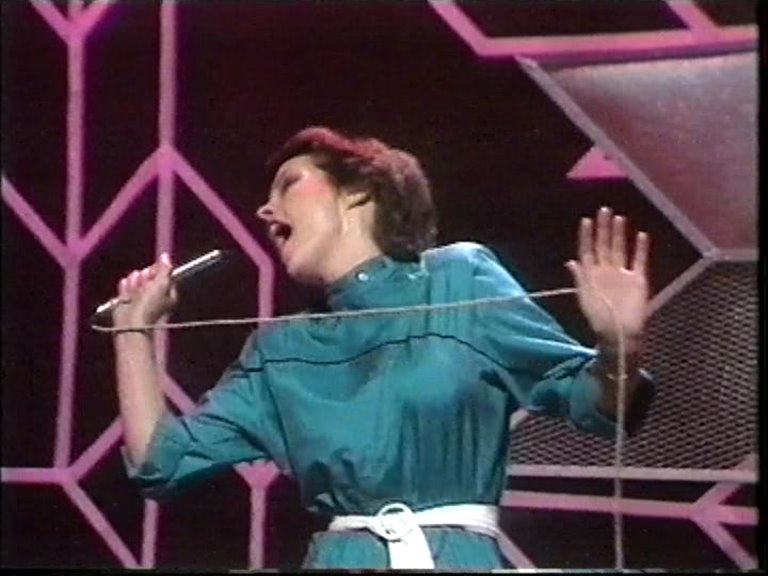
And good things she got - quickly scoring several hits here. It didn't matter if she was a Modern Girl or a traditional stay-at-home, waiting for her hubby to arrive back from his 9 to 5, Sheena could do no wrong...

"All day I think of him - dreaming of him constantly..."

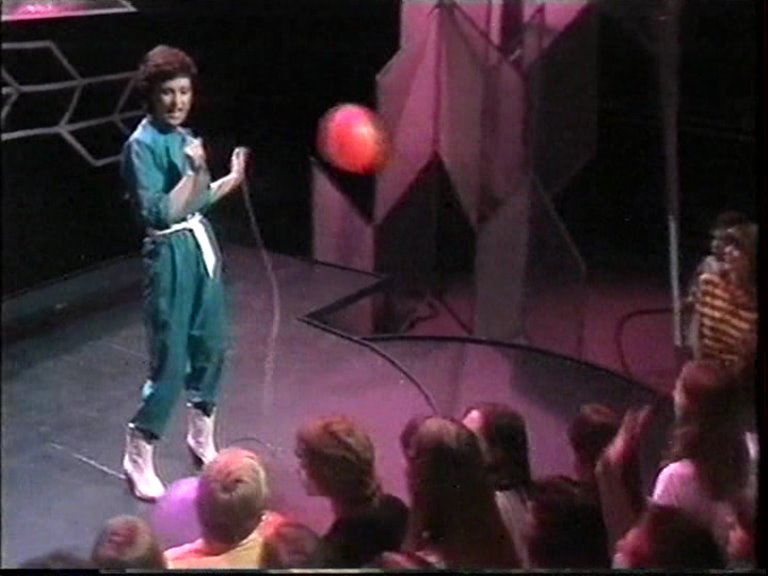
The audience was so thrilled that a balloon was let fly.

Sheena later left us far behind, hitting the USA for a brief (fictional) marriage to Sonny Crockett of Miami Vice and a duet with pop genius Prince.

Who would have believed it back in 1980? In fact, I'd never even heard of The Purple One back then, and Miami Vice was still a twinkle in a scriptwriter's eye...

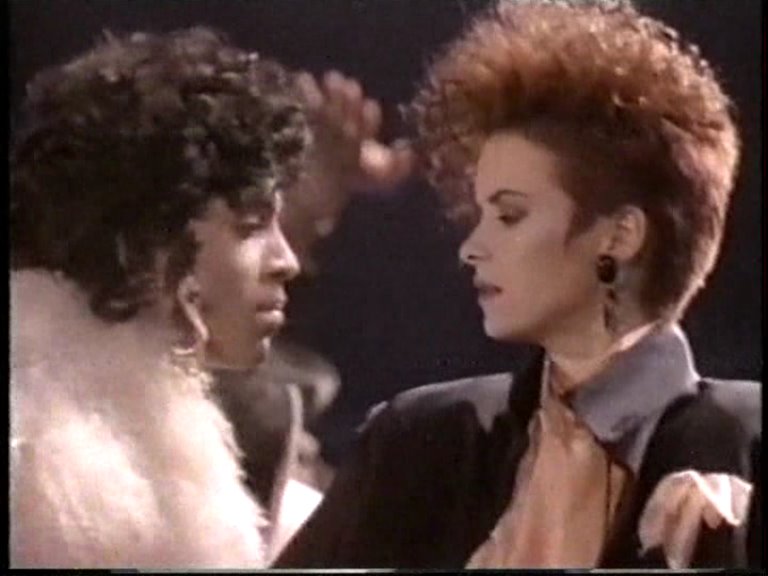
Fast forward... From a boiler suited 1980 to a shoulder padded 1987... Sheena with Prince in the video for "U Got The Look".

1982: The Kids From Fame In England...

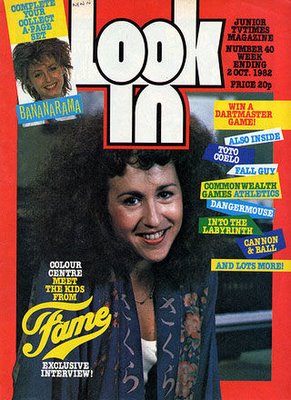
"Baby look at me and tell me what you see..." We see Doris on the cover of an October 1982 Look-In magazine, which contained an invitation for readers to meet the kids from Fame in an EXCLUSIVE INTERVIEW!

"You ain't seen the best of me yet, give me time I'll make you forget the rest..."

It had all started as a film in 1980, but now, in 1982, we got Fame the TV series, and Fame fever struck! The series helped start a major fashion trend - transforming leg warmers from useful but boring garments into high fashion. Yes, they were worn on the streets in high summer.

"You want fame? Well, fame costs. And right here's where you start payin' - in sweaty ankles..."

Here's a newspaper advertisement for Fame, the 1980 film, available on Video 2000 in 1982.

Video what?!

Yes, we didn't only have Betamax and VHS to confuse us. Perhaps it was a good job that video machines were too expensive for many of us!
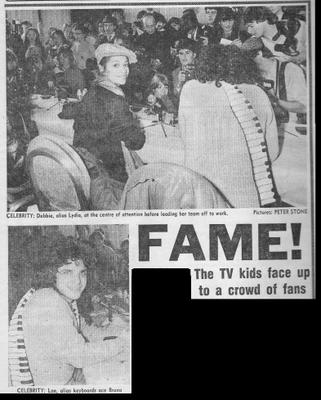
Fame, the TV series, was first shown by the BBC on Thursday, 17/6/1982.

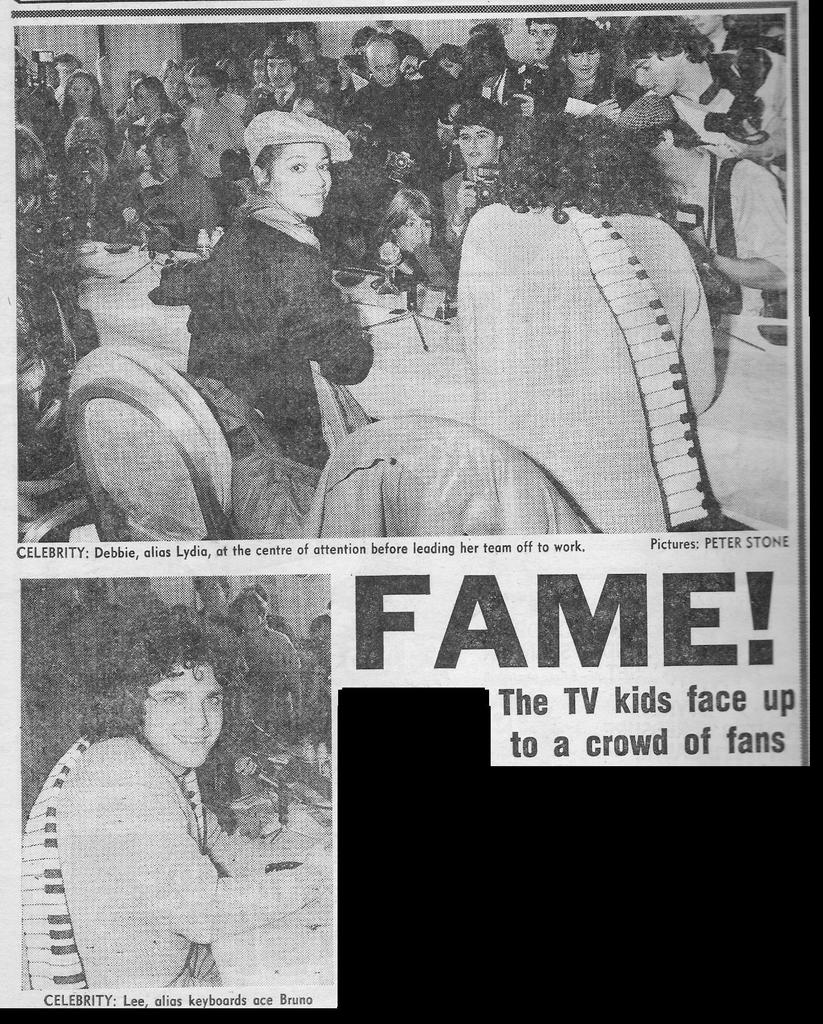
From the Daily Mirror, 31/12/1982:

The Kids from "Fame" faced up to the consequences of their phenomenal showbiz success yesterday. They were hemmed in by a crowd of fans and photographers at their London hotel.

The singing, dancing, music-playing kids, including Debbie Allen and Lee Curreri, came smiling through as they do in their TV shows.

It was their first night off during a ten-day British tour.

But they were given no time to relax at their hotel when the cameras clicked and they were questioned by a group of children for an ITV programme.

One youngster asked Debbie, who plays teacher Lydia Grant in the series: "What do you do if you want to be a dancer?"

The answer: "Just jump into it and work, work, work."

Then, without further ado, Debbie led Lee Curreri, who plays keyboards ace Bruno Martelli, and the rest of the cast back to rehearsals and work, work, work.

Claire, my little sister, was a Fame devotee well before the end of the year. My diary entry for 8/9/1982 reads:

Claire has gone bats on "Fame". I'm going bats listening to her rambling on and on about it. There's going to be trouble if this keeps up.

16 June 2011

Postbox: The 1980s Versus The 1970s...

Thanks to all those who write in. It keeps me company, and I'm truly grateful.

Lovely recent e-mail from Sita:

We have a very attractive young teacher called Miss Cross at my school who likes to encourage debates. She often joins in and hogs the show because she's very fond of herself and usually able to out-argue any student.

One day recently, she set the agenda: "Let's talk about our favourite decades. What decades were significant, and why?"

Immediately, she started going on and on about the 1970's, how wonderful they were, how hippie they were, how world shatteringly eventful and influential they were...

I pricked up my ears and said: "But surely hippies were 1960s? They may have been around in the 1970s - '80s as well - but they started out in the 1960s?"

"Yes," said Miss Cross, "but the full thrust of hippiedom was felt in the 1970s. Woodstock..."

"But that was 1969!" I said.

Miss Cross went a bit red. "The gateway to the 1970s," she said.

"I disagree," I said. "1969 was not the 1970s."

Miss Cross was looking rather cross, and said: "Well, what decades interest you?"

"I find the 1980s fascinating," I said.

"The 1980s?" Miss Cross smirked. "A very conservative and vapid decade, in my opinion."

I frowned: "How come? Red Wedge, Greenham Common, Perestroika, fall of the Berlin Wall, creation of House and Acid House music, invention of the World Wide Web, inner city riots..."

"But many events of the 1980s were the outcome of events from other decades," said Miss Cross.

"And many events of the 1970s were the outcome of events from other decades," I countered. "Left-over hippiedom and flared trousers for a start."

"But the inventions, the fads, fashions and the technology of the 1980s can't hold a candle to the 1970s," said Miss Cross. She was getting very red in the face by now.

"Rubik's Cube, CB radio, ZX Spectrum, Apple Mac, invention of the World Wide Web, goths, shoulder pads, hair gel and mousse, leggings, ra ra skirts, jelly shoes, bulldog clips, first commercial hand-held cell phones, beginnings of GSM system, DNA fingerprinting, Sky TV, Trivial Pursuit, Pac-Man, Super Mario Brothers, Channel 4..." I recited.

The debate ended.

"Yes, well, that's most interesting. Thank you, Sita," said Miss Cross, looking as though she'd like to slap my face.

My friends and I still talk about that day. And it's thanks to you, Andy, because I took all my info from your blog!

Miss Cross hasn't initiated a debate since, and the decades skirmish was two months ago!

Thank you!


Glad to help, Sita. It does give me the pip when people start glorifying decades (usually the 1970s, unfortunately) when they don't know their facts. Decades are ten year spans and every ten years contains its own significant events, fashions, fads, and are usually interesting enough and significant enough without having to embellish them.

Judging by TV, books and on-line stuff, the 1970s are the exception...

But that's not true. Plenty happened in the 1970s, even if you just stick to the real 1970s!

Of course, the 1980s are priggishly disapproved of because they were the era of Thatcher and Reagan and enormous changes, both socially and technologically. But that's why they're so fascinating. And no amount of attempts to rewrite history can make the ... er... actual 1980s any less so.

04 June 2011

The 1980s House - Part 1

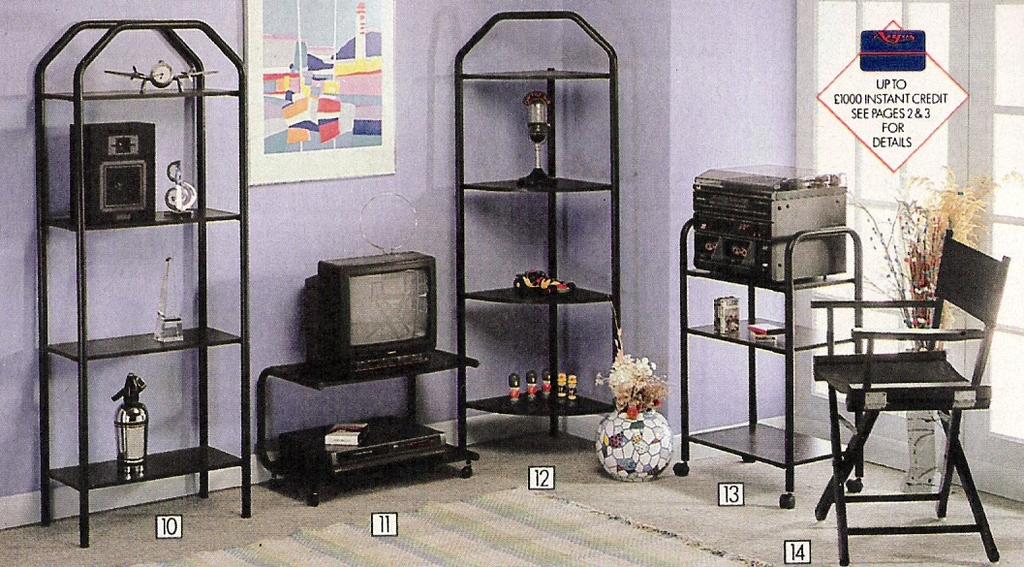
1989 living room from Argos catalogue. Blue pastel walls and black, black, black! Black was hugely popular in the mid-to-late 1980s, even TV casings went that colour - a trend which lasted throughout the 1990s. The director's chair on the far right was a must-have - so very, very stylish!

You've looked around your house, grown sick of your "funky" late-1960s inspired wallpaper (it makes your eyes go funny) and realise you want style. You want a 1980s style home.

Do you? Do you really? There were so many styles of homes in that decade, each one designed to say something about the occupant and their lifestyle.

But you are not to be diverted. You want your home to give a screamingly 1980s effect, and you are determined. OK then. We'll take a look at popular decors of the 1980s including furniture, knick knacks, clocks, kitchens, kitchen ware, and bathrooms. See what you think afterwards. This is the first of four articles designed to bring the 1980s house back to life.

1989: Black blinds... Mmmm... lovely. Red blinds for the kitchen, of course. An uplighter. Glorious. But a black stand for it might be nicer... And look at that music centre - yuppie heaven...

1989: A very beautiful black ash shelving unit and bed settee. The mixing of black, grey and red in the design of the settee material is so 1980s. Don't you just love it?

As well as black, toy box colours were incredibly in, and this kitchen from 1983 simply shrieks "1980s!


If you were poor in the 1980s, you might have painted the wood chip wallpaper in your hall pink and hung up your Adam Ant mirror. In the modern day, this is only recommended for people who remember the 1980s, liked them, and have fond memories of Adam (I do and so the mirror still hangs). It's not terribly evocative of the stylish 1980s house you are trying to create though, so if you don't have a nostalgic attachment to the decade, avoid.

A wonderful 1980s bed (1989) and, of course, a director's chair beside it. Sleep had never been so stylish! In the 1980s, duvets (known in the early-to-mid decade as "continental quilts" but increasingly as the decade wore on duvets) took over from blankets and candlewick bedspreads.

This late 1980s wall clock is called "The Boss" and features a yuppie gorilla on a lovely red '80s phone, chomping on a banana. I don't recommend it, but remember that the 1980s were actually rather brash and whilst they craved style, their taste was not exactly impeccable. You might like it, however, and it's certainly very much of the decade.

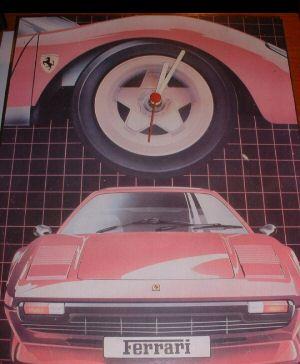
This 1980s Ferrari clock is of a similar style to old monkey chops, but rather more tasteful. I want it all. I want it all. I want it all. And I want it now!

Here's my trusty old wall clock from circa 1987. Still going strong.

More 1980s home design tips coming soon!


31 May 2011

EastEnders: Sue And Ali Osman, 1988...

January 1988, and Sue and Ali Osman (Sandy Ratcliff and Nedjet Salih) are the stars of the cover of Woman's Own. The tragic fictional couple are facing the arrival of a new baby and perhaps a bright new future...

Bright new future? Well the past had been anything BUT bright. Turkish Cypriot Ali Osman had come to England in 1975 and married his English wife, Sue, in 1982.

By early 1985, the Osmans were living in a thoroughly grotty flat in Albert Square, Walford, E20. Ali worked as a taxi driver and Sue ran the cafe in nearby Bridge Street.

The light of their lives was their baby son, Hassan.

Sue had been the child of older parents, both of whom never lavished much warmth or affection on her. She grew up emotionally insecure, and was often to be heard accusing Ali of being unfaithful to her.

Good natured Ali had his own problem - he was teetering on the brink of becoming a compulsive gambler.

Insecure Sue had a simple philosphy in life: get at people or be got at.

As well as bubble and squeak, hot tongue and cold shoulder were always on the menu at the cafe and Sue liked to make sure that the likes of Lou Beale (Anna Wing) got a large helping if required.

She worried over Ali's gambling, and sometimes her rants were fully justified. On one occasion, Ali risked the cafe on a bet!

But that bet paid off, showering them in money.

And then, just afterwards, Hassan died.

A cot death.

Sue and Ali were shattered. After her chilly upbringing, Sue found it hard to let her emotions have free reign, Ali experienced sexual difficulties in the wake of the tragedy.


The state of play in 1987: Ali's brother, Mehmut (Haluk Bilginer) and sister-in-law Guizin (Ishia Bennison) are now participating in running the business with Sue and Ali - and the Ozcabs taxi firm is underway (remember Dot Cotton (June Brown) answering the phone for Ozcabs in her "posh" voice?!).

Sandy Ratcliff wasn't terribly happy with stuck-in-the-mud Sue. In a 1987 interview, she said:

"Sue really annoys me sometimes because she's got no guts. I'd love to liven her up a bit, dress her in some of Angie's clothes, get her out of that cafe, set her up in a business of her own and allow her to make something of her life."

Sandy was into women's rights, and thought Sue should be, too:

"I was under the impression she'd become more assertive. I had visions of a bunch of feminists walking into the cafe one day right in the middle of a typical Sue and Ali fight, and them asking her why she puts up with him.

"No doubt Sue would screw up her nose and ask: 'What do you mean?' But she'd think about it, want to hear more and gradually begin to change her ways to become stronger, more independent!

"I get cheesed off with Sue. She isn't me at all."

And then, in October 1987, Sue announced she was pregnant again.

After years of trying following the death of Hassan, the Osmans were once more to be parents.

The couple's dearest wish.

So, we could be forgiven for thinking that a happy era was on the way for the troubled couple?

Certainly, Sandy Ratcliff and Nedjet Salih believed so when they were interviewed for the January 16th 1988 edition of Woman's Own...

"It's going to be the making of Sue and Ali," said Sandy.

"Neither of them has ever got over the death of Hassan but hopefully the new baby will fill the void in their life."

"Ali is over the moon about being a dad again. It's time they got lucky, isn't it? Hassan has been gone for more than two years and I think Ali was beginning to think Sue would never get pregnant again," said Nedjet.

"The marriage was going downhill. Ali is no angel, but he's had a lot to put up with and has been very tolerant about Sue's depressions. Sue hasn't been easy to live with, she's been such a misery. No wonder he's been looking at other women... although to be honest it's all bravado. He'd get cold feet when it came to it. It's really only Sue he loves and wants."

Some viewers were very involved. Back to Nedjet:

"We've had baby gifts sent in (which will all go to charity), letters of congratulation and wherever I go people stop me in the street and say, 'Well done!' "

"Sue's getting pregnant has put me in a dilemma," said Sandy. "I knew nothing about the baby plans until a few weeks ago when I came back from my holidays and was told that Sue was pregnant again. Sue has gone through enough in the last couple of years. I'm glad she's got her dearest wish. I think she'll make a great mum and I'm sure Ali will be supportive. Hopefully, the story-lines will open up for me, but it also means that if the pregnancy goes well and the baby is fine, it would be very difficult for me to leave without there being another tragedy in the Osman family. I don't think that would be fair on the show or the viewers."

Sue's sour puss attitude and downbeat life were the cause of Sandy's thoughts about leaving the show.

"She's been such an unhappy woman since Hassan died. And it was beginning to rub off on me. I'd go to work, six days a week, be stuck in that grim little cafe and be permanently miserable. I got to the stage when I started to ask myself if I really wanted to spend all my working life playing a misery.

"Now Sue is pregnant and happy I feel differently about the role. So maybe it would be fun to stick around for a couple more years - if I'm wanted."

Sandy linked arms with Nedjet as the interview came to a close.

"I think Sue and Ali are going to be blissfully happy and very successful. Who knows, they might even become Yuppies!"

"Why not?" grinned Nedjet.

Stranger things have certainly happened in Albert Square! commented Women's Own.

Of course, being Albert Square, even way back then, blissful happiness was as unlikely as a tiny shoulder pad in 1988.

Shame really.

Many of us daft viewers were certainly hoping that Sue and Ali would be OK.

So, what DID happen?

Well, in a nutshell, the baby brought with it bad times indeed and the Osmans story ended with Sue taking the child ("Ali junior"), and leaving Ali, Ali snatching the child back, and Sue then having a nervous breakdown and being admitted to a psychiatric hospital. Before the end of 1989, Ali had left Albert Square, and Sue had disappeared into the hospital.

And so the state of blissful happiness envisaged by Sandy Ratcliff never happened.

Bleedin' typical!


28 May 2011

EastEnders: Roly The Poodle

Remember Roly Watts, the poodle who scampered around the Queen Vic, upstairs, downstairs, in and out of the ructions between Den and Angie in the mid-to-late 1980s?

I loved Roly. So interested in him was I that I remember wondering if his name was actually Roland? Surely Roly was always short for Roland? But the love of my life (that week) convinced me that such thoughts could lead to madness - he was Roly, he was a dog, so normal rules didn't apply, and I didn't actually write to the BBC to ask as I had intended.

And I'm glad I didn't - the official EastEnders cast card above, which I discovered recently, seems conclusive evidence that he was actually simply called Roly.

Roly was a real star of the show. He listened with apparently higher intelligence than most of the locals to conversations around him, caused poor Naima to prang Ali's taxi when she was out for a driving lesson with her husband, joined forces with Ethel's little Willy to scoff down the meat intended for the Vic's pub grub pies, and did Pauline and Arthur Fowler a tremendous favour when he tore up the dreadful knitted robe Ethel had concocted for Martin's christening.

Angie rather disgracefully tried to blame Roly for the noises Sharon heard when Ange was "entertaining" Tony Carpenter in a "sauce for the goose" get-back at Den moment. Roly had been very restless that night, she porkie-pied. Sharon was not convinced.

Angie could be a bitch at times, describing Roly as a "mangy, half-wit mongrel" and a "shag pile on wheels", but the fact that, in the story-line, Roly had been a present from Den to Sharon shortly before the series began might have coloured her feelings somewhat. She and Den were fighting a bloody battle for Sharon's affection, each trying to win their adopted daughter's love.

And sympathy.

Actually, it concerned me for a while that Sharon appeared to be unduly influenced by Roly when it came to her hairstyle, but taking a quick look around me at the real world, I encountered such a battery of weird and bad taste barnets (including my own) that I decided it was just a coincidence. Sharon didn't actually aim for the Roly look, although there were times when her "best friend" Michelle Fowler, in the on-going battle for Kelvin Carpenter's affections, thought that Sharon was a right dog anyway.

Roly was in the limelight when the mystery of the father of Michelle's baby was finally solved. Michelle arranged to meet the man down by the canal, and several locals were seen receiving telephone calls and hurriedly leaving the Square. But it was Roly jumping out of Den's car that finally gave the game away.

On-screen, Roly was the complete professional. Gretchen Franklin, who played Ethel Skinner, once commented that he wasn't a strong dog, and couldn't do as much as Ethel's little Willy, but there was no evidence of this when the camera was rolling.

Den and Ange were originally to have had an Alsatian called Prince, but finding a pooch of that type lightly coloured enough so as not to blend in with the pub's colour scheme and the other dowdy interior sets proved very difficult indeed.

Then Janimals, a company which specialised in providing and training animals for television and films, called EastEnders producer Julia Smith with the news that they had a seven-month-old apricot standard poodle and it would take them three weeks to train him.

The poodle, dear Roly, got the part, became the property of the BBC, complete with his own I.D. card, and went to live with Julia.

The 1987 book, EastEnders - The Inside Story by Julia Smith and Tony Holland reveals that Roly and Willy were regarded as EastEnders cast members, not props.

Roly in the mid-1980s, pictured with his fictional home, the Queen Victoria public house, Albert Square, London, E20, and his real life landlady, EastEnders producer Julia Smith.

The canine character outlived the 1980s. He was killed off in the early 1990s, run over in the Square.

In real life, Roly was not in the best of health and died in 1995.

He remains my favourite EastEnders canine of all times (sorry, Willy, loved ya too, but!) and, in fact, probably my favourite telly dog as well.

Those '80s days with Roly, Den, Ange and Sharon at the Queen Vic still make great viewing.

And, somehow, the idea of Den and Ange having such a dog (an Alsatian called Prince would have been so much more appropriate) added a delicious touch of the absurd and slightly surreal to the proceedings.

The explanation that Roly had been bought for the already poodle-haired Sharon was convincing, but he still didn't blend in with his dog rough surroundings, and seeing macho man Den out walking him often reduced me to giggles!

1985 - Den (Leslie Grantham) and Angie (Anita Dobson) slug it out whilst the wonderful Roly looks on. I often wondered what he was thinking at times like that...

23 May 2011

EastEnders: From The Albertine Wine Bar To Albert Square - Well Heeled Left Wing Preaching To The Masses

1980s EastEnders could be wonderful - the picture above reflects some of the show's triumphs. But it could also be patronising propaganda straight from a bunch of well-heeled left wing scriptwriters.

As we know, Julia Smith and Tony Holland were determined that EastEnders was to be set in the 1980s, uncompromisingly (their word) in Thatcher's Britain.

Uncompromisingly? Implies disapproval, doesn't it?

Much as I loved early EastEnders, having just watched a slab of episodes from 1985, I ended up wanting to smash the TV screen.

I mean, bloody hell!

As Julia Smith and Tony Holland made plain in their book, EastEnders - The Inside Story (1987), the Albertine Wine Bar was an important hang-out for them during the show's early stages. And they cleared orf to Lanzarote to write up the EastEnders characters.

I couldn't afford to go there, but I did manage to rent a video recorder and liked the flash side of '80s life (the C&A and Tracey's Nite Spot version, that was!).

The trouble with 1980s EastEnders is a tendency to preach which occasionally comes through to sledge hammer effect. Anti-Thatcher comments sparkle like diamonds, but it's the tendency of the well-heeled (in comparison to the real life Arthur Fowlers and Sue Osmans) production team to clumsily deliver patronising propaganda story-lines that really gets up my nose on watching 1985 episodes again after all these years.

And when one follows hard on another, I really want to be very ill indeed.

Take Andy and Debs - she upwardly mobile bank clerk, he children's nurse. After a burglary, they were deprived of their TV set, record player, newly acquired video recorder and other household sundries.

So devastated were they, they went all limp and pathetic, before before being told off by Tony Carpenter - they were two young people with their health, jobs and a whole house to themselves. They should be thankful!

Meanwhile, another victim of the "consumerist society" was Punk Mary, fed up with living in one room (her treatment was so unlike any single mother I knew in the '80s), and seeing adverts for nice things, things she was apparently supposed to want, she went shop lifting and got "had up" in court. £50 fine and the story vanished - point made. The consumerist society was BAD.

Meanwhile (again), the Square was suddenly afflicted by a power cut. Fault of the government, someone suggested? Eh, we were in 1985, weren't we, not the 1970s?

Meanwhile (yet again!), nurse Andy suggested to Debs that he brought a little boy - a patient - home from the hospital. Debs was horrified, but Andy pointed out it was always happening because of the cut-backs and nursing staff turning a blind eye.

As somebody involved in care/nursing work during the same era, I never saw it. Cut backs, yes, but things were never so bad we took patients home.

What on earth was that little story-line based on?

Reality from Planet Zog?

EastEnders was of the '80s - every bit of it. But unfortunately it represented a very prevalent and highly biased view of working class life as seen by those who hung out in wine bars and got inspiration in places like Lanzarote. As, unfortunately, did a lot of BBC left wing propaganda back then.

At the time, I applauded every second of it, but now it makes me angry.

That's not to say that all early EastEnders was bad. Far from it. It was - and is - in the main - wonderful to view. In my humble opinion, of course.

But the views of leftie BBC "haves" being foisted on to licence paying "have nots" is not an attractive scenario in retrospect.

It was so bloody patronising - and often so grim as to be totally unlike life as thoroughly working class me and my friends lived it back then!

And yet it's taken my years to get things into perspective enough to be able to see it.

10 May 2011

EastEnders: Were Andy and Debs Yuppies?

Shirley Cheriton as Debbie Wilkins. Was Debbie one of those swaggering, ostentatiously rich yuppie people?

An interesting e-mail from "80s TV Lover":

You write quite a lot about EastEnders on here, but I'm not sure you've done the show justice, considering its impact and intial revolutionary soap techniques. Please, Please, PLEASE can we have more 1980s EastEnders stuff on here, and can I ask a pressing question? Were the characters of Andy O'Brien and Debbie Wilkins yuppies? Shirley Cheriton has described Debbie thus in recent years, but I never saw them that way at the time. Upwardly mobile, yes, but not yuppies!

Well, 80s TV Lover, I'm currently writing more EastEnders articles, intended to focus on Ali and Sue Osman (Nedjet Salih and Sandy Ratcliff) and Debbie Wilkins and Andy O'Brien (Shirley Cheriton and Ross Davidson) so I hope you will continue reading!

Certainly, I have made mention of the show's gritty story-lines and groundbreaking approach, along with Brookside, which saw soaps venturing into previously "No Go" territory.

As for Andy and Debs being yuppies, well, I know that Shirley Cheriton has commented that Debbie was, and the use of the "yuppie" word became quite nebulous after its early 1980s coinage. But I don't think Ms Wilkins and Mr O'Brien were actually yuppies, and didn't at the time. Upwardly mobile, yes, but not yuppies, as you say.

Consider this from The Times, October 1987, in the wake of Black Monday:

"I've lost my shirt today as well as the money of a lot of other guys," said one stereotype of the Yuppies who swarmed to the financial world to reap the benefits of the Reagan boom.

The term was originally American, and a yuppie was somebody who sought to make all they could out of the Reagan/Thatcher era, anybody could attempt to make it big, and yuppies sought to become ostentatiously rich.

Yuppies were associated with upwardly mobility, of course, but upwardly mobility was a much older concept. The yuppies sought to make all they could out of the favourable dosh-making conditions wrought by the Reagan/Thatcher era. The upwardly mobiles were usually far more modest, aspiring to a home of their own car, foreign holidays, nice car, etc.

As the '80s continued, usage of the yuppie word was applied to just about anybody who seemed to have done remotely well, often resentfully by those who hadn't (like me!), but in the strictest sense, you couldn't consider a nurse and a bank clerk (the occupations of Andy and Debs) to be yuppies (a nurse is particularly nonsensical). Nor, indeed, Colin Russell (Michael Cashman), a graphic designer who made Albert Square his home. My father-in-law was a graphic designer, but in no way could his upwardly mobile success be described as propelling him into yuppie status.

As an aside, I was a great fan of the Andy and Debs characters, I thought they were well-acted and made a fascinating contrast to the other EastEnders characters, but were absolutely wasted by the show's writers. I'll write more about that soon!

Read all our yuppie material here.

28 April 2011

1981: The Riots And The Royals...

Riots rocked inner cities across the country - etching names like Brixton and Toxteth on all our minds...

... and, wildly contrasting, Prince Charles married Lady Diana Spencer, causing an epidemic of Royal Wedding fever...

Oh the romance, the pomp the ceremony...

There is a glowing moment every bride remembers. When she steps into the sunlight for the first time - as a wife.

For Lady Diana Spencer it was something more. She walked into St Paul's Cathedral as the daughter of an earl. She walked out as the next Queen.

Charles and Diana starred on a very special Rubik's Cube, featuring images of them both and the union flag.

There was a flood of memorabilia...

Royal Wedding - the tray.

And here we have a lovely book about the Royal Wedding. Oh, I'm sorry - it's Not.

The Kids Of 1981 - Rubik's Cube, Fish 'n' Chips, Hide And Seek And Nuclear War...

The Rubik's Cube - UK kids' favourite toy of 1981.

A UK survey on the interests and attitudes of parents and children, carried out for the Walls Ice Cream Company in 1981, made some of the newspapers when the results were published in April 1982.

POWER TO THE KIDS, THE SUN, 21/4/1982.

Children are winning the battle for power in the nation's homes, according to a survey out yesterday.

It reveals that a growing number of youngsters now make the decisions over which hair-styles and clothes to wear - and what to do with their leisure time.

A third of 1,057 seven to seventeen year-olds quizzed claimed they had total freedom over their choice of clothes.

Half made up their own mind over what to do with their spare time - and a third decided what TV programmes to watch.

The favourite toy last year was the Rubik Cube - and hide-and-seek was the top game, followed by chase and cops and robbers.

But the survey - carried out for the Walls Ice Cream Company - showed that youngsters do not get all their own way.

Mums still rule the roost in the kitchen by deciding what food is served.

Fish and chips followed by ice cream was the favourite in most homes last year.

Dads also have the final say over what time children come home at night and go to bed.

The under-tens are in bed between 7.30pm and 8.30pm and six out of ten teenagers have to be in by 10.30pm on weekdays and midnight at weekends.

Only one in six parents interviewed admitted that their children dominated the family's TV viewing habits.

THE BIG WORRIES

Children and their parents share the same big worries about life, the survey reveals.

Both are very concerned about cruelty to children and animals.

Youngsters also fret a great deal about the dangers of smoking and the threat of nuclear war.


Mums and dads are more worried about youth unemployment and rising prices, vandalism, cutbacks in education spending and drug-taking.

The family is the most important thing in the lives of 92 per cent of mothers - and 83 per cent are very happy with their homes.

Most are also satisfied with their standard of living.

But the recession has forced the majority of families to cut back on outings.

26 April 2011

Charles And Diana, 1981: Video 2000 - The Best Choice For The Royal Wedding...

July 29, 1981, saw Lady Diana Spencer marry HRH Prince Charles, and what a day it was. The wedding was a glorious spectacle of pomp and ceremony - and just look at the train on Diana's dress!

1981 was a highly memorable year, with the
Royal Wedding, the Rubik's Cube craze, illegal CB radio usage going into overdrive before legalisation in November, and the inner city riots which rocked England.

It's a year I'll never forget - and it seems almost impossible to accept that it is now thirty years ago. Yes, THIRTY!!!

And we have another Royal Wedding in the offing for 2011.

Were you one of those glued to the Royal Wedding on the telly back in 1981? Did you video it? If so you were lucky because not many people had a VCR in 1981. 5% of the population in 1980 were lucky enough, and the Royal Wedding did cause a small leap in sales and rentals of VCRs, but I didn't know anybody that had one. They were very uncommon in 1981.

By early 1985 the figure stood at 25%.

Still, some were lucky enough to be able to use this uncommon device on that very uncommon occasion.

I was fascinated to find the ad below in the Daily Mirror, July 13, 1981, for Video 2000.

Video WHAT?!!! you splutter.

Well, for a time in the early 1980s, Video 2000 was a serious competitor for VHS...

THE PERFECT MATCH. THE PERFECT REPLAY.

Some souvenirs of the royal wedding will be more authentic than others, like the Video 2000 cassette. Philips have spent six years developing the only cassette that will record the whole event. It's all part of the new Video 2000 system.

THE ONLY VIDEO CASSETTE THAT CAN GO THE DISTANCE

No ordinary video cassette can contain all the emotion of a royal wedding.

Especially when proposed TV coverage is 7 hours long.

The unique Video 2000 cassette will record up to eight hours, because it simply flips over like an audio cassette.

Hour for hour it is one of the cheapest forms of video recording around. It leaves the others waiting at the church.

THE MOST ACCURATE PICTURE EVER

To improve your video picture Philips have invented a totally new tracking system: Dynamic Track Following. It actually lays down a pilot signal during recording.

On playback the video heads continually compare the video track with this original pilot. The result is the most accurate picture ever.

Video 2000 is so accurate that it needs no tracking control - the knob other video users have to twiddle when playing a tape recorded on another machine.

Your video 2000 machine will play any Video 2000 cassette perfectly. And that goes for pre-recorded cassettes too.

A ROSY FUTURE

Video 2000 is here to stay. It has been adopted by over twenty major European brands. Why not see the Philips VR2020 recorder at your Philips Video dealer. It will handle July 29th royally.

Philips Video. Simply years ahead.

VIDEO 2000. If you've been waiting for Video, it's arrived.

Daily Mirror, July 30, 1981:

There is a glowing moment every bride remembers. When she steps into the sunlight for the first time - as a wife.

For Lady Diana Spencer it was something more. She walked into St Paul's Cathedral as the daughter of an earl. She walked out as the next Queen.

How certain things seemed back then. And what a day of joyful optimism the twenty-ninth of July, 1981, was - even for the vast majority of us - those without video recorders!