Total Pageviews

Pages

06 February 2010

EastEnders 25th Anniversary - Post 3

EastEnders 1980s gay couple, Colin and Barry. Colin was a middle class professional man, at home with his sexuality, Barry was a working class East-end lad, who felt pressure to conform to the "norm". The characters were criticised by some for being disgusting, and by others for not being allowed to show much warmth towards each other. But they were very much part of the brave beginnings of bringing gays out of the closet in UK TV soapland.

What made EastEnders different? Why did it originally outrage and delight to such a degree?

In my opinion, this was due to the show's uncompromising grimness - the setting of Albert Square, a few scandals involving early cast members, and the show's intense portrayal of social issues.

The show's left-wing sub text helped, too.


Soaps had "done" social issues before. Coronation Street had its moments right from the beginning, and Crossroads had bravely waded in in the mid-1960s. But it must be said that the issues were handled in a way that was thought to be suitable for the times. For instance, alcoholism could come about in the blink of an eye and could rapidly be overcome.

Were all viewers so much more "enlightened" in the 1980s that they could happily watch uncompromising portrayals of social issues in soaps? No, of course not, but what EastEnders seemed to be saying was: "Up yours, darlin', we're doin' it anyway!"

The thinking behind Producer Julia Smith's attitude to the social realism portrayed in the Albert Square saga can be found in our EastEnders 25th anniversary post 2.

Let's look at the portrayal of gay men in UK soaps from the 1960s to 1980...

The BBC radio soap, The Dales, apparently briefly featured a gay character in the late 1960s, and its successor, Waggoners' Walk (1969-1980), also approached the gay theme in the 1970s. But the character concerned "reformed" after he fathered a child with a local woman (who didn't know he was gay at the time) and got married. I've never known a gay man to "reform" - and why on earth should they?

Waggoners' Walk returned to the gay theme shortly before its axing was announced in 1980, with restaurant waiter Rob Pengelly announcing: "Girls don't turn me on at all!"

Little old working class me, brought up in a tightly bigoted atmosphere, thought: "There's going to be trouble now!" Nobody would have dared to make such an announcement where I lived!

But Waggoners' Walk was set in Hampstead, and the majority of the sophisticated, well-heeled characters took the news in their stride. Only brash, self-made businessman Matt Prior expressed any bigotry, and he soon got over it.

I seem to recall that Southern Television's early afternoon "drama series" (note: not soap!) Together (1980-1981) introduced a gay character - perhaps even a gay couple - circa 1981, not long before the series ended. Together had got off to a somewhat dowdy start in 1980, and it seemed to me at the time of the gay story-line that the writers were inspired more than somewhat by Rob Pengelly of Waggoners' Walk - and had decided to be more up-to-date.

But it's all very hazy, and the show, running only to two series and tucked away in the afternoon schedules, attracted little attention and soon disappeared - as did Southern TV.

And as for Rob of Waggoners' Walk, he got involved with Rocky Rowlands, an American who was internationally famous as a fashion designer.

Not something I could easily relate to.

EastEnders was different in that the characters were mainly working class and issues tended to explode, rather than be carefully discussed by people who would never have dreamt of dropping an aitch, as in Waggoners' Walk.

This was something that I, as a working class man from a thoroughly grotty back street, could identify with. There were sauce bottles and plates of mash on Albert Square tables, not Peter Tyson's latest experiment with herbs and spices. Lou Beale went to bingo - not to dinner with the editor of the Hampstead Herald.

EastEnders also went further than the Walk in the issues covered, shocking many in the process, and "infecting" other soaps.

And its gay men did not "reform", although poor Barry was under pressure to.

I do wonder if EastEnders would have come into existence without Brookside, another soap which sought '80s reality.

But whatever the truth of that, Albert Square's original groundbreaking impact, its thirst for social issues and "in your face" attitude, should not be ignored.

05 February 2010

EastEnders 25th Anniversary - Post 2

Julia Smith and Tony Holland - creators of EastEnders.

On 14 March 1983, Julia Smith and Tony Holland were summoned to the office of David Reid, then head of the BBC's Series/Serials Department. Mr Reid had a proposition for the pair: the BBC had decided to start a popular bi-weekly serial (note: not "soap opera" - the BBC - and other programme producers - then frowned upon the phrase). Julia and Tony, who had previously worked together on Z Cars, Angels and District Nurse, were offered the roles of Producer and Script Editor.

The planned bi-weekly was intended to run every week of the year.

Initially, the show was to be set in a mobile home park. Julia and Tony did not like the idea at all.

They favoured a serial set in modern day London, a view later echoed by the new head of Series/Serials, Jonathan Powell.

And that led Julia and Tony to the East-end.

Filming in the real East-end presented various problems, but finally the vacant "Lot" at the Elstree Studios, previously used for the hugely successful first series of Auf Wiedersehen, Pet, was decided upon as the setting for the new soap, er, sorry, bi-weekly, then provisionally titled E 8.

A purpose built East-end square would be erected on the Lot.

Julia and Tony flew off to Lanzarote in March 1984 to work on creating the characters.

There was to be a crusty old battle axe called Lou Beale; Lou's daughter, Pauline; Pauline's husband, Arthur Fowler; Pauline and Arthur's children, Michelle and Mark; Lou's son, Pete; his wife, Kathy, and son, Ian.

The show was to reflect the multi-ethnic East-end of the 1980s: Saeed and Naima Jeffery, he a quarter English, three-quarters Bengali, and she wholly Bengali, would run the local shop.

A character originally called Alan Carpenter (later changed to Tony) hailed from the Caribbean and would live with his son, Kevin (later changed to Kelvin) in the Square.

Then there was Chris (later changed to Ali) and Sue Osman. Ali was a Turkish Cypriot, Sue was English. They would run the cafe just off the Square.

Dr Harold Legg would be the area's wise, Jewish doctor. He'd lost his wife when a bomb was dropped on Albert Square during the Second World War.

And, as this was the 1980s, what about "upwardly mobile" types? Julia and Tony came up with Debbie Wilkins and Andy O'Brien. They weren't yuppies, Andy was a nurse, Debbie worked in a bank, but they weren't typical Albert Square types by any means.

Back down-to-earth again: Ethel May Skinner was an elderly local woman who doted on her dog, initially intended to be a Yorkie, but, as it turned out, a Pug. This was, of course, "Ethel's little Willy".

Mary Smith was to be a semi-literate young Punk, from the North of England. A single parent, she brought her baby daughter, Annie, to live in the Square.

"Lofty" George Holloway would be the area's misfit, a gawky young man who worked at the local pub, cash in hand.

And what about the family at the pub? Whilst in Lanzarote, Julia and Tony fleshed out the characters of Jack, Pearl and Tracey Watts - Den, Angie and Sharon to you and me. The family was originally intended to have an Alsatian dog called "Prince", but this later morphed into an apricot Standard Poodle called Roly.

A later dreamt-up addition to the original cast of EastEnders characters was Nick Cotton - a thoroughly nasty geezer!

The building of Phase One of the permanent Albert Square set at Elstree in the summer of 1984. It wasn't real. But it sure looked it. The Queen Vic and Lou Beale's house are well on the way, and the gardens in the centre of the Square are looking good.

The first episode of EastEnders was originally intended to be broadcast in January 1985, but this was postponed to February.

And what a shock the show was!

Old Reg Cox was found in his grubby bedsit - close to death, Nick Cotton stuck his fist through one of the Queen Vic's windows, Pauline Fowler was pregnant and her loving mother, Lou, told her to get rid of the kid...

And all in episode one!

Brookside, which began on Channel 4's opening night in November 1982, had already begun the process of de-cosying English soap opera, but EastEnders took things to the next level.

Like Brookside, the show had a left wing sub text ("Don't blame me - it's that cow in No 10!" said Lou Beale to son-in-law Arthur Fowler when he was feeling down because he was unemployed and "Community spirit went out when the Tories came in!" said Pete Beale) but Albert Square was also a place of pot boiling secrets...

Who was Dirty Den Watts' long-term mistress? Who was the father of teenager Michelle Fowler's baby? Who was the terrifying Walford Attacker - was it someone who lived in the Square? Was Pete Beale really Simon Wicks' father?

Often at the centre of the drama, were Den and Angie Watts at the Queen Vic - a married couple who had a spectacularly destructive relationship. and yet, bizarrely, seemed to need the other.

Compelling viewing.

Mrs Mary Whitehouse, clean up TV campaigner, didn't think so:

"It is at our peril that we allow this series. Its verbal aggression and its atmosphere of physical aggression, its homosexuality, its blackmailing pimp and its prostitute, its lies and deceit and its bad language, cannot go unchallenged."

And fancy showing the omnibus on a Sunday!

Julia Smith said:

"I think I'm just as moral as Mrs Whitehouse. And I care possibly more deeply. The difference is she believes in sweeping things under the carpet and pretending they don't exist. I believe in showing what does exist and preparing people for the world they live in. My prime aim is to entertain, my second is to inform. I do not preach. All I do is lead viewers to reach their own conclusions by having different characters representing different points of view. It would be nonsense to portray the East-end without any semblance of violence. It is a very violent place. The people there are not very literate. They express themselves in raucous laughter and hugs, not careful discussion, and it can all turn into anger very quickly. It's a much more physical way of life. I've never been frightened of handling controversial subjects. You can tackle anything, however early in the evening, providing you do it in the right spirit."

Some may criticise that EastEnders did not entirely reflect reality. The lens used was a very trendy left-wing lens indeed, and problems like misandry soon began to pervade on the back of that. I think those uttering such criticisms are right to some degree.

However, the shock waves sent out by Brookside and EastEnders ensured that the 1980s would change English soap opera. Forever.

Soaps today are far less political, far more sensationalised, but the grittiness and the lefty approach to social issues can all be traced back to the Close and the Square. TV soaps did issues before the '80s, but the approach was far less "in your face", far less relentless, and sometimes just plain daft.

Looking in on the action at the Rovers, or at Emmerdale Farm, or at the Crossroads Motel, you could spend lots of time feeling cosy.

But not in Brookside Close - and most certainly not in Albert Square!

Sandy Ratcliff was champion moaner Sue Osman in the early years of EastEnders. And yet somehow I liked the character. I sensed a vulnerability which made me feel for Sue, even before the cot death of her baby son, Hassan, in episode 36, broadcast in June 1985, which was a shattering piece of drama.

Click on the "EASTENDERS" label below for much more '80s Actual Albert Square info.

02 February 2010

1983: President Ronald Reagan Invites Us To Visit America...

Pages from a 1983 magazine advertising feature on America. The pictures on the right features the Twin Towers, the Statue of Liberty and a stretch of desert, whilst on the left, US President Ronald Reagan, elected in November 1980, issues an invitation:

THE WHITE HOUSE

WASHINGTON

On behalf of the American people, I am very proud to invite you to visit the United States.

Our nation's beauty, unique heritage, and hospitality are yours to see and enjoy. I hope you will take advantage of the opportunity to make new friends and participate in social and cultural exchanges with our people.

Remember that America's doors will be open to you during your travels. We will be delighted to provide you with an exciting and educational experience.

Ronald Reagan

Hertz car rental and the Amtrak U.S.A. Rail Pass offered opportunities to see America once you arrived there.

More on President Reagan here.

01 February 2010

Trivial Pursuit In The UK - How The Game Came About, And How We First Pursued It In 1984...

Did you pursue the trivial in 1984? Many people did as the UK edition of Trivial Pursuit made its debut in January.

Trivial Pursuit (originally to be called "Trivia Pursuit") was conceived by two Canadians, Chris Haney and Scott Abbot, on 15 December 1979. The general format was worked out very quickly, but devising the scoring system took three months! Chris and Scott spent the next couple of years setting up their own company and researching marketing techniques.

The famous Trivial Pursuit logo and board was designed in 1981 by artist Michael Wurstlin. A trial run of games was released in the Toronto and Vancouver areas in November 1981. All were sold.

Trivial Pursuit creators Chris Haney and Scott Abbott in the mid-1980s.

-
 In November 1982, Chris and Scott signed a contract with the manufacturers of Scrabble to distribute the game in the USA. Work began on the British edition in April 1983 and, at the start of '84, we discovered we could all pursue the trivial to our hearts content.

The game has cheese shaped wedges, general knowledge questions and a box design which looks good on any coffee table.

We fell in love with Trivial Pursuit here in England - and for the many versions released since, like the "Genius" edition pictured at the top of this post.


The original UK edition of Trivial Pursuit was our 1984 and 1985 Game of the Year.


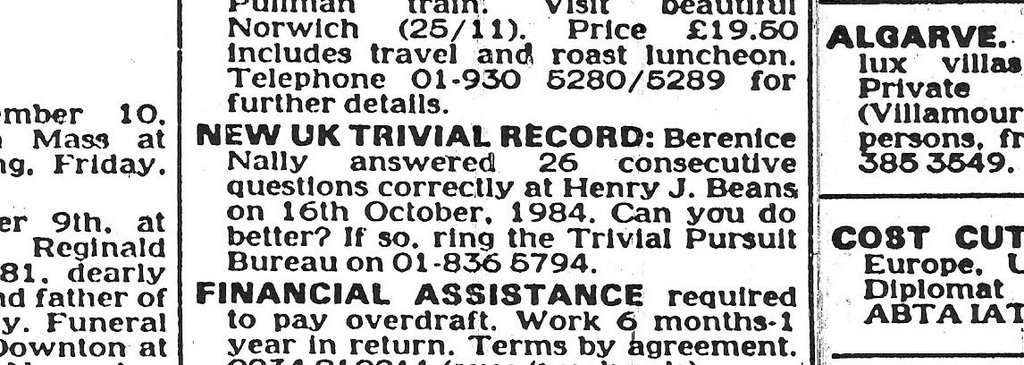
New UK Trivial Record - from the Times, November 1984.

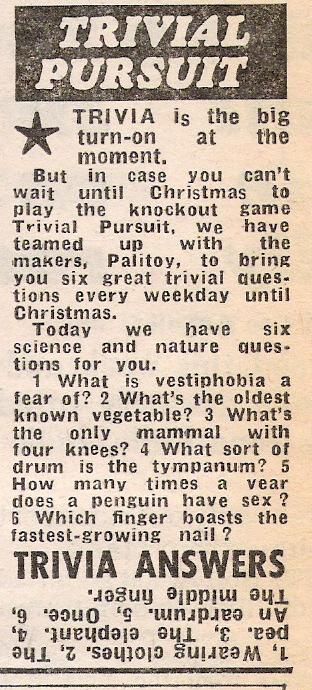
Trivial Pursuit questions (and answers) as featured in the Sun, December, 1984.
The '80s Actual Trivial Pursuit Timeline

(Details culled from a mid-1980s magazine interview with Chris Haney and Scott Abbott)

15 December 1979 - conception:

Chris Abbott and Scott Haney were having a friendly argument in the kitchen of Chris's Montreal home over who was the better Scrabble player. To resolve the dispute, Chris went to buy a Scrabble set, and realised that it was the sixth he'd bought in his life. The pair decided then and there to invent a new game. "It took us forty-five minutes to design the game," explained Scott in a 1985 interview, "and three months to figure out the scoring." Chris and Scott decide to call their new game "Trivia Pursuit" although this will later be altered.

January 1980:

Carrying an expired press pass and a camera without film, Chris and Scott visited a toy fair in Montreal. There, they pumped manufacturers about marketing strategies. According to Scott, the pair "collected about $10,000 dollars' worth of information in one afternoon."

Chris and Scott decided to set up their own company to produce the game, recruiting Chris's older brother John and a lawyer friend, Ed Werner. Chris left his job and began to contact companies who could manufacture the various game components.

October 1980:

Work began on preparing the all-important questions. Chris, his wife, Sarah, and two-year-old son went to Spain to begin the work. John later joined them there. The next five months were spent amassing mountains of trivia.

March - October 1981:

During the summer of 1981, Chris and Scott spent six weeks on the final editing of the Trivial Pursuit questions. Artist Michael Wurstin was hired to design the board and logo - he was paid with shares in the company. The game creators pored over colour combinations and package designs.


They decided to go for a chunky box, bearing the words "Trivial Pursuit" in elegant script, something that would look good on coffee tables, as well as in toy cupboards.

A test run of 1,200 copies was produced after thirty-two friends, relatives and former colleagues bought shares in the venture. In late October 1981, the game components arrived and work was carried out round the clock putting the boxes together.

November 1981 - September 1982:

The stage was set for the first test run of Trivial Pursuit games to make their debut in shops in the Toronto and Vancouver area in November 1981. All were sold.

Orders from retailers began to come in, but the supply of games had been exhausted and its creators had used up all their funds. Various banks were approached, but credit to produce further Trivial Pursuit games was refused. "We'd really hit rock bottom," recalled Chris a few years later.

In March 1982, they found a bank willing to lend them enough money to produce a further 20,000 games.

An old boat-yard on Lake Ontario became their assembly plant, and Scott left his job to become the company accountant. A computer was bought to store the questions in.

October 1982 - October 1983:

The four man team working at the Trivial Pursuit assembly plant were finding it difficult to cope with the flood of orders for the game. In October 1982 they handed over the distribution to a Canadian game manufacturer, which immediately ordered 80,000 games. In November 1982, Chris and Scott signed a contract with the distributors of Scrabble to manufacture and distribute the game in the USA.


In the spring of 1983, Chris phoned Steve Birch, a friend in England: "Can you come over? The game is going pretty well and we want you and Ray to do a British version."

Steve Birch and Ray Loud went to Canada and, with Chris and Scott, pored over the Trivial Pursuit questions, deciding which would need replacing for a British edition.

By the end of August 1983 the British game was ready to be manufactured.

January 1984:

Trivial Pursuit went on sale in Britain.

31 January 2010

1989: A Talking Remote Control For Your VCR...

Video recorders were wonderful but so bloomin' difficult in the 1980s.

In 1980, only 5% of UK households had them.

In 1983, nearly 20% of UK households had a machine, and in early 1985 it was 25%. The sky was now the limit and it would not be long before a VCR in the home was regarded as essential by the majority of us.

Most people I knew rented their first VCR.

And most people I knew had difficulties setting the timer.

"What a load of vidiots!" I chortled.

My mother was one of the first VCR renters I knew. She obtained one in 1983, just before I left home, so I had little time to familiarise myself with it.

I began renting one in 1987.

I wanted to watch the American comedy series The Golden Girls, but as it aired on Channel 4 on Friday nights I had to rent a VCR to be able to see it. Fridays and Saturdays were nights I went out and no way was I staying in.

Having got a video machine, I confronted the timer and entered into battle.

It won.

I couldn't set it, no matter how I tried.

When I tried to tape Channel 4, it taped BBC1, when I tried to tape ITV, it taped grey fuzz...

So, I used to pop a video cassette in and put the machine on record just before I went out on Fridays, leaving it to tape hours of Channel 4 just so I could wade through and watch one half-hour programme.

Perhaps I could have done with the remote control featured in the September 1989 magazine ad above.

One that would have talked me through the process...

WHOEVER'S PROGRAMMING THE VIDEO NEEDS A GOOD TALKING TO.

The Sharp video with Talking Handset.

If you're still wondering why your "Neighbours" didn't turn up.

Or wondering why the Big Film turned into the big fiasco.

Why Ivan Lendl bore a remarkable resemblance to Sandy Gall.

And why J.R. was cut off in his prime.

If all these wonders of conventional video leave you wondering why you keep programming things incorrectly, Sharp now have the solution to your video nasties. The Sharp Video with Talking Handset.

The unique Handset has its own voice to guide you through all of the various stages of programming. Accurate talking instructions for you to follow, from "Let's set the Timer for recording" to "Which channel do you wish to record?"

The 44 function remote control is a handy size with an easy button layout that's simple to operate.

The video itself (VC-T310HM) enables you to pre-programme a full year of recordings with a 365 day eight programme facility.

There's a super search feature which locates any recordings you're looking for.

There's even a child-proof lock.

Sharp really do think of everything.

As well as this particular model, there's an alternative in the Talking Handset range. The VC-T510HM. A 4 head system, providing improved picture quality, an extended recording playback of up to 8 hours, variable slow motion, frame by frame advance and double speed playback. To list just a few features...

The wonders of modern technology. Love the Radio Times Neighbours synopsis featured in the ad:

Charlene breaks out in a mysterious rash.


I would have been so hacked off if the VCR timer had made me miss that...


30 January 2010

EastEnders 25th Anniversary - Post 1

EastEnders first burst on to our screens on 19 February 1985. And that's almost twenty-five years ago.

February 2010 sees the BBC soap celebrate its 25th anniversary, and '80s Actual will be adding to its current Albert Square posts with a short series looking back at some of the behind-the scenes-folk, characters and story-lines from the soap's birth decade, the 1980s.

The photo above shows Pete Beale (Peter Dean), his son (well, at least Pete thought it was), Simon Wicks (Nick Berry) and the fearsome Pat Wicks (Pam St Clement) enjoying a happy evening in the Queen Vic.

Pam St Clement had cut her soap teeth in that other ITV saga Emmerdale Farm. She briefly played a Mrs Eckersley. Debuting in episode 561 on 10 March 1980, she appeared in the Yorkshire farming saga for five episodes, bowing out in episode 565 on 25 March 1980.

Pam's character actually deputised for Emmerdale matriarch Annie Sugden, looking after the cooking and the kitchen at the farm whilst Annie took a holiday in Ireland.

Mrs Eckersley sang hymns as she trundled around Beckindale on her trusty old bike and was a thoroughly nice woman.

Pam St Clement made her debut as Pat Wicks in EastEnders in episode 138, broadcast on 12 June 1986.

Of course, Pat didn't sing hymns. And whilst many Walford locals regarded her as an old bike, she didn't ride one and nobody in those early days would have described her as trusty. Or as a thoroughly nice woman, come to that.

Not even after ten pints of Churchill's strong ale.

But times and soap characters change, and Pat is now an EastEnders favourite.

Click on our EastEnders label below for lots more '80s Albert Square stuff and look out for further 25th anniversary posts.

28 January 2010

EastEnders

It's the day after the first episode, and the Sun gives EastEnders the thumbs up, 20/2/1985. Created by Julia Smith and Tony Holland, EastEnders, like Brookside, was a real kick up the backside for staid, tightly permed soap operas.

Sun writer Charles Catchpole opined:

Ethel is what they call a Character. But she's a cardboard cut-out compared with loud-mouthed Lou Beale. Gravel-voiced granny Lou makes Hilda Ogden look like Mary Poppins.When she lashes out at her friends and family, she makes Ena Sharples sound like Mother Teresa.

Meanwhile, the rest of Albert Square is seething with sex, spite and savagery.

The main man in Albert Square was Dennis "Dirty Den" Watts - landlord of the Queen Vic, husband of Ange, adopted father of Sharon and lover of Jan.

Daily Mirror, 27/2/1985...

There's no doubt that articles like the one above did the show no harm at all. The consensus of opinion was that Leslie Grantham had served his time and there was no reason why he shouldn't be in EastEnders. But the actor's background somehow added something to the character of Den Watts. To many viewers, the boundaries between fiction and reality became blurred.

Emotionally topsy-turvy Angie Watts coped with her pig of a husband by hitting the bottle. She was well used to putting on a brave face behind the bar at the Queen Vic, where she said things like, "Wot can I git ya, darlin'?" and, "yew, yew, aht - go on, git aht."
-
It's hard to imagine, but Anita Dobson was a last minute appointment to the EastEnders cast, and the role of Ange had very nearly been played by somebody else!
-
Tom Watt made a terrific job of playing gawky, spiky-haired misfit Lofty Holloway, who seemed far too naive and vulnerable to be roaming Albert Square.

Tony Carpenter was a cheerful soul, crying out for cheerful situations, but the scriptwriters gave him miserable son Kelvin and nagging wife Hannah instead.

Oscar James, the man behind Tony, was unhappy with the Carpenter family:

"The Carpenters were always arguing and at each other's throat. Having a black family in a top TV show should have been a wonderful method of educating the nation to treat each other as individuals, not according to their colour. That is the way to world peace. EastEnders has done a lot of good. It's just that the BBC could do so much better - and recognise that the ethnic minority in EastEnders deserves better."
-
Dr Harold Legg was the Square's affable Jewish doctor. He'd practiced there for years and had been a confidante to many - including local hubble, bubble, toil and trouble merchant Lou Beale.

Leonard Fenton, the actor behind the good doctor, had appeared in television shows such as Z Cars, Secret Army and Shine On Harvey Moon before becoming Dr Legg - the TV role that made him a household name.

Lou Beale said what she thought to her family or anybody else and there's no doubt she was absolutely right.

As far as she was concerned.

Actress Anna Wing on her interview for the role:

"I knew the producers were looking for the real thing, so I turned up at the interview for the part with my birth certificate, my gran's picture and a family album. You see, I was born in Hackney, the daughter of a greengrocer, and although off-screen I talk with a proper English accent I still have an East End accent in my heart."

Lou was a memorable creation who certainly stamped her mark on the Albert Square saga. Sadly, the character was killed off in 1988 when Anna Wing left the show.
-
The photograph above, signed by Anna "from Lou with love", is my favourite '80s Actual EastEnders item.
-
Wendy Richard - saucy Miss Brahms in Are You Being Served? - made the leap to dowdy Pauline Fowler in EastEnders in 1985. Wendy was an exception to producer Julia Smith's rule not to use established stars in the show.

Pauline struggled with monstrous Mum Lou and a new baby on the way. She also served up some awesome dollops of grey mashed spud.

BT laid on a special "catch-up" service for fans who missed an episode. By dialling 01-482 4042, they could hear Wendy Richard/Pauline explaining what had gone on in the previous episode.
-
The way we talk in my neck of the woods isn't that different to the east-end cockney accent, and whenever I watched EastEnders back in the '80s, I liked to shout questions and advice at the characters on screen and "tork the lingo".
-
September 1985 found me saying:
-
"Awright, 'Chelle, wass goin' on 'ere? You're up the duff, tha's plain, an' I wanna know oo the father is. I've gotta right - I pay me licence fee!"
-
The BBC kept us guessing as young EastEnder Michelle Fowler (Susan Tully) discovered she was pregnant and arranged to meet the father by the canal.
-
Was it Ali from the cafe?
-
"Surely not, 'Chelle - bloke's a loser an' you wait till 'is missus gets 'old of you..."
-
Was it soppy nurse Andy?
-
"Bit of a wimp, 'Chelle - that Debs walks all over 'im..."
-
I was pretty sure it wasn't Tony Carpenter...
-
And what about...
-
Several men were seen leaving Albert Square at the time Michelle was making her way to keep the appointment with the father of her child. Who would it be?
-
A certain Dennis Watts of the Queen Victoria public house, Albert Square, Walford, E20, joined Michelle by the canal.
-
"HIM?! Oh Gawd, 'Chelle," I howled at the telly, "what 'ave you done?!"
-
Ethel Skinner was Albert Square's very own mistress of the malapropism, and also a friend to many. But her number one priority was always her little Willie.
-
Gretchen Franklin, the actress behind Ethel, once said:
-
"I think she was popular because she was simple, kind, generous and brave. But the only thing she and I really had in common was our height."
-
"'Ere, I'm just poppin' over to see Lou..."
-
Dot Cotton arrived in EastEnders in episode 40 - broadcast in July 1985 - and was soon to become one of the show's most popular characters. Hot flushes, fag after fag, 'orrible Charlie (her ever loving) and nasty Nick (her git of a son, who had first appeared in episode one) - Dot's lot was not a happy one.
-
She moaned.
-
She gossiped.
-
She smoked for England.
-
And we loved her.
-
I well remember the time she won a personal stereo in a competition and went round the Square with her headphones on upside down, listening to James Last.
-
Classic.
-
June Brown, the actress behind Dot, was actually born in Suffolk, not the East End of London. But you'd never guess, listening to her on EastEnders!
-
For more EastEnders fun and info, click on subject:
-

16 January 2010

Computers In 1980 - The Acorn Atom, The ZX80, The World's First PET Show And Prestel News At View Data '80...

June 1980: word has arrived from Personal Computer World's distributor that he would like to increase the number of copies printed by 70% - immediately. A move almost unprecedented in the annals of specialist magazine publishing, writes the editorial team, very chuffed about it indeed.

Here, PCW is proclaiming itself as being EUROPE'S LEADING MICRO MAGAZINE on its front cover. At some point between June 1980 and November 1982, it would be demoting itself to BRITAIN'S LARGEST SELLING MICRO MAGAZINE (see here) as interest in computers began to increase, creating an upsurge in computer-related magazines.


Computing 1980 style... (yawn)... sorry, but before the World Wide Web I couldn't see the point. OK, in 1980 something called "Usenet" was established in the States, but it was the invention of the Web in 1989 and its implementation in the early 1990s which led to me joining the computer brigade - and millions of others. In 1980, I never dreamt I'd ever use a computer.

It is worth noting that World Wide Web inventor Sir Tim Berners-Lee took the first steps towards his wondrous 1989 invention in June to December 1980 - he wrote ENQUIRE, his first computer program for storing information. At this time he was working a six month stint as a consultant software engineer at CERN, the European Particle Physics Laboratory in Geneva, Switzerland.

He left CERN for a spell, returning in 1984, and in March 1989 invented the World Wide Web.
Read more about 1989 and the World Wide Web here.

Back to 1980, when most people didn't even have a VCR, let alone a computer, and I must say those Verbatim minidisks in the photograph above don't look very "mini" to me!

A brand new arrival in 1980 - the Acorn Atom:

New! - The Acorn Atom - £120

An outstanding personal computer kit

Also available ready-built for £150 plus VAT and p&p

The ATOM - a definitive personal computer. Simple-to-build, simple-to operate, But a really powerful full-facility computer. And designed on an expandable basis. You can buy a superb expanded package now - tailored to your needs. Or you can buy just the standard Atom kit, and, as you grow in confidence and knowledge, add more chips. No need to replace your equipment. No need to worry that your investment will be overtaken by new technology. As you need more power, more facilities, you can add them!

The standard ATOM kit includes:

*Full sized QWERTY keyboard

*Rugged polystyrene case

*Fibreglass PCB

*2K RAM

*8K ROM

*23 integrated circuits

*Full assembly instructions including tests for fault-finding (once built, connect it to any domestic TV and power source)...

MSI 6800: At the root of every good system...


TANDY - ANOTHER BREAKTHROUGH

TRS.80 MODEL II

5 FIGURE COMPUTING POWER AT A 4 FIGURE PRICE!

COMPLETE SYSTEMS FROM £1999
(plus V.A.T) Delivery 30-60 DAYS

*Built-in 1/2 Megabyte 8'' Floppy Disc

*32 or 64k Random Access Memory

*12" High Resolution Video Monitor

*24 Lines of 80 or 40 (wide) characters

*Upper/Lower Case

*Two RS-232c Serial Interface Ports

*"Power-Up" Self Testing

*One Centronics Parallel Interface Port

*Two Programmable Special Function Keys

*Direct Memory Access

*Vector Driven Interrupts

*Full 4 Megahertz operating speed

*Provisions for plug-in Expansion Boards

Tandy was apparently "THE BIG NAME FOR LITTLE COMPUTERS":

Tandy are opening specialist TRS-80 microcomputer centers the length and breadth of Britain - many are already open and new ones will be appearing all the time. So you'll be able to drop in and experiment with the TRS-80 range, discuss your needs with a TRS-80 expert and buy one over the counter. Each store will be backed by a service engineer to iron out any problems you may encounter when commissioning your system.

1980 saw saw the world's very first Commodore PET show...

There are over 18,000 Commodore PET Microcomputers in regular operation throughout the UK.

The list of PET applications is endless - ledger, payroll, word processing, stock-control, business information, activity planning, time recording, incomplete record accounting, graphics, voltage stabilisation and so on.

One user uses his PET to compose poetry, another even composes musical scores. All on the PET Microcomputer.

Commodore felt that it was high time approved PET Products, PET User Clubs, Special Interest Groups and potential and present PET users were brought together.

So they have asked Baroness International to organise the World's First PET Show, in the Empire Napoleon Suite at Cafe Royal.

Over 50 stands will be demonstrating a range of approved PET Products...

PRESTEL REPORT

One of the highlights of the recent Viewdata '80 exhibition was the announcement of three major enhancements to Prestel - "Picture Prestel", "Telesoftware" and "Dynamically Redefinable Character Sets" (hereinafter referred to as DRCS). The publicity for these developments seems to have been particularly ill-timed considering the fact that, just as Prestel seems to be getting off the ground, along come some new features which demand the use of radically different Prestel receivers. Nevertheless the facilities announced are quite interesting and well worth a closer look.

Click on the image for more details!

Cromenco Micro Systems Ltd, Edinburgh - a lovely display of computers. The thrill of the new in 1980, so quaint today.

The dear old floppy disk... somewhat larger in the 1980s film and TV footage I have seen than the dinky little things prevalant when I first purchased a PC in 2004...

And last, but by no means least, this brand new 1980 arrival needs no introduction - Clive Sinclair's ZX80 - Britain's first complete computer kit - £79.95:

You've seen the reviews... you've heard the excitement... now make the kit!

This is the ZX80. 'Personal Computer World' gave it 5 stars for excellent value. Benchmark tests say it's faster than all previous computers. And the response from kit enthusiasts has been tremendous...

'Excellent value' indeed!

For just £79.95 (INCLUDING VAT and p&p) you get everything you need to build a personal computer at home... PCB with IC sockets for all ICs; case; leads for direct connection to a cassette recorder and television (black and white or colour), EVERYTHING!

Yet the ZX80 really is a complete, powerful, full-facility computer, matching or surpassing other personal computers at several times the price.

The ZX80 is programmed in BASIC, and you can use it to do quite literally anything from playing chess to managing a business.

The ZX80 is pleasantly straightforward to assemble, using a fine-tipped soldering iron. It immediately proves what a good job you've done: connect it to your TV... link it to an appropriate power source... and you're ready to go...

Fascinating - I don't fancy the bit with the soldering iron, though!

Compare computers in 1980 with computers in 1982 here.

14 January 2010

1981: Shergar Wins The Derby

The 1981 Derby - a newspaper report which appeared on 4 June:

Walter Swinburn, boy wonder, moved straight into the superman bracket at Epsom yesterday.

And the Michael Stoute-trained Shergar on whom Walter landed a runaway Derby triumph, is certainly in the superhorse class. Shergar may have been odds-on favourite and expected to win, but could hardly have had better handling from his 19-year-old rider.

Shergar is probably the most famous horse in recent history, but sadly not for stories like the one featured above. In February 1983, he was taken from an Irish stud farm and was never seen again.

05 January 2010

Albion Market - Water Street Set Partly demolished...

The shaded area of this photograph represents the portion of the Albion Market warehouse which has been demolished.

Left - an early '90s view of the old Market set standing beside the newly-opened Victoria and Albert Hotel. Right - the partly-demolished Market set as it is today. A new building stands on the site of the demolished section of the set.

I've had an e-mail from Rod, who asks:

Is it true that the set used for Albion Market in Water Street, Manchester, has been demolished?

Not totally, as far as I know, Rod - unless there have been recent developments I am unaware of.

The building which was used for the market superintendent's office and Waterman's Arms pub was demolished in the early 1990s. A photograph of it exists from 1990, but I think that this was the very last pic taken - the building disappeared, I believe, when work began on the Victoria and Albert Hotel, which opened in 1992.

The building used as the Albion Market bookies disappeared at the same time.

The Albion Market warehouse remained intact until more recent years. Part of it was then demolished to make way for a new building - I believe it is part of the hotel.

If anybody has any more information to share, I would be pleased to hear from them. Click on our "ALBION MARKET" label below for more market memories.

31 December 2009

Happy New Year - And Happy New Decade!

Wishing all our readers a very Happy New Year - and a Happy New Decade too! Of course, there'll never be another decade with the glitz, grit, hustle, bustle, turmoil and sheer pizzaz of the 1980s!

But never mind.

30 December 2009

Emmerdale Farm - Amos Does Himself A Mischief, Crossroads - David And Barbara Get Married, Coronation Street - Hilda And Eddie Sing Carols...

Rita Fairclough (Barbara Knox) gives husband Len (Peter Adamson) a right lambasting before walking out on him in 1980.

What were UK soap operas like in the early '80s?


Well, we had Crossroads, Coronation Street and Emmerdale Farm. The farming saga (as it was then) would not be networked - shown on the same day and at the same time - until January 1988. We also had a couple of new soaps - Take The High Road took us to Scotland - to the village of Glendarroch; Together was set in a block of flats in the south of England. In 1981, we gained English-speaking Welsh soap Taff Acre.

Both Taff Acre and Together were short-lived.

Those were the days before the shock of the new in the soap world - the arrivals of Brookside (1982) and EastEnders (1985). Life in soap land was a lot slower than it is today...

What were the early months of 1980 like in Beckindale, the original name of the village now called Emmerdale? Well, the start of a new decade should have brought smiles to a few of the characters.

Let's time-warp back and pop up to Home Farm to see Judy Westrop (Jane Cussons). Good old Judy's having a fag and saying: "I'm angry - and I'm enjoying it!"

Oh dear...

And Matt Skilbeck (Frederick Pyne) is at the hospital where there's bad news from the doctor: "I'm sorry, Mr Skilbeck, there's no choice. Your wife's condition is critical. We must operate now."

Oh no! But surely there's better news at The Woolpack? After all, Amos Brearly (Ronald Magill) is sure to want to start the new decade on a positive note...

Oh 'eck! Steady on, Amos - you'll do yourself a mischief!

"ARRRGGHHH!!!"

Too late!

Oh, well... much better news - Clive Hornby made his first appearance as Jack Sugden on 19 February 1980 - and Joe (Frazer Hines) greeted him: "Welcome back to Emmerdale, big brother!"

And a bit later there was a new woman at Annie's Aga - just temporary of course... but, hang on, doesn't she look familiar? Good grief, it's Pam St Clement, later Pat of EastEnders, getting an early taste of soap life as Mrs Eckersley in March 1980.

And Grandad Sam Pearson (Toke Townley) caught a big smelly fish whilst on holiday in Ireland: "I'm goin' to 'ave it stuffed, and it's goin' in a glass case over't mantelpiece," said Grandad.

Yeuk!

Funny old year. Funny old start to a new decade...

However, villagers and viewers alike were delighted to meet the new Dolly Skilbeck, now played by Jean Rogers. The new Dolly made her screen debut on 1 April, 1980.

Thanks to our sister blog, the Beckindale Bugle, for our Emmerdale Farm pics and insights.

It was decreed in 1979 that the weekly number of Crossroads episodes broadcast should be cut from four to three in 1980. The IBA was unhappy with the standards of the show.

In the story-line, 1980 got off to a cracking start nonetheless with Rosemary Hunter (Janet Hargreaves) shooting her ex-husband, David (Ronald Allen) in the motel office. David survived and went on to marry his new love, novelist Barbara Brady (Sue Lloyd).

Sue Lloyd had made her debut in the show the year before and revealed in her 1998 autobiography that she had had doubts about going into Crossroads:

The first time I was offered a role in Crossroads, I must admit my initial reaction was to be a bit sniffy about it. The soap was renowned for its wobbly scenery, bizarre sory lines and regular slaughtering by the critics. Why would I, just back from filming The Pink Panther with Peter Sellers in the South of France, and about to embark on the comedy The Upchat Line with John Alderton, want to get involved in a project like that? Besides, I was too busy.

'If they want you,' advised my agent, 'they'll come back.'

He was right. About a year later they called again. They were looking for an actress to play a slightly mysterious, classy lady named Barbara Brady. She was to arrive at the Crossroads Motel, apparently to take a post as a sort of upmarket housekeeper, but in reality she was an author researching material for a new book.

David and Barbara were two of the show's most popular characters until they were axed in 1985.

The Ogdens had been Corrie favourites since the mid-1960s. In December 1981, Daily Mirror TV critic Hilary Kingsley issued a plea to the Street's writers to stop Hilda (Jean Alexander) singing!

Her carol duet with Eddie Yeats (Geoffrey Hughes) had not been appreciated.

Originally a petty crook and lovable layabout, Eddie got a job as a binman in 1980 and moved in with the Ogdens at No 13.

The early '80s were the final on-screen era for a number of the Street's original characters - Annie Walker (Doris Speed), Ena Sharples (Violet Carson), Albert Tatlock (Jack Howarth) and Elsie Tanner (Pat Phoenix) all made their final appearances in the first half of the decade.

By mid-1984, Ken Barlow (William Roache) was the only remaining member of the cast who had appeared in the first episode, broadcast on 9 December 1960.